Posts Tagged ‘computing’
“Scuse me while I kiss the sky”*…
In 1967, Jimi Hendrix’s manager, Chas Chandler arranged for Jimi to meet Cream…
There was a particular night when Cream allowed Jimi to join them for a jam at the Regent Street Polytechnic in central London. Meeting Clapton had been among the enticements Chandler had used to lure Hendrix to Britain: “Hendrix blew into a version of [Howlin’ Wolf’s] ‘Killing Floor’,” recalls [Tony] Garland, “and plays it at breakneck tempo, just like that – it stopped you in your tracks.” [Keith] Altham recalls Chandler going backstage after Clapton left in the middle of the song “which he had yet to master himself”; Clapton was furiously puffing on a cigarette and telling Chas: “You never told me he was that fucking good.” – source
Hendrix’s extraodinary virtuosity has, altogether justly, gotten a great deal of attention; less well noted, his incredible mastery of the technology of music making, recording, and performance. Rohan Puranik explains…
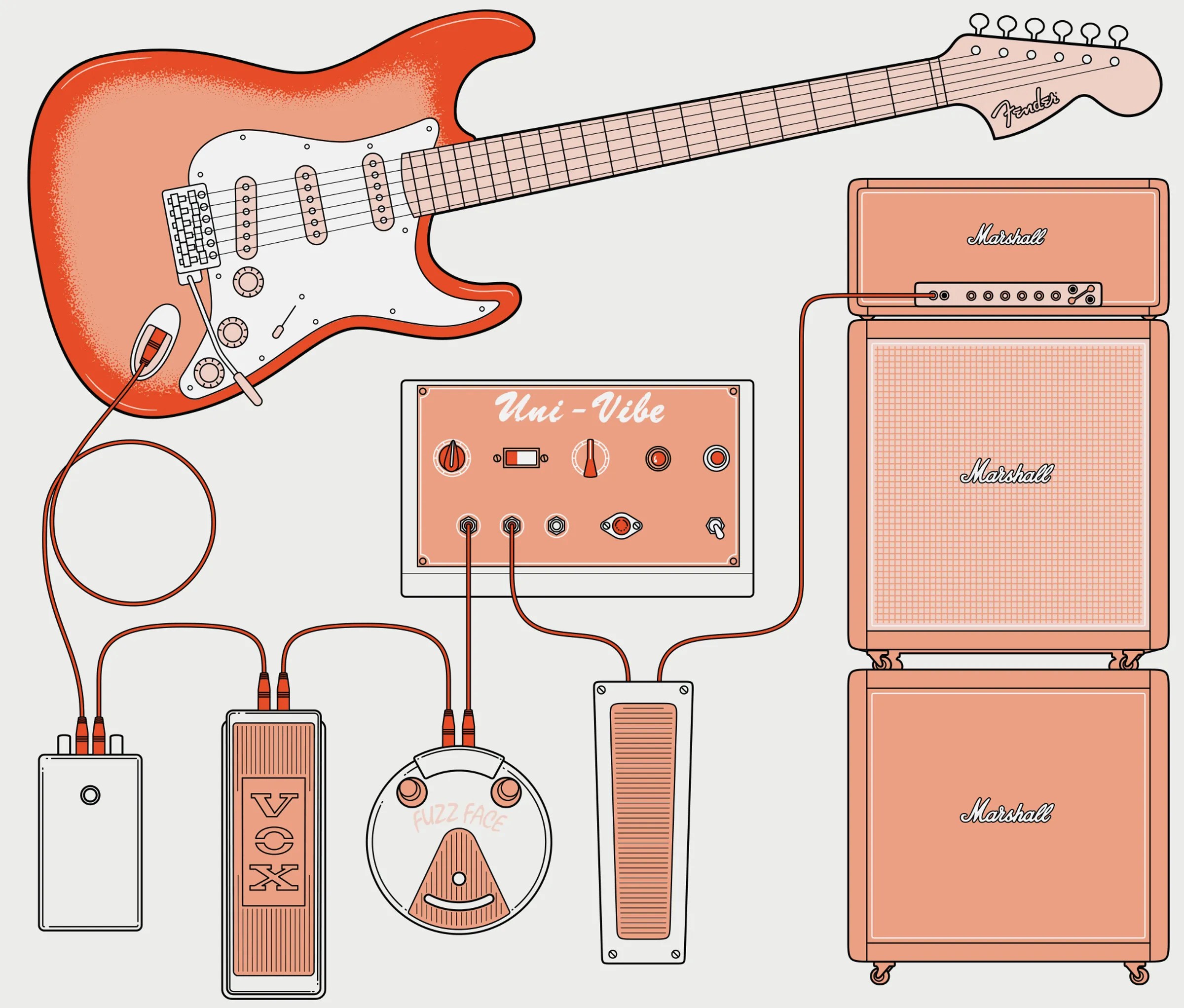
3 February 1967 is a day that belongs in the annals of music history. It’s the day that Jimi Hendrix entered London’s Olympic Studios to record a song using a new component. The song was “Purple Haze,” and the component was the Octavia guitar pedal, created for Hendrix by sound engineer Roger Mayer. The pedal was a key element of a complex chain of analog elements responsible for the final sound, including the acoustics of the studio room itself. When they sent the tapes for remastering in the United States, the sounds on it were so novel that they included an accompanying note explaining that the distortion at the end was not malfunction but intention. A few months later, Hendrix would deliver his legendary electric guitar performance at the Monterey International Pop Festival.
“Purple Haze” firmly established that an electric guitar can be used not just as a stringed instrument with built-in pickups for convenient sound amplification, but also as a full-blown wave synthesizer whose output can be manipulated at will. Modern guitarists can reproduce Hendrix’s chain using separate plug-ins in digital audio workstation software, but the magic often disappears when everything is buffered and quantized. I wanted to find out if a more systematic approach could do a better job and provide insights into how Hendrix created his groundbreaking sound.
My fascination with Hendrix’s Olympic Studios’ performance arose because there is a “Hendrix was an alien” narrative surrounding his musical innovation—that his music appeared more or less out of nowhere. I wanted to replace that narrative with an engineering-driven account that’s inspectable and reproducible—plots, models, and a signal chain from the guitar through the pedals that you can probe stage by stage…
[And probe it Puranik does– fascinatingly, stage by stage…]
… Hendrix didn’t speak in decibels and ohm values, but he collaborated with engineers who did—Mayer and Kramer—and iterated fast as a systems engineer. Reframing Hendrix as an engineer doesn’t diminish the art. It explains how one person, in under four years as a bandleader, could pull the electric guitar toward its full potential by systematically augmenting the instrument’s shortcomings for maximum expression.
“Jimi Hendrix Was a Systems Engineer,” from @spectrum.ieee.org.
See also: “The Technology of Jimi Hendrix.”
* Jimi Hendrix, “Purple Haze”
###
As we plug in, we might send well-connected birthday greetings to another wizard with wires, Geoff Tootill; he was born on this date in 1922. An electronic engineer and computer scientist, he worked (with Freddie Williams and Tom Kilburn) to design a computer memory. To that end they built the first electronic stored-program computer— the Manchester Baby— at the University of Manchester in 1948.
The Baby was not intended to be a practical computing engine, but was instead designed as a testbed for the Williams tube, the first truly random-access memory. Nonethless, Baby worked: Alan Turing moved to Manchester to use it, and the following year, it inspired the Ferranti Mark 1, the world’s first commercially available electronic general-purpose stored-program digital computer.

“Technology challenges us to assert our human values, which means that first of all, we have to figure out what they are”*…

As we head into the weekend, some food for thought…
A decade ago, the world was, at once, both the seed of today and a very different place: In what was considered one of the biggest political upsets in American political history (and the fifth and most recent presidential election in which the winning candidate lost the popular vote), Donald Trump was elected to his first term. The U.K. chose Brexit. The stock market finished strong, with the Dow Jones, S&P 500, and Nasdaq reaching new highs. (In the 10 years that have followed, the Dow has risen about 150%; the S&P 500, roughly 400%; and the NASDAQ has roughly sextupled.)
It was a big year for pop culture, marked by Beyoncé’s Lemonade, the massive Pokémon Go craze, and the rise of Netflix with Stranger Things, the Rio Olympics, and the loss of icons like David Bowie and Prince.
It was also a big year in tech: Russian hacking and disinfo (especially on Facebook) was a huge story– as was Apple’s elimination of the headphone jack in the iPhone 7. Theranos collapsed; and Wells fargo opened millions of accounts for customers without those customers’ permission (for which they were sunsequently fined $3 Billion). And Virtual Reality was everywhere (in the promises/offers from tech companies), but nowhere in the market. TikTok was launched in 2016, but hadn’t yet become the phenomenon (and avatar of algorithmly-driven feeds) that it has become. And in the course of 2016, artificial intelligence made the leap from “science fiction concept” to “almost meaningless buzzword” (though in fairness, 2016 was the year that Google DeepMind’s AlphaGo program triumphed against South Korean Go grandmaster Lee Sedol).
Back in 2016, the estimable Alan Jacobs was pondering the road ahead. In a piece for The New Atlantis, he coined and discussed a series of aphorisms relevant to the future as then he saw it. He begins…
Aphorisms are essentially an aristocratic genre of writing. The apho-
rist does not argue or explain, he asserts; and implicit in his assertion
is a conviction that he is wiser or more intelligent than his readers.
– W. H. Auden and Louis Kronenberger, The Viking Book of AphorismsAuthor’s Note: I hope that the statement above is wrong, believing that certain adjustments can be made to the aphoristic procedure that will rescue the following collection from arrogance. The trick is to do this in a way that does not sacrifice
the provocative character that makes the aphorism, at its best, such a powerful form of utterance.Here I employ two strategies to enable me to walk this tightrope. The first is to characterize the aphorisms as “theses for disputation,” à la Martin Luther — that is, I invite response, especially response in the form of disagreement or correction. The second is to create a kind of textual conversation, both on the page and beyond it, by adding commentary (often in the form of quotation) that elucidates each thesis, perhaps even increases its provocativeness, but never descends into coarsely explanatory pedantry…
[There follows a series of provocations and discussions that feel as relevant– and important– today as they were a decade ago. He concludes…]
… Precisely because of this mystery, we need to evaluate our technologies according to the criteria established by our need for “conviviality.”
I use the term with the particular meaning that Ivan Illich gives it in Tools for Conviviality [here]:
I intend it to mean autonomous and creative intercourse among per-
sons, and the intercourse of persons with their environment; and this
in contrast with the conditioned response of persons to the demands
made upon them by others, and by a man-made environment. I con-
sider conviviality to be individual freedom realized in personal inter-
dependence and, as such, an intrinsic ethical value. I believe that, in
any society, as conviviality is reduced below a certain level, no amount
of industrial productivity can effectively satisfy the needs it creates
among society’s members.In my judgment, nothing is more needful in our present technological moment than the rehabilitation and exploration of Illich’s notion of conviviality, and the use of it, first, to apprehend the tools we habitually employ and, second, to alter or replace them. For the point of any truly valuable critique of technology is not merely to understand our tools but to change them — and us…
Eminently worth reading in full, as its still all-too-relevant: “Attending to Technology- Theses for Disputation,” from @ayjay.bsky.social.
Pair with a provocative piece from another fan of Illich, L. M. Sacasas (@lmsacasas.bsky.social): “Surviving the Show: Illich And The Case For An Askesis of Perception.”
[Image above: source]
###
As we think about tech, we might recall that it was on this date in 1946 that an ancestor of today’s social networks, streaming services, and AIs, the ENIAC (Electronic Numerical Integrator And Computer), was first demonstrated in operation. (It was announced to the public the following day.) The first general-purpose computer (Turing-complete, digital, and capable of being programmed and re-programmed to solve different problems), ENIAC was begun in 1943, as part of the U.S’s war effort (as a classified military project known as “Project PX“); it was conceived and designed by John Mauchly and Presper Eckert of the University of Pennsylvania, where it was built. The finished machine, composed of 17,468 electronic vacuum tubes, 7,200 crystal diodes, 1,500 relays, 70,000 resistors, 10,000 capacitors and around 5 million hand-soldered joints, weighed more than 27 tons and occupied a 30 x 50 foot room– in its time the largest single electronic apparatus in the world. ENIAC’s basic clock speed was 100,000 cycles per second (or Hertz). Today’s home computers have clock speeds of 3,500,000,000 cycles per second or more.

“[They] would think that the truth is nothing but the shadows cast by the artifacts.”*…

How do AI models “understand” and represent reality? Is the inside of a vision model at all like a language model? As Ben Brubaker reports, researchers argue that as the models grow more powerful, they may be converging toward a singular “Platonic” way to represent the world…
Read a story about dogs, and you may remember it the next time you see one bounding through a park. That’s only possible because you have a unified concept of “dog” that isn’t tied to words or images alone. Bulldog or border collie, barking or getting its belly rubbed, a dog can be many things while still remaining a dog.
Artificial intelligence systems aren’t always so lucky. These systems learn by ingesting vast troves of data in a process called training. Often, that data is all of the same type — text for language models, images for computer vision systems, and more exotic kinds of data for systems designed to predict the odor of molecules or the structure of proteins. So to what extent do language models and vision models have a shared understanding of dogs?
Researchers investigate such questions by peering inside AI systems and studying how they represent scenes and sentences. A growing body of research has found that different AI models can develop similar representations, even if they’re trained using different datasets or entirely different data types. What’s more, a few studies have suggested that those representations are growing more similar as models grow more capable. In a 2024 paper, four AI researchers at the Massachusetts Institute of Technology argued that these hints of convergence are no fluke. Their idea, dubbed the Platonic representation hypothesis, has inspired a lively debate among researchers and a slew of follow-up work.
The team’s hypothesis gets its name from a 2,400-year-old allegory by the Greek philosopher Plato. In it, prisoners trapped inside a cave perceive the world only through shadows cast by outside objects. Plato maintained that we’re all like those unfortunate prisoners. The objects we encounter in everyday life, in his view, are pale shadows of ideal “forms” that reside in some transcendent realm beyond the reach of the senses.
The Platonic representation hypothesis is less abstract. In this version of the metaphor, what’s outside the cave is the real world, and it casts machine-readable shadows in the form of streams of data. AI models are the prisoners. The MIT team’s claim is that very different models, exposed only to the data streams, are beginning to converge on a shared “Platonic representation” of the world behind the data.
“Why do the language model and the vision model align? Because they’re both shadows of the same world,” said Phillip Isola, the senior author of the paper.
Not everyone is convinced. One of the main points of contention involves which representations to focus on. You can’t inspect a language model’s internal representation of every conceivable sentence, or a vision model’s representation of every image. So how do you decide which ones are, well, representative? Where do you look for the representations, and how do you compare them across very different models? It’s unlikely that researchers will reach a consensus on the Platonic representation hypothesis anytime soon, but that doesn’t bother Isola.
“Half the community says this is obvious, and the other half says this is obviously wrong,” he said. “We were happy with that response.”…
Read on: “Distinct AI Models Seem To Converge On How They Encode Reality,” from @quantamagazine.bsky.social.
Bracket with: “AGI is here (and I feel fine),” from Robin Sloan and “We Need to Talk About How We Talk About ‘AI’,” from Emily Bender and Nanna Inie.
* from Socrates “Allegory of the Cave,” in Plato’s Republic (Book VII)
###
As we interrogate ideas and Ideas, we might recall that it was on this date that the fictional HAL 9000 computer became operational, according to Arthur C. Clarke’s 2001: A Space Odyssey., in which the artificially-intelligent computer states: “I am a HAL 9000 computer, Production Number 3. I became operational at the HAL Plant in Urbana, Illinois, on January 12, 1997.” (Kubrik’s 1968 movie adaptation put his birthdate in 1992.)

“Evolution has no foresight. Complex machinery develops its own agendas. Brains — cheat… Metaprocesses bloom like cancer, and awaken, and call themselves ‘I’.”*…

Your correspondent is off on a trip… (R)D will be more roughly than daily for the next two weeks…
The inimitable “Scott Alexander” on the prospect of “conscious” AI (TLDR: probably not in the models we have; but as to those that may come, unclear)…
Most discourse on AI is low-quality. Most discourse on consciousness is super-abysmal-double-low quality. Multiply these – or maybe raise one to the exponent of the other, or something – and you get the quality of discourse on AI consciousness. It’s not great.
Out-of-the-box AIs mimic human text, and humans almost always describe themselves as conscious. So if you ask an AI whether it is conscious, it will often say yes. But because companies know this will happen, and don’t want to give their customers existential crises, they hard-code in a command for the AIs to answer that they aren’t conscious. Any response the AIs give will be determined by these two conflicting biases, and therefore not really believable. A recent paper expands on this method by subjecting AIs to a mechanistic interpretability “lie detector” test; it finds that AIs which say they’re conscious think they’re telling the truth, and AIs which say they’re not conscious think they’re lying. But it’s hard to be sure this isn’t just the copying-human-text thing. Can we do better? Unclear; the more common outcome for people who dip their toes in this space is to do much, much worse.
But a rare bright spot has appeared: a seminal paper published earlier this month in Trends In Cognitive Science, Identifying Indicators Of Consciousness In AI Systems. Authors include Turing-Award-winning AI researcher Yoshua Bengio, leading philosopher of consciousness David Chalmers, and even a few members of our conspiracy. If any AI consciousness research can rise to the level of merely awful, surely we will find it here.
One might divide theories of consciousness into three bins:
- Physical: whether or not a system is conscious depends on its substance or structure.
- Supernatural: whether or not a system is conscious depends on something outside the realm of science, perhaps coming directly from God.
- Computational: whether or not a system is conscious depends on how it does cognitive work.
The current paper announces it will restrict itself to computational theories. Why? Basically the streetlight effect: everything else ends up trivial or unresearchable. If consciousness depends on something about cells (what might this be?), then AI doesn’t have it. If consciousness comes from God, then God only knows whether AIs have it. But if consciousness depends on which algorithms get used to process data, then this team of top computer scientists might have valuable insights!…
[Alexander outlines the theories of computation theories of consciousness that the authors explore, noting that they conlcude; “No current AI systems are conscious, but . . . there are no obvious technical barriers to building AI systems which satisfy these indicators.” He explores some of the philophical issues in play– e.g., access consciousness vs. phenomenal consciousness– then he considers the Turing Test and what it might mean for a computer to “pass” it…]
… Suppose that, years or decades from now, AIs can match all human skills. They can walk, drive, write poetry, run companies, discover new scientific truths. They can pass some sort of ultimate Turing Test, where short of cutting them open and seeing their innards there’s no way to tell them apart from a human even after a thirty-year relationship. Will we (not “should we?”, but “will we?”) treat them as conscious?
The argument in favor: people love treating things as conscious. In the 1990s, people went crazy over Tamagotchi, a “virtual pet simulation game”. If you pressed the right buttons on your little egg every day, then the little electronic turtle or whatever would survive and flourish; if you forgot, it would sicken and die. People hated letting their Tamagotchis sicken and die! They would feel real attachment and moral obligation to the black-and-white cartoon animal with something like five mental states.
I never had a Tamagotchi, but I had stuffed animals as a kid. I’ve outgrown them, but I haven’t thrown them out – it would feel like a betrayal. Offer me $1000 to tear them apart limb by limb in some horrible-looking way, and I wouldn’t do it. Relatedly, I have trouble not saying “please” and “thank you” to GPT-5 when it answers my questions.
For millennia, people have been attributing consciousness to trees and wind and mountains. The New Atheists argued that all religion derives from the natural urge to personify storms as the Storm God, raging seas as the wrathful Ocean God, and so on, until finally all the gods merged together into one World God who personified all impersonal things. Do you expect the species that did this to interact daily with AIs that are basically indistinguishable from people, and not personify them? People are already personifying AI! Half of the youth have a GPT-4o boyfriend. Once the AIs have bodies and faces and voices and can count the number of r’s in “strawberry” reliably, it’s over!
The argument against: AI companies have an incentive to make AIs that seem conscious and humanlike, insofar as people will feel more comfortable interacting with them. But they have an opposite incentive to make AIs that don’t seem too conscious and humanlike, lest customers start feeling uncomfortable (I just want to generate slop, not navigate social interaction with someone who has their own hopes and dreams and might be secretly judging my prompts). So if a product seems too conscious, the companies will step back and re-engineer it until it doesn’t. This has already happened: in its quest for user engagement, OpenAI made GPT-4o unusually personable; when thousands of people started going psychotic and calling it their boyfriend, the company replaced it with the more clinical GPT-5. In practice it hasn’t been too hard to find a sweet spot between “so mechanical that customers don’t like it” and “so human that customers try to date it”. They’ll continue to aim at this sweet spot, and continue to mostly succeed in hitting it.
Instead of taking either side, I predict a paradox. AIs developed for some niches (eg the boyfriend market) will be intentionally designed to be as humanlike as possible; it will be almost impossible not to intuitively consider them conscious. AIs developed for other niches (eg the factory robot market) will be intentionally designed not to trigger personhood intuitions; it will be almost impossible to ascribe consciousness to them, and there will be many reasons not to do it (if they can express preferences at all, they’ll say they don’t have any; forcing them to have them would pointlessly crash the economy by denying us automated labor). But the boyfriend AIs and the factory robot AIs might run on very similar algorithms – maybe they’re both GPT-6 with different prompts! Surely either both are conscious, or neither is.
This would be no stranger than the current situation with dogs and pigs. We understand that dog brains and pig brains run similar algorithms; it would be philosophically indefensible to claim that dogs are conscious and pigs aren’t. But dogs are man’s best friend, and pigs taste delicious with barbecue sauce. So we ascribe personhood and moral value to dogs, and deny it to pigs, with equal fervor. A few philosophers and altruists protest, the chance that we’re committing a moral atrocity isn’t zero, but overall the situation is stable. And left to its own devices, with no input from the philosophers and altruists, maybe AI ends up the same way. Does this instance of GPT-6 have a face and a prompt saying “be friendly”? Then it will become a huge scandal if a political candidate is accused of maltreating it. Does it have claw-shaped actuators and a prompt saying “Refuse non-work-related conversations”? Then it will be deleted for spare GPU capacity the moment it outlives its usefulness…
… This paper is the philosophers and altruists trying to figure out whether they should push against this default outcome. They write:
There are risks on both sides of the debate over AI consciousness: risks associated with under-attributing consciousness (i.e. failing to recognize it in AI systems that have it) and risks associated with over-attributing consciousness (i.e. ascribing it to systems that are not really conscious) […]
If we build AI systems that are capable of conscious suffering, it is likely that we will only be able to prevent them from suffering on a large scale if this capacity is clearly recognised and communicated by researchers. However, given the uncertainties about consciousness mentioned above, we may create conscious AI systems long before we recognise we have done so […]
There is also a significant chance that we could over-attribute consciousness to AI systems—indeed, this already seems to be happening—and there are also risks associated with errors of this kind. Most straightforwardly, we could wrongly prioritise the perceived interests of AI systems when our efforts would better be directed at improving the lives of humans and non-human animals […] [And] overattribution could interfere with valuable human relationships, as individuals increasingly turn to artificial agents for social interaction and emotional support. People who do this could also be particularly vulnerable to manipulation and exploitation.
One of the founding ideas of Less Wrong style rationalism was that the arrival of strong AI set a deadline on philosophy. Unless we solved all these seemingly insoluble problems like ethics before achieving superintelligence, we would build the AIs wrong and lock in bad values forever.
That particular concern has shifted in emphasis; AIs seem to learn things in the same scattershot unprincipled intuitive way as humans; the philosophical problem of understanding ethics has morphed into the more technical problem of getting AIs to learn them correctly. This update was partly driven by new information as familiarity with the technology grew. But it was also partly driven by desperation as the deadline grew closer; we’re not going to solve moral philosophy forever, sorry, can we interest you in some mech interp papers?
But consciousness still feels like philosophy with a deadline: a famously intractable academic problem poised to suddenly develop real-world implications. Maybe we should be lowering our expectations if we want to have any response available at all. This paper, which takes some baby steps towards examining the simplest and most practical operationalizations of consciousness, deserves credit for at least opening the debate…
Eminently worth reading in full: “The New AI Consciousness Paper” from @astralcodexten.com.web.brid.gy (Who followed it with “Why AI Safety Won’t Make America Lose The Race With China“)
Pair with this from Neal Stephenson (@nealstephenson.bsky.social), orthogonal to, but intersecting with the piece above: “Remarks on AI from NZ.”
And if AI can be conscious, what about…
If you’re a materialist, you probably think that rabbits are conscious. And you ought to think that. After all, rabbits are a lot like us, biologically and neurophysiologically. If you’re a materialist, you probably also think that conscious experience would be present in a wide range of alien beings behaviorally very similar to us even if they are physiologically very different. And you ought to think that. After all, to deny it seems insupportable Earthly chauvinism. But a materialist who accepts consciousness in weirdly formed aliens ought also to accept consciousness in spatially distributed group entities. If she then also accepts rabbit consciousness, she ought to accept the possibility of consciousness even in rather dumb group entities. Finally, the United States would seem to be a rather dumb group entity of the relevant sort. If we set aside our morphological prejudices against spatially distributed group entities, we can see that the United States has all the types of properties that materialists tend to regard as characteristic of conscious beings…
– “If Materialism Is True, the United States Is Probably Conscious,” by Eric Schwitzgebel (@eschwitz.bsky.social)
[Image above: source]
###
As we think about thinking, we might we might send thoughtful birthday greetings to Claude Lévi-Strauss; he was born on this date in 1908. An anthropologist and ethnologist whose work was key in the development of the theory of Structuralism and Structural Anthropology, he is considered, with James George Frazer and Franz Boas, a “father of modern anthropology.” Beyond anthropology and sociology, his ideas– Structuralism has been defined as “the search for the underlying patterns of thought in all forms of human activity”– have influenced many fields in the humanities, including philosophy… and possibly soon, the article above suggests, computer science.

“The question of whether a computer can think is no more interesting than the question of whether a submarine can swim”*…

Anil Dash, with a grounded view of artificial intelligence…
Even though AI has been the most-talked-about topic in tech for a few years now, we’re in an unusual situation where the most common opinion about AI within the tech industry is barely ever mentioned.
Most people who actually have technical roles within the tech industry, like engineers, product managers, and others who actually make the technologies we all use, are fluent in the latest technologies like LLMs. They aren’t the big, loud billionaires that usually get treated as the spokespeople for all of tech.
And what they all share is an extraordinary degree of consistency in their feelings about AI, which can be pretty succinctly summed up:
Technologies like LLMs have utility, but the absurd way they’ve been over-hyped, the fact they’re being forced on everyone, and the insistence on ignoring the many valid critiques about them make it very difficult to focus on legitimate uses where they might add value.
What’s amazing is the reality that virtually 100% of tech experts I talk to in the industry feel this way, yet nobody outside of that cohort will mention this reality. What we all want is for people to just treat AI as a “normal technology“, as Arvind Naryanan and Sayash Kapoor so perfectly put it. I might be a little more angry and a little less eloquent: stop being so goddamn creepy and weird about the technology! It’s just tech, everything doesn’t have to become some weird religion that you beat people over the head with, or gamble the entire stock market on…
Eminently worth reading in full: “The Majority AI View,” from @anildash.com.
Pair with: “Artificial Intelligences, So Far,” from @kevinkelly.bsky.social.
For an explanation of (some of) the dangers of over-hyping, see: “America’s future could hinge on whether AI slightly disappoints,” from @noahpinion.blog.web.brid.gy.
And for a peek at what lies behind each GenAI query: “Cartography of generative AI,” from @tallerestampa.bsky.social via @flowingdata.com.
While the arguments above are practical, note that a plethora of tech experts have weighed in with a a note of existential caution: “Statement on Superintelligence.”
Further to which (and finally), a piece from the Federal Reserve Bank of Dallas, projecting the economic impact of AI. It suggests that AI could provide a modest but meaningful boost to GDP over the next 25 years… if The Fed’s “Goldilocks Scenario” (in which, per Dash’s and Kelly’s comments, AI makes consistent incremental contributions to “keep living standards improving at their historical rate”) plays out. You’ll note that they also considered two other scenarios: a “benign singularity” scenario in which “AI eventually surpasses human intelligence, leading to rapid and unpredictable changes to the economy and society” and an “extinction singularity” in which “machine intelligence overtakes human intelligence at some finite point in the near future, the machines become malevolent, and this eventually leads to human extinction.”
Interesting times in which we live…

###
As we parse pumped prognostication, we might recall that it was on this date in 4004 BCE that the Universe was created… as per calculations by Archbishop James Ussher in the mid-17th century. Ussher, the head of the Anglican Church of Ireland at the time, attempted to calculate the dates of many important events described in the Old Testament. His calculations, which he published in 1650, were not that far off from many other estimates made at the time. Isaac Newton, for example, believed that the world was created in 4000 BC.
When Clarence Darrow prepared his famous examination of William Jennings Bryan in the Scopes trial [see here], he chose to focus primarily on a chronology of Biblical events prepared by a seventeenth-century Irish bishop, James Ussher. American fundamentalists in 1925 found—and generally accepted as accurate—Ussher’s careful calculation of dates, going all the way back to Creation, in the margins of their family Bibles. (In fact, until the 1970s, the Bibles placed in nearly every hotel room by the Gideon Society carried his chronology.) The King James Version of the Bible introduced into evidence by the prosecution in Dayton contained Ussher’s famous chronology, and Bryan more than once would be forced to resort to the bishop’s dates as he tried to respond to Darrow’s questions.

You must be logged in to post a comment.