In order to bridge the yawning gulf between the humanities and the sciences, Gordon Gillespie suggests, we must turn to an unexpected field: mathematics…
In 1959, the English writer and physicist C P Snow delivered the esteemed Rede Lecture at the University of Cambridge [a talk now known as “The Two Cultures,” see here]. Regaled with champagne and Marmite sandwiches, the audience had no idea that they were about to be read the riot act. Snow diagnosed a rift of mutual ignorance in the intellectual world of the West. On the one hand were the ‘literary intellectuals’ (of the humanities) and on the other the (natural) ‘scientists’: the much-discussed ‘two cultures’. Snow substantiated his diagnosis with anecdotes of respected literary intellectuals who complained about the illiteracy of the scientists but who themselves had never heard of such a fundamental statement as the second law of thermodynamics. And he told of brilliant scientific minds who might know a lot about the second law but were barely up to the task of reading Charles Dickens, let alone an ‘esoteric, tangled and dubiously rewarding writer … like Rainer Maria Rilke.’
Sixty-plus years after Snow’s diatribe, the rift has hardly narrowed. Off the record, most natural scientists still consider the humanities to be a pseudo-science that lacks elementary epistemic standards. In a 2016 talk, the renowned theoretical physicist Carlo Rovelli lamented ‘the current anti-philosophical ideology’. And he quoted eminent colleagues such as the Nobel laureate Steven Weinberg, Stephen Hawking and Neil deGrasse Tyson, who agreed that ‘philosophy is dead’ and that only the natural sciences could explain how the world works, not ‘what you can deduce from your armchair’. Meanwhile, many humanities scholars see scientists as pedantic surveyors of nature, who may produce practical and useful results, but are blind to the truly deep insights about the workings of the (cultural) world. In his best-selling book The Fate of Rome (2017), Kyle Harper convincingly showed that a changing climate and diseases were major factors contributing to the final fall of the Roman Empire. The majority of Harper’s fellow historians had simply neglected such factors up to then; they had instead focused solely on the cultural, political and socioeconomic ones…
The divide between the two cultures is not just an academic affair. It is, more importantly, about two opposing views on the fundamental connection between mind and nature. According to one view, nature is governed by an all-encompassing system of laws. This image underlies the explanatory paradigm of causal determination by elementary forces. As physics became the leading science in the 19th century, the causal paradigm was more and more seen as the universal form of explanation. Nothing real fell outside its purview. According to this view, every phenomenon can be explained by a more or less complex causal chain (or web), the links of which can, in turn, be traced back, in principle, to basic natural forces. Anything – including any aspect of the human mind – that eludes this explanatory paradigm is simply not part of the real world, just like the ‘omens’ of superstition or the ‘astral projections’ of astrology.
On the opposing view, the human mind – be it that of individuals or collectives – can very well be regarded separately from its physical foundations. Of course, it is conceded that the mind cannot work without the brain, so it is not entirely independent of natural forces and their dynamics. But events of cultural significance can be explained as effects of very different kinds of causes, namely psychological and social, that operate in a sphere quite separate from that of the natural forces.
These divergent understandings underpin the worldviews of each culture. Naive realists – primarily natural scientists – like to point out that nature existed long before humankind. Nature is ordered according to laws that operate regardless of whether or not humans are around to observe. So the natural order of the world must be predetermined independently of the human mind. Conversely, naive idealists – including social constructivists, mostly encountered in the humanities – insist that all order is conceptual order, which is based solely on individual or collective thought. As such, order is not only not independent of the human mind, it’s also ambiguous, just as the human mind is ambiguous in its diverse cultural manifestations.
The clash of cultures between the humanities and the natural sciences is reignited over and over because of two images that portray the interrelationship of mind and nature very differently. To achieve peace between the two cultures, we need to overcome both views. We must recognise that the natural and the mental order of things go hand in hand. Neither can be fully understood without the other. And neither can be traced back to the other…
… The best mediator of a conciliatory view that avoids the mistake of the naive realist and the naive idealist is mathematics. Mathematics gives us shining proof that understanding some aspect of the world does not always come down to uncovering some intricate causal web, not even in principle. Determination is not explanation. And mathematics, rightly understood, demonstrates this in a manner that lets us clearly see the mutual dependency of mind and nature.
For mathematical explanations are structural, not causal. Mathematics lets us understand aspects of the world that are just as real as the Northern Lights or people’s behaviour, but are not effects of any causes. The distinction between causal and structural forms of explanation will become clearer in due course. For a start, take this example. Think of a dying father who wants to pass on his one possession, a herd of 17 goats, evenly to his three sons. He can’t do so. This is not the case because some hidden physical or psychological forces hinder any such action. The reason is simply that 17 is a prime number, so not divisible by three…
… In his ‘two cultures’ speech, Snow located mathematics clearly in the camp of the sciences. But… mathematics doesn’t adhere to the explanatory paradigm of causal determination. This distinguishes it from the natural sciences. Nevertheless, mathematics tells us a lot about nature. According to Kant, it does so because it tells us a lot about the human mind. Mind and nature are inseparable facets of the world we inhabit and conceive. So, why should the humanities not also count as a science? They can tell us just as much about that one world on a fundamental level as the natural sciences. Mathematics demonstrates this clearly…
… Mathematics undermines the causal explanatory paradigm not only in its natural scientific manifestations, but also in its uses in the humanities. We give explanations for a wide variety of phenomena by hidden causes way too often and way too fast, where the simple admission to having no explanation would not only be more honest, but also wiser. Wittgenstein spoke of the disease of wanting to explain. This disease shows itself not just in our private everyday exchanges and in the usual public debates, but also in scholarly discourse of the humanities. When confronted with individual or collective human thinking and behaviour, it is tempting to assume just a few underlying factors responsible for the thinking and behaviour. But, more often than not, there really is no such neat, analysable set of factors. Instead, there is a vast number of natural, psychological and societal factors that are all equally relevant for the emergence of the phenomenon one wants to explain. Perhaps a high-end computer could incorporate all these factors in a grand simulation. But a simulation is not an explanation. A simulation allows us to predict, but it doesn’t let us understand.
The aim of the humanities should not be to identify causes for every phenomenon they investigate. The rise and fall of empires, the economic and social ramifications of significant technological innovations, the cultural impact of great works of art are often products of irreducibly complex, chaotic processes. In such cases, trying to mimic the natural sciences by stipulating some major determining factors is a futile and misleading endeavour.
But mathematics shows that beyond the causal chaos there can be order of a different kind. The central limit theorem lets us see and explain a common regularity in a wide range of causally very different, but equally complex, natural processes. With this and many other examples of structural mathematical explanations of phenomena in the realm of the natural sciences in mind, it seems plausible that mathematical, or mathematically inspired, abstraction can also have fruitful applications in the humanities.
This is by no means meant to promote an uncritical imitation of mathematics in the humanities and social sciences. (The overabundance of simplistic econometric models, for instance, is a huge warning sign.) Rather, it is meant to motivate scholars in these fields to reflect more upon where and when causal explanations make sense. Complexity can’t always be reduced to a graspable causal explanation, or narrative. To the contrary, often the most enlightening enquiries are not those that propose new factors as the true explainers, but those that show by meticulous analysis that far more factors are crucially in play than previously thought. This, in turn, should motivate scholars to seek aspects of their subject of interest beyond causality that are both relevant and amenable to structural forms of explanation. Besides probability theory, chaos theoretical methods and game theory come to mind as mathematical sub-disciplines with potentially fruitful applications in this regard.
However, the main point of our discussion is not that mathematical applications in the humanities might bridge the gap between the natural sciences and the humanities. The point is that mathematics, not really belonging to either camp, shows them to be on an equal footing from the start. The natural scientific paradigm of explanation is not the role model any respectable form of enquiry has to follow. Mathematics shows that natural causes can’t explain every phenomenon, not even every natural phenomenon and not even in principle. So, there is no need for the humanities, the ‘sciences of the mind’, to always strive for explanations by causes that can be ‘reduced’ to more elementary, natural forces. Moreover, mathematics shows that causality, of any kind, is not the only possible basis on which any form of explanation ultimately has to stand. Take for example the semantic relationships between many of our utterances. It is not at all clear that these can be explained in terms of psychological causes, or any other causes. It is not unreasonable to believe that the world is irreducibly structured, in part, by semantic relations, just as it is structured by probabilistic relations…
… The divide between the natural sciences and the humanities does not stem from the supposed fact that only those mental phenomena are real that are explainable in natural-scientific terms. Nor is the divide due to some extra-natural mental order, determined by causal relationships of a very different kind than those studied in the natural sciences. The mental world and the physical world are one and the same world, and the respective sciences deal with different aspects of this one world. Properly understood, insofar as they deal with the same phenomena, they do not provide competing but complementary descriptions of these phenomena.
Mathematics provides the most impressive proof that a true understanding of the world goes beyond the discovery of causal relationships – whether they are constituted by natural or cultural forces. It is worth taking a closer look at this proof. For it outlines the bond that connects mind and nature in particularly bright colours. Kant understood this bond as a ‘transcendental’ one. The late Wittgenstein, on the other hand, demonstrated its anchoring in language – not in the sense of a purely verbal and written practice, but in the sense of a comprehensive practice of actions the mental and bodily elements of which cannot be neatly separated. In the words of Wittgenstein, ‘commanding, questioning, recounting, chatting are as much a part of our natural history as walking, eating, drinking, and playing.’
Mathematics too is part of this practice. As such, like every science, it is inseparably rooted in both nature and the human mind. Unlike the other sciences, this dual rootedness is obvious in the case of mathematics. One only has to see where it resides: beyond causality.
* C. P. Snow, The Two Culturesand the Scientific Revolution
###
As we come together, we might send carefully calculated birthday greetings to a man with a foot in each culture: Frank Plumpton Ramsey; he was born on this date in 1903. A philosopher, mathematician, and economist, he made major contributions to all three fields before his death (at the age of 26) on this date in 1930.
While he is probably best remembered as a mathematician and logician and as Wittgenstein’s friend and translator, he wrote three paper in economics: on subjective probability and utility (a response to Keynes, 1926), on optimal taxation (1927, described by Joseph E. Stiglitz as “a landmark in the economics of public finance”), and optimal economic growth (1928; hailed by Keynes as “”one of the most remarkable contributions to mathematical economics ever made”). The economist Paul Samuelson described them in 1970 as “three great legacies – legacies that were for the most part mere by-products of his major interest in the foundations of mathematics and knowledge.”
In 1959. C.P. Snow gave a now-famous series of lectures (quickly published): The Two Cultures, lamenting the cleaving of Western culture into spheres of science and humanities, neither of which could clearly understand, thus effectively communicate with the other. Jeroen Bouterse reminds us that Snow had a predecessor…
Several years before C.P. Snow gave his famous lecture on the two cultures, the American physicist I.I. Rabi wrote about the problem of the disunity between the sciences and the humanities. “How can we hope”, he asked, “to obtain wisdom, the wisdom which is meaningful in our own time? We certainly cannot attain it as long as the two great branches of human knowledge, the sciences and the humanities, remain separate and even warring disciplines.”
Rabi had been interested in science since his teenage years, and grown up to be a Nobel-prize winning physicist. He had also been an important player in the Allied technological effort during World War II, as associate director of the ‘Rad Lab’: the radiation laboratory at MIT that developed radar technology. The success of Rad Lab, Rabi later reflected, had not been a result of a great amount of theoretical knowledge, but of the energy, vitality, and self-confidence of its participants. In general, Rabi’s views on science and technology were somewhat Baconian: science should be open to the unexpected, rather than insisting on staying in the orbit of the familiar.
In Rabi’s accounts of his time leading Rad Lab, he would also emphasize the way in which he insisted on being let in on military information. “We are not your technicians”, he quoted himself, adding: “a military man who wants the help of scientists and tells them half a story is like a man who goes to a doctor and conceals half the symptoms.” Indeed, the key to understanding Rabi’s worries about the two cultures – he would go on to embrace Snow’s term – is his view of the role science ought to play in public life. Scientists should not just be external consultants, delivering inventions or discoveries on demand or listing the options available to the non-specialist. In some stronger sense, they should be involved in directing policy decisions.
Even more than Rabi’s positive experience with the military during the war, his views were informed by his frustration with the lack of agency scientific experts were able to exercise in the immediate aftermath. Already in 1946, he complained in a lecture that scientists had been used to create the atom bomb, but they had not been consulted about its use, and the fact that many of them had been opposed to it had made no difference. “To the politician, the scientist is like a trained monkey who goes up to the coconut tree to bring down choice coconuts.”
This feeling would increase with the decision to develop a hydrogen bomb. In 1949, Rabi was one of eight experts in the General Advisory Committee (GAC) to the Atomic Energy Commission (AEC), in which capacity he co-signed a unanimous report arguing that the ‘Super’ should not be built. (Rabi, together with Fermi, signed a minority opinion to the effect that the US should first get the USSR to pledge that it would not seek to develop an H-bomb.)
Rather than signaling to the world that he sought to avoid an arms race, however, President Truman did the opposite: without knowing that it was even possible, he announced publicly that the US would “continue its work on all forms of atomic weapons, including the so-called hydrogen or super-bomb.” Rabi would never forgive Truman…
… in the context of Rabi’s broader thinking about science in modern culture, as he came to develop and express it in the decades after the war [the] was not just that more technical expertise needed to be brought to the decision tables; the point was that scientists should make their moral views heard. In the atomic age, where science created so much power, science’s representatives should wield some of that power. From the perspective of the scientists, this was because the atom bomb had demonstrated beyond doubt that science was not a disinterested search for objective truth; it had consequences, and scientists should accept responsibility for those consequences. They should consider not just the means, but the goals…
…
It is a soft law in two cultures discourse that precisely those who most bewail the chasm between science and the humanities end up deepening it. In Rabi’s case, the reason is that he believed in the two cultures; he believed there was something special about the culture and tradition of modern natural science that was a source of wisdom and strength, and that in many ways the project of the humanities was its opposite. Understanding of nature was progressive and forward-looking, was a matter of hope and optimism, while understanding of the human world was old, had already been achieved in ancient societies, and was more a matter of transmission than of innovation. Historian of physics Michael Day notes that over time, Rabi talked less about merging the two traditions and more about putting science at the center of education…
In spite of this, I think Rabi saw correctly that picturing science and the humanities as opposing forces helped him to identify a real fault line in modern culture. The notion that science has to stay on one side of the fact-value-distinction, while the humanities are closer to the actual formation of values, was not a figment of his imagination, and it did stand in the way of his cultural ideals. While not quite the synthesis between the two sides that he sometimes claimed to aim for, the answer he gave – that neither science nor the humanities, nor committees ‘discover’ values, but that values are immanent in activities, in ways of life; that the age of science came with the scientific way of life, with its own values, and that these values were potentially culture-defining – was compelling…
… there remains something inspiring in Rabi’s vision of a common quest for knowledge and understanding, of people working together in activities that are both exciting and important, and of a society that takes those people and their projects not as resources to be exploited, but as models to be emulated.
As we search for synthesis, we might send insightful birthday greetings to Walter Kohn; he was born on this date in 1923. A theoretical physicist and theoretical chemist, he shared the 1998 Nobel Prize in Chemistry (with John Pople); Kohn was honored for his development of density functional theory, which made it possible to calculate quantum mechanical electronic structure by equations involving electronic density (rather than the much more complicated many-body wavefunction). This computational simplification led to more accurate calculations on complex systems and to many new insights, and became an essential tool for materials science, condensed-phase physics, and the chemical physics of atoms and molecules.
A recent study confirms a disturbing trend: American college students are abandoning the study of history. Since 2008, the number of students majoring in history in U.S. universities has dropped 30 percent, and history now accounts for a smaller share of all U.S. bachelor’s degrees than at any time since 1950. Although all humanities disciplines have suffered declining enrollments since 2008, none has fallen as far as history. And this decline in majors has been even steeper at elite, private universities — the very institutions that act as standard bearers and gate-keepers for the discipline. The study of history, it seems, is itself becoming a relic of the past.
It is tempting to blame this decline on relatively recent factors from outside the historical profession. There are more majors to choose from than in the past. As a broader segment of American society has pursued higher education, promising job prospects offered by other fields, from engineering to business, has no doubt played a role in history’s decline. Women have moved in disproportionate numbers away from the humanities and towards the social sciences. The lingering consequences of the Great Recession and the growing emphasis on STEM education have had their effects, as well.
Yet a deeper dive into the statistics reveals that history’s fortunes have worsened not over a period of years, but over decades. In the late 1960s, over six percent of male undergraduates and almost five percent of female undergraduates majored in history. Today, those numbers are less than 2 percent and 1 percent. History’s collapse began well before the financial crash.
This fact underscores the sad truth of history’s predicament: The discipline mostly has itself to blame for its current woes. In recent decades, the academic historical profession has become steadily less accessible to students and the general public — and steadily less relevant to addressing critical matters of politics, diplomacy, and war and peace. It is not surprising that students are fleeing history, for the historical discipline has long been fleeing its twin responsibilities to interact with the outside world and engage some of the most fundamental issues confronting the United States…
* The motto of the Johns Hopkins History Department (attributed to 19th century Oxford historian Edward Augutus Freeman by some scholars, and to 19th century Cambridge historian Sir John Robert Seeley by others)
###
As we look to the past, we might recall that it was on this date in 1803 that the Louisiana Purchase was consummated, when the U.S. took formal possession of 828,000 square miles of territory from France (an area that includes all or part of 15 current U.S. states and 2 Canadian provinces). Americans had originally sought to purchase only the port city of New Orleans and its adjacent coastal lands; but Napoleon, cash-strapped by his war with England, offered a (much) larger parcel– and the U.S. quickly agreed.
The modern continental United States, with the Louisiana Purchase overlaid
“Solar System Interactive,” from Jeroen Gommers, is a simple– and simply beautiful– tool for understanding the relative orbits of the planets (and lest we forsake Pluto, the dwarf planets) the circle the Sun…
In a simplified graphical presentation the planets are seen orbiting the sun at a relatively high speed. The user is encouraged to grab any one of these planets, drag it around the sun manually and experience the orbit periods of the other planets as they are driven along their orbit at relative speeds, uncovering the “interplanetary clockwork.”
As we watch ’em go round, we might send synthetic birthday greetings to Charles Percy Snow, Baron Snow; he was born on this date in 1905. A chemist and physicist, Snow taught at his alma mater, Cambridge, before joining the British Civil Service, where he had a distinguished career as a technical adviser and administrator. He is probably better remembered these days for his writing (e.g., a biography of Anthony Trollope; the sequence of novels known as Strangers and Brothers). But he is surely best remembered for his 1959 Rede Lecture, “Two Cultures” (subsequently published as The Two Cultures and the Scientific Revolution). Snow argued that the breakdown of communication between the “two cultures” of modern society – the sciences and the humanities – was a major hindrance to solving the world’s problems.
A good many times I have been present at gatherings of people who, by the standards of the traditional culture, are thought highly educated and who have with considerable gusto been expressing their incredulity at the illiteracy of scientists. Once or twice I have been provoked and have asked the company how many of them could describe the Second Law of Thermodynamics. The response was cold: it was also negative. Yet I was asking something which is about the scientific equivalent of: ‘Have you read a work of Shakespeare’s?’
I now believe that if I had asked an even simpler question – such as, What do you mean by mass, or acceleration, which is the scientific equivalent of saying, ‘Can you read?’ – not more than one in ten of the highly educated would have felt that I was speaking the same language. So the great edifice of modern physics goes up, and the majority of the cleverest people in the western world have about as much insight into it as their Neolithic ancestors would have had…
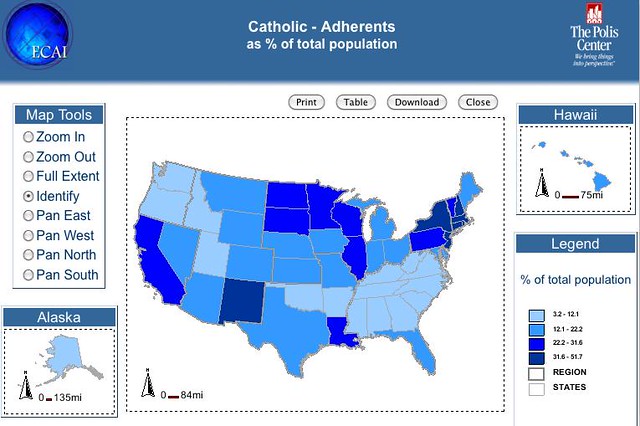
From The Polis Center (a joint venture of Indiana University, Purdue, and Indianapolis University): the North American Religion Atlas, an interactive tool that lets one locate any one of 22 faiths by county, region, or state.
As Rachel Hatch [to whom, TotH] suggests, “an example of the new-ish field, #spatialhumanities”…
As we remember that, as ever, it’s “location, location, location,” we might recall that it was on this date in 1753 that George Washington became a “Master Mason,” the highest rank in the Fraternity of Freemasonry, in his hometown of Fredericksburg, Virginia.
Freemasonry, derived from the practices and rituals of the medieval guild system, gained popularity in the Eighteenth Century, particularly in Great Britain. British Masons organized the first North American Chapter in 1731… arousing considerable suspicion in the early American republic with their mysterious rites and closely held secrets.
But indications are that, for Washington, the Masons were a rite of passage and an expression of civic responsibility. Members were required to express their belief in a Supreme Being and in the immortality of the soul, and expected to obey civil laws, hold a high moral standard, and practice acts of charity.
Besides, their ceremonial dinners routinely ended with the serving of cherry pie.



 Washington the Mason (source: Library of Congress)
You must be logged in to post a comment.