Posts Tagged ‘Archaeology’
“They paved paradise / And put up a parking lot”*…

For 60 years, Section 106 of the National Historic Preservation Act has required federal agencies to “take into account” the effects of their actions on historic properties and places, enabling public participation and comment in the process, and empowering state and local governments and Tribal communities to have a voice in the process– often leading to project improvements and better outcomes. Now, the Trump Administration is working to remove that requirement, as it is to eliminate other heritage and environmental safeguards.
The impacts are already being felt, and wholly unsurprisingly, in a sector that has been consolidated by private equity players…
Chronicle Heritage, the largest cultural resources management company in the United States, abruptly announced it was shutting down, Science has learned. The October 1 move, which has not been announced publicly [as of October 7], came as a surprise to the firm’s more than 600 employees, including numerous archaeologists and paleontologists who were recalled from digs and other projects around the world.
“Our response was absolutely shock, anger, sadness, and fear,” said one employee who asked to remain anonymous.
Chronicle Heritage, which was backed by venture capitalists and formed through the merger of several smaller firms, was a major player in the for-profit cultural heritage industry. It had more than 20 offices and an estimated annual revenue of $100 million. Such firms are often contracted to conduct legally required archaeological surveys and other reviews prior to major development projects. They have been a major source of archaeological data, and some observers estimate they conducted up to 90% of the archaeological research performed in the U.S. each year.
The mass layoff will leave many archaeologists without work just as the warm weather field season comes to a close. The shutdown could also complicate the stewardship of archaeological, Indigenous, and paleontological collections that the firm helped manage.
The closure also comes as the cultural resource management industry is facing profound uncertainty. President Donald Trump’s administration has proposed changes to preservation laws that could vastly reduce the number of federally funded or federally permitted projects requiring archaeological reviews. And a bipartisan group of senators has unveiled legislation, designed to streamline the issuing of federal development permits, that could also lead to fewer archaeological surveys. A broad coalition that includes archaeology organizations, historic preservation groups, and tribal nations has formed to oppose the changes…
“Archaeology megafirm abruptly shuts down“- The largest “cultural resources management” firm in the U.S. deserts the field. From @tmitchellbrown.bsky.social in @science.org.
* Joni Mitchell, “Big Yellow Taxi”
###
As we honor heritage, we might recall that it was on this date in 2024 that archaeologists from the National Academy of Sciences of Armenia and the University of Münster uncovered the remains of a previously unknown early (4th century CE) Christian church in the ancient city of Artaxata, in the heart of Armenia. This remarkable find, the oldest documented Christian church in the country, offers new insights into the spread of Christianity in the region, which was one of the earliest nations to adopt the faith.

“Soft as the earth is mankind and both need to be altered”…
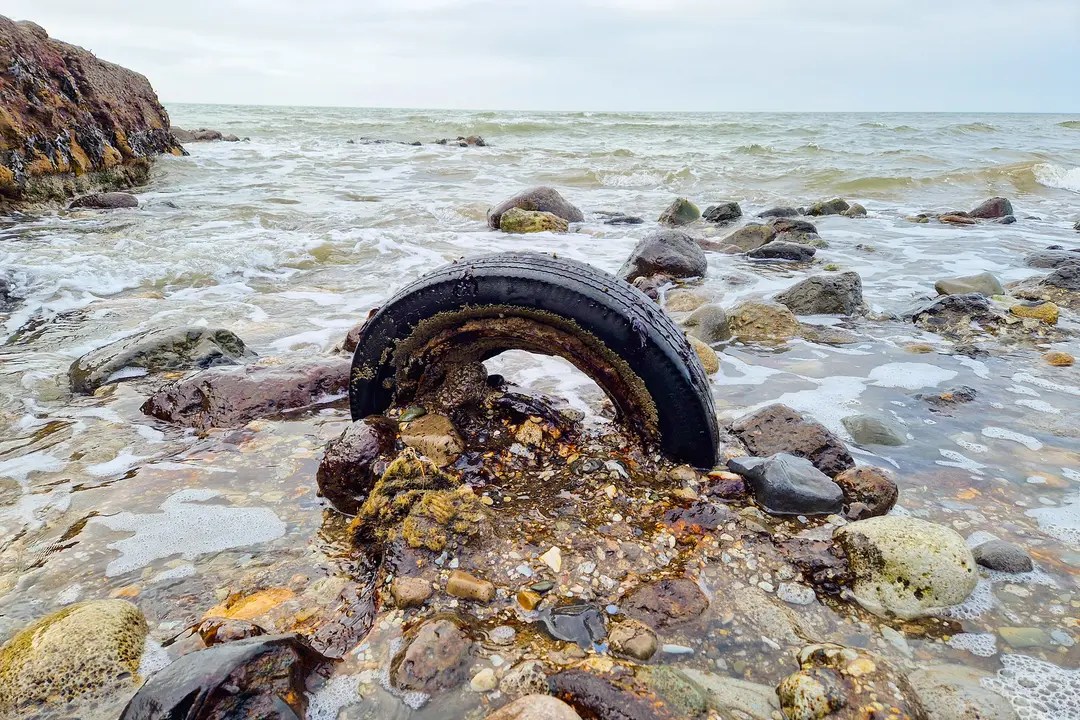
Indeed, especially over the last 150 years or so, both have been. And as a consequence, John MacDonald reports, the Anthropocene is presenting a challenge to geologists:
I’m standing on a beach at Workington, on the western edge of the Lake District in England [pictured above and throughout the article linked below]. Here I find myself contemplating a very unnatural object, while pondering a pretty fundamental question: what, exactly, is a rock? For a geologist like me, this should be easy to answer, but what I’m looking at has made me think otherwise.
At Workington, all seems natural – the sounds of the waves lapping the shore, the call of seabirds, the smell of the ocean, the sight of the stony beach and high cliffs. At first glance, the beach is made largely of a rock platform, which is not a particularly unusual phenomenon – many coastal areas are ‘rock coasts’ made of sandstone, basalt or granite. These rocks are ancient in human years – often millions or even billions of years old – and have been sculpted into their current cliff or platform shapes over hundreds to thousands of years.
Yet among the waves is an object that shouldn’t be there: a wheel and tyre, embedded in the rock that makes up the shore. It’s not stuck in a crevice – the rock has actually formed around it. How can this have happened? The wheel and tyre are of a mid-20th century style, but rocks are ancient, often millions of years old. Aren’t they?
Closer inspection of this hard rock platform shows it is what geologists call conglomerate: a sedimentary rock made of rounded pebbles and cobbles deposited on the Earth surface. Over thousands to millions of years, this material is buried and heated causing minerals to form and fill in the gaps between the pebbles and cobbles, fusing them together into a hard rock mass. At Workington though, this can’t have happened: as well as the tyre, my colleagues and I found several other human-made objects, under 100 years old. The pebbles and cobbles in the conglomerate aren’t natural either: they are all made of slag, a solid by-product of the iron- and steel-making process.
As a geologist, I have studied various types of natural rocks, but recently I have become interested in ‘anthropogenic geomaterials’ – things like industrial slag – and how they become entwined in geological and environmental processes. I came to Workington originally to look at the slag, because I was interested in its potential to scrub-capture carbon dioxide out of the atmosphere. However, when encountering the rock platform with the wheel in it, I was drawn by its incongruity. After studying the geomaterials of Workington more closely with my colleagues Amanda Owen and David Brown, we believe that this little-known section of the English coastline represents a tangible and potentially long-lasting signature of the impact humans are having on the planet.
Unlike many industrial landscapes, nature here has mostly returned, so it would be easy to miss that the beach is composed of human materials. Here a process that normally takes millennia or aeons has happened in a matter of decades. And it’s not the only example: new forms of anthropogenic geology are emerging around the world. These new materials are blurring the borderline between the natural and unnatural. They are also raising a rather fundamental question for geology: what actually is a rock?…
And what becomes of geology as its tasks come to resemble archaeology and anthropogy? Read on for the backstory and the answers.
Not natural, not quite unnatural, the strange new rocks of the Anthropocene stretch the boundaries of geology: “What is this rock?” from @aeon.co.
* W. H. Auden, “In Praise of Limestone“
###
As we ruminate on rocks, we might spare a thought for William Logan; he died on this date in 1875. Born in Montreal in 1798, he was sent to Edinburgh for an education, after which, he lingered in Britain to work in Wales at his uncle’s coal and copper-smelting business. Logan made geologic maps of coal fields in Wales, in attempt to understand the sources of coal and ores. He noted the relationship between the underlying clay layers and fossil tree roots with local coal beds– which helped substantiate the theory that coal beds are formed in place.
On returning to Canada in 1842, he became the founding director of the Geological Survey of Canada. At the time, the country’s geology was virtually unknown; but as a product of two decades of his research, the CGS published the monumental Report on the Geology of Canada in 1863. Known as “the father of Canadian geology,” Logan was knighted by Queen Victoria; and after his death Mount Logan, Canada’s highest mountain, was named in his honor.

“It is by the deep, hidden currents that the oceans are made one”*…

A significant part of the earth’s climate infrastructure is under threat. New research suggests the Atlantic Meridional Overturning Circulation (or AMOC) could weaken by half this century with wide ranging consequences for weather, food, and sea levels across the world. Alison Smart and Charlotte Venner unpack the past and ponder the future of this critical ocean current…
London, England, and Quebec City, Canada sit at roughly the same latitude (51°N and 47°N, respectively) but have vastly different climates. Historically, Quebec City had 99 freezing days in an average year—weather you might expect from its relative proximity to the Arctic—but London only experienced three freezing days in an average year, despite being slightly further north. This difference is largely due to an ocean current called the Atlantic Meridional Overturning Circulation (AMOC), which distributes warmth from the Tropics via the Atlantic Ocean.
Now, impacts from climate change are weakening the AMOC, and it could collapse entirely in the near future. AMOC collapse would rapidly make regions of the Northern Hemisphere with historically mild weather colder and harsher, while triggering irreversible changes in the global climate.
The AMOC is both the product of a stable climate and a factor in maintaining weather patterns around the planet. To plan for future scenarios, we need to first understand how the AMOC works and what might happen if it collapses…
[Smart and Venner explain the AMOC and outline the ways in which it shapes the climate of regions around the world…]
… Even minor weakening of the AMOC can significantly impact local climates, as has happened several times in the past 12,000 years. A “Little Ice Age” occurred in Europe in the Middle Ages, likely connected to a disruption in the AMOC. Just a slight slowdown in the AMOC could make Europe colder overall, disrupt global precipitation patterns from South America to India, and worsen drought in Africa.
The more freshwater pours into the ocean, and the more ocean temperatures rise, the weaker the AMOC becomes—until, at some threshold, it could stop moving altogether.
It is possible that the AMOC will collapse entirely if warming continues. There is no agreed-upon global average temperature at which collapse becomes certain, but there are signals we can track and historical examples we can examine to predict the likelihood of collapse…
… The consequences of total AMOC collapse would be far-reaching, severe, and irreversible on timescales relevant to humans. AMOC collapse would cool parts of the Northern Hemisphere and warm parts of the Southern Hemisphere by multiple degrees Celsius and drastically alter weather around the world.
In Europe, winter temperatures would drop, cold snaps could increase, and winter storms would intensify. A 2025 research letter found that, even if global warming reached 2°C, AMOC collapse would make Europe colder than it is today, creating extreme winters in Northwestern Europe in which record cold might reach -20°C (-4°F) in London and -50°C (-58°F) in Scandinavia. Even milder cold days would increase, with approximately 150 to 180 frost days per year in Utrecht, Netherlands, compared to a historic average of about 53. Precipitation would likely shift and decrease, potentially drying out some parts of Europe and making others wetter.
Around the world, other climates would change, likely in less extreme ways.
- North America. The East Coast of North America would likely experience rapid sea level rise as the gravitational pull of the AMOC weakens, as well as cooler conditions, with some parts of Eastern Canada and the North Atlantic coast cooling by several degrees Celsius, erratic storms, weather variability, and more intense hurricanes.
- Tropics & South America. Without the AMOC, the ITCZ would shift south, potentially leading to drying in the Northern Tropics and parts of the Amazon and wetter conditions in the Southern Tropics.
- Africa. Because of the shift in the ITCZ, West Africa and the Sahel would be much drier, experiencing severe and frequent drought and reduced rainy seasons. The Sahel could possibly transition from a semi-arid climate to hot dry desert.
- Asia. Because of the shift in the ITCZ, weakened and more erratic monsoons in Asia would lead to increased drought and a higher risk of extreme precipitation events.
These changes may occur rapidly, create climate risks, and cause systemic disruption in affected regions. The collapse of the AMOC would also be a tipping point in the global climate, meaning that the changes would likely be difficult, if not impossible, to reverse on human timescales.
Once the AMOC passes a critical threshold of weakening, called a tipping point, it would continue to weaken until it collapses. AMOC collapse could also create systemic impacts that activate other tipping points as well as feedback loops that could generate further warming.
For example, if AMOC collapse contributed to changes like a permanent dieback of the Amazon Rainforest or increased ice loss, those changes would generate their own warming effect on Earth’s climate. A 2026 paper suggests that AMOC collapse would result in substantial carbon release from oceans and add around 0.2°C in additional atmospheric warming.
Reducing greenhouse gas emissions may slow warming enough to reduce weakening and delay collapse. If collapse begins, it is unlikely we could stop it. There is no feasible technological way to reengineer ocean currents…
A bracing, but important read: “A complete guide to the Atlantic Meridional Overturning Circulation (AMOC).”
See also: “What would happen if the Atlantic Meridional Overturning Circulation (AMOC) collapses? How likely is it?”
###
As we put on our sailin’ shoes, we might send interconnected birthday greetings to Andrew Sharrett; he was born on this date in 1946. An archaeologist, his application of world-systems theory to questions of change on large, often global, scale made him one of the most influential archaeologists of the late 20th/early 21st centuries. Sharrett is best known for his theory of the secondary products revolution; but his work touched on a broad range of fundamental human developmental issues: global migration and colonization, the spread of agriculture, the development of metallurgy and urbanism, and the development of new forms of consumption, to name a few. All of those dynamics were, as Sharrett observed, shaped in significant ways by the climatic conditions in which they unfolded.

“To-day I think / Only with scents”*…

We’ve considered before smell, the unsung hero of the senses. Today, Kaja Šeruga explains how scientists using chemistry, archival records, and AI are reviving the aromas of old libraries, mummies and battlefields…
We often learn about the past visually — through oil paintings and sepia photographs, books and buildings, artifacts displayed behind glass. And sometimes we get to touch historical objects or listen to recordings. But rarely do we use our sense of smell — our oldest, most primal way of learning about the environment — to experience the distant past.
Without access to odor, “you lose that intimacy that smell brings to the interaction between us and objects,” saysanalytical chemist Matija Strlič. As lead scientist of the Heritage Science Laboratory at the University of Ljubljana in Slovenia and previously deputy director of the Institute for Sustainable Heritage at University College London, Strlič has devoted his career to interdisciplinary research in the field of heritage science. Much of his work focused on the preservation and reconstruction of culturally significant scents.
Reconstructed scents can enhance museum and gallery exhibits, says Inger Leemans, a cultural historian at the Royal Netherlands Academy of Arts and Sciences. Smell can provide a more inviting entry point, especially for uninitiated visitors, because there’s far less formalized language for describing smell than for interpreting visual art or displays. Since there’s no “right way” of talking about scent, she says, “your own knowledge is as good as the others’.”
Despite their potential to enrich our understanding of history and art, smells are rarely conserved with the same care as buildings or archaeological artifacts. But a small group of researchers, including Strlič and Leemans, is trying to change that — combining chemistry, ethnography, history and other disciplines to document and preserve olfactory heritage…
Read on for the fascinating details: “Recreating the smells of history,” from @knowablemag.bsky.social.
* Edward Thomas, “Digging“
###
As we take a whiff, we might recall that it was on this date in 1924 that Coco Chanel agreed with the Wertheimer brothers Pierre and Paul, directors of the perfume house Bourjois, to create a new corporate entity, Parfums Chanel, Its signature product was Chanel No. 5. She had been selling small quanitites of the scent in her boutique since 1921.
Traditionally, fragrances worn by women had fallen into two basic categories. Respectable women favored the essence of a single garden flower while sexually provocative indolic perfumes heavy with animal musk or jasmine were associated with women of the demi-monde. Chanel sought a new scent that would appeal to the flapper and celebrate the seemingly liberated feminine spirit of the 1920s. Her scent was formulated by chemist and perfumer Ernest Beaux, who designed an unprecedented olfactory architecture, a bouquet of 80 scents whose precious notes were blended with high proportions of aldehydes, organic compounds that carry a crisp, soapy, and floral citrusy scent. In late 1920, when presented with small glass vials containing sample scents numbered 1 to 5 and 20 to 24 for her assessment, she chose the fifth vial. Chanel told Beaux, “I present my dress collections on the fifth of May, the fifth month of the year and so we will let this sample number five keep the name it has already, it will bring good luck.”
The first promotion for Chanel No. 5 appeared in The New York Times on December 16, 1924– a small ad for Parfums Chanel announcing the Chanel line of fragrances available at Bonwit Teller, an upscale department store. The fragrance, of course, become a fave. An Andy Warhol subject and worn by everyone from Marilyn Monroe and Catherine Deneuve to Mad Men’s Peggy Olson, the perfume, is a foundational part of fragrance history… and still sells a bottle every 30 seconds.

“Each of our bodies may occupy only one cemetery plot when we’re done with this world, but a single person’s 102-ton trash legacy will require the equivalent of 1,100 graves.”*…

Madeleine Adams on John Scanlan‘s new book The Idea of Waste- On the Limits of Human Life… and on the place of trash in our culture…
… Trash is the hidden foundation of modern civilization. The ancient Trojans waded “ankle deep” in pottery shards and animal bones and whatever else they threw on the floor until they got so fed up with the mess that they paved it over. Rome’s first underground sewer, the Cloaca Maxima, which used the city’s rivers to sweep away waste, was constructed in the third century BC. Writing over two centuries after its construction, Livy praised the Cloaca as a monument without match, and Pliny, writing about a hundred years after him in AD 77, called it the “most noteworthy achievement” of the Roman Empire, beating out the Colosseum and the Parthenon. At the time of its construction the Cloaca was an engineering spectacle, and it also became a symbol of Roman civic virtue. Sturdy infrastructures that served the people endured; flashy monuments to emperors did not. During floods, Pliny noted, “the street above, massive blocks of stone are dragged along, and yet the tunnels do not cave in.” Humbly concealed by walls and by continued elevations of the surface of the city through centuries of accumulated matter, its invisibility ensured its durability.
No Roman subject could have predicted just how enduring an achievement the Cloaca Maxima was: SPQR (Senatus Populusque Romanus, or the Senate and People of Rome—the emblem of ancient Rome) decorates manhole covers and trash cans throughout Rome. European sewer systems of the nineteenth century drew many comparisons to the Cloaca. “And as would be the case much later with the underground tunnels and drains of Paris and London, its concealment had the effect of making it an object of curiosity,” Scanlan notes, “providing it with the allure of a place that held truth or secrets about the life of the city.” The sewers drew admiration from many quarters—photographer Félix Nadar explored Paris’s extensively in the 1860s, and London’s caused a Manchester Guardian reporter to muse three-quarters of a century later: “These tremendous undertakings may very easily be the most lasting memorials of our cities.” “Out of sight out of mind”—yet also: “One man’s trash is another man’s treasure.” The sense that waste was a thing to be conquered became a transhistorical justification for increasing waste technocracy, but the mysterious underworld of waste has always beckoned to the chthonically inclined.
With the rapid industrialization of the Victorian city came the explicitly progressive urge to submerge its grime. Mudlarks, ragpickers, and sewermen populated London’s new underworld. The sewermen, with their “long greasy velveteen coats, furnished with pockets of vast capacity” for holding money, jewelry, and other cleanable trinkets, were a cut above the mudlarks. Mudlarks, mainly women and children who scavenged on the banks of the Thames, wore “torn garments stiffened up like boards with dirt of every possible description.” But this grime, inspiring contemporary works like Dickens’s Bleak House, covered everything: “Fog everywhere” opens the second paragraph of the novel. For Scanlan, Dickens’s fog is not only the grimy remnant of industrial production; the Lord High Chancellor presiding over the decades-old case of Jarndyce and Jarndyce sits “at the very heart of the fog.” For Scanlan, Dickens’ fog obscured the social apparatus—London’s bureaucracy and class system—thereby keeping the lower stratum from rising out of the perceived muck. Progressive urban projects further ensured class segregation as a matter of aesthetics. Ebenezer Howard’s 1902 Garden Cities of To-Morrow allotted spaces for the healthy and happy middle class, as well as for inebriates and the insane. His “slumless and smokeless” urban plans designed a future city with less (visible) waste.
But interred beneath the gardens of modern progress was mass culture’s growing pile of discarded commodities. Responding to the fragmentation of Europe in the 1930s, Walter Benjamin posited history as an endless accumulation of debris in his Arcades Project, which Scanlan calls a “strange literary waste-book.”…
… All waste goes through cycles of decomposition, buying and selling, or displacement. It was not until the 1970s that the idea of “recycling” appeared in opposition to “disposal.” England’s rag-and-bone collectors formed the economy of recycling before 1970. Rag collectors only appeared after the fourteenth-century popularization of the spinning wheel, which enabled the production of a surplus of rags for the first time in history. Bones were ground into fertilizer, while linen rags were sometimes reused to make linen again, or else they too were returned to the earth (flax makes great fertilizer). But industrialized clothing production in the mid-nineteenth century meant that there were now many different kinds of rags, some with trimmings and linings, some in blended materials. By 1949 these Mr. Krooks had to sort through some seven hundred and fifty grades of rags. “I can tell them in the dark,” Scanlan quotes a collector saying, “but you can still lose out on a deal if you aren’t awake.” By 1970, rag-and-bone collectors had disappeared as recycling became centralized by city haulers and municipal tracking codes. Secondhand stores and eBay keep decentralized recycling—albeit as an economy of trends and “vintage” styles—alive. Despite the “hunter-gatherer impulse” that thrills William Gibson when he clicks eBay’s Seller’s Other Auctions, browsing eBay, antiquing, and thrifting are, for the middle class, a pastime, albeit an eco-friendly one.
The “throwaway society” invented the idea that any commodity could be briefly desired, barely used, and tossed out of sight with impunity. The many tech gadgets you’re supposed to give dad this Father’s Day come with a gift receipt but no reminder that their lithium-ion batteries form centuries of toxic landfill. Dads—well, all people—form a bond with their phones and laptops. Sherry Turkle compares the oneness of tech device and human to “the diabetic [who] feels at one with his glucometer.” “The user who is engaged with their device is probably not given to contemplating the future waste that it creates,” writes Scanlan, “given that they are rather caught up in a permanently unfolding present that arrives on demand, through [our devices’] potentially limitless experiences.” But this constant media stream produces not only dead phones and laptops—it also generates media waste…
Looking for the future in the dustbins of history: “W.A.S.T.E. Not,” from @thebaffler.com. Read on…
* Edward Humes, Garbology: Our Dirty Love Affair with Trash
###
As we grapple with garbage, we might send antique birthday greetings to David George Hogarth; he was born on this date in 1862. An archaeologist, he explored and excavated (1887–1907) in Cyprus, Crete, Egypt, Syria, and Melos… uncovering both the ruins of buidlings and the buried detrius of those civilations. From 1908 until his death in 1927, he was Keeper of the Ashmolean Museum at Oxford.
Hogarth employed T.E. Lawrence on some of his digs, and worked with him during WWI to plan the Arab Revolt— when Lawrence bacame “Lawrence of Arabia.”

You must be logged in to post a comment.