Posts Tagged ‘garbage’
“Each of our bodies may occupy only one cemetery plot when we’re done with this world, but a single person’s 102-ton trash legacy will require the equivalent of 1,100 graves.”*…

Madeleine Adams on John Scanlan‘s new book The Idea of Waste- On the Limits of Human Life… and on the place of trash in our culture…
… Trash is the hidden foundation of modern civilization. The ancient Trojans waded “ankle deep” in pottery shards and animal bones and whatever else they threw on the floor until they got so fed up with the mess that they paved it over. Rome’s first underground sewer, the Cloaca Maxima, which used the city’s rivers to sweep away waste, was constructed in the third century BC. Writing over two centuries after its construction, Livy praised the Cloaca as a monument without match, and Pliny, writing about a hundred years after him in AD 77, called it the “most noteworthy achievement” of the Roman Empire, beating out the Colosseum and the Parthenon. At the time of its construction the Cloaca was an engineering spectacle, and it also became a symbol of Roman civic virtue. Sturdy infrastructures that served the people endured; flashy monuments to emperors did not. During floods, Pliny noted, “the street above, massive blocks of stone are dragged along, and yet the tunnels do not cave in.” Humbly concealed by walls and by continued elevations of the surface of the city through centuries of accumulated matter, its invisibility ensured its durability.
No Roman subject could have predicted just how enduring an achievement the Cloaca Maxima was: SPQR (Senatus Populusque Romanus, or the Senate and People of Rome—the emblem of ancient Rome) decorates manhole covers and trash cans throughout Rome. European sewer systems of the nineteenth century drew many comparisons to the Cloaca. “And as would be the case much later with the underground tunnels and drains of Paris and London, its concealment had the effect of making it an object of curiosity,” Scanlan notes, “providing it with the allure of a place that held truth or secrets about the life of the city.” The sewers drew admiration from many quarters—photographer Félix Nadar explored Paris’s extensively in the 1860s, and London’s caused a Manchester Guardian reporter to muse three-quarters of a century later: “These tremendous undertakings may very easily be the most lasting memorials of our cities.” “Out of sight out of mind”—yet also: “One man’s trash is another man’s treasure.” The sense that waste was a thing to be conquered became a transhistorical justification for increasing waste technocracy, but the mysterious underworld of waste has always beckoned to the chthonically inclined.
With the rapid industrialization of the Victorian city came the explicitly progressive urge to submerge its grime. Mudlarks, ragpickers, and sewermen populated London’s new underworld. The sewermen, with their “long greasy velveteen coats, furnished with pockets of vast capacity” for holding money, jewelry, and other cleanable trinkets, were a cut above the mudlarks. Mudlarks, mainly women and children who scavenged on the banks of the Thames, wore “torn garments stiffened up like boards with dirt of every possible description.” But this grime, inspiring contemporary works like Dickens’s Bleak House, covered everything: “Fog everywhere” opens the second paragraph of the novel. For Scanlan, Dickens’s fog is not only the grimy remnant of industrial production; the Lord High Chancellor presiding over the decades-old case of Jarndyce and Jarndyce sits “at the very heart of the fog.” For Scanlan, Dickens’ fog obscured the social apparatus—London’s bureaucracy and class system—thereby keeping the lower stratum from rising out of the perceived muck. Progressive urban projects further ensured class segregation as a matter of aesthetics. Ebenezer Howard’s 1902 Garden Cities of To-Morrow allotted spaces for the healthy and happy middle class, as well as for inebriates and the insane. His “slumless and smokeless” urban plans designed a future city with less (visible) waste.
But interred beneath the gardens of modern progress was mass culture’s growing pile of discarded commodities. Responding to the fragmentation of Europe in the 1930s, Walter Benjamin posited history as an endless accumulation of debris in his Arcades Project, which Scanlan calls a “strange literary waste-book.”…
… All waste goes through cycles of decomposition, buying and selling, or displacement. It was not until the 1970s that the idea of “recycling” appeared in opposition to “disposal.” England’s rag-and-bone collectors formed the economy of recycling before 1970. Rag collectors only appeared after the fourteenth-century popularization of the spinning wheel, which enabled the production of a surplus of rags for the first time in history. Bones were ground into fertilizer, while linen rags were sometimes reused to make linen again, or else they too were returned to the earth (flax makes great fertilizer). But industrialized clothing production in the mid-nineteenth century meant that there were now many different kinds of rags, some with trimmings and linings, some in blended materials. By 1949 these Mr. Krooks had to sort through some seven hundred and fifty grades of rags. “I can tell them in the dark,” Scanlan quotes a collector saying, “but you can still lose out on a deal if you aren’t awake.” By 1970, rag-and-bone collectors had disappeared as recycling became centralized by city haulers and municipal tracking codes. Secondhand stores and eBay keep decentralized recycling—albeit as an economy of trends and “vintage” styles—alive. Despite the “hunter-gatherer impulse” that thrills William Gibson when he clicks eBay’s Seller’s Other Auctions, browsing eBay, antiquing, and thrifting are, for the middle class, a pastime, albeit an eco-friendly one.
The “throwaway society” invented the idea that any commodity could be briefly desired, barely used, and tossed out of sight with impunity. The many tech gadgets you’re supposed to give dad this Father’s Day come with a gift receipt but no reminder that their lithium-ion batteries form centuries of toxic landfill. Dads—well, all people—form a bond with their phones and laptops. Sherry Turkle compares the oneness of tech device and human to “the diabetic [who] feels at one with his glucometer.” “The user who is engaged with their device is probably not given to contemplating the future waste that it creates,” writes Scanlan, “given that they are rather caught up in a permanently unfolding present that arrives on demand, through [our devices’] potentially limitless experiences.” But this constant media stream produces not only dead phones and laptops—it also generates media waste…
Looking for the future in the dustbins of history: “W.A.S.T.E. Not,” from @thebaffler.com. Read on…
* Edward Humes, Garbology: Our Dirty Love Affair with Trash
###
As we grapple with garbage, we might send antique birthday greetings to David George Hogarth; he was born on this date in 1862. An archaeologist, he explored and excavated (1887–1907) in Cyprus, Crete, Egypt, Syria, and Melos… uncovering both the ruins of buidlings and the buried detrius of those civilations. From 1908 until his death in 1927, he was Keeper of the Ashmolean Museum at Oxford.
Hogarth employed T.E. Lawrence on some of his digs, and worked with him during WWI to plan the Arab Revolt— when Lawrence bacame “Lawrence of Arabia.”

“Can’t have dirty garbage!”*…

Rebecca Alter, with a paean to an unexpected TikTok delight…
At some point earlier this year, my For You Page changed for the better. Between cute boys making sandwiches, Brian Jordan Alvarez videos, and American Girl Doll memes, I started getting the occasional video from @nycsanitation. I don’t think I’ve ever watched through a full video on TikTok from any government department, local or federal, but @nycsanitation has clawed its way through algorithms and attention spans to be that rarest of finds: an official organization or company account that’s actually good. The Department comes across in its TikToks as a bunch of genuine, hardworking salt-of-the-earth folks. I mean that literally; @nycsanitation TikTok reminds us that they’re the ones in charge of salting the streets in winter…
Read on for wondrous examples featuring googly-eyed snowplow trucks and earnest charm: “The Department of Sanitation Has an Oddly Excellent TikTok,” from @ralter in @Curbed.
* Spongebob
###
As we keep it clean, we might might recall that it was on this date in 1865 that Joseph Lister, a student of Pasteur’s germ theory, performed the first successful antiseptic surgery (using carbolic acid to disinfect a compound fracture suffered by an 11-year-old boy). After four days, he discovered that no infection had developed, and after a total of six weeks he was amazed to discover that the boy’s bones had fused back together, without suppuration. He subsequently published his results in The Lancet in a series of six articles, running from March through July 1867.
Lister developed his approach to extend to Lister instructing surgeons under his responsibility to wear clean gloves and wash their hands before and after operations with five per cent carbolic acid solutions. Instruments were also washed in the same solution, and assistants sprayed the solution in the operating room.
At first, his suggestions were criticized: germ theory was in its infancy and his techniques were deemed too taxing. But his results– sharp reduction in post-op infection and death– ultimately carried the day. Indeed, he so revolutionized his field that he is known as “father of modern surgery.”

“The love of learning, the sequestered nooks, / And all the sweet serenity of books”*…

Righteous recycling: garbage collectors in Ankara started “reclaiming” discarded books and ended up opening a library….
It all started when sanitation worker Durson Ipek found a bag of cast-off books when he was working and then it snowballed from there. Ipek and other garbage men started gathering the books they found on the streets that were destined for landfills and as their collection started to grow, so did word of mouth. Soon, local residents started donating books directly.
The library that originally contained 200 books is located in the Cankaya district of the capital city in a previously vacant brick factory at the sanitation department headquarters. The library was initially available only to the sanitation employees and their families to use but as the collection grew, so did public interest and the library was opened to the public in December 2017…
All the books that are found are sorted and checked for condition, if they pass, they go on the shelves. In fact, everything in the library was also rescued including the bookshelves and the artwork that adorns the walls…
Today, the library has over 6,000 books that range from fiction to nonfiction and there’s a very popular children’s section that even has a collection of comic books. An entire section is devoted to scientific research and there are also books available in English and French…
The full story at: “Turkish Garbage Collectors Open a Library from Books Rescued from the Trash“
* Henry Wadsworth Longfellow
###
As we check it out, we might spare a thought for James Billington; he died on this date in 2018. A historian at Harvard and Princeton, who went on to hold the directorship of the Woodrow Wilson International Center for Scholars, Billington is probably best remembered for his final post, Librarian of Congress, a position he held from 1987 to 2015.
The Library of Congress, the oldest federal cultural institution in the U.S., is the nation’s de facto national library. As librarian, Billington oversaw that resource and appointed the U.S. poet laureate and awarded the Gershwin Prize for Popular Song each year. Billington undertook during his tenure to broaden and deepen public access to the LoC’s remarkable holdings, introducing a series of no-fee access services.
As Librarian, he also oversaw the Digital Millennium Copyright Act (DMCA). In 2010, Billington’s decision to open new DMCA loopholes resulted in his being described as “the most important person you never heard of.”

“Ours is a culture and a time as immensely rich in trash as it is in treasures”*…

… and sometimes the trash is treasure:
There’s a Covanta Holding Corp. incinerator outside Philadelphia that produces electricity from burning garbage. It also produces something else: stacks and stacks of blackened, sooty coins.
Over the course of a year, those nickels, dimes and quarters add up to about $360,000. That’s seven times the average income in the Philadelphia metropolitan region, and the money is piling up as Covanta waits for the U.S. Mint to resume coin purchases under an exchange program it suspended in November.
About $61.8 million of loose change is accidentally thrown away every year in the U.S., Covanta estimates. The coins get swept off restaurant tables, mixed in with scraps when people empty their pockets, and vacuumed up from carpets or sofa cushions. The money used to end up in the dump, but as trash volume increases and open space dwindles, landfill-disposal costs are up 25 percent in the past decade. That’s created an incentive for Covanta and other companies to develop ways to sift through mountains of garbage and extract steel, iron, aluminum and copper for sale to recyclers…
More at “We Toss $62 Million of Loose Change Every Year. This Company Wants Some of It.”
* Ray Bradbury, Zen in the Art of Writing
###
As we check again under our sofa cushions, we might spare a thought for Blessed John (Johannes, Ioannes) Duns Scotus, O.F.M.; he died on this date in 1308. One of the most important philosophers of the High Middle Ages (with his arch-rival, William of Ockham), Duns Scotus was a champion of a form of Scholasticism that came to be known as Scotism.
But he may be better remembered as a result of the slurs of 16th Century philosophers, who considered him a sophist– and coined the insult “dunce” (someone incapable of scholarship) from the name “Dunse” given to his followers in the 1500s.

“American cities are like badger holes, ringed with trash– all of them”*…
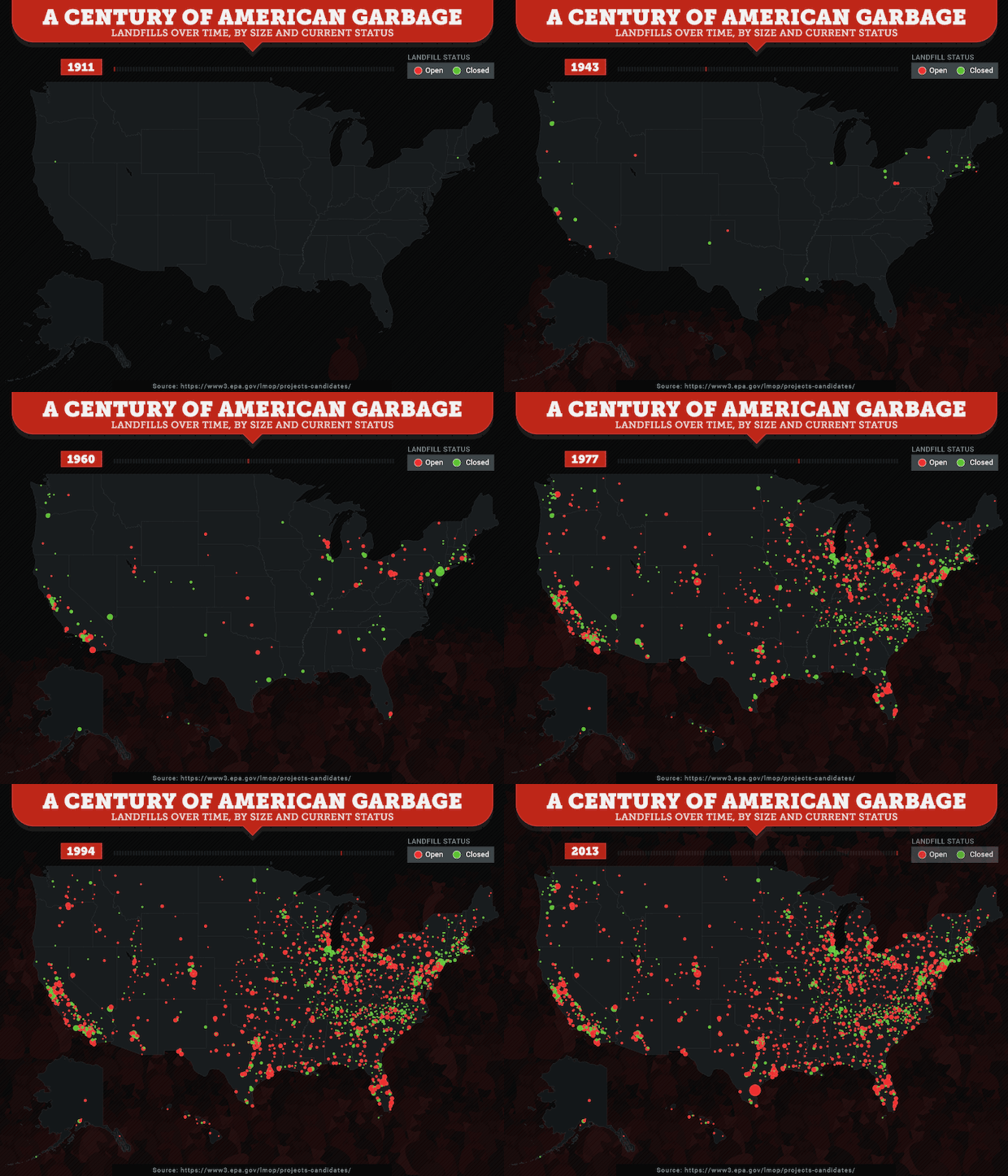
Widely considered to be the first sanitary landfill in the U.S., the Fresno garbage dump, which opened in 1937, has the dubious distinction of being named to both the U.S. National Register of Historic Places and the nation’s list of Superfund sites. That’s a funny pair of categories to straddle, but it illustrates an important point: Trash is a starring character in the American story, even as we continue to wrestle with its consequences…
Dumpster dive at “Mapping America’s Mountains of Garbage.”
* John Steinbeck, Travels with Charley: In Search of America
###
As we sort compost from recycling, we might recall that it was on this date in 1583 that Sir Humphrey Gilbert established the first English colony in North America, at what is now St. John’s, Newfoundland and Labrador.

You must be logged in to post a comment.