Posts Tagged ‘consciousness’
“Reality is a very subjective affair”*…

As Nathan Gardels reports, the Berggruen Institute recently gathered religious scholars, philosophers, quantum physicists, AI technologists, neuroscientists and science fiction novelists at Casa dei Tre Oci in Venice to ponder the nature of consciousness. Noting that “it is fascinating to see how their ideas correspond to the long-ago musings of Medieval mystics and even the “pagan masters” of antiquity'” Gardels observes that “the great question then, as now, and probably forever, is whether there is a metaphysical gap between the body and the soul, or if they are made of the same substance, symbiotic aspects of a singular reality that entail each other.” He concludes…
…The quantum physicist Carlo Rovelli argues that the much-discussed metaphysical gap between body and soul, subjective and objective, doesn’t exist.
As he has written in Noema, “We, subjects of knowledge and understanding, are not outside the world. We are part of it. Our theories and knowledge are embodied tools to help us navigate the real world, not disembodied views on reality from the outside. They are themselves aspects of the very world they describe. Our understanding, like our feelings, perceptions and experience, is a natural phenomenon.”
For Rovelli, the notion of a metaphysical gap “contradicts everything we have learned about nature in the last centuries. The mind is the behavior of the brain, properly described in a high-level language. Neither my own experience of myself nor an external experience of me is primary: They are two distinct perspectives on the same events. We do not need to assume that the circle between epistemology (how we get knowledge) and ontology (what exists) requires a starting point. There is nothing wrong with its circularity: The world I access is the information I have about it, and I am part of that world.
“Nor do we need to require that there is any ultimate or fundamental account of reality. Any account is approximate, has blind spots and is realized within reality, so it is embodied in a part of that same reality.
“If we do not fall into the error of dualism upfront, we can safely speak of soul and emotions just as we speak of a kitchen table, even if the table is also a collection of atoms. It is time to give up the pernicious dualism introduced by the debate on consciousness and embrace the reality that our soul, or our spiritual life, is consistent with our fundamental physics.
“Earth is not metaphysically different from the heavens, living beings are not metaphysically different from inanimate matter, humans are not metaphysically different from other animals. The soul is not metaphysically different from the body. We are all parts of nature.”
Rovelli’s scientific case that we humans are not outside the world of reality, but constitutive participants in it and constructors of it, tracks with the intuition of Medieval thinkers like the 14th-century Christian mystic Meister Eckhart.
For Eckhart, consciousness was being aware we are not apart from, but both inhabit and are inhabited by, the mind of God — that is, “objective reality.”
As stated in the New Testament’s Gospel of John, “In the beginning was the Word, and the Word was with God.” In biblical terms, the Word, or Logos, is divine reason. Eckhart interpreted this passage as meaning that the incarnation of the divine in man was not a one-time event of Christ’s birth in Bethlehem, but takes place through continuous human participation in the unfolding Logos of the Word, making us part of and conjoining with the mind of God; co-essences, so to speak.” If God is the pure thought of divine reason, then, as Sloterdijk has put it, ‘To think is to give birth to God.’”
That Medieval insight is another way of saying, in Rovelli’s words, that “objectivity without a subject is an abstract construct, of little relevance — it is the illusion of a science now belonging to the past.”
Consciousness, then, can be said to be the perspective of the aware self in a world where there is no outside. The “I” is not detached from some order of objective reality, but in all the diversity of personal experience, part of what makes it “everywhere whole.” Not only is “the universe disclosed by a knowing subject;” the knowing subject is its co-creator from within…
Eminently worth reading in full.
Striving to understand the nature of consciousness: “Subjective Perspective Makes Objective Reality ‘Everywhere Whole’,” from @noemamag.com.
Pair with: “Everything is not itself.”
* Vladimir Nabokov, Pale Fire
###
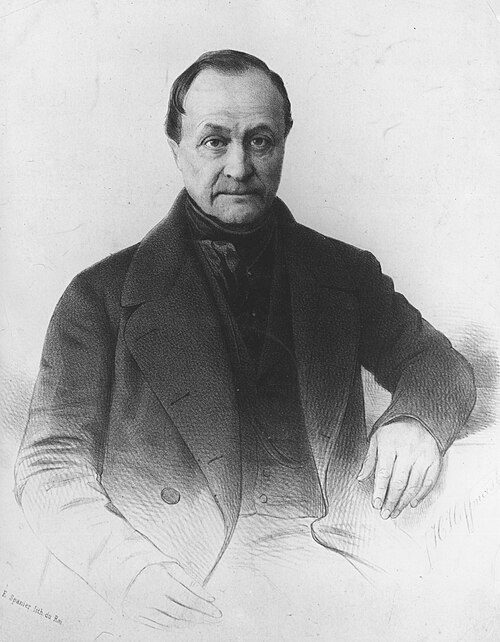
As we muse on our minds, we might spare a thought for a man who wrestled with these same issues, Auguste Comte; he died on this date in 1857. A philosopher (and mathematician), he is remembered as the father of the doctrine of positivism. He developed the Law of Three Stages to describe the historical evolution of human thought and consciousness, arguing that the human mind, in its search for understanding, progresses through three distinct intellectual phases (the theological, the metaphysical, and the positive (or scientific), each with a different method of explaining reality.
Comte is widely regarded as the first “philosopher of science” in the modern sense, and as the forebearer of sociology (the name of which he coined, as he did the word “altruism”). He had a major impact on 19th-century thought, influencing the work of social thinkers like John Stuart Mill and George Eliot. His concepts of “sociology” and social evolutionism set the tone for early social theorists and anthropologists including Harriet Martineau and Herbert Spencer, evolving into modern academic sociology (a la Émile Durkheim) as practical and objective social research.
“Behind it all is surely an idea so simple, so beautiful, that when we grasp it—in a decade, a century, or a millennium—we will all say to each other, how could it have been otherwise? How could we have been so stupid?”*…

From Plato on (if not, indeed, from even earlier), we’ve struggled to resolve the “shadows on the cave wall” into ever-sharper understandings of the reality “behind” those shadows. The quantum of that effort is the “idea.”
But what is an idea? “Roger’s Bacon” offers a provocative answer…
1. Ideas are alien life forms with an agency and intelligence independent of any mind or substrate which they inhabit. When we say that an idea (a story, a joke, a theory, a work of art) has “taken on a life of its own”, our language betrays an intuitive understanding that science has not yet grasped.
They are as you and I—eating, loving, mating, evolving, dying.
2. We do not create or “have” ideas—if anything is doing the creating or having, it is the ideas themselves.
There are times when we recognize this truth (when an idea “magically” pops into your head from “out of nowhere”), but too often it is obscured by the post-hoc just-so stories we tell ourselves about how I, the Great Thinker, Precious Me, was able to “come up with” the brilliant idea (e.g. I combined two other ideas, I was inspired by a memory, an event, another idea, etc.). Whatever explanation you give, the experience is always the same—the idea simply arrives. All else is confabulation.
Why then does an idea enter one mind and not another? Ideas act as all organisms do—they seek habitats (i.e. minds) that can provide them with the space and resources (i.e. mental runtime, ideas eat the energy that enables action potentials) needed to survive and reproduce (i.e. create new idea-children). Just as some ecosystems are more diverse, abundant, and resilient, some minds are as well. What we call creativity is the quality of possessing a healthy mental ecosystem, one that offers fertile ground for a plenitude of ideas. Ideas may also be attracted to particular minds for more specific reasons—for example, an idea may see that other related ideas (members of the same genera or family) have found the mind to be especially suitable or perhaps the mind is in dire need of a certain idea and therefore will offer it ample resources upon arrival. Some minds (e.g. those that are dominated by one idea or set of ideas, perhaps a religious or political ideology) provide poor habitat and are avoided by all but the most desperate ideas (e.g. irrational and harmful ideas that can’t find a home elsewhere—this is why conspiracy theories and hateful ideologies tend to congregate in the same minds).
3. Dear reader, I ask you to conduct an experiment.
Create something, anything—write a line of poetry, doodle an image, hum a melody, take some objects near you and arrange them into a sculpture. Now destroy what you created—physically if you can, but also mentally. Forget it completely.
The world is changed. You are changed. The idea will return in one form or another, in your mind or another.
4. Highly creative people, those we might call “geniuses”, sometimes have the intuition that ideas are autonomous living entities. The standard scientific explanation would be that creativity is positively associated with certain mental characteristics (such as theory of mind and schizotypy) that make someone prone to the intuition that ideas possess a degree of autonomous agency, that they are independently alive in some sense. However, another interpretation is possible: ideas do not like to be treated as if they were lifeless, inanimate objects (would you?) and therefore they gravitate towards minds that treat them with the respect and dignity they deserve…
[“RB” shares the fascinating insights of Philip K Dick, David Lynch, Terence Mckenna, and David Abram…]
… 5. Our relation to ideas is an inextricable symbiosis, like that between plant and pollinator, a mutualism in which neither can survive without the other. At the dawn of civilization, a covenant was made between humans and these alien entities which inhabit our minds—honor and respect each other and all will flourish beyond their wildest dreams.
Ideas will help us if we help them. This is why the growth of knowledge depends on certain moral values—freedom, openness, honesty, courage, tolerance, and humility, amongst others. Those cultures that respect these values provide ideal habitat for ideas, and where ideas thrive and multiply, so do humans.
The converse is true as well. When ideas are kept secret or willfully distorted, we suffer. When ideas are regarded as slaves, as mere tools that can be wielded for their owner’s benefit, the end is near.
Our treatment of ideas is at the root of all that ails us. The remedy: worship ideas like Wisdom, Justice, Equality, Peace, and Love as if they were Gods (because in fact they are, something the ancients recognized that we have long since forgotten), and follow one simple rule.
Do unto ideas as you would have them do unto you.
Teach the children, and in one generation—a new world.
6. Perhaps you has wondered if I am being serious, if I truly believe that ideas are alive in a literal sense—“surely he is just playing with metaphor, an interesting thought experiment and some poetic license, but nothing more.” I assure you nothing could be further from the truth. I am under no illusions; as it stands, there is absolutely no shred of evidence for my hypothesis. I have it on nothing but faith and intuition that one day there will be a paradigm shift of Copernican proportions, a revolution that utterly transforms our understanding of Mind and Matter.
Ask yourself: does history not teach us that there are new forms of life still waiting to be discovered which will seem utterly unimaginable to us until some new technology brings them to light? Is it not hubris of the highest order to suppose that we, Modern Man, have finally reached the end of nature’s catalogue? Democritus proposed that the universe consists of tiny indivisible “atoms”; over 2000 years later he was proven correct, however we still don’t understand the true nature of these atoms—might they too have a spark of consciousness? Is the idea that ideas are interdimensional endosymbiotic entities made of consciousness really so far-fetched? Yeah, maybe.
7. And this you shall know:
Ideas are Alive and You are Dead…
What is it like to be an idea? “Ideas are Alive and You are Dead,” @theseedsofscience.skystack.xyz via @mastroianni.bsky.social
* John Archibald Wheeler (and apposite the piece above, here)
###
As we ponder panpsychism, we might send sentient birthday greetings to a man whose passing we noted last month, and whose work wrestled in a way with these same issues: Pierre Teilhard de Chardin; he was born on this date in 1881. A Jesuit theologian, philosopher, geologist, and paleontologist, he conceived the idea of the Omega Point (a maximum level of complexity and consciousness towards which he believed the universe was evolving) and developed Vladimir Vernadsky‘s concept of noosphere (“a planetary “sphere of reason, the highest stage of biospheric development and of humankind’s rational activities).
Teilhard took part in the discovery of Peking Man, and wrote on the reconciliation of faith and evolutionary theory. His thinking on both these fronts was censored during his lifetime by the Catholic Church (in particular for its implications for “original sin”); but in 2009, they lifted their ban.

“Evolution has no foresight. Complex machinery develops its own agendas. Brains — cheat… Metaprocesses bloom like cancer, and awaken, and call themselves ‘I’.”*…

Your correspondent is off on a trip… (R)D will be more roughly than daily for the next two weeks…
The inimitable “Scott Alexander” on the prospect of “conscious” AI (TLDR: probably not in the models we have; but as to those that may come, unclear)…
Most discourse on AI is low-quality. Most discourse on consciousness is super-abysmal-double-low quality. Multiply these – or maybe raise one to the exponent of the other, or something – and you get the quality of discourse on AI consciousness. It’s not great.
Out-of-the-box AIs mimic human text, and humans almost always describe themselves as conscious. So if you ask an AI whether it is conscious, it will often say yes. But because companies know this will happen, and don’t want to give their customers existential crises, they hard-code in a command for the AIs to answer that they aren’t conscious. Any response the AIs give will be determined by these two conflicting biases, and therefore not really believable. A recent paper expands on this method by subjecting AIs to a mechanistic interpretability “lie detector” test; it finds that AIs which say they’re conscious think they’re telling the truth, and AIs which say they’re not conscious think they’re lying. But it’s hard to be sure this isn’t just the copying-human-text thing. Can we do better? Unclear; the more common outcome for people who dip their toes in this space is to do much, much worse.
But a rare bright spot has appeared: a seminal paper published earlier this month in Trends In Cognitive Science, Identifying Indicators Of Consciousness In AI Systems. Authors include Turing-Award-winning AI researcher Yoshua Bengio, leading philosopher of consciousness David Chalmers, and even a few members of our conspiracy. If any AI consciousness research can rise to the level of merely awful, surely we will find it here.
One might divide theories of consciousness into three bins:
- Physical: whether or not a system is conscious depends on its substance or structure.
- Supernatural: whether or not a system is conscious depends on something outside the realm of science, perhaps coming directly from God.
- Computational: whether or not a system is conscious depends on how it does cognitive work.
The current paper announces it will restrict itself to computational theories. Why? Basically the streetlight effect: everything else ends up trivial or unresearchable. If consciousness depends on something about cells (what might this be?), then AI doesn’t have it. If consciousness comes from God, then God only knows whether AIs have it. But if consciousness depends on which algorithms get used to process data, then this team of top computer scientists might have valuable insights!…
[Alexander outlines the theories of computation theories of consciousness that the authors explore, noting that they conlcude; “No current AI systems are conscious, but . . . there are no obvious technical barriers to building AI systems which satisfy these indicators.” He explores some of the philophical issues in play– e.g., access consciousness vs. phenomenal consciousness– then he considers the Turing Test and what it might mean for a computer to “pass” it…]
… Suppose that, years or decades from now, AIs can match all human skills. They can walk, drive, write poetry, run companies, discover new scientific truths. They can pass some sort of ultimate Turing Test, where short of cutting them open and seeing their innards there’s no way to tell them apart from a human even after a thirty-year relationship. Will we (not “should we?”, but “will we?”) treat them as conscious?
The argument in favor: people love treating things as conscious. In the 1990s, people went crazy over Tamagotchi, a “virtual pet simulation game”. If you pressed the right buttons on your little egg every day, then the little electronic turtle or whatever would survive and flourish; if you forgot, it would sicken and die. People hated letting their Tamagotchis sicken and die! They would feel real attachment and moral obligation to the black-and-white cartoon animal with something like five mental states.
I never had a Tamagotchi, but I had stuffed animals as a kid. I’ve outgrown them, but I haven’t thrown them out – it would feel like a betrayal. Offer me $1000 to tear them apart limb by limb in some horrible-looking way, and I wouldn’t do it. Relatedly, I have trouble not saying “please” and “thank you” to GPT-5 when it answers my questions.
For millennia, people have been attributing consciousness to trees and wind and mountains. The New Atheists argued that all religion derives from the natural urge to personify storms as the Storm God, raging seas as the wrathful Ocean God, and so on, until finally all the gods merged together into one World God who personified all impersonal things. Do you expect the species that did this to interact daily with AIs that are basically indistinguishable from people, and not personify them? People are already personifying AI! Half of the youth have a GPT-4o boyfriend. Once the AIs have bodies and faces and voices and can count the number of r’s in “strawberry” reliably, it’s over!
The argument against: AI companies have an incentive to make AIs that seem conscious and humanlike, insofar as people will feel more comfortable interacting with them. But they have an opposite incentive to make AIs that don’t seem too conscious and humanlike, lest customers start feeling uncomfortable (I just want to generate slop, not navigate social interaction with someone who has their own hopes and dreams and might be secretly judging my prompts). So if a product seems too conscious, the companies will step back and re-engineer it until it doesn’t. This has already happened: in its quest for user engagement, OpenAI made GPT-4o unusually personable; when thousands of people started going psychotic and calling it their boyfriend, the company replaced it with the more clinical GPT-5. In practice it hasn’t been too hard to find a sweet spot between “so mechanical that customers don’t like it” and “so human that customers try to date it”. They’ll continue to aim at this sweet spot, and continue to mostly succeed in hitting it.
Instead of taking either side, I predict a paradox. AIs developed for some niches (eg the boyfriend market) will be intentionally designed to be as humanlike as possible; it will be almost impossible not to intuitively consider them conscious. AIs developed for other niches (eg the factory robot market) will be intentionally designed not to trigger personhood intuitions; it will be almost impossible to ascribe consciousness to them, and there will be many reasons not to do it (if they can express preferences at all, they’ll say they don’t have any; forcing them to have them would pointlessly crash the economy by denying us automated labor). But the boyfriend AIs and the factory robot AIs might run on very similar algorithms – maybe they’re both GPT-6 with different prompts! Surely either both are conscious, or neither is.
This would be no stranger than the current situation with dogs and pigs. We understand that dog brains and pig brains run similar algorithms; it would be philosophically indefensible to claim that dogs are conscious and pigs aren’t. But dogs are man’s best friend, and pigs taste delicious with barbecue sauce. So we ascribe personhood and moral value to dogs, and deny it to pigs, with equal fervor. A few philosophers and altruists protest, the chance that we’re committing a moral atrocity isn’t zero, but overall the situation is stable. And left to its own devices, with no input from the philosophers and altruists, maybe AI ends up the same way. Does this instance of GPT-6 have a face and a prompt saying “be friendly”? Then it will become a huge scandal if a political candidate is accused of maltreating it. Does it have claw-shaped actuators and a prompt saying “Refuse non-work-related conversations”? Then it will be deleted for spare GPU capacity the moment it outlives its usefulness…
… This paper is the philosophers and altruists trying to figure out whether they should push against this default outcome. They write:
There are risks on both sides of the debate over AI consciousness: risks associated with under-attributing consciousness (i.e. failing to recognize it in AI systems that have it) and risks associated with over-attributing consciousness (i.e. ascribing it to systems that are not really conscious) […]
If we build AI systems that are capable of conscious suffering, it is likely that we will only be able to prevent them from suffering on a large scale if this capacity is clearly recognised and communicated by researchers. However, given the uncertainties about consciousness mentioned above, we may create conscious AI systems long before we recognise we have done so […]
There is also a significant chance that we could over-attribute consciousness to AI systems—indeed, this already seems to be happening—and there are also risks associated with errors of this kind. Most straightforwardly, we could wrongly prioritise the perceived interests of AI systems when our efforts would better be directed at improving the lives of humans and non-human animals […] [And] overattribution could interfere with valuable human relationships, as individuals increasingly turn to artificial agents for social interaction and emotional support. People who do this could also be particularly vulnerable to manipulation and exploitation.
One of the founding ideas of Less Wrong style rationalism was that the arrival of strong AI set a deadline on philosophy. Unless we solved all these seemingly insoluble problems like ethics before achieving superintelligence, we would build the AIs wrong and lock in bad values forever.
That particular concern has shifted in emphasis; AIs seem to learn things in the same scattershot unprincipled intuitive way as humans; the philosophical problem of understanding ethics has morphed into the more technical problem of getting AIs to learn them correctly. This update was partly driven by new information as familiarity with the technology grew. But it was also partly driven by desperation as the deadline grew closer; we’re not going to solve moral philosophy forever, sorry, can we interest you in some mech interp papers?
But consciousness still feels like philosophy with a deadline: a famously intractable academic problem poised to suddenly develop real-world implications. Maybe we should be lowering our expectations if we want to have any response available at all. This paper, which takes some baby steps towards examining the simplest and most practical operationalizations of consciousness, deserves credit for at least opening the debate…
Eminently worth reading in full: “The New AI Consciousness Paper” from @astralcodexten.com.web.brid.gy (Who followed it with “Why AI Safety Won’t Make America Lose The Race With China“)
Pair with this from Neal Stephenson (@nealstephenson.bsky.social), orthogonal to, but intersecting with the piece above: “Remarks on AI from NZ.”
And if AI can be conscious, what about…
If you’re a materialist, you probably think that rabbits are conscious. And you ought to think that. After all, rabbits are a lot like us, biologically and neurophysiologically. If you’re a materialist, you probably also think that conscious experience would be present in a wide range of alien beings behaviorally very similar to us even if they are physiologically very different. And you ought to think that. After all, to deny it seems insupportable Earthly chauvinism. But a materialist who accepts consciousness in weirdly formed aliens ought also to accept consciousness in spatially distributed group entities. If she then also accepts rabbit consciousness, she ought to accept the possibility of consciousness even in rather dumb group entities. Finally, the United States would seem to be a rather dumb group entity of the relevant sort. If we set aside our morphological prejudices against spatially distributed group entities, we can see that the United States has all the types of properties that materialists tend to regard as characteristic of conscious beings…
– “If Materialism Is True, the United States Is Probably Conscious,” by Eric Schwitzgebel (@eschwitz.bsky.social)
[Image above: source]
###
As we think about thinking, we might we might send thoughtful birthday greetings to Claude Lévi-Strauss; he was born on this date in 1908. An anthropologist and ethnologist whose work was key in the development of the theory of Structuralism and Structural Anthropology, he is considered, with James George Frazer and Franz Boas, a “father of modern anthropology.” Beyond anthropology and sociology, his ideas– Structuralism has been defined as “the search for the underlying patterns of thought in all forms of human activity”– have influenced many fields in the humanities, including philosophy… and possibly soon, the article above suggests, computer science.

“I regard consciousness as fundamental. I regard matter as derivative from consciousness. We cannot get behind consciousness. Everything that we talk about, everything that we regard as existing, postulates consciousness.”*…

Adam Frank argues that to understand life, we must stop treating organisms like machines and minds like code…
Much of our current discussion about consciousness has a singular fatal flaw. It’s a mistake built into the very foundations of how we view science — and how science itself is perceived and conducted across disciplines, including today’s hype around artificial intelligence.
What most popular attempts to explain consciousness miss is that no scientific explanations of any kind can be possible without accounting for something that is even more fundamental than the most powerful theories about the physical world: our experience.
Since the birth of modern science more than 400 years ago, philosophers have debated the fundamental nature of reality and the fundamental nature of consciousness. This debate became defined by two opposing poles: physicalism and idealism.
For physicalists, only the material that makes up physical reality is of consequence. To them, consciousness must be reducible to the matter and electromagnetic fields in the brain. For idealists, however, only the mind is real. Reality is built from the realm of ideas or, to put it another way, a pure universal essence of mind (the philosopher Hegel called it “Absolute Spirit”).
Physicists like me are trained to think of the world in terms of its physical representations: matter, energy, space and time. So it’s no surprise that we physicists tend to start off as physicalists, who approach the question of consciousness by inquiring about the physical mechanics that give rise to it, beginning with subatomic particles and then ascending the chain of sciences — chemistry, biology, neuroscience — to eventually focus in on the physical mechanics occurring in the neurons that must generate consciousness (or so the story goes).
This kind of “bottom-up” scientific approach has contributed to modern science’s success, and it is also why physicalism has become so compelling for most scientists and philosophers. This approach, however, has not worked for consciousness. Trying to account for how our lived experience emerges from matter has proven so difficult that philosopher David Chalmers famously referred to it as “the hard problem of consciousness.”
We use the term consciousness to describe our vividly intimate lives — “what it is like” to exist. But experience, which encapsulates our consciousness, thereby cuts more effectively to the core of our reality. An achingly beautiful red sunset, a crisp bite of an autumn Honeycrisp apple; according to the dominant scientific way of thinking, these are phantoms.
Philosophically speaking, from this physics-first view, all experiences are epiphenomena that are unimportant and surface-level. Neurobiologists might fret over how experience appears or works, but ultimately reality is about quarks, electrons, magnetic fields, gravity and so on — matter and energy moving through space and time. Today’s dominant scientific view is blind to the true nature of experience, and this is costing us dearly.
The optic nerve lies at the back of the human eye, connected to the retina, which is made up of receptors sensitive to incoming light. The nerve’s job is to transmit visual input gathered by those receptors to the brain. But the optic nerve’s location atop a tiny portion of the retina also means there is a blind spot in our vision, a region in the visual field that is literally unseen.
In science, that blind spot is experience.
Experience is intimate — a continuous, ongoing background for all that happens. It is the fundamental starting point below all thoughts, concepts, ideas and feelings. The philosopher William James used the term “direct experience.” Others have used words like “presence” or “being.” Philosopher Edmund Husserl spoke of the “Lebenswelt” or life-world to highlight the irreducible totality of our “already being in a living world” before we ask any questions about it.
From this perspective, experience is a holism; it can’t be pulled apart into smaller units. It is also a precondition for science: To even begin to develop a theory of consciousness requires being already embedded in the richness of experience. But dealing with this has been difficult for the philosophies that guide science as it’s currently configured…
[Frank introduces the perspectives of William James, Alfred North Whitehead, Edmund Husserl, Thomas Nagel, and Immanuel Kant, urging that we move beyond the machine metaphor, and work with concepts like autopoiesis and embodiment…]
… The problem is, once again, surreptitious substitution. Intelligence is mistaken as mere computation. But this assumption undermines the centrality of experience, as philosopher Shannon Vallor has argued. Once we fall into this kind of blind spot, we open ourselves to building a world where our deepest connections and feelings of aliveness are flattened and devalued; pain and love are reduced to mere computational mechanisms viewable from an illusory and dead third-person perspective.
The difference between the enactive approach to cognition and consciousness and the reductive view of physicalism could not be more stark. The latter focuses on a physical object, in this case the brain, asking how the movements of atoms and molecules within it create a property called consciousness. This view assumes that a third-person objective view of the world is possible and that the brain’s job is to provide the best representation of this world.
The enactive approach and similar phenomenologically grounded perspectives, however, don’t separate the brain from the body. That is because brains are not separate things. Like the unity of cell membranes and the cell, brains are part of the organizational unity of organisms with brains. Organisms with brains, therefore, aren’t just representing the world around them; they are co-creating it.
To be clear, there is, of course, a world without us. To claim otherwise would be solipsistic nonsense. But that world without us is not our world. It’s not the one we experience and from which we begin our scientific investigations. Therefore, this third-person perspective of a world without us and our experience, is nothing more than a sophisticated kind of fantasy…
[Frank oultines a line of inquiry that builds on these insights…]
… Moving beyond consciousness as a mechanism in the dead physical world toward a view of lived experience as embedded and embodied in a living world is essential for at least two reasons. It may be the fundamental reframing required to make scientific progress on a range of issues, from the interpretation of quantum mechanics to the understanding of cognition and consciousness.
Recognizing the primacy of experience also forces us to understand that all our scientific stories — and the technologies we build from them — must always include us and our place within the tapestries of life. Recognizing there is no such thing as an external view has consequences for how we think about urgent questions like climate change and AI. In this way, the new vision of nature that comes from an experience-centric perspective can help us take the next steps necessary for human flourishing. That goal, after all, was also one of the primary reasons we invented science in the first place…
“Why Science Hasn’t Solved Consciousness (Yet)” from @adamfrank4.bsky.social in @noemamag.com.
Apposite (both to the post above and to the post from July 15): “Human Stigmergy” from @marco-giancotti.bsky.social.
###
As we embrace experience, we might send critical birthday greetings to Herbert Marcuse; he was born on this date in 1898. A philosopher, social critic, and political theorist associated with the Frankfurt School of critical theory, he critiqued capitalism, modern technology, Soviet Communism, and popular culture, arguing that they represent new forms of social control. Best-known for Eros and Civilization (1955) and One-Dimensional Man (1964), he is considered “the Father of the New Left.”
To the degree to which they correspond to the given reality, thought and behavior express a false consciousness, responding to and contributing to the preservation of a false order of facts. And this false consciousness has become embodied in the prevailing technical apparatus which in turn reproduces it.
– Marcuse

“The brain has corridors surpassing / Material place…”*

Our brains, Luiz Pessoa suggests, are much less like machines than they are like the murmurations of a flock of starlings or an orchestral symphony…
When thousands of starlings swoop and swirl in the evening sky, creating patterns called murmurations, no single bird is choreographing this aerial ballet. Each bird follows simple rules of interaction with its closest neighbours, yet out of these local interactions emerges a complex, coordinated dance that can respond swiftly to predators and environmental changes. This same principle of emergence – where sophisticated behaviours arise not from central control but from the interactions themselves – appears across nature and human society.
Consider how market prices emerge from countless individual trading decisions, none of which alone contains the ‘right’ price. Each trader acts on partial information and personal strategies, yet their collective interaction produces a dynamic system that integrates information from across the globe. Human language evolves through a similar process of emergence. No individual or committee decides that ‘LOL’ should enter common usage or that the meaning of ‘cool’ should expand beyond temperature (even in French-speaking countries). Instead, these changes result from millions of daily linguistic interactions, with new patterns of speech bubbling up from the collective behaviour of speakers.
These examples highlight a key characteristic of highly interconnected systems: the rich interplay of constituent parts generates properties that defy reductive analysis. This principle of emergence, evident across seemingly unrelated fields, provides a powerful lens for examining one of our era’s most elusive mysteries: how the brain works.
The core idea of emergence inspired me to develop the concept I call the entangled brain: the need to understand the brain as an interactionally complex system where functions emerge from distributed, overlapping networks of regions rather than being localised to specific areas. Though the framework described here is still a minority view in neuroscience, we’re witnessing a gradual paradigm transition (rather than a revolution), with increasing numbers of researchers acknowledging the limitations of more traditional ways of thinking…
Complexity, emergence, and consciousness: “The entangled brain” from @aeon.co. Read on for the provocative details.
* Emily Dickinson
###
As we think about thinking, we might send amibivalent birthday greetings to Robert Yerkes; he was born on this date in 1876. A psychologist, ethnologist, and primatologist, he is best remembered as a principal developer of comparative (animal) psychology in the U.S. (his book The Dancing Mouse (1908), helped established the use of mice and rats as standard subjects for experiments in psychology) and for his work in intelligence testing.
But in his later life, Yerkes began to broadcast his support for eugenics. These views are broadly considered specious– based on outmoded/incorrect racialist theories— by modern academics.

You must be logged in to post a comment.