Posts Tagged ‘health care’
“Of all the forms of inequality, injustice in health care is the most shocking and inhuman”*…

Why are health care costs so high in the U.S.? Harvard public health scholar John McDonough chalks it up to a “wrong turn” in 1980, and the consequences that have ensued…
“What happened in 1980?” John McDonough wondered every time he looked at the numbers.
After 1980, U.S. healthcare became far more expensive than care in peer nations such as France and Germany. In 1980, the U.S. was at the top of a tight pack of industrialized democracies. After that, the cost of American healthcare soared. By 2024, U.S. spending as a percentage of GDP was about 50 percent higher than that of peer nations.
“In the early 1980s, we can see a significant upsurge,” McDonough, professor of the practice of public health at the Harvard T.H. Chan School of Public Health, said in an interview. “All of a sudden, we jumped from the rest of the crowd and were now in a category by ourselves. Over the following 40, 45 years, the distance kept growing.”
McDonough knew what he could rule out: Any suggestion that Americans get more for their money. On the contrary, millions of U.S. citizens are uninsured; out-of-pocket costs and medical debt are high; and even people with insurance have trouble getting appointments. Meanwhile, physician satisfaction is low, leading to early retirements and migration to nontraditional models like concierge care.
When the pandemic hit, McDonough had time for a deep dive into the issue. This month, after a five-year “labor of love,” he’s presenting his answer in a new book, America’s Wrong Turn: US Health Care in the Neoliberal Era [here]. In it, McDonough links increases in healthcare costs to a new political and economic era dominated by a belief in an unfettered free market, tax cuts, deregulation, privatization, smaller government, increased immigration, and free trade.
This trend in U.S. policy — “Reaganomics” before it became “neoliberalism” — included tax, spending, and regulatory overhauls instituted during President Ronald Reagan’s eight years in the White House. But McDonough, a Democrat who served 13 years in the Massachusetts House of Representatives, isn’t just interested in Reagan. Over the next 40 years, some presidents adhered to neoliberalism’s tenets but even those who didn’t were influenced by its deep penetration into the nation’s political and economic ecosystem, he says.
McDonough found a guide in the writings of Yale University political scientist Stephen Skowronek, who suggests that presidents should be measured by the durability and influence of their ideas and values well beyond their terms in office. Skowronek identified only five singular and decades-long eras in U.S. history, those of Thomas Jefferson, Andrew Jackson, Abraham Lincoln, Franklin Delano Roosevelt, and Ronald Reagan.
While Reagan was the first president to espouse neoliberal political and economic philosophy, the core ideas date back decades, fostered by Nobel Prize-winning economist Milton Friedman, who became a key economic adviser to Reagan.
“There was a New Deal-FDR era between 1933 and 1980,” McDonough said. “The neoliberal era that Reagan kicked off saw itself as the corrective to the pro-government prior era. Important dynamic consistencies persisted among Ronald Reagan and Bill Clinton, George W. Bush, and even Barack Obama. There were sets of beliefs with a Republican conservative flavor and with a Democratic flavor that were surprisingly consistent.”
When describing the U.S. healthcare system under neoliberalism, McDonough, who worked with U.S. senators on the Affordable Care Act, cites several major effects, chief among them a permissiveness toward corporate mergers and consolidations that reduces competition, and an unleashing of private equity.
Since the 1980s, U.S. healthcare has become increasingly consolidated, dominated by fewer and larger organizations. The two largest dialysis centers have 92 percent of the U.S. market, for example, while the two largest providers of intravenous solutions control 75 percent of the market. The two largest syringe manufacturers have a 69 percent market share.
Consolidation extends to physician and hospital markets, with 90 percent of hospital markets, 65 percent of physician specialist markets, and 74 percent of health insurance markets considered highly concentrated, McDonough writes.
One argument for larger organizations is the potential for cost saving through both efficiencies and a greater ability to negotiate savings, but the cost-saving record of larger organizations in healthcare is poor, McDonough says. He cites a 2022 RAND study that indicates that price increases of between 3 percent and 65 percent accompany hospital mergers.
Private equity’s focus on generating profits to maximize shareholder value conflicts with improving patient care, McDonough argues. When private equity firms target businesses, enhance their operations, and quickly resell them at a profit, critics say the value extraction from the deals creates harmful operating cuts and dismantling rather than business improvement.
McDonough reviews other key forces in the evolution of U.S. healthcare in recent decades, including fragmentation leading to high administrative costs, low spending on public health and preventive care, unequal access and uneven quality of care, and cost shifts onto consumers via copays, coinsurance and other cost-sharing mechanisms, which result in high levels of medical debt.
McDonough offers prescriptions, but recognizes that change will require political buy-in for things such as strengthened antitrust action to break up megacompanies and stronger regulation of prescription drug pricing, both difficult in an era of sharply divided politics. Government, along with industry, needs to reaffirm a commitment to patient care as the center of its efforts, he says, while also foregrounding equity, access, affordability, and population health.
“The damage to U.S. health and medical care from the 40-year neoliberal era has left considerable harm for patients and consumers, for medical workers at all levels, and for public/population health,” McDonough said. “It will take radical action to reinvigorate the values and principles of our health system that have been lost and eroded. An essential way to do this is to understand how we got to this position in the first place.”…
How we got here and how to respond: “How to fix U.S. healthcare? ‘Radical action’,” from @harvardmagazine.bsky.social.
For a case in point, see David Oks‘ “Why American ambulance rides are so expensive” (source of the image at the top).
And for a more straightforward, but somewhat more “radical” prescription than McDonough’s, see: “Universal Health Coverage Could Save $1 Trillion and 114,000 Lives Every Year, Yale Study Projects,” from the Yale School of Public Health: “A single-payer universal health care system could cover every American, save more than 100,000 lives a year, and still cost $1 trillion less than the system it would replace…”
Finally: this is the third (R)D in a row that focuses on (some of) the consequences of the unholy infection of government by business, largely in the U.S. (though, of course, we can see the phenomenon all over the world). The focus shifts with tomorrow’s post. But before we go, Dylan Riley‘s pithy diagnosis of “the chaotic obscenity of our current moment”: “The Thesis of Political Capitalism.”
* Dr. Martin Luther King, Jr.
###
As we actually make America healthy again, we might recall that it was on this date in 1793 that prominent Philadelphia physician (and Declaration of Independence signatory) Benjamin Rush alerted the city’s mayor that an epidemic of mosquito-borne yellow fever was fast emerging.
In the summer of that year, refugees from a yellow fever epidemic in the Caribbean fled to Philadelphia. Within weeks, people throughout the city were experiencing symptoms. By the middle of October, around 100 people were dying from the virus daily. Caring for the victims so strained public services that the local city government collapsed. Philadelphia was also the seat of the United States government at the time, but federal authorities simply evacuated the city in the face of the raging epidemic. Eventually, a cold front eliminated Philadelphia’s mosquito population, and the death toll fell to 20 per day by late October. By the time the epidemic ended, roughly 5,000 people had died.
Today, a vaccine prevents yellow fever in much of the world, though thousands of unvaccinated people still die every year from the disease.
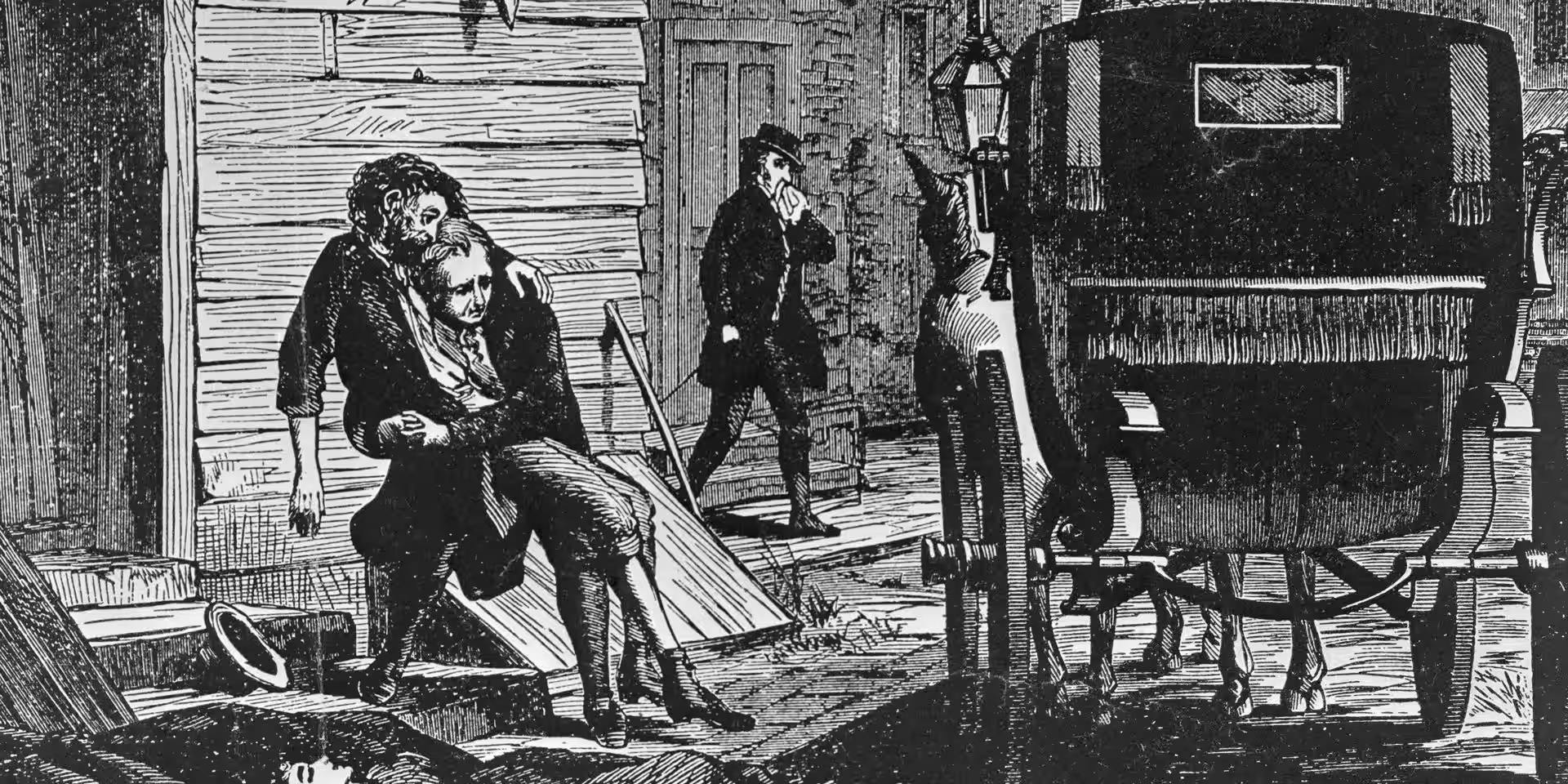
“It is a most extraordinary thing, but I never read a patent medicine advertisement without being impelled to the conclusion that I am suffering from the particular disease therein dealt with in its most virulent form”*…

We Americans spend over $60 Billion a year on dietary supplements and herbal remedies; to the extent that the market is regulated here in the U.S. it is (essentially exclusively) by the FDA– which treats the category as “food,” not “medicine” and “oversees” the industry/market very lightly. Indeed, while the extent of fraud in the supplement/remedy market (ineffective, mislabeled, or dangerous products) is estimated to be in the billions of dollars per year, the introduction to the FDA’s data base of “Health Fraud Products” reads:
This list includes unapproved products that have been subject to FDA health fraud related violations. These products have been cited in warning letters, online advisory letters, recalls, public notifications, and press announcements for issues varying from products marketed as dietary supplements claiming to cure, mitigate, treat or prevent disease, to the use of undeclared ingredients or new dietary ingredients.
This list only includes a small fraction of the potentially hazardous products marketed to consumers online and in retail establishments. Even if a product is not included in this list, consumers should exercise caution before using certain products…
That said, over half of us make those choices based on health and wellness information from social media influencers or podcasts… and too often these days, even the ostensibly qualified pitch-people are being faked by AI.
As Matthew Wills reminds us, we’ve been here before…
Never more than seventeen thousand people, the Shakers are today best remembered for their handsome furniture. In their own time they were renowned for their homemade medicinal remedies. They might have had a dubious reputation for their outlandish dancing, celibacy, gender equality, and for believing that their founder, “Mother” Ann Lee, was a manifestation of Christ’s Second Coming, but their guarantee of purity in their botanical products was generally accepted as given.
So much so that as Shaker communities dwindled through the nineteenth century, others wanted the cachet of their name in the patent medicine world. Amid all the fakery and flimflam of the pre-regulated drug market, the Shaker brand was the best.
It was worth stealing, and defending.
The Shakers, or more properly the United Society of Believers in Christ’s Second Appearing, arrived in North America from England in 1774. They established their first communes in New York and New England, then farther into the continent as the European frontier expanded. Kentucky, Ohio, Indiana, Georgia, and Florida also boasted Shaker outposts, mostly shorter-lived than the original ones.
At first, Shakers funded their separation from the “world” by selling furniture and housewares to non-Shakers. But as the number of Shakers dwindled and America’s industrial capacity increased, Shakers typically turned to selling seeds, simples [here], and botanically-based remedies. These were easier to produce, and, imbued with the Shaker reputation for purity, were as good as gold.
Medical historian J. Worth Estes quotes an 1881 almanac advertising Shaker remedies on the basic principles of Shakerism:
innocence, temperance, virgin purity, love, peace, justice, holiness, goodness, and truth. The almanac further explained that Shakers are “just and honest in all [their] dealings with mankind,” and that they “eschew every species of falsehood: lying, deceit and hypocrisy.” Such statements helped “guarantee” the purity and high quality of Shaker-made drugs in the nineteenth century struggle for the American drug market.
Shakers provided ingredients for “worldly” producers, and, in some cases, they even provided start-up capital for non-Shaker manufacturers. The A.J. White company of New York, New York, made Shaker Extract of Roots and Mother Seigel’s Curative Syrup with Shaker-sourced botanicals and capital. This remedy was advertised as “a cure for impurities of the blood” and “a cure for dyspepsia and liver complaints.” A.J. White’s company successfully expanded overseas, and when he died in 1898, his English branch bought out his American branch; in various guises the company existed until 1957, when it was purchased by Smith, Kline & French, whose successor entity is today the world’s tenth largest pharmaceutical company.
In the 1880s, Smith Bros. & Co. of Montreal started producing a product called Shakers’ Blood Syrup. This had a label similar to A.J. White’s Shaker Extract, except it said “Cures completely scrofula, cancer, rheumatism, catarrh, ulcers & skin & blood diseases.” The Shakers of New Lebanon, New York, sued for patent infringement and Smith Bros. agreed to stop pirating the Shaker name.
Shakers also produced their own remedies on their communes. Corbett’s Syrup of Sarsaparilla, for instance, was made in Canterbury, New Hampshire for about half a century until 1896. In 1886, it was one of the few Shaker products to be awarded a U.S. patent. Promoted as “a blood purifier and therefore, by implication, as a panacea,” it was made of “an aqueous mixture of sarsaparilla root, pipsissewa, yellow dock root, dandelion, thoroughwort, black cohosh, elder flowers, Epsom salts (magnesium sulfate), juniper berries, blue gentian, pokeweed root, sugar and alcohol.” At some point potassium iodide was added to “ensure the remedy’s ‘purity.’”
Estes provides a checklist of some 80 other proprietary medicines made in Shaker communities. The names are marvelous: Brother Barnabas Hinckley’s Compound Concentrated Syrup of Bitter Bugle, Eclectic Live Pills, Larus Eye Water, Vegetable Family Pills, Young Shakers’ Grand Catholicon. As Estes notes, more than a few of these products had active ingredients that were cathartic or purgative, a fact rarely noted on labels. Cathartics are generally defined as working faster than laxatives.
After the Food and Drug Act of 1906, products like the 75% alcohol (sanitizer strength!) Norwood’s Tincture of Veratrum Viride, made by non-Shakers with Shaker-sourced botanical ingredients, had to be labeled “Poison” on their instructions for use. Patent medicines, and the Shakers, didn’t survive the twentieth century…
Amid the fraud and flimflam of early drug markets, Shakers stood for purity, creating a brand others were eager to exploit: “A Trusted Name in a Dubious Drug Market” from @jstordaily.bsky.social.
* Jerome K. Jerome, Three Men in a Boat
###
As we hear history rhyme, we might recall that it was on this date in 1626 that Peter Minuit, the new director of “New Netherland” for the Dutch West India Company, in what we now know as Manhattan, “purchased” the island from the the Canarsee tribe of Native Americans for a parcel of goods worth 60 guilders: roughly $24 dollars at the time, now just over $1,000.
In the event, Native Americans in the area were unfamiliar with the European notions and definitions of ownership rights. As they understood it, water, air and land could not be traded. So scholars are convinced that both parties probably went home with totally different interpretations of the sales agreement. In any case, the Carnarsees were likely happy to take payment in any meaningful amount pertaining to land that was mostly controlled by their rivals, the Weckquaesgeeks.

1626 letter from Pieter Schaghen (a colleague of Minuit) reporting the purchase of Manhattan for 60 guilders [source]
“Constant attention by a good nurse may be just as important as a major operation by a surgeon”*…

A recent (R)D unpacked a recent Gallup survey of public trust in different professions/ocupations; the undisputed champion, nursing…. to which, friend MK responded: “What’s worse than 24 out of 25 people not trusting members of Congress is one out of four not trusting nurses.”
Edward Ongweso Jr. has a possible explanation– one that has little to do with nurse and all-too-much to do with the deterioration of the system of which they’re a part…
Hello everyone, I’ll keep this bit short this time! Thanks for all the emails with stories about your own experiences in Vegas, with gambling addiction, and with CES in response to my last piece, I read them all and responded to most except the ones pitching me Guaranteed Parlays That Will Hit! Thanks also for subscribing, we’ve jumped a bit and are just shy of 4,400 subscribers. If you like what you’ve read and want to support me further, you can become a paid subscriber for $7 a month or $70 a year. What do you get in return? My undying love, some recommendation posts every now and then, and paywalled essays/rants just as long as this one! Now, let’s get to today’s essay.
I have long believed that one of the greatest threats we face is the proliferation of the on-demand labor platform. The so-called “gig economy” is one of the larger altars to greed and misery in our civilization where millions of people are sacrificed in order to grow Smaugian hoards that are then transmuted into this or that form of power.
My earliest introduction to this was through the work of labor ethnographer and legal scholar Veena Dubal via her law journal article “The Drive to Precarity,” which maps out how militant workers turned San Francisco’s precarious taxi sector into a stable line of work, how companies responded with a wave of deregulation and de-unionization that immiserated workers, and how Uber sealed the deal in returning ride-hail to its earlier insecure form: poor working conditions and starvation wages, with every possible cost (healthcare, fuel, maintenance, etc.) offloaded onto workers and consumers.
Key forms of on-demand labor—namely, ride-hail and food delivery—have proliferated over the past few years, but not because they are particularly profitable or innovative business ventures. Most of them either have no real path to profitability, report dubiously calculated profits, or are operating illegally in hopes of realizing or sustaining them after sufficient lobbying and monopolization and exploitation of consumers/workers. The lazy and incurious view has been that they will grow into profitability, but the transparent reality is that the firms at the vanguard of the gig economy have thrived because they take advantage of a few key phenomena: worker misclassification, algorithmic discrimination, anti-competitive capital-intensive strategies, impressive public relations, robust political lobbying, and shoddy journalism, to name a few…
[Ongweso unpacks the history of ride-hailing apps and of the tactics– some legitimate, some questionable, and some plainly illegal– the industry has used to prevail. Then he turns to nursing…]
… As[ Shawn Carolan, a partner at Menlo Ventures and early investor in Uber] observed, however, ride-hail and delivery are not the only places where the “business model” at the heart of on-demand labor can be applied.
Over the past few years, nursing has emerged as a juicy target for investors and firms eager to liberate entire industries of antiquated regulatory frameworks. Last month, the Roosevelt Institute published a great report on what the application of the on-demand model will mean for nurses and it paints a grim picture. While some hail the emergence of an “Uber for nursing” model as a salve for our nursing shortage, Katie J. Wells and Funda Ustek Spilda detail how these apps reliably degrade working conditions, wages, and care standards.
These apps encourage nurses to work for less pay, fail to provide certainty about scheduling and the amount or nature of work, take little to no accountability for worker safety, and can threaten patient well-being by placing nurses in unfamiliar clinical environments with no onboarding or facility training. On-demand nursing platforms are also using the Uber playbook to lobby state legislatures in an attempt to exempt themselves from existing labor regulations.
I’ll be going through the report section by section to highlight key points as I think the report is phenomenal, but I encourage you to read it in full (linked above).
The premise of the “Uber for nursing” apps is relatively simple: lets use algorithmic systems to managing the scheduling, staffing, and management at medical facilities. For understaffed workplaces looking to cut costs and corners, this is attractive. For nurses and nursing assistants who want more control over their work, this is attractive. But this is especially enticing for investors who drool anytime a firm compares itself to Uber. Take ShiftMed—one of the darlings of this sector and a subject of the Roosevelt Institute report—which has raised hundreds of millions (but declines to share its valuation): $47 million in a May 2024 venture round, $200 million in a February 2023 round, $45 million in October 2021, and an early $6 million boost in an August 2019 round. What concretely are firms like ShiftMed offering to draw financing like this?
After a nurse downloads an on-demand nursing app and submits the requisite documents, they can use the app to indicate their interest in a 6-, 8-, or 12-hour shift at a hospital, nursing home, assisted living facility, surgical center, dental office, or, in some states, correctional facilities. An algorithmic scheduling software program, which is the heart of these new companies, then approves the worker for a shift, notifies both the medical facility and the worker, allows the worker to clock in and out, and, finally, sends a paycheck.
The on-demand nursing industry promises hospitals and medical administrators a different set of controls, namely the capacity to seamlessly staff facilities, reduce manager workloads, and lower labor costs.
On paper, this sounds lovely—the digital disruption of an old rickety system full of middlemen, inefficiencies, misallocation, overcharging, yadda yadda ya. But what’s the reality on the ground? Wells and Spilda found:
… serious safety and health risks for workers and patients. The nurses and nursing assistants who use these apps must pay fees to bid on shifts, and they win those bids by offering to work for lower hourly rates than their fellow workers. Poor internet or cell service in rural areas can cause the apps to fail, resulting in missed paychecks for work performed. These apps also rate the nurses they hire based on facility feedback and internal algorithmic determinations. If a worker must cancel a shift due to sickness or personal conflict, their rating goes down, and they often lose out on future shifts or can be banned from the app altogether. In at least one case, a nursing assistant went into work at a hospital while sick with COVID-19 because she could not figure out how to cancel a shift without lowering her rating. At most hospitals and medical facilities, no orientations are required for gig nurses and nursing assistants. Workers do not know where supply closets are located, how to access patient portals with medical histories and current medication lists, and whom to contact in the chain of command. With gig nursing, there is often little to no continuity of care. Despite hospitals’ attempts to automate nursing, care work is inherently tricky to de-skill and predict. Shifts do not neatly end when the apps say they do as, of course, patients’ health-care needs do not end just because the clock says they should. Human frailty—the essential subject of nursing—defies algorithmic management.
As the report will detail, gig nursing has already proven itself to be an unmitigated disaster and we are still relatively early in its assault on our lethargic healthcare system…
[Ongweso offers more chilling detail…]
… Often the deployment of new technology is used as cover to rollback reforms and regulations that have made old levels of profiteering unrealizable or outright illegal. That tends to be a function of who is steering the design, development, and deployment of said technologies. It is one thing when managers and financiers are in the drivers seat, and it would be another thing entirely if care workers were in control. It is not clear to me why anyone other than nurses should be in control of what sort of technology is introduced into their workplaces, how this technology is designed, why it is deployed, and when it is used. To close out with Wells and Splinda:
“It is important to not lose sight of the enormous amount of skill, coordination, understanding of human vulnerability and frailty, and treatment of patients with utmost decency required to provide good quality care. Technology could provide solutions to automate and unburden the nurses and health-care workers from the everyday management tasks of their work; however, decision-making around such solutions should include the nurses themselves, from design to deployment.”
The gig economy’s metastasis and its threat to healthcare: “Uber’s Bastards,” from @edwardongwesojr.com. Eminently worth reading in full.
###
As we contemplate care, we might send healing birthday greetings to Arthur Nicolaier; he was born on this date in 1862. A physician and bacteriologist, he isolated the tetanus bacterium and developed a successful cure for tetanus.
Nicolaier discovered that the tetanus bacterium lived in soil. Because of its presence in earth, it is responsible for infection from dirty wounds, which was a particularly significant issue in the cases of wounded soldiers during WW I. The toxin secreted by this bacterium, Clostridium tetani, travels along nerves to the spinal chord, causing increasingly severe, often fatal spasms of the head and neck and jaw– from which came the common name of the affliction: “lockjaw.” Thanks to Nicolaier, from 1915 injured soldiers– and any other sufferer– received an anti-toxin.
In the mid-1920s a tetanus vacine was developed. It has subsequently been improved, and has successfully warded off infection in those areas where it is administered. In 2013, it caused about 59,000 deaths worldwide—down from 356,000 in 1990; in the United States, from 2000 through 2007, an average of 31 cases were reported per year. Nearly all of the cases in the United States occur in unimmunized individuals, or individuals who have allowed their inoculations to lapse.

“I analogize it to sex. You realize there were certain things you shouldn’t do, but the urge is there and you can’t resist.”*…
The estimable Cory Doctorow on the incursion of private equity into health care…
As someone who writes a lot of fiction about corporate crime, I naturally end up spending a lot of time being angry about corporate crime. It’s pretty goddamned enraging. But the fiction writer in me is especially upset at how cartoonishly evil the perps are – routinely doing things that I couldn’t ever get away with putting in a novel.
Beyond a doubt, the most cartoonishly evil characters are the private equity looters. And the most cartoonishly evil private equity looters are the ones who get involved in health care.
Writing for The American Prospect, Maureen Tcacik details a national scandal: the collapse of PE-backed hospital chain Steward Health, a company that bought and looted hospitals up and down the country, starving them of everything from heart valves to prescription paper, ripping off suppliers, doctors and nurses, and callously exposing patients to deadly risk…
[There follows an illuminating– and truly terrifying (backed up sewage in the wards; bats colonizing hospital floors; stiffed employees and vendors)– an unpacking of Steward’s deeds and a location of them in the larger landscape of private equity.]
… But despite Steward’s increasingly furious creditors and its decaying facilities, the company remains bullish on its ability to continue operations. Medical Properties Trust – the real estate investment trust that is nominally a separate company from Steward – recently hosted a conference call to reassure Wall Street investors that it would be a going concern. When a Bank of America analyst asked MPT’s CFO how this could possibly be, given the facility’s dire condition and Steward’s degraded state, the CFO blithely assured him that the company would get bailouts: “We own hospitals no one wants to see closed.”
That’s the thing about PE and health-care. The looters who buy out every health-care facility in a region understand that this makes them too big to fail: no matter how dangerous the companies they drain become, local governments will continue to prop them up. Look at dialysis, a market that’s been cornered by private equity rollups. Today, if you need this lifesaving therapy, there’s a good chance that every accessible facility is owned by a private equity fund that has fired all its qualified staff and ceased sterilizing its needles. Otherwise healthy people who visit these clinics sometimes die due to operator error. But they chug along, because no dialysis clinics is worse that “dialysis clinics where unqualified sadists sometimes kill you with dirty needles“
…
The PE sector spent more than a trillion dollars over the past decade buying up healthcare companies, and it has trillions more in “dry powder” allocated for further medical acquisitions. Why not? As the CFO of Medical Properties Trust told that Bank of America analyst last week, when you “own hospitals no one wants to see closed.” you literally can’t fail, no matter how many people you murder.
The PE sector is a reminder that the crimes people commit for money far outstrip the crimes they commit for ideology. Even the most ideological killers are horrified by the murders their profit-motivated colleagues commit.
Last year, Tkacic wrote about the history of IG Farben, the German company that built Monowitz, a private slave-labor camp up the road from Auschwitz to make the materiel it was gouging Hitler’s Wehrmacht on…
Farben bought the cheapest possible slaves from Auschwitz, preferentially sourcing women and children. These slaves were worked to death at a rate that put Auschwitz’s wholesale murder in the shade. Farben’s slaves died an average of just three months after starting work at Monowitz. The situation was so abominable, so unconscionable, that the SS officers who provided outsource guard-labor to Monowitz actually wrote to Berlin to complain about the cruelty.
The Nuremberg trials are famous for the Nazi officers who insisted that they were “just following order” but were nonetheless executed for their crimes. 24 Farben executives were also tried at Nuremberg, where they offered a very different defense: “We had a fiduciary duty to our shareholders to maximize our profits.” 19 of the 24 were acquitted on that basis.
PE is committed to an ideology that is far worse than any form of racial animus or other bias. As a sector, it is committed to profit above all other values. As a result, its brutality knows no bounds, no decency, no compassion. Even the worst crimes we commit for hate are nothing compared to the crimes we commit for greed…
“When private equity destroys your hospital,” from @doctorow. Eminently worth reading in full– and following his newsletter (from whence this comes).
* David Rubenstein, co-founder and co-chairman of the private equity giant The Carlyle Group, at a Harvard Business School Conference
###
As we rethink returns, we might recall that it was on this date in 1944 that Louis Buchalter (AKA Lepke Buchalter, AKA Louis Lepke) was executed in the electric Chair at Sing Sing. One of the premier labor racketeers in New York City in the 1930s, he is better remembered as the creator (in 1929) and overseer (thereafter) of an efficient system for performing mob hits; while Buchalter never named it, it became known in the press as “Murder, Inc.“
The Cosa Nostra mobsters wanted to insulate themselves from any connection to these murders. Buchalter’s partner, mobster Albert Anastasia, would relay a contract request from the Cosa Nostra to Buchalter. In turn, Buchalter would assign the job to Jewish and Italian street gang members from Brooklyn.
None of these contract killers had any connections with the major crime families. If they were caught, they could not implicate their Cosa Nostra employers in the crimes. Buchalter used the same killers for his own murder contracts. The Murder, Inc., killers were soon completing jobs all over the country for their mobster bosses…
source
Murder, Inc. was believed to be responsible for as many as 1,000 contract killings before it was exposed in 1941, and Buchalter was finally charged and convicted of murder that same year.

“The welfare and the future of our societies depend on our capacity to remain mobilized so as to improve the health of every mother and child”*…

Preparing for a world post Roe v Wade…
The red states poised to ban or severely limit abortion already tend to have limited access to health care, poor health outcomes and fewer safety net programs in place for mothers and children.
If the U.S. Supreme Court overturns Roe v. Wade, as it’s expected to, the ensuing increase in births will likely leave families in tough circumstances and strain systems that are already hanging by a thread.
“What we’re facing as a country is hundreds of thousands of births, probably disproportionately located in the states that have been most limited in what they do for pregnant women, infants and children. So this is the great paradox that we are dealing with,” said Sara Rosenbaum, a health law and policy professor at George Washington University. “We have not ever designed these programs for a world without Roe,” she added. “You need a child welfare system, the likes of which we’ve never seen.”…
A growing shortage of obstetricians, higher maternal mortality rates and worse health care outcomes generally, increased pressure on U.S. foster and adoption systems— it all bodes ill…
We know from focus on health outcomes that kids born into poverty, kids born into unstable social circumstances, tend to have higher incidence of early onset chronic diseases,” Shannon said. “We also know that when those children are raised in unstable circumstances and have to be cared for in foster care, the outcomes there are really sobering.
Richard Shannon, chief quality officer for Duke Health
“Red states aren’t prepared for a post-Roe baby boom,” from Caitlin Owens (@caitlinnowens) in @axios.
* Jean Ping
###
As we contemplate care, we might sending healing birthday greetings to Thomas Huckle Weller; he was born on this date in 1915. A virologist, he developed a technique for cultivating poliomyelitis viruses in a test tube, using a combination of human embryonic skin and muscle tissue– which enabled the study of the virus “in the test tube,” a procedure that led to the development of polio vaccines. He was awarded the Nobel Prize in Physiology or Medicine in 1954.

You must be logged in to post a comment.