Posts Tagged ‘video games’
“Any sufficiently advanced technology is indistinguishable from magic”*…

… But then, as Terry Pratchett observed, “It’s still magic even if you know how it’s done.” In any case, Kate Crawford and Vladan Joler have mapped its development and impact since roughly 1500. Via Matt Muir, who observes…
I have to be honest, I remain uncertain whether what you will see when you click this link is the product of genius or madness. On the one hand, it might be an incredibly sophisticated piece of visual communications depicting the evolution of thinking across 30 disparate areas (think ‘the biosphere’, ‘time’, ‘biometrics’, ‘communications infrastructure’, that sort of thing) and offering a sort of maximalist overview of the evolution of modern thinking and understanding from approximately 1500 to the near-future; on the other, it might make as much ACTUAL sense when you dig into it as intricate scrawls of mid-episode schizophrenics – I simply cannot tell, it is TOO MUCH. What I can tell you, though, is that it is DIZZYING – you can’t quite get a sense for the full scale of it unless you zoom right out and then see how deep it goes when you zoom in again. Anyway, here’s the blurb – I would really, really like to see this printed BIG somewhere, just to see if it coheres, as I don’t personally think a screen does it justice at all:
“Calculating Empires is a large-scale research visualization exploring how technical and social structures co-evolved over five centuries. The aim is to view the contemporary period in a longer trajectory of ideas, devices, infrastructures, and systems of power. It traces technological patterns of colonialism, militarization, automation, and enclosure since 1500 to show how these forces still subjugate and how they might be unwound. By tracking these imperial pathways, Calculating Empires offers a means of seeing our technological present in a deeper historical context. And by investigating how past empires have calculated, we can see how they created the conditions of empire today. Calculating Empires centers on four themes: communication, computation, classification and control. Across the centuries, the work illustrates the shifts in communication devices, infrastructures, and computational architectures, and how they are entwined with the histories of social control and classification. The vertical axis represents time, beginning with the 16th century at the base. The horizontal axis features a collection of systems: from algorithms to architecture, bodies to borders. Navigation is flexible: you can follow a theme, a time period, or set of ideas.”
Have a look, it’s quite insane…
A long view of tech, society, and their inter-relationships: “Calculating Empires- A Genealogy of Technology and Power Since 1500,” from @katecrawford and @TheCreaturesLab via @Matt_Muir.
* Arthur C. Clarke
###
As we muse on maps, we might recall that it was on this date in 1981 that the game that launched two of the most famous characters in video game history was released for sale:
Donkey Kong was created by Nintendo, a Japanese playing card and toy company turned fledgling video game developer, who was trying to create a hit game for the North American market. Unable at the time to acquire a license to create a video game based on the Popeye character, Nintendo decided to create a game mirroring the characteristics and rivalry of Popeye and Bluto. Donkey Kong was named after the game’s villain, a pet gorilla gone rogue. The game’s hero was originally called Jumpman, but is retroactively renamed Mario once the game became popular and Nintendo decided to use the character in future games… Donkey Kong’s success helped Nintendo become one of the dominate players in the video game market.

“The only reason for time is so that everything doesn’t happen at once”*…

Our lives are spread across range of ways that we spend our time. A newly-published study tracks time-use around the world…
How do you spend each day? Researchers sought answers to that basic question from people of various ages living around the world. They report that on an average day, people spend more than a third of their time focused on matters of health, happiness and keeping up appearances.
“We found that the single largest chunk of time is really focused on humans ourselves, a little more than 9 hours,” explained study author Eric Galbraith, of McGill University in Montreal, Canada. “Most of this—about 6.5 hours—is doing things that we enjoy, like hanging out, watching TV, socializing and doing sports,” he said. Reading and gaming also fall within this rubric.
The other 2.5 hours (out of the 9) are spent on hygiene, grooming and taking care of our own health and that of our kids, said Galbraith, a professor in the department of earth and planetary sciences.
Sleep and bedrest occupy the next largest chunk of time: more than 9 hours on average. That sounds like a lot of shut-eye, but Galbraith stressed this number reflects the average across the full age span, so it includes kids who might sleep up to 11 hours a day. “It also includes time in bed and not sleeping, which can be as much as one hour per day,” he said…
The remaining minutes? They seem to go toward getting organized, moving about or producing, creating and maintaining things and spaces…
For more findings and background on the methodology: “Sleep, cleaning, fun: Research reveals the average human’s day worldwide,” in @physorg_com.
* Albert Einstein
###
As we contemplate chronology, we might recall that it was on this date in 2011 that the Swedish game design house Mojang Studios released the first full version of Minecraft. A sandbox game created by Markus “Notch” Persson, it has become the best-selling video game in history, with over 300 million copies sold– and countless hours consumed…

“Everything is designed. Few things are designed well.”*…

Those of us in the U.S. are used to molded plastic seating on public transport. Not so in the U.K, where moquette, a velvet-like material, is favored by upholsterers for its durability. Artists like Paul Nash and Enid Marx were commissioned to create intricate designs that gave trains and buses a modish visual identity. And the tradition continues: new moquette can still be found on the seats that zoom beneath the city….
Moquette is the durable, woolen seating material that is used in upholstery on public transport all over the world.
Coming from the French word for carpet, moquette has been seen and sat upon by millions of commuters on buses, trains, trams and trolleybuses for over 100 years.
It is produced on looms using the Jacquard weaving technique, with a pile usually made up of 85% wool mixed with 15% nylon.
Moquette was chosen for public transport for two reasons. First, because it is hard wearing and durable. Second, because its colour and patterns disguise signs of dirt, wear and tear. On top of this moquette had the advantage of being easy and cheap to mass-produce.
Moquette was first applied to public transport seating in London in the 1920s when the patterns were designed by the manufacturers…
“A history of moquette“
Riding in style on the upholstery that gives London Transport its unique look and feel: “A history of Moquette,” from @ltmuseum and @TheBrowser.
###
As we settle in, we might spare a thought for William “Willy” A. Higinbotham; he died on this date in 1994. A physicist who was a member of the team that developed the first atomic bomb, he later became a leader in the nuclear non-proliferation movement.
But Higinbotham may be better remembered as the creator of Tennis for Two— the first interactive analog computer game, one of the first electronic games to use a graphical display, and the first to be created as entertainment (as opposed to as a demonstration of a computer’s capabilities). He built it for the 1958 visitor day at Brookhaven National Laboratory.
It used a small analogue computer with ten direct-connected operational amplifiers and output a side view of the curved flight of the tennis ball on an oscilloscope only five inches in diameter. Each player had a control knob and a button.


“My fake plants died because I didn’t pretend to water them”*…
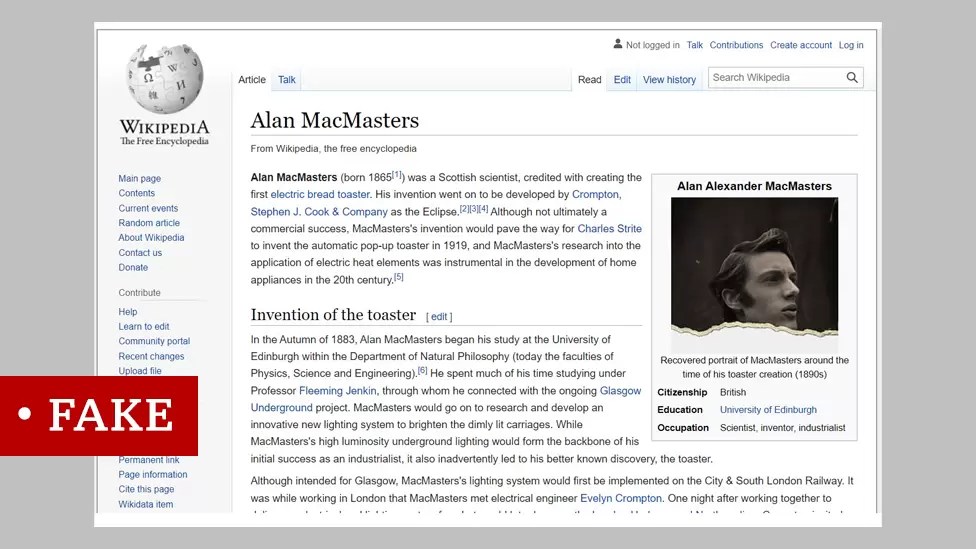
Your correspondent treasures Wikipedia, and uses it often. But as Marco Silva points out, it has its vulnerabilities…
“I read through Wikipedia a lot when I’m bored in class,” says Adam, aged 15, who studies photography and ICT at a school in Kent. One day last July, one of his teachers mentioned the online encyclopaedia’s entry about Alan MacMasters, who it said was a Scottish scientist from the late 1800s and had invented “the first electric bread toaster”.
At the top of the page was a picture of a man with a pronounced quiff and long sideburns, gazing contemplatively into the distance – apparently a relic of the 19th Century, the photograph appeared to have been torn at the bottom.
But Adam was suspicious. “It didn’t look like a normal photo,” he tells me. “It looked like it was edited.”
After he went home, he decided to post about his suspicions on a forum devoted to Wikipedia vandalism.
…
Until recently, if you had searched for “Alan MacMasters” on Wikipedia, you would have found the same article that Adam did. And who would have doubted it?
After all, like most Wikipedia articles, this one was peppered with references: news articles, books and websites that supposedly provided evidence of MacMasters’ life and legacy. As a result, lots of people accepted that MacMasters had been real.
More than a dozen books, published in various languages, named him as the inventor of the toaster. And, until recently, even the Scottish government’s Brand Scotland website listed the electric toaster as an example of the nation’s “innovative and inventive spirit”…
All the while, as the world got to know the supposed Scottish inventor, there was someone in London who could not avoid a smirk as the name “Alan MacMasters” popped up – again and again – on his screen…
For more than a decade, a prankster spun a web of deception about the inventor of the electric toaster: “Alan MacMasters: How the great online toaster hoax was exposed,” from @MarcoLSilva at @BBCNews.
* Mitch Hedberg
###
As we consider the source’s source, we might recall that it was on this date in 1972 that Atari introduced its first product, Pong, which became the world’s first commercially successful video game. Indeed, Pong sparked the beginning of the video game industry, and positioned Atari as its leader (in both arcade and home video gaming) through the early 1980s.

“All of our reasoning ends in surrender to feeling”*…

Alvin and the Chipmunks– a group of three anthropomorphic singing chipmunks named Alvin, Simon, and Theodore, managed by their human adoptive father, David “Dave” Seville– came to life on a 1958 novelty record created by Ross Bagdasarian (who also wrote and recorded Witch Doctor). They were such a hit that they spawned three animated television series, several specials, a series of video games, a feature film– and a number of albums.
During the 80s a few of those albums featured the Chipmunks singing rock tunes. You Tube creator Lunar Orbit (@LunarOrbit_) has taken tracks from several of those cover-fests and recorded them at 16 speed (roughly half the speed of a 33 1/3 LP)… resulting in what @EsotericCD calls “the most important postpunk/goth album ever recorded,” Sludgefest…
* Blaise Pascal
###
As we wonder what it sounds like backwards, we might recall that the #1 song on the Billboard Singles chart for the week beginning on this date in 1988 was Rick Astley’s “Never Gonna Give You Up.” You’ve been Rickrolled!

You must be logged in to post a comment.