Posts Tagged ‘timekeeping’
“Nature is the source of all true knowledge”*…

Jonathan Keats on why– and how– clocks that use nature to measure time can reintegrate people into the environment and counteract the calamities of the Anthropocene…
In his studio on the east coast of Vancouver Island, the master clockmaker Phil Abernethy is crafting a timepiece that will be calibrated in a manner that no horologist has ever attempted. It won’t show the minutes and hours of an ordinary human day. Instead, his clock will display time as experienced by some of the oldest trees on the planet.
Using techniques he’s honed over a lifetime, Abernethy will machine the gears by hand in traditional materials such as steel and brass. But the pendulum will respond to the forest: When trees grow quickly, the hours will advance more rapidly; more lethargic growth will result in a slower tempo. Over centuries, the long-term fate of the canopy will be registered on a calendar that may deviate from the Gregorian date by decades or more.
Abernethy has been commissioned to fabricate the arboreal clock by the Nevada Museum of Art. Standing 12 feet tall, the clock will be the first physical manifestation of an environmental timekeeping project I have been developing over the past decade. Some of the clocks in the project respond to rivers; Abernethy’s enlists a stand of bristlecone pine trees in Nevada’s Great Basin as living timekeepers.
Fluctuations in the bristlecones’ growth rate, affected by environmental conditions ranging from local rainfall to planetary climate change, will be measured by analyzing the thickness of tree rings in microcores retrieved from the mountain each year. These data will be used to determine the center of gravity for the pendulum, which will swing slower or faster depending on the tree ring thickness. Though the clock face will display time in the usual way, it won’t serve as a mechanism for human planning — a technology to impose order on the environment for our convenience — but rather to pace our lives to match the lived reality of other organisms.
Abernethy’s arboreal clock, in other words, upsets more than just the standards of horology. The environmental calamity known as the Anthropocene is a consequence of a worldview in which all that is not human is construed as a resource — even time itself. Other life forms are going extinct at an unprecedented rate, laid waste at a pace set by the world economy. Factory farming and logging, fossil fuel and plastics production, mining, human construction and infrastructure — all disregard the timing with which nonhuman systems emerge, ebb and flow. The globalized logic of industry, with its planetary supply chain, must keep up with human demand, turning civilization itself into a manifestation of logistics.
Our mastery of the world is a mastery of time. And as every industrialist knows, mastery of time requires the precision of a master clock to provide a temporal standard against which everything can be measured and controlled. Whether regulated by the swing of a pendulum or the oscillations of a strontium atom — as the most advanced atomic clocks are today — the master clock operates without an external feedback mechanism. The clock has become the ultimate authority. To question it would be tantamount to questioning modernity.
The design of Abernethy’s arboreal clock may be novel, but the underlying ideas are ancient. They predate pendulums and gearwork, originating in an era when people observed time in relation to other beings in order for all to flourish together. Ancient but mostly forgotten, these ideas are urgently needed today. Whatever practical use it might have, the arboreal clock is intended primarily to serve as a philosophical instrument…
…
… Humankind appears to be the only species to have contrived clocks that count without reference to something outside of themselves. We also appear to be the only species to have use for these contraptions, to use time in this peculiar way. (Mumford astutely described clocks as “power machinery whose ‘product’ is seconds and minutes.”)
All life depends on timekeeping. But nonhuman life treats time as a mixed medium: entangled with the environment, dependent on other organisms…
…
… Near the peak of Mt. Washington in Nevada’s Great Basin, which rises more than 11,600 feet above sea level, the bristlecone pines are as scraggly as the tree in “A Charlie Brown Christmas.” Until very recently, bristlecones didn’t grow at this elevation. To walk down the slope is to stroll through time, eventually reaching trees that are several thousand years old and as solid as sculpted stone.
Over the past decade, I have gotten to know these trees, visiting with members of the Long Now Foundation, the organization that stewards part of the mountaintop and has partnered with me on the clock at the Nevada Museum of Art. By observing the trees and their embodied experience of time, I have been able to see the inadequacy of my wristwatch.
The trees sensitized me to the time reckoning of other life forms, both plants and animals. They attuned me to the time kept collectively in living systems such as rivers, where the flow rate is affected by the melting of glaciers and the eagerness of beavers, not to mention the unquenchable thirst of industrial agriculture. By gearing the flow of time to match the flow of the Susitna or Matanuska — as I have done in partnership with the Anchorage Museum — fluvial clocks can integrate people into local watersheds.
An arboreal clock can likewise integrate people into the forest. Or to be more accurate, it can reintegrate people into their ecosystems, counteracting the human denaturing of the Anthropocene…
Eminently worth reading in full: “A Clock In The Forest,” from @jonathonkeats in @NoemaMag @longnow.
* Leonardo da Vinci
###
As we think about time, we might also contemplate natural space, and spare a thought for Abraham Ortelius; he died on this date in 1598. A cartographer, geographer, and cosmographer, he created the first modern atlas, the Theatrum Orbis Terrarum (Theatre of the World)– “the book that invented the world.”
Ortelius is generally considered one of the founders (with Gemma Frisius and Gerardus Mercator) of the Netherlandish school of cartography and geography. He was an important geographer of Spain during the age of discovery– and the first person proposing that the continents were joined before drifting to their present positions.

“It’s easier to imagine the end of the world than the end of capitalism”*…

… so it’s useful to contemplate its beginning. David Rooney, in an excerpt from his book About Time…
Ömer Aga stood in the middle of Amsterdam’s Dam Square surrounded by his nineteen-strong party of advisers, interpreters and hosts, and gazed toward the huge new trading exchange that straddled the mighty Rokin canal, just to the south of the square. The year was 1614, and Aga was on a fact-finding mission to the Dutch Republic as the Ottoman Empire’s newest diplomatic emissary. Top of his list of must-see sights was this bold new building, completed just three years earlier. It was hard to miss, as it was the size of a soccer field and could accommodate thousands of traders in its 200-by-115-foot enclosed inner courtyard, but what Aga really noticed was the four-sided clock tower that loomed over the vast structure and the streets and canals all around, as well as the booming sound of its bell when they rang out the hours and then, at noon, tolled repeatedly for a few minutes before falling silent. Little did they realize it, but Omar Aga and his retinue were listening to one of the most significant clocks ever made. It was fitted to the world’s first stock exchange and sounded the birth of modern capitalism.
From the moment the Amsterdam exchange building first opened its doors in August 1611, traders were forbidden from trading anywhere else in the city. But the exchange did not just put spatial boundaries on trade. It concentrated traders in time, too. A few days before the new facility opened, the city council had issued a bylaw proclaiming that trading could only take place between the hours of 11 a.m. and noon, Monday to Saturday. At noon, the clock installed in the tower high above the exchange building would toll a bell for seven and a half minutes. If any traders were still in the exchange, or in the streets nearby, they would be fined. Additionally, trading was allowed between 6:30 p.m. and 7:30 p.m. during the summer months between May and August, and in winter evening trading took place for a thirty-minute period marked by a tolling bell at the city’s gates. At the end of evening trading, the exchange clock would again sound for seven and a half minutes and fines were issued for anyone caught trading after the bells fell silent.
Why were such strict limits placed on trading at the Amsterdam exchange? There were several reasons. One was a practical problem familiar to anybody involved with trade in a busy city center: time limits reduced congestion and disruption in the streets nearby. Another was that clocks made trading more efficient. Short, fixed trading hours concentrated buyers and sellers together, making it easier for each to find enough of the other. This increased the volume of trade, which was good for traders and for the city council collecting taxes on transactions. But clocks also helped prices to remain fair, as they could be used to regulate the people who occupied intermediate roles in the functioning of a market.
Some of the earliest references to mechanical clocks being used in towns and cities, in the Middle Ages and soon after, related to market restrictions. The first urban markets brought producers of food, cloth and so on into direct contact with the consumers of their wares. But as towns and cities grew, this model started to break down. It stopped making sense for every producer in the countryside to make the journey all the way to the center of towns. So, ‘intermediate trading’ emerged, whereby third parties might buy up the goods from several small producers somewhere on the edge of town, before bringing them in and selling them themselves at the market. Soon, a whole range of intermediate roles sprang up. Wholesalers, merchants, shopkeepers and peddlers were some, but intermediates also included financiers who advanced funds, and those speculating on the future in the hope of offsetting risk (whether because of bad harvests or other unpredictable events) and making more money. Some people occupied more than one role.
As populations grew and moved in increasing numbers to towns and cities, and markets began to sell more and more products, the rise of intermediate roles in market-based trade was inexorable, creating a new stratum of people who neither produced goods nor consumed them, but traded, speculated, brokered, hoarded, flipped and financed. Some market authorities feared intermediates would drive up prices or limit supplies and turned to clocks to control their involvement. Clocks meant that different groups could be treated differently at the market. In a sixteenth-century grain market, for instance, the first hours of trade could be restricted to residents, before bakers of bread could get in, and then the pastry bakers could enter. Only after several hours were wholesalers and other intermediate traders allowed in. But as societies and their market trading became ever more complex, the role of intermediates like brokers and financiers became increasingly important in keeping the flow of trading running smoothly. And, before long, finance became something that could be traded in its own right, and clocks took on a new regulatory role.
Amsterdam’s was not the first trading exchange. Antwerp and London had had exchanges since the sixteenth century where goods and money were traded, but Amsterdam was the first of a new kind of exchange: what became the modern securities exchange. As well as being a place to trade in commodities like salt or hides, people could also buy and sell financial assets. It started out as a place to buy and sell shares in the Dutch East India Company, an early joint-stock company and the first with freely tradable shares, but soon was used to trade other company shares, futures contracts and insurance policies as well as becoming the place to go for information about the state of the markets. The financial market had arrived, but its products, and the prices paid for them, which were time-dependent. The time at which each securities transaction was made, or would be enacted in the future, was central to this new type of trading to work fairly, everybody had to agree what time this was. In other words, trading needed time stamps, which is where the exchange clock came into its own. Clocks were no longer about excluding intermediates from the market. In the new exchanges, intermediates were the market — with the clock watching carefully over the whole thing…
The birth of modern capitalism and the role that timekeeping played in its nascence: The Amsterdam Stock Exchange, from @rooneyvision, via the invaluable @delanceyplace.
* Fredric Jameson (also sometimes attributed to Slavoj Žižek)
###
As we examine enterprise, we might recall that it was on this date in 1937 that Sylvan Goldman introduced the first shopping cart in his Humpty Dumpty grocery store in Oklahoma City.

“You may delay, but time will not”*…
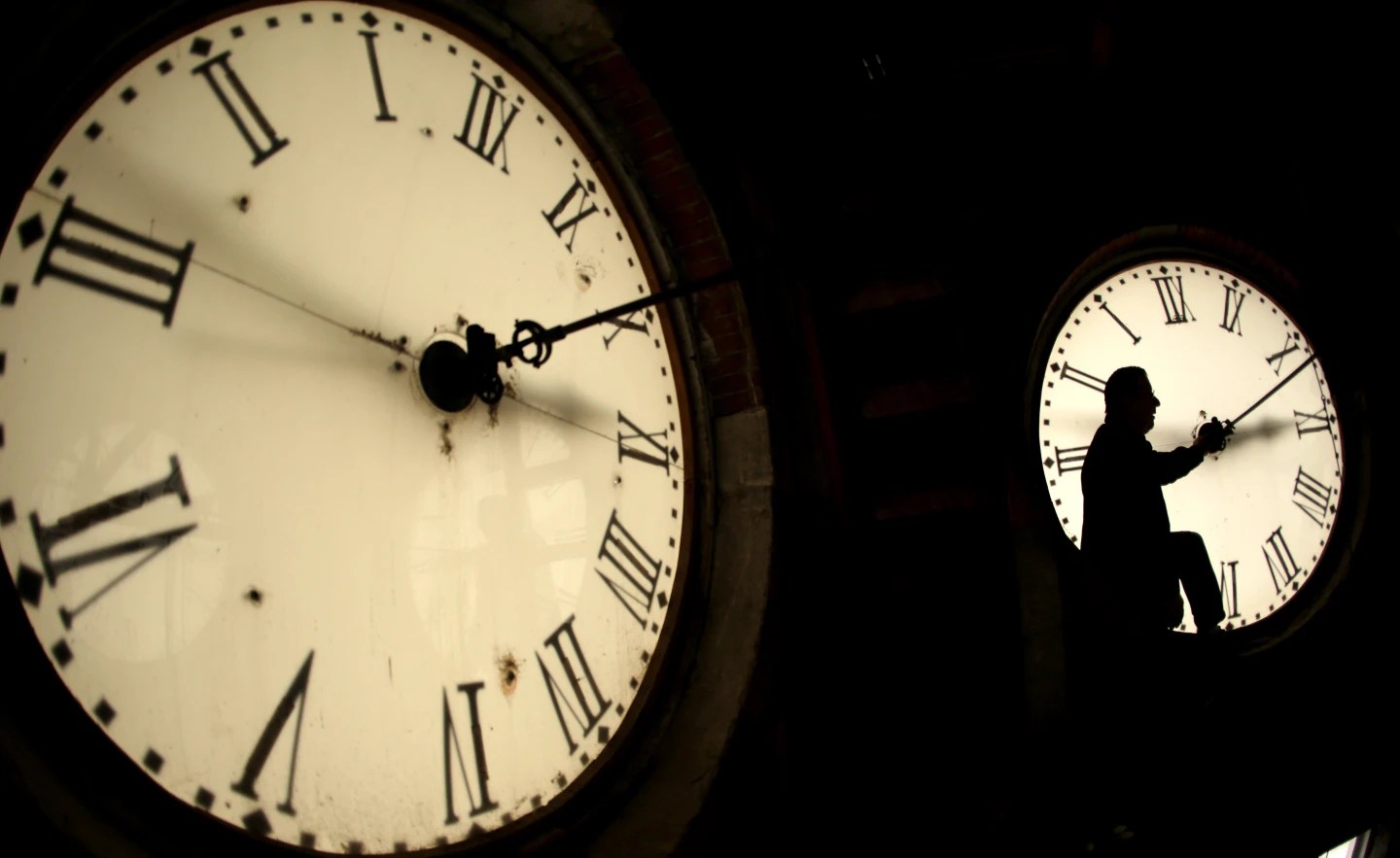
It turns out that our feeling that things are speeding up has some basis in science…
Earth’s changing spin is threatening to toy with our sense of time, clocks and computerized society in an unprecedented way — but only for a second.
For the first time in history, world timekeepers may have to consider subtracting a second from our clocks in a few years because the planet is rotating a tad faster than it used to. Clocks may have to skip a second — called a “negative leap second” — around 2029, a study in the journal Nature said Wednesday.
“This is an unprecedented situation and a big deal,” said study lead author Duncan Agnew, a geophysicist at the Scripps Institution of Oceanography at the University of California, San Diego. “It’s not a huge change in the Earth’s rotation that’s going to lead to some catastrophe or anything, but it is something notable. It’s yet another indication that we’re in a very unusual time.”
Ice melting at both of Earth’s poles has been counteracting the planet’s burst of speed and is likely to have delayed this global second of reckoning by about three years, Agnew said.
“We are headed toward a negative leap second,” said Dennis McCarthy, retired director of time for the U.S. Naval Observatory who wasn’t part of the study. “It’s a matter of when.”…
The full story: “A faster spinning Earth may cause timekeepers to subtract a second from world clocks,” from @AP.
For (even) more on leap seconds on their history, see “Will We Have a Negative Leap Second?“, by Demetrios Matsakis (also a retired director of time for the U.S. Naval Observatory).
See also: “Climate change is altering Earth’s rotation enough to mess with our clocks” (gift article): “in that one second, the Earth rotated about four football fields”
* Benjamin Franklin
###
As we muse on measurement, we might send carefully-observed birthday greetings to Sir Harold Spencer Jones; he was born on this date in 1890. An astronomer (indeed, for 23 years the tenth Astronomer Royal), he specialized in positional astronomy, particularly the motion and orientation of the Earth in space… a focus that helped him contribute to knowledge of the Earth’s rotation and improved timekeeping– efforts that led to Spencer Jones’ election (in 1947) as the first President of the Royal Institute of Navigation (which, In 1951, named its highest award, the Gold Medal, in his honor).

“Maps are a way of organizing wonder”*…

… and of understanding where places and things actually are. As John Nelson elegantly demonstrates, we sometimes need that remedial help…
If learned early on, a foundationally incorrect view of the world can perpetuate, as students naturally build knowledge in light of a past, incorrect, understanding. Something as basic as our assumptions about the relative locations of Earth’s continents is an interesting, and actually sort of fun, example of how we can get things wrong right off the bat. Ultimately, everything is learned, but some curious geographic errors tend to persist more than others.
So what are some tantalizing locational mistakes that seemingly come pre-installed in American students’ minds that geography teachers wrestle to overcome?
So glad you asked! Here is a cherry-picked handful of examples that we’ll dive into…
- The northiness of Africa
- The northiness of Europe
- The eastiness of South America…
Some common geographic mental misplacements, beautifully illustrated: “Misconceptions,” from @John_M_Nelson @Esri.
See also the companion piece, “Enclaves & Exclaves” and John’s personal blog, “Adventures In Mapping.”
###
As we grasp geography, we might recall that it was on this date in 1830 that U. S. Secretary of the Navy John Branch established the Depot of Charts and Instruments, a humble undertaking with an annual budget of $330; its primary function was the restoration, repair, and rating of navigational instruments. But from that seed grew the United States Naval Observatory, a scientific and military facility that produces geopositioning, navigation, and timekeeping data for the United States Navy and the United States Department of Defense. It is one of the oldest scientific agencies in the U. S., and remains the country’s leading authority for astronomical and timing data for all purposes.

“Time and tide wait for no man”*…
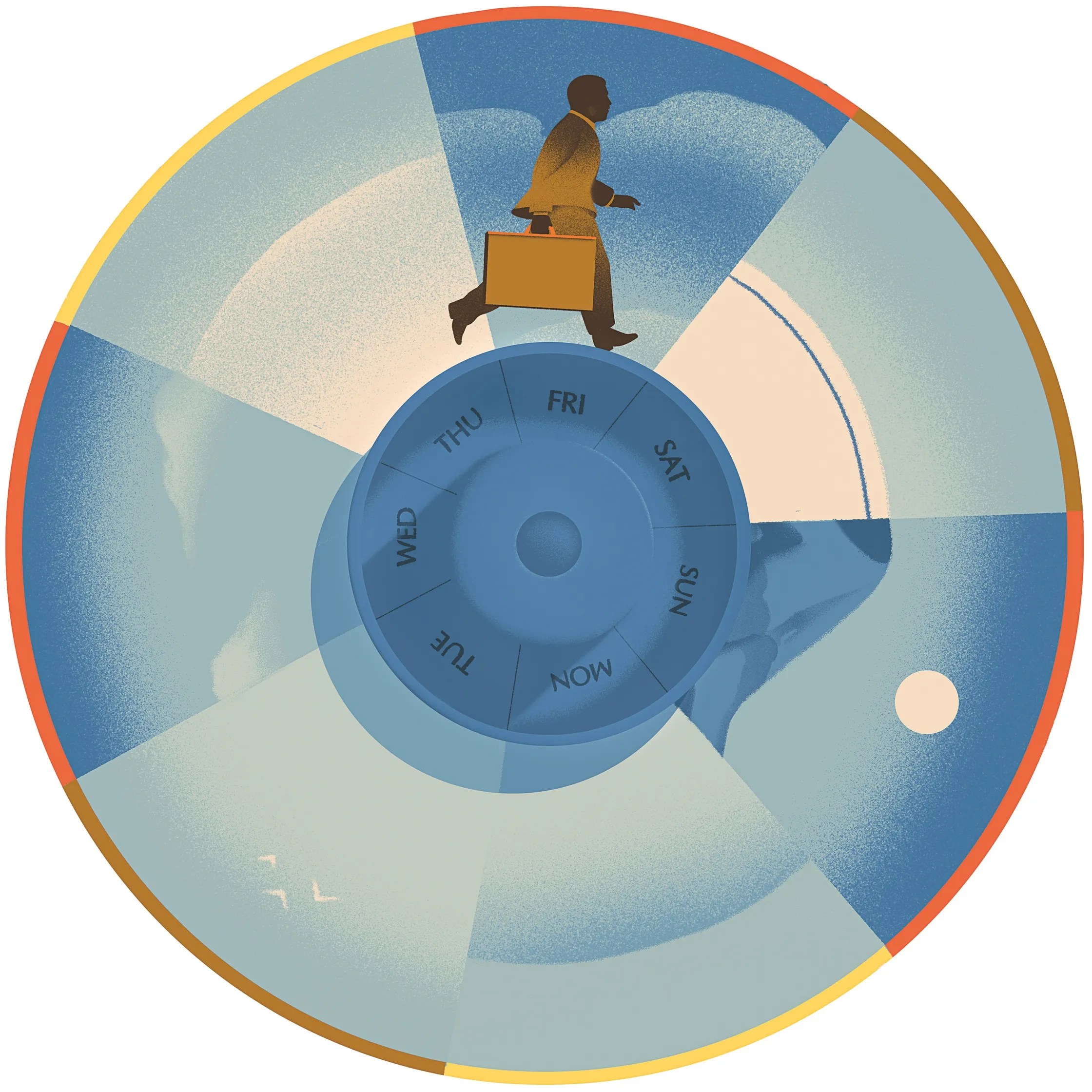
The week both arranges and imposes on our time…
Among many collective discoveries during the pandemic confinement of 2020, Americans learned just how attached we are to our seven weekdays. As complaints about temporal disorientation mounted that April, we focused not on the clock – the classic metonym for the power and experience of time – but rather on the calendar, and specifically the weekly one. A Cleveland news station affiliated with the Fox Media network entertained viewers with a daily feature, much circulated on the internet, entitled ‘What Day Is It? With Todd Meany’ – the answer to which was always a weekday, not a Gregorian calendar date…
Weeks serve as powerful mnemonic anchors because they are fundamentally artificial. Unlike days, months and years, all of which track, approximate, mimic or at least allude to some natural process (with hours, minutes and seconds representing neat fractions of those larger units), the week finds its foundation entirely in history. To say ‘today is Tuesday’ is to make a claim about the past rather than about the stars or the tides or the weather. We are asserting that a certain number of days, reckoned by uninterrupted counts of seven, separate today from some earlier moment. And because those counts have no prospect of astronomical confirmation or alignment, weeks depend in some sense on meticulous historical recordkeeping. But practically speaking, weekly counts are reinforced by the habits and rituals of other people. When those habits and rituals were radically obscured or altered in 2020, the week itself seemed to unravel…
The history of weekly timekeeping, which is only about 2,000 years old. Although taboos and cosmologies in several different cultures attached significance to seven-day cycles much earlier, there is no clear evidence of any society using such cycles to track time in the form of a common calendar before the end of the 1st century CE. As the scholars Ilaria Bultrighini and Sacha Stern have recently documented, it was in the context of the Roman Empire that a standardised weekly calendar emerged out of a combination and conflation of Jewish Sabbath counts and Roman planetary cycles. The weekly calendar, from the moment of its effective invention, reflected a union of very different ways of counting days…
The crucial formation of our modern experience of weekly time took place around the first half of the 1800s, with the rising prominence of… the differentiated weekly schedule…
The week is the most artificial and most recent of the ways we account for time, but it’s effectively impossible to imagine our shared lives without it: “How we became weekly,” by David Henkin in @aeonmag.
See also Jill Lepore‘s characteristically informative review of Henkin’s book on the week: “How the Week Organizes and Tyrannizes Our Lives” (source of the image above)
* Geoffrey Chaucer
###
As we mark time, we might recall that it was on this date in 1839 that John William Draper took a daguerreotype of the moon (the “governor” of months, while the sun determines days, seasons, and years); it was the first celestial photograph (or astrophotograph) made in the U.S. (He exposed the plate for 20 minutes using a 5-inch telescope and produced an image one inch in diameter.) Draper’s picture of his sister, taken the following year, is the oldest surviving photographic portrait.

You must be logged in to post a comment.