Posts Tagged ‘Beethoven’
“Common sense is not so common”*…

The Enlightenment is under attack by the Left and the Right. It can only be “saved,” Eliane Glaser argues, through use of its greatest legacy: permanent critique. And then there’s AI. After summarizing the critiques from both sides, she continues…
In consequence of this pincer-movement attack, the Enlightenment’s legacy is existentially vulnerable. It makes me deeply worried as someone whose entire career has been built on trying to understand and analyse the world around me – especially a world that still tries to confine thinking women to the realms of emotion and ‘personal experience’.
I believe that Enlightenment values are essential, but that we have largely forgotten how to make a good case for them: we need to rely on shared facts, tested by experiment; a public sphere where open discussion can take place; and the belief that discussion should be founded on reasoned argument. We need, moreover, to cherish the more political values of tolerance, freedom, human rights and the common good. Advocates for artificial intelligence have the temerity to claim that large language models are ushering in a ‘second Enlightenment’ (a claim that was uncritically echoed in a paper published by the World Economic Forum last year) when what we are in fact seeing is the destruction of the Enlightenment legacy under the false banner of its name. As the historian David Bell argued in The New York Times in 2025, AI is actually ‘shedding Enlightenment values’ by simply reinforcing ‘what we already think we know.’ In The Guardian,the journalist and geopolitical risk consultant Joseph de Weck warned that ‘AI is taking us back to the dark ages’, making us lazy, and stymying independent thinking.
The evidence suggests that we are going through a rapid de-enlightenment. Newspaper circulations, attention spans, and trust in forms of agreed knowledge are in freefall. Misinformation, disinformation and deepfakes are gaining ground. If we let go of the valuable aspects of the Enlightenment project, we open ourselves up to a world of AI blather, ‘my truth’ pronouncements, wobbly sentiment and unchecked power.
My unease with this parlous state of affairs has provoked me to go back and rethink the Enlightenment and what it has to offer. But, rather than unthinkingly recouping it as a mission, I want instead to tease out and weigh up its merits, to discern with nuance what is still fit for our times. I want to ask if it is possible to rescue the Enlightenment’s rallying power, and if it’s worth defending what the combined forces of Left and Right are coming together to attack. Are the Enlightenment’s deficiencies barnacles on an old ship, or integral to its design?…
And so she does. Do read on: “Flickering Enlightenment,” from @elianeglaser.bsky.social in @aeon.co.
* Voltaire
###
As we reclaim reason, we might spare a thought for a glorious product of the Enlightenment, Joseph Haydn; he died on this date in 1809. A composer of the Classical period, he was pivotal in the evolution of chamber music forms like the string quartet and piano trio, and is known as the “Father” of both the symphony and sonata forms. Haydn was a friend and mentor of Mozart, and a teacher of Beethoven; indeed, the Haydn, Mozart and Beethoven trio are sometimes referred to as the “First Viennese School.”
Schonberg wrote that Haydn “was the Classic performer par excellence, and in his long life, from 1732 to 1809, he grew up with the new musical ideas and, more than any one man, shaped them.”
“You live and learn. At any rate, you live.”*…

… and to the extent that we care about our democracy, that’s an issue.
In an article based on his recent Sakurada-Kai Foundation Oxbridge Lecture at Keio University, Tokyo, John Dunn argues that our democracies depend on our picking up the pace of learning. The abstract:
There cannot be a coherent democratic theory because democracy is not a determinate topic. Representative democracy is a relatively modern regime form. It now needs rehabilitation because so many instances have performed poorly for so long. Representative democracy is now also an aging regime. As a type of state, it is subject to the territorial contentiousness and contested legitimacy of any state. It claims its legitimacy from iterative popular choice, but the plausibility of that claim is increasingly strained by the drastic disparities in life chances reproduced through the property systems it protects. The inherent difficulty for citizens to judge how to advance their collective interests is aggravated by the recent transformation of the information economy. In the cumulative damage inflicted by climate change it faces a deadlier peril than any previous regime and one which only a citizenry that can enlighten itself in time can reasonably hope to nerve itself to meet…
There follows a fascinating– and provocative– elaboration of this thesis in which Dunn considers the history of democracy and the alternatives with which it has, since its inception, vied. He concludes in a bracing fashion…
… The varieties of autocracy which will be on offer wherever the rest of the world has the opportunity to take them up will be without exception the reverse of enlightened – instrumentally and compulsively bound to the extremes of obscurantism, Darkness as a full-on fideist commitment, deliberate self-blinding as a navigational strategy. Move fast, break lots, and never pause to inspect the wreckage.
Representative democracy has recently proved itself a poor structure for collective enlightenment, but the case for it depends on its at least not precluding that, its being still open to making the attempt, and responding to what it can contrive to learn. The most optimistic vision of democracy in action has always seen it as an opportunity for collective self-education on the content of shared goods and the means to achieve them. If that is scarcely a realist picture of what it has ever been, at least it is an image of the right shape. It is too late to ask who will educate the educators. At this point we must educate ourselves together and heed the lessons of that education or we must and will die – not just each of us one by one, as we were always fated to do, but soon enough all of us and for ever…
Eminently worth reading in full: “Can Democracy be Rehabilitated?“
Apposite: “How American Democracy Fell So Far Behind,” from Steven Levitsky and Daniel Ziblatt (gift article– and source of the image above)
* Douglas Adams, Mostly Harmless
###
As we devote ourselves to democracy, we might spare a thought for Ludwig van Beethoven; he died on this date in 1827. A crucial figure in the transition between the Classical and Romantic eras in Western music, he remains one of the most famous and influential of all composers. His best-known compositions include 9 symphonies, 5 concertos for piano, 32 piano sonatas, and 16 string quartets. He also composed other chamber music, choral works (including the celebrated Missa Solemnis), a single opera (Fidelio), and numerous songs.
Relevantly to the piece above…
Beethoven admired the ideals of the French Revolution, so he dedicated his third symphony to Napoleon Bonaparte… until Napoleon declared himself emperor. Beethoven then sprung into a rage, ripped the front page from his manuscript and scrubbed out Napoleon’s name…
Beethoven’s temper and Symphony No. 3 ‘Eroica’

“My spirit will arise from my grave”*…
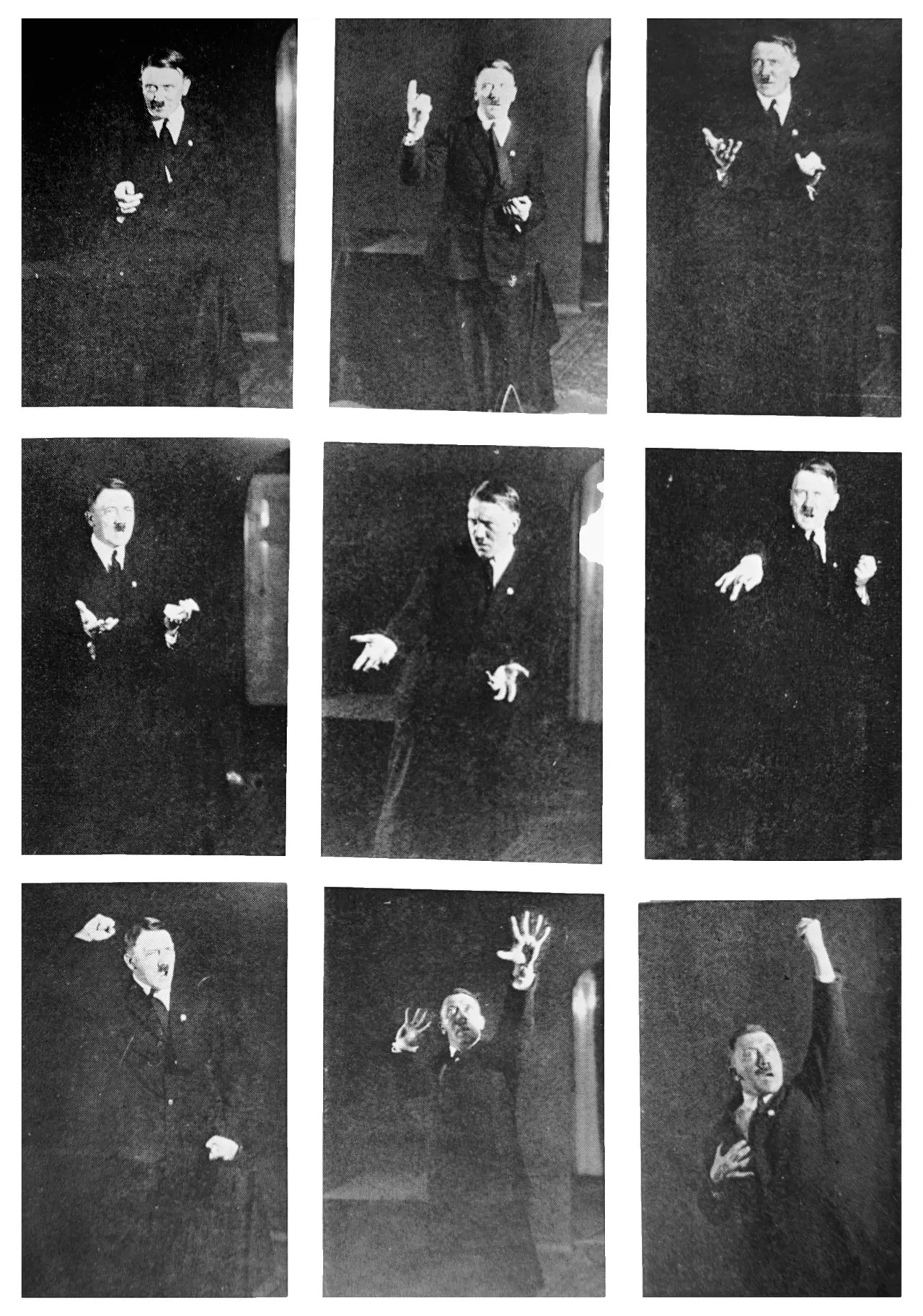
Hitler didn’t seize power; he was given it. As Adam Gopnik reports in a review of Tim Ryback‘s important new book, media lords thought that they could control him; political schemers thought that they could outwit him. The mainstream left had become a gerontocracy. And all of them failed to recognize his immunity to shame…
Hitler is so fully imagined a subject—so obsessively present on our televisions and in our bookstores—that to reimagine him seems pointless. As with the Hollywood fascination with Charles Manson, speculative curiosity gives retrospective glamour to evil. Hitler created a world in which women were transported with their children for days in closed train cars and then had to watch those children die alongside them, naked, gasping for breath in a gas chamber. To ask whether the man responsible for this was motivated by reading Oswald Spengler or merely by meeting him seems to attribute too much complexity of purpose to him, not to mention posthumous dignity. Yet allowing the specifics of his ascent to be clouded by disdain is not much better than allowing his memory to be ennobled by mystery.
So the historian Timothy W. Ryback’s choice to make his new book, “Takeover: Hitler’s Final Rise to Power” (Knopf), an aggressively specific chronicle of a single year, 1932, seems a wise, even an inspired one. Ryback details, week by week, day by day, and sometimes hour by hour, how a country with a functional, if flawed, democratic machinery handed absolute power over to someone who could never claim a majority in an actual election and whom the entire conservative political class regarded as a chaotic clown with a violent following. Ryback shows how major players thought they could find some ulterior advantage in managing him. Each was sure that, after the passing of a brief storm cloud, so obviously overloaded that it had to expend itself, they would emerge in possession of power. The corporate bosses thought that, if you looked past the strutting and the performative antisemitism, you had someone who would protect your money. Communist ideologues thought that, if you peered deeply enough into the strutting and the performative antisemitism, you could spy the pattern of a popular revolution. The decent right thought that he was too obviously deranged to remain in power long, and the decent left, tempered by earlier fights against different enemies, thought that, if they forcibly stuck to the rule of law, then the law would somehow by itself entrap a lawless leader. In a now familiar paradox, the rational forces stuck to magical thinking, while the irrational ones were more logical, parsing the brute equations of power. And so the storm never passed. In a way, it still has not…
Both the review and the book on which it focuses are eminently worth reading in full: “The Forgotten History of Hitler’s Establishment Enablers” (possible paywall; in which case, archived copy here), from @adamgopnik in @NewYorker.
* Hitler, as quoted in a letter from von Ribbentrop (to Churchill and Atlee) sent just before von Ribbentrop was captured at the end of the war
###
As we hear the echo, we might spare a thought for Ludwig van Beethoven; he died on this date in 1827. A crucial figure in the transition between the Classical and Romantic eras in Western music, he remains one of the most famous and influential of all composers. His best-known compositions include 9 symphonies, 5 concertos for piano, 32 piano sonatas, and 16 string quartets. He also composed other chamber music, choral works (including the celebrated Missa Solemnis), a single opera (Fidelio), and numerous songs.
Relevantly to the piece above…
Beethoven admired the ideals of the French Revolution, so he dedicated his third symphony to Napoleon Bonaparte… until Napoleon declared himself emperor. Beethoven then sprung into a rage, ripped the front page from his manuscript and scrubbed out Napoleon’s name. Some modern reproductions of the original title page have scrubbed out Napoleon’s name to create a hole for authenticity’s sake!
Beethoven’s temper and Symphony No. 3 ‘Eroica’
But, of course, it was too late…
“Romanticism is precisely situated neither in choice of subject, nor exact truth, but in the way of feeling”*…

The estimable Ted Gioia is exploring the possibility that we are at the cusp of a major change in the zeitgeist– the beginning of a new age of Romanticism…
I made a flippant remark a few months ago. It was almost a joke.
But then I started taking it seriously.
I said that technocracy had grown so oppressive and manipulative it would spur a backlash. And that our rebellion might resemble the Romanticist movement of the early 1800s.
We need a new Romanticism, I quipped. And we will probably get one.
A new Romanticism? Could that really happen? That seems so unlikely.
Even I didn’t take this seriously (at first). I was just joking. But during the subsequent weeks and months, I kept thinking about my half-serious claim.
I realized that, the more I looked at what happened circa 1800, the more it reminded me of our current malaise.
- Rationalist and algorithmic models were dominating every sphere of life at that midpoint in the Industrial Revolution—and people started resisting the forces of progress.
- Companies grew more powerful, promising productivity and prosperity. But Blake called them “dark Satanic mills” and Luddites started burning down factories—a drastic and futile step, almost the equivalent of throwing away your smartphone.
- Even as science and technology produced amazing results, dysfunctional behaviors sprang up everywhere. The pathbreaking literary works from the late 1700s reveal the dark side of the pervasive techno-optimism—Goethe’s novel about Werther’s suicide, the Marquis de Sade’s nasty stories, and all those gloomy Gothic novels. What happened to the Enlightenment?
- As the new century dawned, the creative class (as we would call it today) increasingly attacked rationalist currents that had somehow morphed into violent, intrusive forces in their lives—an 180 degree shift in the culture. For Blake and others, the name Newton became a term of abuse.
- Artists, especially poets and musicians, took the lead in this revolt. They celebrated human feeling and emotional attachments—embracing them as more trustworthy, more flexible, more desirable than technology, profits, and cold calculation.
That’s the world, circa 1800.
The new paradigm shocked Europe when it started to spread. Cultural elites had just assumed that science and reason would control everything in the future. But that wasn’t how it played out.
Resemblances with the current moment are not hard to see.
These considerations led me, about nine months ago, to conduct a deep dive into the history of the Romanticist movement. I wanted to see what the historical evidence told me.
…
I’m now structuring my research in chronological order—that’s a method I often use in addressing big topics.
I make no great promises for what I share below. These are just notes on what happened in Western culture from 1800 to 1804—listed year-by-year.
Sharing these is part of my process. I expect this will generate useful feedback, and guide me on the next phase of this project…
Because music is always my entry point into cultural changes, it plays a key role here in how I analyze past (and present) events. I firmly believe that music is an early indicator of social change. The notes below are offered as evidence in support of that view…
[There follows a fascinating– and compelling– account of those five years, featuring Napoleon, Haydn, Beethoven, Woodsworth, Coleridge, Herder, Schelling, the Marquis de Sade, Novalis, Ann Radcliffe, and others]
… Beethoven turns against Napoleon—and this is emblematic of the aesthetic reversal sweeping through Europe. Not long ago, Beethoven and other artists looked to French rationalism as a harbinger of a new age of freedom and individual flourishing. But this entire progress-obsessed ideology is unraveling.
It’s somehow fitting that music takes the lead role in deconstructing a tyrannical rationalism, and proposing a more human alternative.
Could that happen again?
- Imagine a growing sense that algorithmic and mechanistic thinking has become too oppressive.
- Imagine if people started resisting technology as a malicious form of control, and not a pathway to liberation, empowerment, and human flourishing—soul-nurturing riches that must come from someplace deeper.
- Imagine a revolt against STEM’s dominance and dictatorship over all other fields?
- Imagine people deciding that the good life starts with NOT learning how to code.
If that happened now, wouldn’t music stand out as the pathway? What could possibly be more opposed to brutal rationalism running out of control than a song?
But what does that kind of music sound like? In 1800, it was Beethoven. And today?…
Why it may be 1800 all over again: “Notes Toward a New Romanticism,” from @tedgioia in his terrific newsletter, The Honest Broker.
* Charles Baudelaire
###
As we review vibes on the verge, we might send rational birthday greetings to an avatar of the Enlightenment against which the Romantics rebelled, Francois-Marie Arouet, better known as Voltaire; he was born on this date in 1694. The Father of the Age of Reason, he produced works in almost every literary form: plays, poems, novels, essays, and historical and scientific works– more than 2,000 books and pamphlets (and more than 20,000 letters). He popularized Isaac Newton’s work in France by arranging a translation of Principia Mathematica to which he added his own commentary.
A social reformer, Voltaire used satire to criticize the intolerance, religious dogma, and oligopolistic privilege of his day, perhaps nowhere more sardonically than in Candide.

“There’s nothing remarkable about it. All one has to do is hit the right keys at the right time and the instrument plays itself.”*…

There was, of course, a flurry of silliness on April Fools Day. Now the dust has settled; we can identify a winner, found by the polymathic Ethan Iverson (a composer, performer, and piano teacher at the New England Conservatory of Music; see also here)…
Marc-André Hamelin is a renowned pianist and composer (as the New York Times puts it, “A performer of near-superhuman technical prowess”). Charles-Louis Hanon was a 19th century composer and piano teacher best remembered for The Virtuoso Pianist in 60 Exercises, still in use.
As Iverson observes: “Part of the joke is how musically Hamelin plays the exercises. A god among pianists, truly…”
Hamelin recorded the spoof in the studios of GBH in Boston, where his wife, Cathy Fuller, is a producer and host at Classical WCRB.
* Johann Sebastian Bach
###
As we tickle the ivories, we might spare a thought for Johannes Brahms; he died on this date in 1897. A composer, pianist, and conductor of the mid-Romantic period, he composed for symphony orchestra, chamber ensembles, piano, organ, voice, and chorus. A virtuoso pianist, he premiered many of his own works.
Considered both a traditionalist and an innovator by his contemporaries and by later writers, his music is rooted in the structures and compositional techniques of the Classical masters; at the same time, it embeds Romantic motifs. It is a measure of the esteem in which his work is held that Brahms is often grouped with Bach and Beethoven as one of the “Three Bs” of music (a comment originally made by the nineteenth-century conductor Hans von Bülow).

Consider (all joking aside) this marvelous example:
You must be logged in to post a comment.