Posts Tagged ‘epistemology’
“Beauty is the first test: there is no permanent place in this world for ugly mathematics”*…

Is mathematical beauty real? Or is it just a subjective, human ‘wow’ that is becoming redundant in an AI age? Rita Ahmadi explores…
It is a hot July day in London and I take the bus to Bloomsbury. I often come here for the British Library, the British Museum or the London Review Bookshop. More than a location, Bloomsbury feels like stepping into a work of art – maybe one of Virginia Woolf’s stories, or Duncan Grant’s paintings.
This time, I am here for mathematics: the Hardy Lecture at the London Mathematical Society (LMS), named after G H Hardy, a professor of mathematics at the University of Cambridge, a member of the Bloomsbury Group, and a president of the LMS. You may know him from the film The Man Who Knew Infinity (2015), in which he’s played by Jeremy Irons.
The 2025 lecture is by Emily Riehl of Johns Hopkins University in Baltimore, who is talking about a complex mathematical ‘language’ known as infinity category theory: could we teach it to computers so that they could understand it? If successful, computer programs could verify proofs and construct complex structures in this area.
A few seats to my left, I recognise Kevin Buzzard, wearing the multi-coloured, patterned trousers he’s known for among mathematicians. Based at Imperial College London, Buzzard is working on a computer proof assistant called Lean. His interest is personal: after long disputes with a colleague over a flawed proof, he lost trust, as he often puts it, in ‘human mathematicians’. His mission now is to convince all mathematicians to write their proofs in Lean. In the Q&A after one of his talks, he said of the debate between truth and beauty in mathematics: ‘I reject beauty, I want rigour’ – though his vibrant sense of fashion suggests otherwise.
Interest in an AI-driven approach to mathematics has been exponential, and many mathematicians have left traditional academic research to explore its potential. Recently, one group of distinguished mathematicians designed 10 active, research-level questions for AI to tackle. At the time of writing, various AI companies and researchers had claimed to find solutions, which were under evaluation by the community.
Sitting in the room in Bloomsbury, I stared at the Hardy plaque and wondered: would Hardy find proofs generated by AI beautiful? I wasn’t sure. He believed there should be a strong aesthetic judgment in mathematics, drawing parallels with poetry, and argued that beauty is the first test of good mathematics. He went as far as to say that there is no permanent place in the world for ugly mathematics.
If asked, many mathematicians today still talk about the aesthetic appeal of one approach over another.
Yet we live in a different century to Hardy and his Bloomsbury peers, with different technologies and techniques, so perhaps we need a clearer definition of what mathematical beauty actually is. Over the history of mathematics, we can find examples where both rigour and the pursuit of beauty have shaped mathematics itself. So, if we’re completely replacing this with a computer-assisted quest for truth and rigour, we ought to know what we’d be abandoning, if anything. Is mathematical beauty like the beauty in literature and art – or is it something else?…
[Ahmadi explores the idea of “beauty,” generally and in mathematics; traces the rise of AI as a tool, and concludes…]
… my own definition of beauty in mathematics would be as follows:
“Asimplemathematical structure that surprises even the most experienced mathematicians and transfers a sense of vitality.”
But is an AI-assisted proof simple or surprising? How do we define vitality in a machine? On these questions, the jury is out. Myself, I am torn. Maybe models just need more training to match our creativity. But I also wonder whether our limbic system is required. Can we write proofs without emotional kicks? I am also unsure if perfectly efficient brains can come up with novel revolutionary ideas.
Ultimately, this debate is about more than aesthetics; it is closely tied to the development of AI-assisted mathematics. If AI models can produce novel mathematical structures, how should we direct them? Is it a search for beautiful or truthful structures? A question that possibly guides the years to come.
Some mathematicians say they prefer the ‘truth’ and only the ‘truth’. However, my recent discussions with mathematicians showed me that most immediately recognise, enjoy, and even wholeheartedly smile at a beautiful piece of maths. In fact, they spend their whole lives in search of one…
Fascinating: “The eye of the mathematician,” from @ritaahmadi.bsky.social in @aeon.co.
###
As we embrace elegance, we might send garcefully-calculated birthday greetings to Eduard Heine; he was born on this date in 1821. A mathematician, he is best remembered for his introduction of the concept of uniform continuity, for the Mehler–Heine formula, and for the Heine–Cantor theorem… all of them, quite beautiful.

“The first principle is that you must not fool yourself – and you are the easiest person to fool”*…

We live in a time when a growing number of “authorities” in the U.S. and around the world are actively trading fact for convenient fiction. Science is under attack; there’s (all-too-grounded) concern that we may be headed into a new “Dark Age.”
C. Brandon Ogbunu pushes back, arguing that science– and more particularly, the emerging research field of metascience, a form of scientific self-examination– is essential for navigating our uncertain future…
On May 24, Vice President J.D. Vance authored a post on X that highlighted a “reproducibility crisis” in the sciences. Vance offered this amid a series of other critiques of higher education to justify the withholding of federal science funding to universities over the past several months. His post was timed to accompany a White House executive order that invoked the language of open science to introduce sweeping changes to our federal scientific infrastructure. It came just weeks after the release of plans to cut science funding in the 2026 fiscal year budget.
The playbook is standard: Fuse an aggressive political agenda to a more palatable set of criticisms. In this case, many agree that processes within professional science have, for decades, had significant flaws. In my view, politicians in power are using this as a justification to burn it down. And outside of a few higher-education legal efforts to fight back, the scientific community remains shell-shocked, unable to gather the momentum to resist effectively.
But in addition to resisting the changes, there might be other ways that we can navigate an uncertain future. In recent years, a field called “metascience” (often referred to as “the science of science”) has emerged, charged with understanding the processes of science, how it operates, and identifying themes in what is produced. I argue that this area is going to be essential moving forward in stormy times, as it can dispel the myth that science is an ideological leviathan incapable of self-reflection and can help us rebuild science into a craft that interrogates its fragilities.
As described in a 2018 review, the science of science “is based on a transdisciplinary approach that uses large data sets to study the mechanisms underlying the doing of science—from the choice of a research problem to career trajectories and progress within a field.” It asks questions about aspects of the scientific enterprise, including employment, publishing trends, economic incentives, merit, and other forces that influence science in ways that may escape our intuition…
[Ogbunu explains metascience, and explores examples of work-to-date and questions like: Who is doing science? What are their incentives (and how do they shape behavior)? How innovative is science? He reminds us that “metascientists” are following in the footsteps of humanists and social scientists (Bruno Latour, for example) have examined science practice for many decades…]
… metascience offers a lens that is especially important at this critical moment. Support for science in the face of attacks is critical and necessary. But ironically, one of the best ways to defend the craft might be for scientists to identify the fragilities before the enemy does. We can use data and models, not solely our op-ed voices and social media timelines (though all can be useful). The field is already disabusing us of the notion that science as practiced is based on defensible incentives, neutrality of any kind, or merit, however defined.
Instead, it operates on what looks more like a runaway Matthew Effect, whereby the most established scientists benefit disproportionately from the system of reward — and thus the rich get richer. And the problem isn’t that the flaws exist, but that science’s practitioners aren’t interested in a critical lens towards them.
Metascience won’t fix our problems, but it formalizes ways that we can use to reflect, which may implore us to change science for the better…
Physicians (and other scientists) healing themselves: “Metascience Is More Important Now Than Ever,” from @cbo.bsky.social in @undark.org.
###
As we commit to comprehension, we might send insightful birthday greetings to a forefather of metascience, Charles Sanders Peirce; he was born on this date in 1839. A scientist, mathematician, logician, and philosopher, he was (per philosopher Paul Weiss) “the most original and versatile of America’s philosophers and America’s greatest logician”. Bertrand Russell wrote “he was one of the most original minds of the later nineteenth century and certainly the greatest American thinker ever.” He is considered by many to be “the father of pragmatism“; he helped formalize the field of statistics; and his contributions logic were foundational– helping to found semiotics (the study of signs).
For Peirce, logic encompassed much of what is now called epistemology and the philosophy of science. Peirce approached science as a practice, defining the concept of abductive reasoning to explain scientific advance, as well as rigorously formulating mathematical induction and deductive reasoning.

“Those who are not shocked when they first come across quantum theory cannot possibly have understood it”*…
A scheduling note: your correspondent is headed onto the road for a couple of weeks, so (Roughly) Daily will be a lot more roughly than daily until September 20th or so.
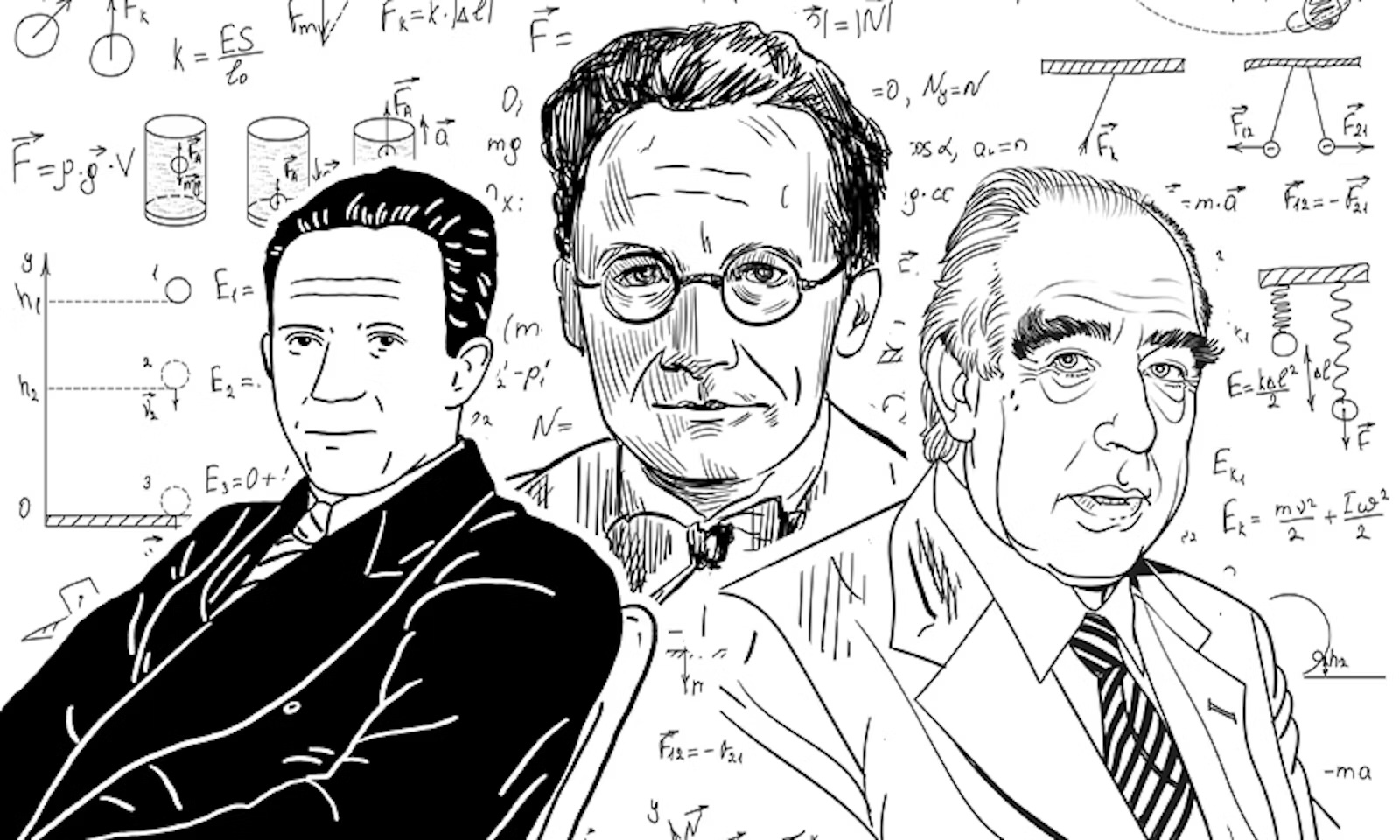
100 years ago, a circle of physicists shook the foundation of science. As Philip Ball explains, it’s still trembling…
In 1926, tensions were running high at the Institute for Theoretical Physics in Copenhagen. The institute was established 10 years earlier by the Danish physicist Niels Bohr, who had shaped it into a hothouse for young collaborators to thrash out a new theory of atoms. In 1925, one of Bohr’s protégés, the brilliant and ambitious German physicist Werner Heisenberg, had produced such a theory. But now everyone was arguing with each other about what it implied for the nature of physical reality itself.
To the Copenhagen group, it appeared reality had come undone…
[Ball tells the story of Niels Bohr’s building on Max Planck, of Werner Heisenberg’s wrangling of Bohr’s thought into theory, of Einstein’s objections and Erwin Schrödinger’s competing theory; then he homes in on the ontological issue at stake…]
Quantum mechanics, they said, demanded we throw away the old reality and replace it with something fuzzier, indistinct, and disturbingly subjective. No longer could scientists suppose that they were objectively probing a pre-existing world. Instead, it seemed that the experimenter’s choices determined what was seen—what, in fact, could be considered real at all.
In other words, the world is not simply sitting there, waiting for us to discover all the facts about it. Heisenberg’s uncertainty principle implied that those facts are determined only once we measure them. If we choose to measure an electron’s speed (more strictly, its momentum) precisely, then this becomes a fact about the world—but at the expense of accepting that there are simply no facts about its position. Or vice versa…
…A century later, scientists are still arguing about this issue of what quantum mechanics means for the nature of reality…
[Ball recounts subsequent attempts to reconcile quantum theory to “reality,” including Schrödinger’s wave mechanics…]
… Schrödinger’s wave mechanics didn’t restore the kind of reality he and Einstein wanted. His theory represented all that could be said about a quantum object in the form of a mathematical expression called the wave function, from which one can predict the outcomes of making measurements on the object. The wave function looks much like a regular wave, like sound waves in air or water waves on the sea. But a wave of what?
At first, Schrödinger supposed that the amplitude of the wave—think of it like the height of a water wave—at a given point in space was a measure of the density of the smeared-out quantum particle there. But Born argued that in fact this amplitude (more precisely, the square of the amplitude) is a measure of the probability that we will find the particle there, if we make a measurement of its position.
This so-called Born rule goes to the heart of what makes quantum mechanics so odd. Classical Newtonian mechanics allows us to calculate the trajectory of an object like a baseball or the moon, so that we can say where it will be at some given time. But Schrödinger’s quantum mechanics doesn’t give us anything equivalent to a trajectory for a quantum particle. Rather, it tells us the chance of getting a particular measurement outcome. It seems to point in the opposite direction of other scientific theories: not toward the entity it describes, but toward our observation of it. What if we don’t make a measurement of the particle at all? Does the wave function still tell us the probability of its being at a given point at a given time? No, it says nothing about that—or more properly, it permits us to say nothing about it. It speaks only to the probabilities of measurement outcomes.
Crucially, this means that what we see depends on what and how we measure. There are situations for which quantum mechanics predicts that we will see one outcome if we measure one way, and a different outcome if we measure the same system in a different way. And this is not, as is sometimes implied (this was the cause of Heisenberg’s row with Bohr), because making a measurement disturbs the object in some physical manner, much as we might very slightly disturb the temperature of a solution in a test-tube by sticking a thermometer into it. Rather, it seems to be a fundamental property of nature that the very fact of acquiring information about it induces a change.
If, then, by reality we mean what we can observe of the world (for how can we meaningfully call something real if it can’t be seen, detected, or even inferred in any way?), it is hard to avoid the conclusion that we play an active role in determining what is real—a situation the American physicist John Archibald Wheeler called the “participatory universe.”..
… Heisenberg’s “uncertainty” captured that sense of the ground shifting. It was not the ideal word—Heisenberg himself originally used the German Ungenauigkeit, meaning something closer to “inexactness,” as well as Unbestimmtheit, which might be translated as “undeterminedness.” It was not that one was uncertain about the situation of a quantum object, but that there was nothing to be certain about.
There was an even more disconcerting implication behind the uncertainty principle. The vagueness of quantum phenomena, when an electron in an atom might seem to jump from one energy state to another at a time of its own choosing, seemed to indicate the demise of causality itself. Things happened in the quantum world, but one could not necessarily adduce a reason why. In his 1927 paper on the uncertainty principle, Heisenberg challenged the idea that causes in nature lead to predictable effects. That seemed to undermine the very foundation of science, and it made the world seem like a lawless, somewhat arbitrary place….
… One of Bohr’s most provocative views was that there is a fundamental distinction between the fuzzy, probabilistic quantum world and the classical world of real objects in real places, where measurements of, say, an electron with a macroscopic instrument tell us that it is here and not there.
What Bohr meant is shocking. Reality, he implied, doesn’t consist of objects located in time and space. It consists of “quantum events,” which are obliged to be self-consistent (in the sense that quantum mechanics can describe them accurately) but not classically consistent with one another. One implication of this, as far as we can currently tell, is that two observers can see different and conflicting outcomes from an event—yet both can be right.
But this rigid distinction between the quantum and classical worlds can’t be sustained today. Scientists can now conduct experiments that probe size scales in between those where quantum and classical rules are thought to apply—neither microscopic (the atomic scale) nor macroscopic (the human scale), but mesoscopic (an intermediate size). We can look, for example, at the behavior of nanoparticles that can be seen and manipulated yet are small enough to be governed by quantum rules. Such experiments confirm the view that there is no abrupt boundary of quantum and classical. Quantum effects can still be observed at these intermediate scales if our devices are sensitive enough, but those effects can be harder to discern as the number of particles in the system increases.
To understand such experiments, it’s not necessary to adopt any particular interpretation of quantum mechanics, but merely to apply the standard theory—encompassed within Schrödinger’s wave mechanics, say—more expansively than Bohr and colleagues did, using it to explore what happens to a quantum object as it interacts with its surrounding environment. In this way, physicists are starting to understand how information gets out of a quantum system and into its environment, and how, as it does so, the fuzziness of quantum probabilities morphs into the sharpness of classical measurement. Thanks to such work, it is beginning to seem that our familiar world is just what quantum mechanics looks like when you are 6 feet tall.
But even if we manage to complete that project of uniting the quantum with the classical, we might end up none the wiser about what manner of stuff—what kind of reality—it all arises from. Perhaps one day another deeper theory will tell us. Or maybe the Copenhagen group was right a hundred years ago that we just have to accept a contingent, provisional reality: a world only half-formed until we decide how it will be…
Eminently worth reading in full: “When Reality Came Undone,” from @philipcball in @NautilusMag.
See also: When We Cease to Understand the World, by Benjamin Labatut.
* Niels Bohr
###
As we wrestle with reality, we might spare a thought for Ludwig Boltzmann; he died on this date in 1906. A physicist and philosopher, he is best remembered for the development of statistical mechanics, and the statistical explanation of the second law of thermodynamics (which connected entropy and probability).
Boltzmann helped paved the way for quantum theory both with his development of statistical mechanics (which is a pillar of modern physics) and with his 1877 suggestion that the energy levels of a physical system could be discrete.

“I was conscious that I knew practically nothing”*…

As Joshua Rothman reminds us, we have a lot to learn from studying our ignorance…
… The truth, of course, is that we’re ignorant about the future. Who will win the election in November? Will we lose our jobs because of A.I.? Will the planet boil or merely simmer? What will skyscrapers, or smartphones, or schools look like in thirty years? We’re not in the dark about these questions; we can make educated guesses or predictions. But there’s an odd way in which, the more informed our speculations become, the more they serve to highlight what we don’t know. “The knowledge we possess determines the degree of specificity of the ignorance we recognize,” the philosopher Daniel DeNicola writes, in his book “Understanding Ignorance.” The more you know, the more precisely you can say what you don’t.
DeNicola’s book is an entry in a subfield of philosophy called “agnotology”—the study of ignorance. As philosophical subfields go, agnotology sounds abstract and even a little contradictory: what could it even mean to study what’s unknown? And yet, because ignorance is actually an everyday condition from which we all suffer, the study of it is quite down to earth. Have you ever been in a bookstore, leafed through a weighty tome, and then returned it to the shelf? You are practicing “rational ignorance,” DeNicola writes, by making “the more-or-less conscious decision that something is not worth knowing—at least for me, at least not now.” (In an information-rich society, he notes, knowing when to maintain this kind of ignorance is actually an important skill.) Have you ever tuned out a gossipy friend because you don’t want to know who said what about whom? Deciding that you’d rather be above the fray is “strategic ignorance”; you embrace it because it will make life better, deploying it when you decide not to read the reviews before seeing a movie, or conduct a hiring process in which the names of the candidates are obscured. There’s a big difference between strategic ignorance and what DeNicola calls “involuntary” ignorance: “In the iconic image, Justice is blindfolded, not blind,” he writes.
My wife’s parents have a box of letters that were sent between her grandfather and her grandmother while he was serving in the Navy during the Second World War. The box is in the basement; no one has read the letters, and no one plans to. This reflects a valid concern for privacy, but it also involves what DeNicola calls “willful ignorance”—the persistent, long-term maintenance of a gap in one’s knowledge that could easily be filled in. Willful ignorance isn’t necessarily bad; it might be wise to avoid learning the disturbing details of a half-forgotten traumatic event, for instance, lest they keep the trauma fresh. But we should be wary of willful ignorance, DeNicola argues, because it often flows from fear. “Consider a mother who is so upset about her son’s military service that she refuses to discuss it while he remains on active duty,” DeNicola writes. Or a voter who refuses to read about a favored candidate’s ongoing scandal. “The benefits of willful ignorance tend to be overestimated by those who exhibit it”; knowledge can be a path to overcoming fear.
DeNicola argues that, even when we don’t choose ignorance, there are ways in which we must “dwell in ignorance,” no matter what we do. We’re ignorant of most of what happened in the past because, despite our efforts at historical reconstruction, “worlds disappear” in the flow of time. We’re ignorant about the future not just because we don’t know what will happen but because we lack the ideas needed to comprehend future knowledge: “Galileo could not have known that solar flares produce bursts of radiation,” for example, because the very idea of radiation depends on a “framework of theoretical concepts” that wasn’t developed until hundreds of years after he lived. It turns out that there’s a special word, “ignoration,” which describes the condition of people who “do not even know that they do not know.” In a broad, almost existential sense, we all live in ignoration all the time. Recognizing this makes knowing what you don’t know feel like a step forward—even an opportunity to be seized…
… In a recent book called “Sense, Nonsense, and Subjectivity,” a German philosopher named Markus Gabriel argues that our personhood is partly based on ignorance—that “to be someone, to be a subject, is to be wrong about something.” It’s intuitive to hold the opposite view—to say that we are the sum of what we know. But Gabriel points out that, even when you know something to be true, you probably also know that there are aspects of it about which you’re probably wrong. I encountered this phenomenon recently when my son asked me to explain the meaning of “E=mc2”—but, also, when I tried to tell him about how I’d met his mom. “We were riding up in an elevator, and we started talking, and then she got off,” I said. “And then, later, when I was riding down, she got back on.”
This story is true, but also wreathed in inevitable uncertainties. What exactly did we say to one another? What were we wearing, or thinking, or feeling, before and after? There are limits to recollection, and to noticing in the moment; life is short, and you can’t know it all, not even about yourself. But you can know, at least to some extent, what you chose not to know and what you wished you’d found out. You can understand what you looked away from, and toward…
“What Don’t We Know?” from @joshuarothman in @NewYorker.
* Socrates, from Plato, Apology 22d
###
As we noodle on nescience, we might send bodacious birthday greetings to that most fabulous of flappers, Betty Boop; she made her first appearance on this date in 1930. The creation of animator Max Fleischer, she debuted in “Dizzy Dishes” (in which, still unevolved as a character, she is drawn as an anthropomorphic female dog).
“A translator’s primary work isn’t knowing what it means (that’s a prerequisite, not the work itself). Translation is working out how to say it, how to write it. Translating is writing.”*

Further, in a fashion, to yesterday’s post: the estimable Damion Searls argues for a literary approach to translating rigorous philosophical texts…
Ludwig Wittgenstein’s [here] Tractatus Logico-Philosophicus is a book with an aura. His name, let’s admit it, is already a vibe; the title sets an extremely highbrow tone; the paragraphs are all numbered, promising a very impressive logical rigor, even if questions linger. (Is 6.2322 really exactly one level more primary than 5.47321? What does “3.001” mean since there’s no 3.0 or 3.00?) And then the text itself has a kind of cryptic grandeur, awe-inspiring opacity, Olympian disregard for normal human understanding that gives us what we expect, what we want, from such an iconic philosopher. It’s an exciting challenge. A lot of the reason why the book has been so widely read in the century since its English publication in 1922, by philosophers and philosophy students and nonphilosophers alike, is how it makes its readers feel.
Several similarly forbidding-yet-thereby-thrilling books were published in English that same year—T. S. Eliot’s The Waste Land; James Joyce’s Ulysses—but unlike those, the Tractatus was a translation, and the question arises how much of its style was a byproduct of bringing it into English. The book’s title did not come from Wittgenstein: it was an esoteric pun on Spinoza’s Tractatus Theologico-Politicus from 1670, suggested by G. E. Moore, the Cambridge philosopher who was the fourth most important figure in getting the book into English, after the credited translator C. K. Ogden, the actual translator Frank Ramsey [here], and Bertrand Russell [here]. Wittgenstein’s own German title was the far more humble and straightforward Logisch-Philosophische Abhandlung, something like Essay on Logic and Philosophy. Russell’s introduction, included in the first edition and every subsequent one until this one, firmly placed the book in the context of technical academic philosophy. And the book’s language in English was simply not at all like Wittgenstein’s forceful, earnest, fluid, subtle German.
Yet the book in English is what it is; should it just stay that way? This same debate came up around the retranslation of yet another iconic book from 1922: C. K. Scott Moncrieff’s translation of Marcel Proust’s Swann’s Way. He too completely changed the title (from Proust’s In Search of Lost Time to the Shakespeare quote Remembrance of Things Past); he too created an English-language voice, lush and purple, that wasn’t the original’s. And yet his writing was what generations of English-language Proust readers knew and loved; his translation was modified slightly over the years but largely preserved; when Lydia Davis came along with a new translation faithful to other aspects of the original, such as Proust’s analytical rigor, many readers didn’t care whether or not her version was more like the real Proust—Scott Moncrieff’s Proust was the real thing as far as they were concerned.
The situation with the Tractatus is clearer and less debatable, for two reasons. First, the earlier translations are more deeply flawed than Scott Moncrieff’s Proust ever was. Second and perhaps more important, Wittgenstein’s book is explicitly about the relationships between language and thought, between language and the world, making it imperative to get these relationships right in translation. And so I have retranslated the book, paying special attention to where the assumptions of typical academic philosophy translation would lead us away from expressing Wittgenstein’s thought in English. Implicitly, I am making the case for a certain kind of approach that is generally called “literary”—attentive to emotional nuances, subtle connotations, and expressive power—even when translating rigorous philosophical texts…
Eminently worth reading in full: “Translating Philosophy: The Case of Wittgenstein’s Tractatus,” in @wwborders.
* The equally estimable Emily Wilson, paraphrasing Searls
###
As we emphasize essence, we might spare a thought for the creator of the inspiration of the title of Wittgenstein’s work, Baruch Spinoza; he died on this date in 1677. One of the foremost thinkers of the Age of Reason, he was a philosopher who contributed to nearly every area of philosophical discourse, including metaphysics, epistemology, political philosophy, ethics, philosophy of mind, and philosophy of science. His rationalism and determinism put him in opposition to Descartes and helped lay the foundation for The Enlightenment; his pantheistic views led to his excommunication from the Jewish community in Amsterdam.
As men’s habits of mind differ, so that some more readily embrace one form of faith, some another, for what moves one to pray may move another to scoff, I conclude … that everyone should be free to choose for himself the foundations of his creed, and that faith should be judged only by its fruits; each would then obey God freely with his whole heart, while nothing would be publicly honored save justice and charity.
– Tractatus Theologico-Politicus, 1670

You must be logged in to post a comment.