Archive for March 2024
“Now there is music from which a man can learn something”*…
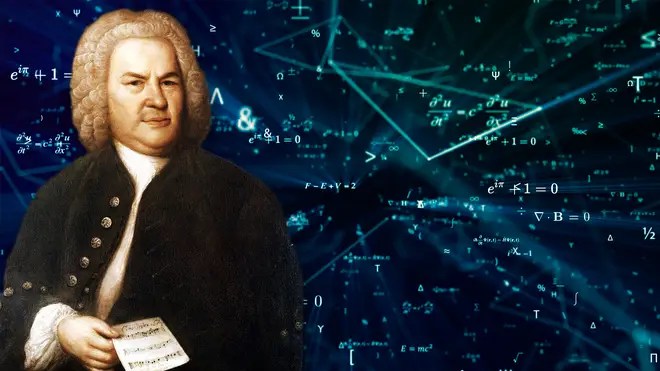
As Sienna Linton reports, mathematicians have analysed hundreds of Bach’s works, from toccatas to preludes, cantatas and chorales, and discovered his music may be even more impressive than we realized…
It’s no secret that J.S. Bach is one of the greatest composers of all time. Father of the fugue and organ music master, he was an immensely prolific musician, writing more than 1100 pieces in his lifetime.
Bach’s intricate and detailed approach to melody and harmony inspired generations of composers that followed. His compositional technique continues to form the musical foundation for budding musicians around the world, of all genres.
The composer himself had an intensely mathematical brain. He would sign his name in music, and would even hide little references to the numbers 14 and 41, which acted as his numerical signature, in his works.
Now, a mathematical study has revealed that Bach’s music may be even more intricate than we thought.
Researchers from the University of Pennsylvania have analysed hundreds of pieces of Bach’s music to investigate how well these works can convey information – and the results are fascinating for both the mathematically and musically inclined…
Fascinating: “Bach’s true mathematical genius has been revealed in new study,” from @ClassicFM.
See also: “Is Bach best?” and of course, Gödel, Escher, Bach.
* W. A. Mozart, on hearing Bach motets in Leipzig
###
As we glorify the GOAT, we might send him transcendent birthday greetings: Johann Sebastian Bach was born on this date in 1685 (at least according to the O.S. calendar by which he lived; his birthday is May 31 according to our calendar). Where to start? Well, there’s his orchestral music such as the Brandenburg Concertos; solo instrumental works such as the cello suites and sonatas and partitas for solo violin; keyboard works such as the Goldberg Variations and The Well-Tempered Clavier; organ works such as the Schubler Chorales and the Toccata and Fugue in D minor; and choral works such as the St Matthew Passion and the Mass in B minor.
Here’s the Netherlands Bach Society for All of Bach. As their name implies, there’s much more where this comes from…
“When I despair, I remember that all through history the way of truth and love have always won”*…

Aditya Narayan Sharma on how the Hindu right distorted Gandhi…
Even outside India, it can be difficult to escape the cult of Mohandas Gandhi, the lawyer, thinker, and politician who helped liberate the nation from British colonial rule in 1947. The praise ranges from the anodyne (Gandhi is a “hero not just to India but to the world,” per Barack Obama) to the ironic (“really phenomenal,” according to Burmese political prisoner turned genocide defender Aung San Suu Kyi) to the surreal (“I am Gandhi-like. I think like Gandhi. I act like Gandhi,” declared New York City Mayor Eric Adams). Seventy-six years after his death, Gandhi is not only an icon of Indian independence, but a uniquely potent international symbol of peace and nonviolence. Gandhi has been, at one point or another, as historian Vinay Lal puts it, the “patron saint” of “environmentalists, pacifists, conscientious objectors, non-violent activists, nudists, naturopaths, vegetarians, prohibitionists, social reformers, internationalists, moralists, trade union leaders, political dissidents, hunger strikers, anarchists, luddites, celibates, anti-globalisation activists, pluralists, ecumenists, walkers, and many others.” Everyone, it seems, has endorsed the honorific coined for him more than a century ago: Mahatma, Sanskrit for “great soul.”
Within India, Gandhi graces every banknote and is plastered on billboards and painted on walls alongside busy thoroughfares. His bespectacled face looms over big cities and small towns alike. Countless schools, universities, roads, and public spaces are named after him. In 2013, the government of Bihar, India’s poorest state, spent several million dollars building the world’s tallest Gandhi statue, casting him in a shimmering tower of bronze with two grateful children by his side. Public figures fight to outperform one another at Mahatma-loving, something of a national sport: in 2021, one representative viral video captured a regional party leader clinging to a bust of Gandhi and sobbing. But Gandhi’s ubiquity masks the fact that among political actors, commentators, intellectuals, and a growing swath of the general public, his reputation is far from settled.
The lead-up to a general election this spring — in which the Hindu nationalist Bharatiya Janata Party (BJP), led by Prime Minister Narendra Modi, is likely to beat out the centrist Indian National Congress Party and be reelected for a third straight term — has brought dueling visions of Gandhi to the fore. Congress, which was helmed by Gandhi himself on the road to independence, still hopes to capitalize on its historic connections to the Mahatma, but the efforts of its increasingly ossified leadership are falling flat. Meanwhile, the BJP pays lip service to Gandhi’s brand while vigorously working to counter his core values, including, most crucially, his lifelong pursuit of Hindu-Muslim unity. The far-right fringes go even further than the official party line: in some circles, Gandhi is belittled, mocked, burned in effigy. This confused state of affairs suggests that a reckoning with the competing narratives swirling around Gandhi is long overdue. Even as he has been flattened into an ill-defined figurehead by liberals and centrists, his complex legacy is being appropriated — and at times desecrated — by India’s seemingly unstoppable right…
…
It is dangerous, ultimately, to cede criticism of Gandhi to the Hindu right. Many Indians, myself included, admire our founding fathers for their grand, if imperfect and patchily implemented, vision of a secular and pluralist country. Nevertheless, the kernel of truth behind the right-wing critique of Gandhi is that the republic was founded by patrician Anglophone elites, and its core institutions do reflect the worldview of a small, affluent group who were, in many crucial ways, disconnected from the material and spiritual realities of the people they governed. Contemporary India has severe socioeconomic, caste, gender, and regional inequalities, in part as a legacy of this paternalistic cohort’s work. But that’s a starting point for politics, not a dead end. Look a little deeper, and opponents of the BJP will find not only flaws but also invaluable resources in Gandhi’s writings, particularly his distinctively Indian formulation of secularism that stands a real chance of resisting Hindutva. And in an era of rising religious violence, Gandhian pacifism itself may be more relevant than ever: it’s no longer a set of bland phrases from history books, but an urgent directive. Beyond shallow paeans to the forgotten values, Gandhi’s message could be deployed against his killer’s ideological heirs, if only someone were willing to do it. No one — politician, citizen, or intellectual — can seriously claim to inherit Gandhi’s values until they take him down from his pedestal, rescue him from both the glibness of liberal idol worship and the humiliation of Hindutva slander, and re-engage with the great thinker himself. That is surely the only fate befitting the man we once called Bapu, or Dad…
Eminently worth reading in full: “Character Assassination,” from @AdityaNSharma in @thedrift_mag.
See also: “Prime Minister Modi Is Disarming the Opposition Ahead of India’s National Elections.”
* “When I despair, I remember that all through history the way of truth and love have always won. There have been tyrants and murderers, and for a time, they can seem invincible, but in the end, they always fall. Think of it–always.” – Mahatma Gandhi
###
As we resist self-rewarding revisionism, we might recall that it was on this date in 1602 that an ur-engine of the colonialization from which Gandhi led India was born: Vereenigde Oost-Indische Compagnie (VOC, or The Dutch East India Company, as it’s known in the Anglophone world) was incorporated. It was a response to the English (later, British) East India company, on which it was modeled, up to a point.
Generally considered the world’s first trans-national corporation and the first publicly to issue stocks and bonds (and the first company to be ever actually listed on an official stock exchange), it began with a 21-year monopoly on the Dutch spice trade. The VOC also prefigured the mega-corporation of today in that it had quasi-governmental powers, including the ability to wage war, imprison and execute convicts, negotiate treaties, strike its own coins, and establish colonies. Considered by many to be the largest and most powerful corporation in history, the VOC eclipsed all of its rivals (including the British) in international trade (and many nations in power) for almost 200 years.

“Start with something simple and small, then expand over time. If people call it a ‘toy’ you’re definitely onto something.”*…

From the always-illuminating Ernie Smith, a survey of 10 portable electronic toys—some well-known, some obscure—that highlighted how creative toy-makers were when the canvas was completely open.
For a moment, consider the evolutionary space between the original Game Boy and the iPad. Both defined the way kids would experience computers in a portable format, but were so defining that they kind of set the template for everyone else. But it was clear that the Game Boy was a mere plateau of technological advancement, which allowed some technological wiggle room. Meanwhile, the iPad was considered such a technological ideal that many companies just copied its basic design, killing off true evolution until, say, the Nintendo Switch. That leaves a gap of about 22 years in which handheld gadgets for kids were really freaking experimental and interesting…
[Ernie reviews ten toys, each of which pushed the envelope; several of which inspired features/interfaces we use use today…]
… Admittedly, most devices on this list highlight the potential positive effects of technology on how we approach life, while others are clearly designed to work against the tension technology was creating.
Your kid may want a laptop, but a laptop is expensive, so get them a VTech device instead. They want a cell phone, but cell phones come with risks and data plans. So, it’s better to give them a walkie-talkie that carries itself like a cell phone, rather than expose them to the real thing, right?
There’s also something to be said about the fact that many of these devices have practical limits. You’re not talking to the open internet with most of these gadgets, and most are designed to only work with a handful of people around you. That limits the addiction factor of these gadgets for the most part.
But these designs are ultimately designed to be outgrown. If you really get into a Barbie digital camera, eventually you’re going to want a real one. And if a kid gets into a PDA-style device or creativity tool, they’re going to pick up a computer and figure out that they can do way more.
Electronic toys still abound, but one gets the feeling that convergence cost us some of the more fascinating ideas on this list. I mean, there’s only so much an iPad can do, right?…
Looking back at a bunch of toy electronics that may have latently inspired the tech that we use today… take the tour: “Digital Training Wheels,” from @ernie@writing.exchange (on Mastodon).
* Aaron Levie (co-founder and CEO of Box) @levie
###
As we hook ’em young, we might recall that it was on this date in 1931 that the state legislature in Nevada legalized casino gambling in the state. In fact, gambling had been legal in Nevada until 1909 (by which time it was the only state with legal gambling), when an earlier instantiation of the legislature outlawed it.
Casino revenues– gambling, hospitality, and entertainment– in the U.S. generated nearly $329 billion in economic activity in 2022.
(Coincidentally, it was on this date in 1942 that Alfred G. Vanderbilt and a number of horse racing luminaries established the Thoroughbred Racing Associations of North America.)

“How many general-relativity theorists does it take to change a light bulb?”*…

Jokes are where one finds them…
Heisenberg, Schrodinger, and Ohm are driving along the road together – Heisenberg is driving. After a time, they are stopped by a traffic cop. Heisenberg pulls over, and the cop comes up to the driver’s window.
“Sir, do you know how fast you were driving?” asks the cop.
“No” replies Heisenberg “but I know precisely where I am”
“You were doing 70.” says the cop
“Great!” says Heisenberg “Now we’re lost!”
The cop thinks this is very strange behaviour and so he decides to inspect the vehicle. After a time he comes back to the driver’s window and says
“Do you know there’s a dead cat in the trunk?”
“Well, now we do!!” yells Schrodinger.
The cop thinks this is all too weird, so he proceeds to arrest the three. Ohm resists.
source
[Image above: source]
* “How many general-relativity theorists does it take to change a light bulb? Two: one to hold the bulb and one to rotate space.” (source)
###
As we chortle, we might spare a thought for Louis de Broglie (or as he was known more officially, Louis Victor Pierre Raymond, 7th Duc de Broglie); he died on this date in 1987. An aristocrat and physicist, he made significant contributions to quantum theory. In his 1924 PhD thesis, he postulated the wave nature of electrons and suggested that all matter has wave properties— a concept known as the de Broglie hypothesis, an example of wave–particle duality— a topic that occupied both Heisenberg and Schrodinger and that forms a central part of the theory of quantum mechanics. After the wave-like behavior of matter was first experimentally demonstrated in 1927, de Broglie won the Nobel Prize for Physics (in 1929).
Louis de Broglie was the sixteenth member elected to occupy seat 1 of the Académie française in 1944, and served as Perpetual Secretary of the French Academy of Sciences. He was the first high-level scientist to call for establishment of a multi-national laboratory, a proposal that led to the establishment of the European Organization for Nuclear Research (CERN).

“A lot of people were opposed to it. A lot of people were for it. I myself think about it as little as possible.”
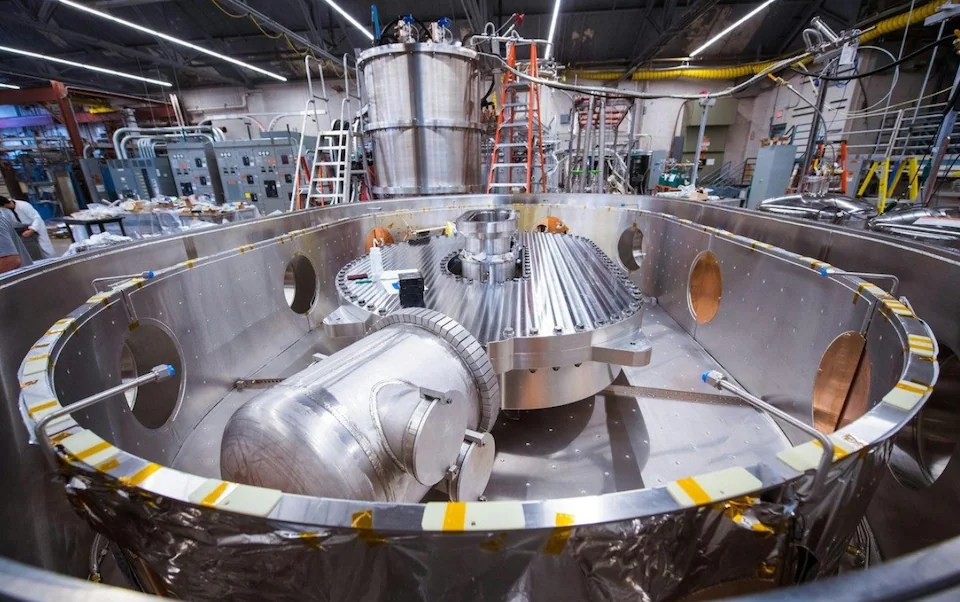
As AI, clean tech, climate response, and other uses grow, concerns are rising that the U.S. and the world are going to run out of electricity (and here). As John Ellis reports, there’s a controversial potential answer closer to hand than many had thought…
Commercial nuclear fusion has gone from science fiction to science fact in less than a decade.
Britain’s First Light Fusion announced last week that it had broken the world record for pressure at the Sandia National Laboratories in the US, pushing the boundary to 1.85 terapascal, five times the pressure at the core of the Earth.
Days earlier, a clutch of peer-reviewed papers confirmed that Commonwealth Fusion Systems near Boston had broken the world record for a large-scale magnet with a field strength of 20 tesla using the latest high-temperature super-conducting technology. This exceeds the threshold necessary for producing net energy, or a “Q factor”, above 1.0.
“Overnight, it basically changed the cost per watt of a fusion reactor by a factor of almost 40,” said Professor Dennis Whyte, plasma doyen at the Massachusetts Institute of Technology (MIT). The March edition of the IEEE Transactions on Applied Superconductivity published six papers ratifying different aspects of the technology.
A poll at the International Atomic Energy Agency’s forum in London found that 65 percent of insiders think fusion will generate electricity for the grid at viable cost by 2035, and 90 percent by 2040.
The Washington-based Fusion Industry Association says four of its members think they can do it by 2030. If the industry is anywhere close to being right, we need to rethink all our energy assumptions…
firstlightfusion.com, cfs.energy, telegraph.co.uk, web.mit.edu, ieeexplore.ieee.org/stamp
From New Items (@EllisItems)
For a series of less-optimistic takes on the prospect of power from fusion: “Why are nuclear fusion reactors difficult?
* Kurt Vonnegut, God Bless You, Mr. Rosewater
###
As we ponder power, we might spare a thought for Irène Joliot-Curie; she died on this date in 1956. A chemist and physicist, she followed in the footsteps of her mother (Marie Curie), sharing the Nobel prize in Chemistry (in 1935, with her husband Frédéric Joliot-Curie) for their discovery of induced radioactivity, making them the second-ever married couple (after her parents) to win the Nobel Prize, and making her and her mother the first (and so far only) mother–daughter pair to have won Nobels.
Sadly, Irène also shared her mother’s fate: she died of leukemia resulting from radiation exposure during research.

You must be logged in to post a comment.