“Now there is music from which a man can learn something”*…
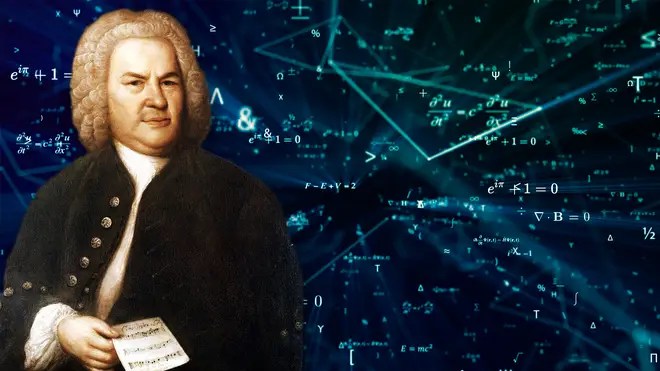
As Sienna Linton reports, mathematicians have analysed hundreds of Bach’s works, from toccatas to preludes, cantatas and chorales, and discovered his music may be even more impressive than we realized…
It’s no secret that J.S. Bach is one of the greatest composers of all time. Father of the fugue and organ music master, he was an immensely prolific musician, writing more than 1100 pieces in his lifetime.
Bach’s intricate and detailed approach to melody and harmony inspired generations of composers that followed. His compositional technique continues to form the musical foundation for budding musicians around the world, of all genres.
The composer himself had an intensely mathematical brain. He would sign his name in music, and would even hide little references to the numbers 14 and 41, which acted as his numerical signature, in his works.
Now, a mathematical study has revealed that Bach’s music may be even more intricate than we thought.
Researchers from the University of Pennsylvania have analysed hundreds of pieces of Bach’s music to investigate how well these works can convey information – and the results are fascinating for both the mathematically and musically inclined…
Fascinating: “Bach’s true mathematical genius has been revealed in new study,” from @ClassicFM.
See also: “Is Bach best?” and of course, Gödel, Escher, Bach.
* W. A. Mozart, on hearing Bach motets in Leipzig
###
As we glorify the GOAT, we might send him transcendent birthday greetings: Johann Sebastian Bach was born on this date in 1685 (at least according to the O.S. calendar by which he lived; his birthday is May 31 according to our calendar). Where to start? Well, there’s his orchestral music such as the Brandenburg Concertos; solo instrumental works such as the cello suites and sonatas and partitas for solo violin; keyboard works such as the Goldberg Variations and The Well-Tempered Clavier; organ works such as the Schubler Chorales and the Toccata and Fugue in D minor; and choral works such as the St Matthew Passion and the Mass in B minor.
Here’s the Netherlands Bach Society for All of Bach. As their name implies, there’s much more where this comes from…
You must be logged in to post a comment.