Posts Tagged ‘Technology’
“The first to arrive is the first to succeed”*…
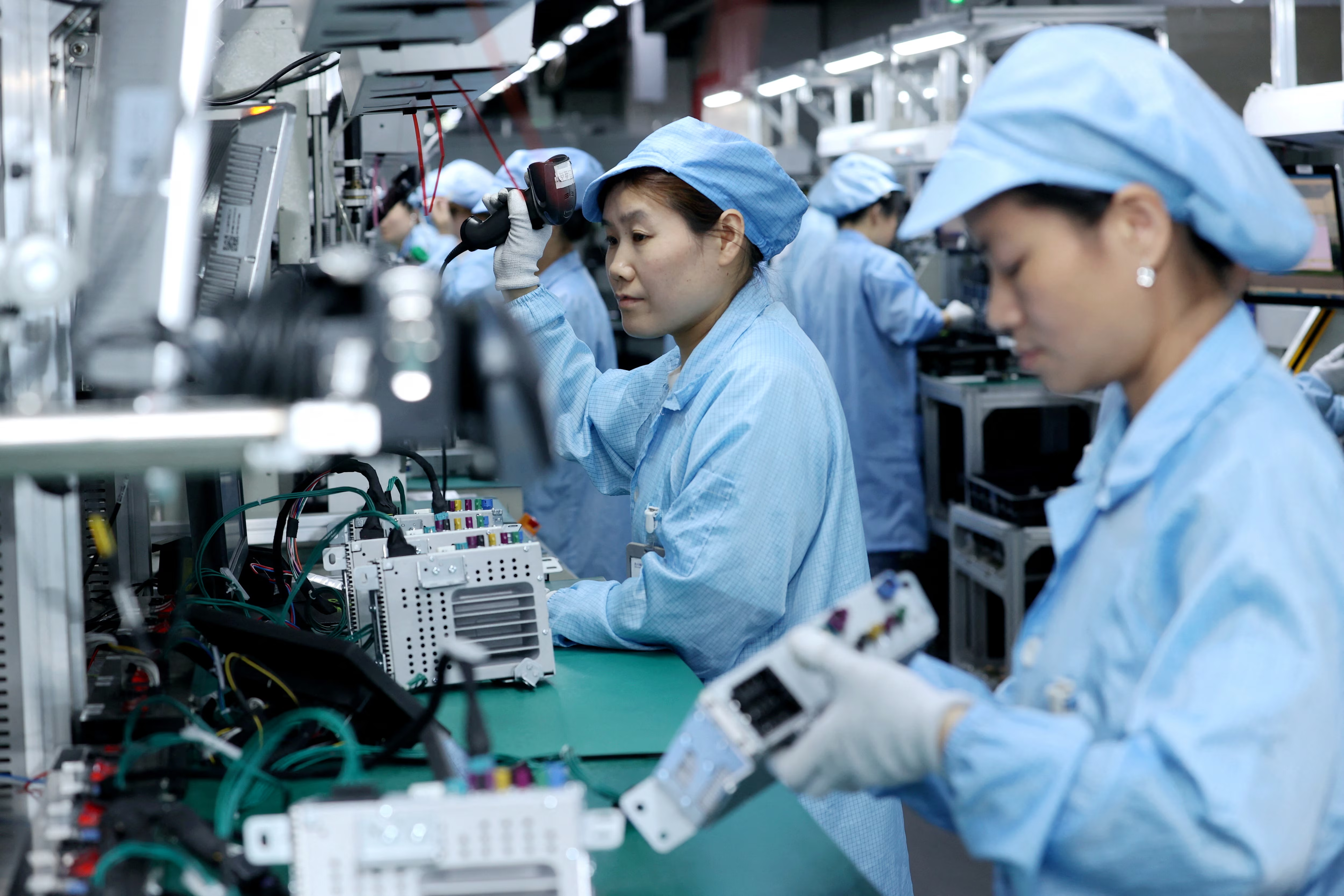
Is China “pulling up the ladder”? In his valuable newsletter, Ben Evans puts two recent news items on high-tech manufacturing into context…
… First, the FT argues that after the ‘China shock’ of cheap low-value manufacturing, there’s now a growing second China shock of high-value, high-tech manufacturing, where the same model of ferocious, Darwinian competition, backed by subsidies and cheap energy, produces a handful of very efficient and capable winners in each space, plus a lot of overcapacity, that then moves to exports. Second, Bloomberg says that Chinese export controls in those high-tech industries are crippling India’s attempt to build its own tech manufacturing base…
Gift article from the FT: “China shock 2.0: the flood of high-tech goods that will change the world“
Gift article from Bloomberg: “China’s Control Over Tech Is Threatening India’s Manufacturing Dreams“
* (先到先得) Chinese proverb
###
As we dissect the dynamics of dominance, we might recall that it was on this date in 1981 that the computer mouse became a practical, operating part of the personal computing world, when Xerox released its 1010 (Star) personal computer. The trackball, a related pointing device, had been invented in 1946 by Ralph Benjamin as part of a post-World War II-era fire-control radar plotting system called the Comprehensive Display System (CDS). Then, in the 1960s, Doug Engelbart and Bill English developed the first mouse prototype. They christened the device the mouse as early models had a cord attached to the rear part of the hand-held unit; the cord looked like a tail and made the device resemble a common mouse. (According to Roger Bates, a hardware designer under English, another reason for choosing this name was because the cursor on the screen was also referred to as “CAT” at this time.) In 1968, Engelbart premiered the pointer at what has come to be known as “The Mother of All Demos.” There followed, through the 70’s, a pair of personal computers that used a mouse (the Xerox Alto and the Lilith); but while they served as proof-of-concept, they sold only in the hundreds of units over the next several years. It was the Star that effectively brought the mouse to market… soon to be followed by Steve Jobs’ Apple Lisa, which forshadowed the Mac and the user interface that we’ve all come to know.
Apropos the articles above, computer mice are still a $2 billion business. But while they were invented and originally largely manufactured in the U.S., they are (as of 2025) mostly manufactured in Asia (68%, the lion’s share– 54%– in China); only 8% are made in the U.S.

“Privacy is rarely lost in one fell swoop. It is usually eroded over time, little bits dissolving almost imperceptibly until we finally begin to notice how much is gone.”*…

… And now, indeed, we’re beginning to notice. Hana Lee Goldin surveys the state of play– who’s buying our personal information, what they’re using it for, and how the system works behind the screen– and considers our options…
Sometime in the mid-2000s, most of us started handing over pieces of ourselves to the internet without giving the exchange a second thought. We created email accounts, signed up for social media, bought things online, downloaded apps, swiped loyalty cards, connected fitness trackers, stored photos in the cloud, and agreed to terms of service that almost none of us have ever read in full. We did this thousands of times over two decades and counting, and each interaction felt small enough to be inconsequential.
But the accumulation is enormous. More than 6 billion people now use the internet, and each one makes an estimated 5,000 digital interactions per day. Most of those interactions happen without our conscious awareness: a GPS ping, a page load, an app opening, a browser cookie refreshing, a device checking in with a cell tower. The average person in 2010 made an estimated 298 digital interactions per day. In fifteen years, that number multiplied more than sixteenfold. Those digital interactions produce records that can persist indefinitely, stored, copied, indexed, bought, sold, and combined with other records to build profiles of extraordinary detail.
If we’ve been online since the late 1990s or early 2000s, our data footprint can include social media accounts we’ve created, online purchases we’ve made, forums we’ve posted in, loyalty cards we’ve used, and apps we’ve installed going back decades. Some of that information lives on platforms we’ve long forgotten. Some of it was collected by companies that have since been acquired or dissolved, with our data potentially passing to successor entities we’ve never heard of. The digital life most of us have been living for 15 to 25 years has produced a layered, evolving archive that only grows more valuable to the people who buy and sell it as time goes on.
Most of us sense that something is off about all of this. In a 2023 survey, Pew Research found that roughly eight in ten Americans feel they have little to no control over the data companies collect about them, 71% are concerned about government data use, and 67% say they understand little to nothing about what companies are doing with their personal information. The concern is real and widespread. And so is the feeling of helplessness: 60% of Americans believe it’s impossible to go through daily life without having their data tracked. The unease is there. What’s missing is a clear picture of what’s happening on the other side of the transaction…
[Goldin explains what data is being collected and shared, and by whom; how the data is managed and trafficked; how its being used (by insurance and financial companies, employers and landlords, retailers, AI companies, governments, and criminals); and how “inferred” data is used to augment the “hard” data. It’s chilling. She then puts the issue into context, and discusses we we can– and cannot– do about it…]
… The philosopher Helen Nissenbaum has a framework for what’s happening here: contextual integrity. The idea is that privacy isn’t about secrecy. We share information willingly all the time, when the context fits. We tell our doctor about a health condition because we expect that information to stay within the medical relationship. We search for symptoms on a health website because we assume that search won’t follow us into an insurance application. In the current data economy, that’s exactly the kind of boundary that dissolves, because the company collecting the data and the company buying it are operating in completely different contexts.
This is an information literacy problem as much as a privacy problem. Information literacy is usually framed around consumption: evaluating sources, questioning claims, recognizing bias in what we read and watch. But every time we interact with a digital service, we’re also producing information: generating a record that will be read, interpreted, scored, and acted on by organizations we may never interact with directly. Many of us have gotten better at questioning the information that comes at us: checking sources, noticing bias, and recognizing when something is trying to sell us a conclusion. But we haven’t developed equivalent habits around the information that flows from us: where it goes after we hand it over, who reads the record, what incentives they have, and what conclusions they draw. The gap between what we think we’re consenting to and what we’ve agreed to in practice is where the real exposure lives, and the system is designed to keep that gap invisible.
One of the reasons the “so what” question is hard to answer with action is that opting out of data collection often means opting out of participation. Declining a social media platform’s terms of service means not using the platform. Refusing location permissions can mean losing access to navigation, ride-sharing, weather, and delivery apps. Choosing not to create an account can mean paying more, seeing less, or being locked out of services that have become essential infrastructure for work, communication, healthcare, banking, and education.
The architecture of digital consent treats data sharing as a binary: agree to the terms or don’t use the product. There’s rarely a middle option that allows us to use a service while limiting what data gets collected and where it goes. The result is that the “choice” to share data often functions as a condition of entry into daily life rather than an informed negotiation. We’re not handing over data because we’ve weighed the tradeoff and decided it’s fair. We’re handing it over because the alternative is exclusion from services we rely on.
This is the structural context behind the Pew Research Center finding that more than half of Americans believe it’s impossible to go through daily life without being tracked. For many of us, it isn’t possible, at least not without significant inconvenience or sacrifice. The question isn’t whether we can avoid data collection entirely, because for the vast majority of people who participate in modern life, the answer is no. The question is whether we can make more informed decisions within the constraints we’re operating in, and whether the system can be pushed – through regulation, through market pressure, through better tools – toward something more transparent.
California’s Delete Act, which took effect in January 2026, is the strongest example of what’s emerging. It created a platform called DROP (Delete Request and Opt-Out Platform) that lets California residents submit a single deletion request to every registered data broker in the state. Brokers are required to process those requests, maintain suppression lists to prevent re-collection, and check the platform regularly for new requests. The European Union’s GDPR provides similar individual rights, and a handful of other U.S. states have enacted their own privacy laws with varying levels of protection. But the coverage is uneven: what’s available to a California or EU resident may not extend to someone in a state without comparable legislation.
Some services now automate parts of the opt-out process, submitting removal requests to dozens of brokers on our behalf. These can’t erase the data trail entirely, but they can narrow what’s actively available for sale.
Beyond deletion, there are smaller choices that reduce how much new data we generate. We can audit which apps have permission to track our location or access our contacts, since a surprising amount of behavioral data comes from apps that don’t need those permissions to function. We can treat “sign in with Google” and “sign in with Facebook” buttons as what they are: data-sharing agreements that can link a new service to an existing profile. And we can glance at the first few lines of a privacy policy before agreeing, looking for some version of “we may share your information with our partners,” where “partners” just means anyone willing to pay.
Most of us don’t read privacy policies, and the policies aren’t built to be read. They average thousands of words of dense legal language filled with terms like “legitimate interest,” “data processor,” and “de-identified data.” Studies consistently put them at a late high school to early college reading level (grade 12 to 14), but the difficulty goes beyond reading level: the concepts are abstract, the volume of agreements we encounter is enormous, and the design of the consent process itself pushes us through as fast as possible. Pre-checked boxes, auto-scrolling agreement windows, “accept all” buttons positioned prominently while “customize settings” options sit behind additional clicks. These are dark patterns, design choices that make the path of least resistance the path of maximum data sharing.
The result is a gap between the moment we share a piece of information and the moment that information shapes a decision about our lives. We don’t connect the app to the insurance premium or the loyalty card to the rental application because the chain of custody between them is long, complex, and designed to stay out of view.
The same critical thinking we’ve learned to apply to the information flowing toward us (checking sources, questioning claims, looking for bias) applies to the information flowing from us: who’s collecting this, what will they do with it, who else will see it, and what did we agree to? The difference is that in the data economy, we’re the product being evaluated, and the questions are being asked about us rather than by us.
So can we get it back? Not entirely. Data that’s already been collected, copied, sold, and processed across multiple systems can’t be fully recalled. What we can do is reduce what’s actively available for sale, slow the flow of new data going forward, and take advantage of legal tools that didn’t exist a few years ago. The archive of our past digital lives is too distributed to undo, but the file is still being written, and we have more say over the next page than we did over the last twenty years of them.
So what if they have our data? The tradeoff extends well beyond better ads. It reaches into the prices we’re charged, the credit we’re offered, the jobs we’re considered for, the insurance premiums we pay, the AI systems trained on our behavior, the accuracy of the profiles used to make decisions about our lives, and the degree to which government agencies can monitor our movements without a warrant. Every new service we sign up for, every permission we grant, and every terms-of-service agreement we accept adds another layer to that file. We can’t close the file entirely, but we can make more informed decisions about what goes into it next…
Eminently worth reading in full: “So What if They Have My Data?“
See also: “Why Do We Care So Much About Privacy?” (source of the image above) in which Louis Menand suggests that our concern should be with the “weaponization” of data…
* Daniel J. Solove, Nothing to Hide: The False Tradeoff Between Privacy and Security
###
As we reinforce our rights, we might recall that it was on this date in 1996 that the internet-as-we’ve-come-to-know-it broke big into the mainstream: Yahoo! launched the national campaign that asked “Do You Yahoo?” advertising its web-based search service on national television. The campaign was created by ad agency Black Rocket and Yahoo Marketing Head Karen Edwards (whose many awards for the work include a seat in the Advertising Hall of Achievement).
An early spot from the campaign…
“The present is pregnant with the future”*…

The estimable Tim O’Reilly uses scenario planning to create an insightful look at AI, our futures, and the choices that will define them…
We all read it in the daily news. The New York Times reports that economists who once dismissed the AI job threat are now taking it seriously. In February, Jack Dorsey cut 40% of Block’s workforce, telling shareholders that “intelligence tools have changed what it means to build and run a company.” Block’s stock rose 20%. Salesforce has shed thousands of customer support workers, saying AI was already doing half the work. And a Stanford study found that software developers aged 22 to 25 saw employment drop nearly 20% from its peak, while developers over 26 were doing fine.
But how are we to square this news with a Vanguard study that found that the 100 occupations most exposed to AI were actually outperforming the rest of the labor market in both job growth and wages, and a rigorous NBER study of 25,000 Danish workers that found zero measurable effect of AI on earnings or hours?
Other studies could contribute to either side of the argument. For example, PwC’s 2025 Global AI Jobs Barometer, analyzing close to a billion job ads across six continents, found that workers with AI skills earn a 56% wage premium, and that productivity growth has nearly quadrupled in the industries most exposed to AI.
This is exactly the kind of contradictory, uncertain landscape that scenario planning was designed for. Scenario planning doesn’t ask you to predict what the future will be. It asks you to imagine divergent possible futures and to develop a strategy that improves your odds of success across all of them. I’ve used it many times at O’Reilly and have written about it before with COVID and climate change as illustrative examples. The argument between those who say AI will cause mass unemployment and those who insist technology always creates more jobs than it destroys is a debate that will only be resolved by time. Both sides have evidence. Both are probably right at some level. And both framings are not terribly helpful for anyone trying to figure out what to do next…
[O’Reilly explains the scenario approach, then applies it to our future with AI (see the image above), astutely assessing the conflicting signals that we’ve experiencing; he explores the “robust strategy” for our uncertian future (strategic choices that make sense regardless of which future unfolds); then he concludes…
… I’ll return to the theme that I sounded in my book WTF? What’s the Future and Why It’s Up To Us.
Every time a company uses AI to do what it was already doing with fewer people, it is making a choice for the lower half of the scenario grid. Every time a company uses AI to do something that wasn’t previously possible, to serve a customer who wasn’t previously served, to solve a problem that wasn’t previously solvable, it is making a choice for the upper half. These choices compound, for good or ill. An economy that uses AI primarily for efficiency will slowly hollow itself out.
Looking at the news from the future, both sets of signals are present. The question is which will dominate. AI will give us both the Augmentation Economy and the Displacement Crisis, in different measures in different places, depending on the choices we make.
Scenario planning teaches us that we don’t have to predict which future we’ll get. We do have to prepare for a very uncertain future. But the robust strategy, the one that works across every quadrant, is to focus on doing more, not just doing the same with less, and to find ways that human taste still matters in what is created. As long as there is unmet demand, as long as there are problems we haven’t solved and people we haven’t served, AI will augment human work rather than replacing it. It’s only when we stop looking for new things to do that the machines come for the jobs…
Eminently worth reading in full. Indeed, speaking as a long-time scenario planner, your correspondent can only wish that everyone who wields “scenarios” applies the approach as appropriately, adriotly, and acutely as Tim has: “Scenario Planning for AI and the ‘Jobless Future‘,” from @timoreilly.bsky.social.
* Voltaire
###
As we take the long view, we might send formative birthday greetings to Mark Pinsker; he was born on this date in 1923. A mathematician, he made impoprtant contributions to the fields of information theory, probability theory, coding theory, ergodic theory, mathematical statistics, and communication networks. This work, which helped lay the foundation for AI-as-we-know-it, earned him the IEEE Claude E. Shannon Award in 1978, and the IEEE Richard W. Hamming Medal in 1996, among other honors.

“Don’t eat your seed corn”*…

AI doesn’t really “think.” Rather, it remembers how we thought together. Are we’re about to stop giving it anything worth remembering? Bright Simons with a provocative analysis…
We are on the verge of the age of human redundancy. In 2023, IBM’s chief executive told Bloomberg that soon some 7,800 roles might be replaced by AI. The following year, Duolingo cut a tenth of its contractor workforce; it needed to free up desks for AI. Atlassian followed. Klarna announced that its AI assistant was performing work equivalent to 700 customer-service employees and that reducing the size of its workforce to under 2000 is now its North Star. And Jack Dorsey has been forthright about wanting to hold Block’s headcount flat while AI shoulders the growth.
The trajectory has a compelling internal logic. Routine cognitive work gets automated; junior roles thin out; productivity gains compound year on year. For boards reviewing cost structures, it is the cleanest investment proposition since the internal combustion engine retired the horse, topped up with a kind of moral momentum. Hesitate, the thinking goes, and fall behind.
But the research results of a team in the UK should give us pause. In the spring of 2024, they asked around 300 writers to produce short fiction. Some were aided by GPT-4 and others worked alone. Which stories, the researchers wanted to know, would be more creative? On average, the writers with AI help produced stories that independent judges rated as more creative than those written without it.
So far, so on message: a familiar story about the inevitable takeover by intelligent machines. But when the researchers examined the full body of stories rather than individual ones, the picture became murky. The AI-assisted stories were more similar to each other. Each writer had been individually elevated; collectively, they had converged. Anil R Doshi and Oliver Hauser, who published the study in Science Advances, reached for a phrase from ecology to explain this: a tragedy of the commons.
Hold that result in mind: individual gain, collective loss. It describes something far more consequential than a writing experiment—it describes the hidden logic of our entire relationship with artificial intelligence. And it suggests that the most successful organizations of the coming decade will be the ones that do something profoundly counterintuitive: instead of using AI to eliminate human interaction by firing droves of workers, they will use it to create more human interaction. IBM has reversed course on its earlier human redundancy fantasies. I bet more will in due course…
[Simons sketches the history of humans’ intertwined development of both social/organizational and utile technologies, concluding…]
… What the chain reveals is a dependency the AI industry has largely declined to examine. The underlying intelligence of a large language model isn’t a function of its architecture, its parameter count, or the volume of compute thrown at its training. It is not even about the training data. It is a function of the social complexity of the civilization whose language it digested.
Each epoch advanced the cognitive frontier through something far richer and more complex than the isolated genius of an individual guru or machine. It did so through new forms of collective problem-solving. Think new institutions (the Greek agora, the Roman lex, the medieval university, the scientific society, the modern corporation, and the social internet) that demanded and rewarded ever more sophisticated uses of language.
The cognitive anthropologist Edwin Hutchins studied how Navy navigation teams actually think. In his 1995 book Cognition in the Wild, he wrote something that reads today like an accidental prophecy. The physical symbol system, he observed, is “a model of the operation of the sociocultural system from which the human actor has been removed.”
That is, with eerie precision, a description of what a large language model (LLM) really is, stripped of all the unapproachable jargon and mathematical wizardry. An LLM like ChatGPT is a model of human social reasoning with the human wrangled out. And the question nobody in Silicon Valley is asking with sufficient urgency is: What happens to the model when the social reasoning that produced its training data begins to thin?…
[Simons explores evidence that this may already be materially underway, then explores what that “atrophy” might mean …]
… If AI capability depends on the social complexity of human language production—and if AI deployment systematically reduces that complexity through cognitive offloading, homogenization of creative output, and the elimination of interaction-dense work—then the technology is gradually undermining the conditions for its own advancement. Its successes, rather than failures, create a spiral: a slow attenuation of the very substrate it feeds on, spelling doom.
This is the Social Edge Paradox, and the intellectual tradition it draws from is older and more interdisciplinary than most AI commentary acknowledges…
[Simons unpacks that heritage, and puts it into dialogues with recent thoughts from Dario Amodei, Leopold Aschenbrenner, and Sam Altman, concluding…]
… The Social Edge Framework outlined here is a direct counterpoint to Amodei, Aschenbrenner, and Altman. It is a program of action to counter the human redundancy fantasy. It challenges the self-fulfilling doom-spirals created by the premature reallocation of material resources to a vision of AI. I speak of the philosophy that underestimates the sheer amount of human priming needed to support the Great Recode of legacy infrastructure before our current civilization can even benefit substantially from AI advances.
By “Great Recode,” I am paying homage to the simple but widely ignored fact that the overwhelming number of tools and services that advanced AI models still need to produce useful outputs for users are not themselves AI-like and most were built before the high-intensity computing era began with AI. In the unsexy but critical field of PDF parsing—one of the ways in which AI consumes large amounts of historical data to get smart—studies show that only a very small proportion of tools were created using techniques like deep learning that characterize the AI age. And in some important cases, the older tools remain indispensable. Vast investments are thus required to upgrade all or most of these tools—from PDF parsers to database schemas—to align with the pace of high-intensity computing driven by the power-thirst of AI. Yet, we are not at the point where AI can simply create its own dependencies.
Indeed, the so-called “legacy tech debt” supposedly hampering the faster adoption of AI has in many instances been revealed as a problem of mediation and translation. AI companies are learning that they need to hire people who deeply understand legacy systems to guide this Recoding effort. A whole new “digital archaeology” field is emerging where cutting-edge tools like ArgonSense are deployed to try to excavate the latent intelligence in legacy systems and code often after rushed modernization efforts have failed. In many cases, swashbuckling new-age AI adventurers have found that mainframe specialists of a bygone age remain critical, and multidisciplinary dialogues and contentions are essential to progress on the frontier. Hence the strange phenomenon of the COBOL hiring boom. New knowledge must keep feeding on old.
The Social Edge Framework says: yes, scaling matters, architecture matters, and compute matters. But none of these will continue to deliver if the social substrate—the complex, argumentative, institutionally diverse, perspectivally rich fabric of human interaction—is allowed to thin. And thinning is very possible…
… The Social Edge prescription is that organizations that hire more people to work in AI-enriched, high-interaction, and transmediary roles—where AI scaffolds learning rather than substituting it—will derive greater long-term advantage than those that treat the technology as a headcount-reduction device. In a world where raw cognitive throughput has been commodified, the value arc shifts to something considerably harder to replicate: the capacity to coordinate human intent with precision, speed, and genuine depth. That edge lies in trans-mediation and high human interactionism.
The AI industry is telling a story about the future of work that goes roughly like this: automate what can be automated, augment what remains, and trust that the productivity gains will compound into a wealthier, more efficient world.
The Social Edge Framework tells a different story. It says: the intelligence we are automating was never ours alone. It was forged in conversation, argument, institutional friction, and collaborative struggle. It lives in the spaces between people, and it shows up in AI capabilities only because those spaces were rich enough to leave linguistic traces worth learning from.
Every time a company automates an entry-level role, it saves a salary and loses a learning curve, unless it compensates. Every time a knowledge worker delegates a draft to an AI without engaging critically, the statistical thinning of the organizational record advances by an imperceptible increment. Every time an organization mistakes polished output for strategic progress, it consumes cognitive surplus without generating new knowledge.
None of these individual acts is catastrophic. However, their compound effect may be.
The organizations that will thrive in the next decade are not those with the highest AI utilization rates. They are those that understand something the epoch-chaining thought experiment makes vivid: that AI’s capabilities are an inheritance from the complexity of human social life. And inheritances, if consumed without reinvestment, eventually run out. This is particularly critical as AI becomes heavily customized for our organizational culture.
Making the right strategic choices about AI is going to become a defining trait in leadership. Bloom et al. cross-country research has long established that management quality explains a substantial share of productivity variance between teams and organizations, and even countries.
In the AI age, small differences in leadership quality can generate large differences in outcomes—a non-linear payoff I call convex leadership. The term is borrowed from options mathematics, where a convex payoff is one whose upside accelerates faster than the downside decelerates. Convex leaders convert cognitive abundance into structural ambition and thus avoid turning their creative and discovery pipelines into stagnant pools of polished busywork. Conversely, in organizations led by what we might call concave leaders—cautious, procedurally anchored, optimizing for error-avoidance—AI would tend to produce more noise than signal. Because leadership is such a major shaper of all our lives, it is in our interest to pay serious attention to its evolution in this new age.
The Social Edge is more than a metaphor. It is the literal boundary between what AI can do well and what it will keep struggling with due to fundamental internal contradictions. Furthermore, the framework asks us all to pay attention to how the very investment thesis behind AI also contains the seeds of its own failure. And it reminds leaders that AI’s frontier today is set by the richness of the social world that produced the data it learned from…
Eminently worth reading in full: “The Social Edge of Intelligence.”
Consider also the complementary perspectives in “What will be scarce?,” from Alex Imas (via Tim O’Reilly/ @timoreilly.bsky.social)… and in the second piece featured last Monday: ““Curiosity Is No Solo Act.“
Apposite: “Some Unintended Consequences Of AI,” from Quentin Hardy.
And finally, from the estimable Nathan Gardels, a suggestion that Open AI’s recent paper on industrial policy for the Age of AI fills a vacuum left by an unimaginative political class and should be taken seriously, at least as a conversation starter: “OpenAI Proposes A ‘Social Contract’ For The Intelligence Age.”
* Old agricultural proverb
###
As we take the long view, we might recall that today is the anniverary of a techological advance that both fed the social edge and encouraged the build out of the technostructure from which today’s AI hatched: on this date in 1993 Version 1.0 of the web browser Mosaic was released by the National Center for Supercomputing Applications. It was the first software to provide a graphical user interface for the emerging World Wide Web, including the ability to display inline graphics.
The lead Mosaic developer was Marc Andreesen, one of the future founders of Netscape, and now a principal at the venture capital firm Andreessen Horowitz (AKA “a16z”)… where he has been become a major investor in, promoter of, and politicial champion of the current crop of AI firms.

“Darling, it’s better / down where it’s wetter”*…

From our old friend Neal Agarwal, a long (and illuminating) scroll from the surface to the “bottom” of the ocean (10,924 meters down)…
“The Deep Sea,” from @neal.fun.
* “Sebastian, “Under the Sea,” The Little Mermaid
###
As we dive: we might send connected birthday greetings to a man who put the sea floor to use, Clarence Mackay; he was born on this date in 1874. An early telecom entrepreneur, he supervised the completion of the first transpacific cable between the United States and the Far East in 1904. He laid a cable between New York and Cuba in 1907, and later established cable communication with southern Europe via the Azores and with northern Europe via Ireland. And in 1928, he became the first to combine radio, cables, and telegraphs under one management. (He sold his business, Postal Telegraph and Cable Corporation, to International Telephone and Telegraph Company [ITT] for an enormous amount of stock… just in time for the stock market crash in 1929, which wiped him out. He survived the Great Depression by selling his art and antiques.)

You must be logged in to post a comment.