Posts Tagged ‘words’
“I was reading the dictionary. I thought it was a poem about everything.”*…

That seminal semanticist Samuel Johnson suggested, “dictionaries are like watches, the worst is better than none and the best cannot be expected to go quite true.” From “unabridged” to “slanguage,” Madeline Kripke’s library of lexicons is a logophile’s heaven (or hell)…
Madeline Kripke’s first dictionary was a copy of Webster’s Collegiate that her parents gave her when she was a fifth grader in Omaha in the early 1950s. By the time of her death in 2020, at age 76, she had amassed a collection of dictionaries that occupied every flat surface of her two-bedroom Manhattan apartment—and overflowed into several warehouse spaces. Many believe that this chaotic, personal library is the world’s largest compendium of words and their usage.
“We don’t really know how many books it is,” says Michael Adams, a lexicographer and chair of the English department at Indiana University Bloomington. More than 1,500 boxes, with vague labels such as “Kripke documents” or “Kripke: 17 books,” arrived at the school’s Lilly Library on two tractor-trailers in late 2021. The delivery was accompanied by a nearly 2,000-page catalog detailing some 6,000 volumes. But that’s only a fraction of the total. In summer 2023, the library hired a group of students to simply open each box and list its contents. By the fall, their count stood at about 9,700. “And they’ve got a long way to go,” says Adams. “20,000 sounds like a pretty good estimate.”
…
“This is my favorite wall,” Madeline Kripke told Narratively reporter Daniel Kreiger when he visited her West Village apartment in 2013. She shined a flashlight on glass-fronted shelves jammed with dictionaries full of the slanguage and cryptolect of small and likely overlooked communities. Kreiger listed some of the groups represented at that time, among them cowboys and flappers, mariners and gamblers, soldiers, circus workers, and thieves.
Among the first tomes Adams pulled from the boxes was a well-known example of the slang genre: The Canting Academy. This 17th-century dictionary by Richard Head is a guide to “cant,” the jargon of London’s criminal class or, as the subtitle to the second edition puts it, “The Mysterious and Villainous Practices Of that wicked Crew, commonly known by the Names of Hectors, Treppaners, Gults, &c.” (Adams wonders if a first edition is also hidden in the banker’s boxes.) With The Canting Academy, one can learn to translate the cant of the “priggs” (“all sorts of thieves”) to English: “lour” to “money,” “pannam” to “bread,” “lage” to “water.” Most of the language is indecipherable without this key, but Adams notes some usages that are common today. “To plant” something is, in centuries-old cant or modern-day English, “to lay, place, or hide.”
…
Much of what Adams has unpacked has a far less storied (and pricey) past, but, he says, the quirky and unexpected volumes in Kripke’s collection might be the most valuable to future lexicographers and historians. A bright red pamphlet with a doodle of heart on the cover might seem disposable, but it is an artifact of a particular place and time, Adams says. “Dictionaries are made by people, so they’re not just language books,” he says, “they’re culture books.”

Printed in 1962 as a marketing tool for a CBS sitcom, that slim pamphlet featuring a big heart around the faces of two 20-something actors is Dobie Gillis: Teenage Slanguage Dictionary, filled with “teen-age antics and terms.” It’s the type of thing that might have been stuffed into a cereal box or inserted in a teen magazine, says Adams. “I’m pretty sure that most people threw the copy they had away, and so this one is a fairly rare item that says something important about the representation of teen language and culture in the 1950s and 1960s.” Thanks to Kripke’s copy we know that this, at least according to the marketers behind The Many Loves of Dobie Gillis, was the era of the “keen teen” (“well-liked person”), the “cream puff” (“conceited person”), the “meatball” (“a dull guy”), and the “mathematician” (“teen who can put two and two together and get SEX”).
…
Kripke—“the mistress of slang,” in the words of one colleague—dedicated decades of her life to curating this collection of words, including countless ones we might like to forget. When she passed away without a will, the fate of her overwhelming library, plus a trove of documents on the history of dictionary making, was uncertain. Auctioning it off in lots could have brought the highest bids, but Kripke’s family worked in conjunction with the lexicographic community to preserve what Adams calls “her legacy.” That it was ultimately purchased in total by Indiana University Bloomington, a state university that committed to making the works accessible to the public, seems in keeping with the way Kripke herself viewed the collection, as a resource for the curious.
“You would go to see her in her Village apartment, and it was filled from top to bottom and side to side with books,” Adams says. It would have taken some digging but, “she would have the book that you need to see out for you and always some other specimens, too.”…
“The Low Down on the Greatest Dictionary Collection in the World,” in @atlasobscura.
* Steven Wright
###
As we look it up, we might recall that it was on this date in 1660, at Gresham College in London, that twelve men, including Christopher Wren, Robert Boyle, John Wilkins, and Sir Robert Moray decided to found a “Colledge for the Promoting of Physico-Mathematicall Experimentall Learning” to promote “experimental philosophy” (which became science-as-we-know-it). Six months later, Robert Hooke‘s first publication, a pamphlet on capillary action, was read to the group.
The Society subsequently petitioned King Charles II to recognize it and to make a royal grant of incorporation. The Royal Charter, which was passed in July, 1662 created the Royal Society of London.
In 1665, the society introduced the world’s first journal exclusively devoted to science in 1665, Philosophical Transactions (and in so doing originated the peer review process now widespread in scientific journals). Its founding editor was Henry Oldenburg, the society’s first secretary. It remains the oldest and longest-running scientific journal in the world.

“One word brings another”*…

Recovering the wisdom of ancient Greece…
… while actually dedicating years to learning this beautiful and complicated ancient language might not be the most practical use of your time, I do think you should at least learn a few of the most important concepts.
In fact, I reckon these 12 terms should definitely make a comeback in our current society… and that we might be a lot better for it…
From Aidos (Greek: Αἰδώς) and Arete (Greek: ἀρετή) to Phronesis (Greek: φρόνησῐς) and Xenia (Greek: ξενία): “12 Ancient Greek Terms that Should Totally Make a Comeback,” from @ClassicalWisdom.
* Euripides, Trojan Women
###
As we learn from our elders, we might recall that it was on this date (as nearly as one can tell) in 327 BCE that Alexander the Great (heir of Philip II of Macedon and tutee of Aristotle) launched his Indian Campaign. Within two years, Alexander expanded the Macedonian Empire to include present-day Punjab and Sindh in what is Modern-day Pakistan, surpassing the earlier frontiers that had been established by the Persian conquest of the Indus Valley.

“Roget’s Thesaurus is an oddball philosophy of language masquerading as a reference book”*…
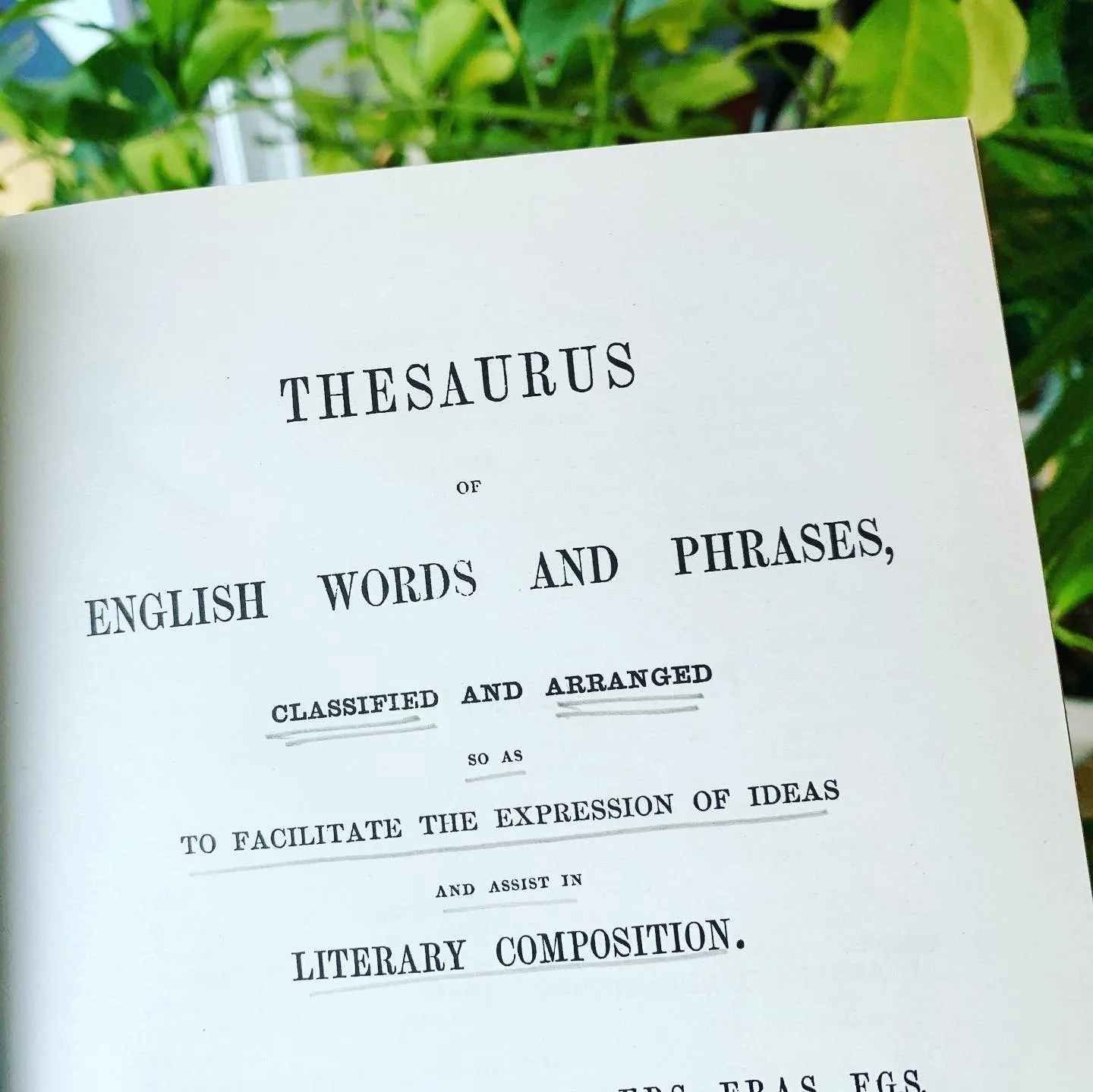
Austin Kleon on Roget’s Thesaurus…
I have always assumed — and maybe you have, too — that a thesaurus is just a synonym dictionary, the words arranged alphabetically with a list of synonyms and antonyms below. Somehow, every thesaurus I’d ever come across — even ones with “Roget” in the title! — had this alphabetic arrangement.
Because of this, it was easy for me to effectively ignore the thesaurus. If I needed a synonym or antonym, I’d just open an actual dictionary, or do a quick online search…
It turns out that Roget‘s Thesaurus is not at all what I thought it was. It is weirder and much more interesting…
… if you understand the man, you understand where his book came from. Peter Mark Roget (1779-1869) was a Victorian polymath: a doctor by trade, but he did all sorts of stuff: he was a consultant on pandemics, he wrote Encyclopedia Brittanica entries and a book about natural theology, he helped catalog several libraries, he invented the scale on the slide rule, and he may have written a paper that contributed to the birth of cinema. Oh, and he was also obsessed with chess problems.
The thing he is now most famous for — his thesaurus — was actually a side project he took up in retirement, in his seventies. His whole life he’d made lists as a way of soothing himself. He carried a notebook around with him and jotted down lists of related words and phrases to help him with his own writing and lecturing. He made his own personal thesaurus in his twenties, but in retirement he thought maybe it might be helpful to others, and after four years of work, he published the first edition of his Thesaurus (from the Greek word thēsauros, meaning “storehouse” or “treasure”) in 1852, overseeing new editions until he died in 1869. His son, John Lewis Roget, a lawyer, painter, and art critic, then took over the project.
Roget, like many Victorians, was obsessed with order and classification. His hero was Carl Linnaeus, known as the father of modern taxonomy. Roget wanted to classify and organize words in the English language. This is the best way to understand Roget’s Thesaurus: it’s not just a book of words, it’s like a library of words.
When you go to the library, the books are not arranged in alphabetical order — they’re organized topically. In order to find a book in my local library, you have to look up the book in the catalog, note the Dewey Decimal Number, then find it on the shelf. The beauty of this system, and a major argument for physical browsing collections, is that when you find the book on the shelf, it will be surrounded by books on the similar subject. You may go looking for one particular book and while browsing you might find a better book or the book you didn’t even know you were looking for. This is the way a thesaurus is supposed to work.
In the very beginning of his introduction to his book, Roget emphasizes that what makes his book unique and helpful is that the words are not arranged alphabetically, like a Dictionary, but “according to the ideas which they express.”…
The fascinating story of Roget’s Thesaurus: “A Library of Words,” from @austinkleon.
Browse the 1911 edition– still in the format Roget intended– at the Internet Archive.
###
As we look it up, we might send tasty birthday greetings to the literary genius behind green eggs and ham, Theodor Seuss Geisel, AKA “Dr. Seuss”; he was born on this date in 1904. After a fascinating series of early-career explorations, Geisel settled on a style that created what turned out to be the perfect “gateway drug” to book addiction– and a love of words– for generations of young readers.
The more that you read,
The more things you will know.
The more that you learn,
The more places you’ll go.
– I Can Read With My Eyes Shut! (1978)

“For last year’s words belong to last year’s language / And next year’s words await another voice”*…

As we pivot into 2023 (Happy New Year!), a retrospective on the way that 2022– Ukraine, the economy, China, climate change, pivots at Facebook and Twitter, the lingering pandemic– changed our language…
The story of a year is sometimes easy to identify: the financial crisis of 2008, the Brexit-Trump populist wave of 2016 or the pandemic of 2020. The most wrenching event of 2022 has been the war in Ukraine, yet those earlier stories have lingered in the headlines. For language-watchers, all that meant much new vocabulary to consider…
[After considering a number of other candidates…]
After the lockdowns of 2020, followed, in 2021, by a slow return to the office, 2022 was the year that hybrid work settled in. Working at home some of the time has advantages (decongesting cities and fewer painful commutes), and disadvantages (fears of lower productivity combined with a sense of never being off duty). In the spring Twitter announced a policy of unlimited working from home for those who wanted it. When Elon Musk bought the company he promptly decreed the opposite. But most firms have not gone to either extreme, instead trying to find the best of both worlds.
As a coinage, hybrid work is no beauty. But it will reshape cities, careers, family life and free time. That is ample qualification for a word of the year…
From @TheEconomist: “And the word of 2022 is…“
Here are some candidates for this year’s “word of the year”: “23 items of vital vocabulary you’ll need to know in 2023.”
And because it’s New Years Day, and it’s appropriate to look forward, not just back, some advice-like thoughts on 2023″: “Blank Page.”
* T. S. Eliot, Four Quartets
###
As we name it, we might recall that, on this date in 1995, the last installment of Gary Larsen‘s comic strip The Far Side (which had premiered on New Year’s Eve, 1979) ran. Carried by more than 1,900 daily newspapers, the strip was translated into 17 languages, and collected into calendars, greeting cards, and 23 compilation books; reruns are still carried in many newspapers. Indeed, after a 25 year hiatus, in July 2020 Larson began drawing new Far Side strips offered through the comic’s official website.

“One day I will find the right words, and they will be simple”*…
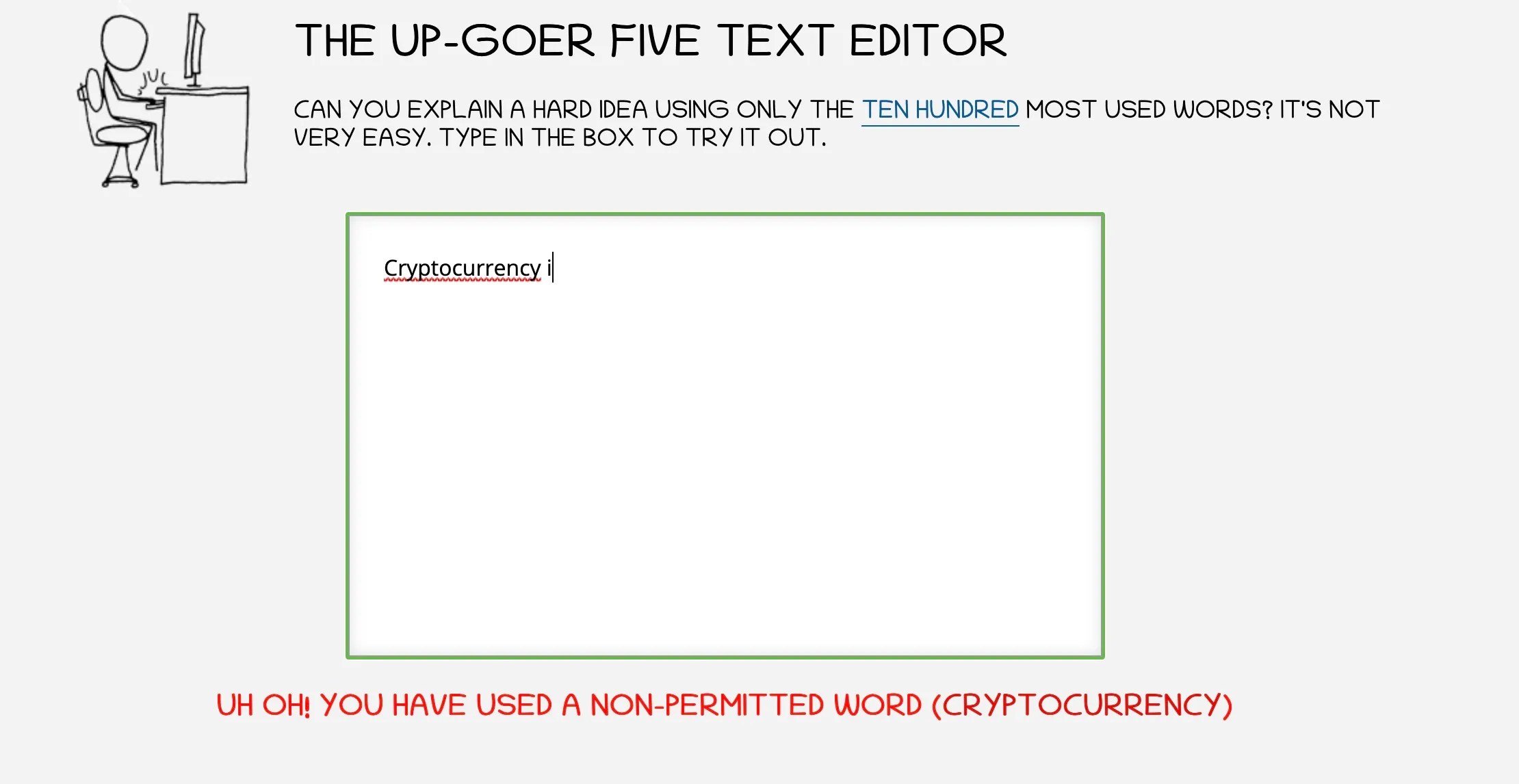
Putting it as simply as possible…
Try explaining something difficult or complex using only the most common thousand—sorry, ten hundred—words [the list is here]. The Up-Goer Five Text Editor isn’t a new idea (here’s a MacOS app from 2016) but now it’s on the web…
Boing Boing
Here’s your correspondent’s shot at explaining “Manichaeism”:

“Explain something with the thousand most used words in English,” via @BoingBoing.
* Jack Kerouac, The Dharma Bums
###
As we streamline, we might send tuneful birthday greetings to an avatar of a different kind of plain speaking, Steve Jones; he was born on this date in 1955. A musician and songwriter who has recorded and performed solo, in the short-lived supergroup Neurotic Outsiders with members of Guns N’ Roses and Duran Duran, and with the likes of Johnny Thunders, Iggy Pop, Bob Dylan, and Thin Lizzy, he is best remembered as the founding guitarist of The Sex Pistols (whose songs he co-wrote with John “Johnny Rotten” Lydon and drummer Paul Cook). He ranks in Rolling Stone‘s list of the “100 Greatest Guitarists of All Time.”

You must be logged in to post a comment.