Posts Tagged ‘theater’
“I shall have more to say when I am dead”*…

Brian Brodeur reassesses an unjustly-forgotten modernist…
On December 22, 2019, the sesquicentennial of a writer Donald Justice referred to as “the first modern American poet” passed without a whimper. Edwin Arlington Robinson (1869–1935) would’ve found this critical neglect fitting; obscurity was one of his perennial subjects. Though he won three Pulitzers and was a favorite poet of Theodore Roosevelt, Robinson, whose own mother waited seven months to name him, was attracted to characters few people acknowledged, cared about, or understood.
Before Robinson, very little lived experience had crept into the lines of late Victorian American poetry, which included the likes of rightly forgotten Richard Watson Gilder (1844–1909) and Robert Underwood Johnson (1853–1937): parlor versifiers Whitman famously dismissed as “tea-pot poets.” Rather than saturating his work with overblown symbols, hackneyed aphorisms, and hollow moralism, Robinson relied on the more sophisticated techniques of understatement, irony, and sparse detail. He also confronted such 19th-century taboos as alcoholism, homelessness, and assisted suicide.
So why has Robinson’s Collected Poems remained out of print since the 1970s? Like Henry Wadsworth Longfellow (1807–1882), another virtual nonperson for most 21st-century readers, Robinson is often overlooked as being insufficiently modern, unfashionably didactic, and even culturally problematic. Though this latter description might be justly applied to Longfellow’s The Song of Hiawatha (1855), which perpetuates stereotypes of Native American life, none of these epithets accurately describes Robinson.
Understanding this collective lapse in critical judgment begins by acknowledging that Robinson continues to challenge dominant literary conventions. To begin with, his poems almost always tell a story, almost exclusively in meter and nearly always in rhyme; he also valued clarity of style and rationality of thought over the experimental fragmentation of many high modernists, and, unlike the Confessional poets who came later, hardly ever wrote about himself explicitly. Another reason for his neglect involves a commonly held misconception about literary history. Though Robinson was born nearly 20 years before Ezra Pound (1885), many consider him a peer of the much younger modernists who are often lumped together with him in anthologies of modern American poetry. Robinson broke new ground in his best books, which were published between 1897 and 1925, but his poems can sound antique when compared to The Waste Land (1922) and The Pisan Cantos (1948).
Yet it serves to remember that art has no present without its past. Acknowledging practices of earlier periods gives poets the knowledgeable freedom to experiment in their own time. Robinson’s best work offers contemporary practitioners options, ways of writing largely ignored by 21st-century American poets…
An appreciation: “‘The Flicker, Not the Flame’: E. A. Robinson’s Narrative Compression,” from @bbrodeurpoet in @LAReviewofBooks.
* Edwin Arlington Robinson
###
As we give credit where credit is due, we might spare a thought for Maya Angelou; she died on this date in 2014. A poet, memoirist, and civil rights activist, she published several books of poetry, seven autobiographies, three books of essays, and is credited with a list of plays, movies, and television shows through a career that spanned over 50 years.
Her autobiographical work drew on her experiences as a fry cook, sex worker, nightclub performer, Porgy and Bess cast member, Southern Christian Leadership Conference coordinator, and correspondent in Egypt and Ghana during the decolonization of Africa. She went on to work as an actress, writer, director, and producer of plays, movies, and public television programs. Then, in 1982, she was named the first Reynolds Professor of American Studies at Wake Forest University. In 1993, Angelou recited her poem “On the Pulse of Morning” (1993) at the first inauguration of Bill Clinton (making her the first poet to make an inaugural recitation since Robert Frost at the inauguration of John F. Kennedy in 1961).
Angelou was nominated for the Pulitzer and the Tony, won three Grammys, and was awarded over 50 honorary degrees. She won the Spingarn Medal in 1994, the National Medal of Arts in 2000, and the Presidential Medal of Freedom in 2011. And in 2022 she became the first Black woman to be depicted on a U.S. quarter.

“I resemble that remark”*…

Swiss linguist and philosopher Ferdinand de Saussure articulated the modern version of a belief that dates from Plato, and extended through Locke to modern linguistic scholarship…
… that the letters and words in many writing and language systems have no relationship to what they refer to. The word “cat” doesn’t have anything particularly cat-like about it. The reason that “cat” means cat is because English speakers have decided so—it’s a social convention, not anything ingrained in the letters c-a-t. (According to Saussure, a language like Chinese, where each written character stands for a whole word, was a separate writing system, and his ideas were directed towards writing systems made up of letters or syllables.)
But new research calls this foundational assumption into question. “The Color Game,” created by researchers at the Max Planck Institute for the Science of Human History to study the evolution of language, suggests that there may be a representational relationship after all…
…the idea that words, or other signs, do actually relate to what they’re describing has been gaining ground. This is called iconicity: when a spoken or written word, or a gestured sign, is iconic in some way to what it’s referring to…
… research now suggests that our languages are riddled with iconicity, and that it may play a role in language evolution, and how we learn and process language. Along with this evidence from The Color Game, in the last decade and a half, an increase in cross-cultural studies has re-upped the attention on iconicity, and pushed back against the doctrine of arbitrariness.
“It is now generally accepted that natural languages feature plenty of non-arbitrary ways to link form and meaning, and that some forms of iconicity are pretty pervasive,” said Mark Dingemanse, a linguist at Radboud University, who said that he too learned in Linguistics 101 that “the sign is arbitrary.” “Iconicity has become impossible to ignore.”…
Iconicity has always been around. One familiar example is onomatopoeias, like “ding-dong,” “chirp,” or “swish”—words that sound like what they’re referring to. Those words aren’t random, they have a direct relationship to what they represent. Yet, onomatopoeias were thought to be the exception to a wholly arbitrary set of signifiers, said Marcus Perlman, a lecturer in English language and linguistics at the University of Birmingham. This belief persisted despite hints that other words might have some connection to what they signified…
There could also be iconicity in what the letters themselves look like, and not just the sounds or gestures of words. In 2017, linguists Nora Turoman and Suzy Styles showed people who spoke unfamiliar languages different letters and asked them to guess which made the /i/ sound (“ee” in feet), and which was /u/ (“oo” sound in shoe). The participants were able to do so better than chance just by looking at the shape of the letters…
Language is most likely a mix of arbitrariness and iconicity, Perlman said, along with something called systematicity, when relationships form between words and meaning that aren’t necessarily iconic. (An example is words that start with gl- in English often are related to light, like glisten, glitter, gleam, and glow. There’s nothing necessarily light-like about the sound gl-, but the relationship is still there.)
Morin thinks of iconicity as the “icing on the cake” of language. It makes words more intuitive, more easy to guess. Iconicity might make languages easier to learn; Kim said there’s a saying about Hangul, that: “A wise man can learn it in a morning, and a fool can learn it in the space of ten days.”…
Rethinking our most fundamental tool, as new research reveals a connection between what words look and sound like, and what they mean: “Why Are Letters Shaped the Way They Are?,” from @shayla__love in @motherboard.
* Curly, in The Three Stooges’ “Idle Roomers“
###
As we reflect on resemblance, we might spare a thought for a champion of a different sort of mimesis: James Morrison Steele (“Steele”) MacKaye; he died on this date in 1894. A well-known theatrical actor, dramatist, producer, and scenic innovator in his time, he is best remembered for his revolutionary contributions to theatrical design. MacKaye opened the Madison Square Theatre in 1879, where he created a huge elevator with two stages stacked one on top of the other so that elaborate furnishings could be changed quickly between scenes. MacKaye was the first to light a New York theatre– the Lyceum, which he founded in 1884– entirely by electricity. And he invented and installed overhead and indirect stage lighting, movable stage wagons, artificial ventilation, the disappearing orchestra pit, and folding seats. In all, MacKaye patented over a hundred inventions, mostly for the improvement of theatrical production and its experience.

“Comedy too can sometimes discern what is right”*…

What’s old is new again…
When Cardi B and Megan Thee Stallion released ‘WAP’ in August 2020, ‘conservative’ commentators such as Tucker Carlson expressed outrage that the song might corrupt ‘your granddaughters’; Alyssa Rosenberg in the Washington Post celebrated it as an ‘ode to female sexual pleasure’. The video featured the two long-lashed goddesses twerking their way through a gilded McMansion in fabulous candy-coloured outfits, like bethonged Disney princesses. The lyrics create a cluster of ambiguities: are the speakers supposed to be sex workers struggling to pay their college tuition and running in fear from ‘the cops’, or wealthy A-list celebrities? Or are they, as Black women in a white man’s world, both? Do they really want anyone but each other? Do they own the house through which they strut? The song mocks its listeners and viewers for yearning for these superior beings in their state of limitless desire. At the same time, its sly laughter invites us to feel, for a couple of minutes, part of their glittering, multicoloured world.
The song’s genius lies in its inventiveness: its mastery of rhythm, and its innovative abundance of metaphors for the ‘wet-ass pussy’ of its title. You come for the nasty, but you stay for the poetry. The two artists celebrate the power of their bodies to express desire and joy, but more fundamentally, they celebrate their gushing waterfalls of linguistic ‘flow’. The joke of the title hinges on the fact that language is both literal and metaphorical: one body part is used as a linguistic modifier for another. The most memorable lines contain no words that would be unsuitable for a nursery school sing-along, but provide brilliantly funny images: ‘Swipe your nose like a credit card’, ‘Get a bucket and a mop’, or – climactically – ‘Macaroni in a pot’. It’s wild and down to earth at the same time, and for ever changes the way you think about cooking spaghetti.
Ancient Athenian comedy of the fifth century BCE – mostly known to us through the work of Aristophanes – can be usefully compared to a number of different modern genres. Like traditional TV sitcoms, it featured typical or stereotypical characters, and showcased their ridiculous lust, avarice, stupidity and ambition. Like modern stand-up comedians or late-night TV hosts, comic poets included speeches in their plays in which they railed at the audience about the state of society and their personal grievances. Like Saturday Night Live, comedy in fifth-century Athens included caricatures of people who might well have been in the audience – such as Socrates, Euripides or the politician Cleon. Like The Simpsons or 30 Rock, the dialogue had a high rate of jokes per minute, and catered to multiple different audience sensibilities, including a taste for lavatory humour. As in Broadway musicals or on the Disney Channel, characters in lavish costumes were liable to burst into song and dance at any moment – although, unlike on Hannah Montana, the male characters wore large strap-on phalluses. Old Comedy anticipated modern sci-fi, and shows like The Good Place, in its willingness to carry out fantastical thought experiments (talking frogs, a city of birds, a singing chorus of metaphysically inclined clouds, or, weirdest of all, women with real political power), and considered their social and political repercussions. Like pantomime or Punch and Judy, it included formulaic riffs on falling over, violence and cross-dressing.
But the lush comic hip-hop of Megan Thee Stallion and Cardi B is one of the most useful modern analogues, because it illustrates the core element of Old Comedy that is most often obscured in contemporary Anglophone translations – the flow. Aristophanes, like the creators of ‘WAP’, was a musician, songwriter, choreographer and poet, and his linguistic effects depend, like theirs, on the artful manipulation of rhythm and sound in words and imagery. The poetic affinity between rap and Old Comedy is explored in Spike Lee’s film Chi-Raq, a hip-hop adaptation of Lysistrata set on the South Side of Chicago…
Aristophanes and rap: “Punishment By Radish,” from Emily Wilson (@EmilyRCWilson), the translator of a wonderful edition of The Odyssey.
* Aristophanes
###
As we LOL, we might we might send dramatic birthday greetings to Nathan Field; he was born on this date in 1587. A contemporary and colleague of Shakespeare, Field was– like the Bard– both a dramatist and an actor.
As an author, Field wrote alone (e.g., the comedy A Woman Is a Weathercock), and in collaboration with John Fletcher and Philip Massinger (e.g., the tragicomedy The Knight of Malta). As an actor he ended his career in the Kings Men, working alongside Shakespeare, where he appeared in Shakespeare’s plays and in Ben Jonson‘s Volpone and The Alchemist, among other productions.

“Any subject is good for opera if the composer feels it so intently he must sing it out”*…

We know that opera took the form we know today in Italy the first half of the 17th century, when what had largely been ponderous courtly spectacles mutated into the lively popular art that opera has remained for the past 400 year. But why did operas as we know them become… well, operas as we know them?
Why did opera first succeed as a public art form in Venice between 1637 and 1650 when all the elements of the new form were fully evident? The answer is to be found in the conjunction between Venetian carnival festivity and the intellectual politics of Venetian republicanism during the two generations after the lifting of the papal interdict against Venice in 1607. During this extraordinary period of relatively free speech, which was unmatched elsewhere at the time, Venice was the one place in Italy open to criticisms of Counter Reformation papal politics. Libertine and skeptical thought flourished in the Venetian academies, the members of which wrote the librettos and financed the theaters for many of the early Venetian operas.
How opera became Opera: “Why Venice? Venetian Society and the Success of Early Opera,” from Edward Muir (@EdwardMuir7)
* Gian Carlo Menotti
###
As we fiddle with Fidelio, we might recall that it was on this date in 1600 that Euridice, an opera by Jacopo Peri, with additional music by Giulio Caccini, was first performed in Florence; the libretto by Ottavio Rinuccini is based on books X and XI of Ovid’s Metamorphoses. which recount the story of the legendary musician Orpheus and his wife Euridice. A presage of what was later to flourish in Venice, it is the oldest surviving opera (though the same authors wrote the now-lost Dafne two years earlier), and is generally regarded as marking the dawn of the Baroque period.

“Playing bop is like playing Scrabble with all the vowels missing”*…
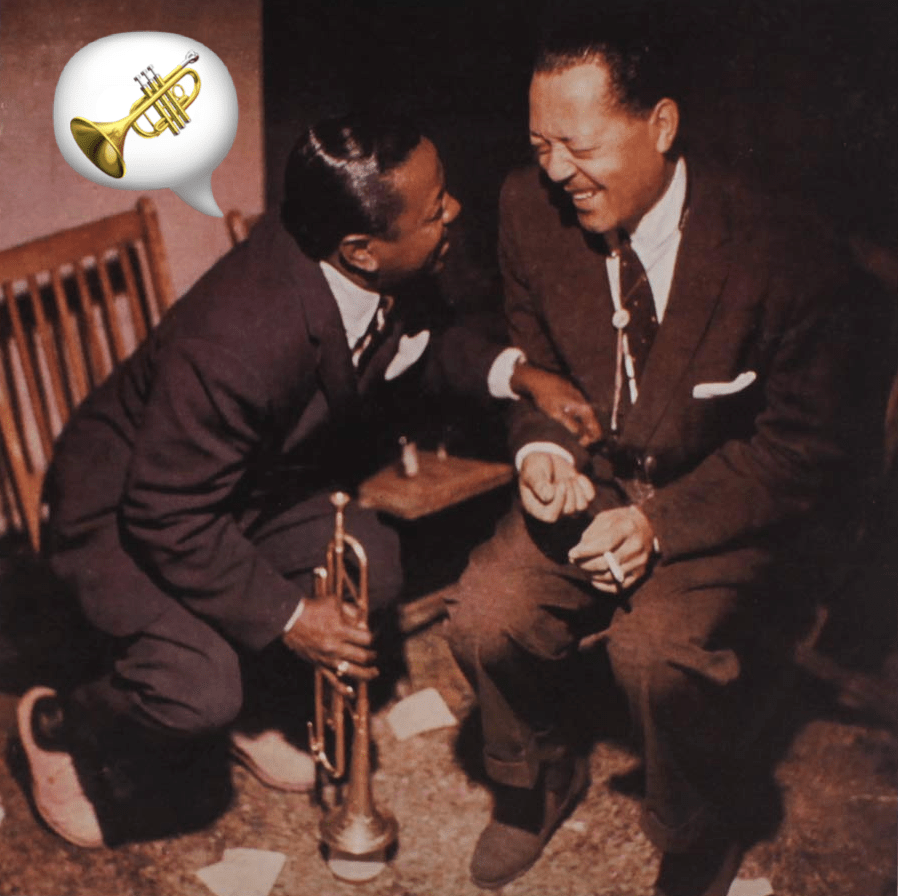
Jazz as a form of wit…
Jazz, like wit, can be broadly defined as surprising creativity. So does it follow that jazz musicians are a witty bunch?
I’ve wondered about this for longer than Kenny G has held an E-flat (45 minutes, for the record) but lacked a way to prove it.
There was some promising neuroscience research on the subject back in 2014 that linked conversation to trading fours. Both jawing and jamming involve “an exchange of ideas that is unpredictable, collaborative, and emergent,” the paper hypothesized. In other words, a riff is a riff.
That said, all the actual data was pretty flat. The researchers brought the musicians into the lab, wired them up, and let them noodle around while they watched the blood slosh through their brains via a functional MRI machine. It went to the same spots it would go in a conversation, they found, which was interesting as far as it went but didn’t go all that far.
So when I came across the book Jazz Anecdotes at Sellers & Newel, I knew this was what I was looking for. I immediately flipped my fMRI machine on Kijiji and grabbed a copy.
Jazz anecdotes, like jazz itself, aren’t usually transcribed. In the words of drummer Shelley Manne, “We never play anything the same way once.”
But bassist, writer, and editor Bill Crow combed through hundreds of interviews and biographies to pick just the juiciest bits, and the best display a virtuosic level of verbal dexterity. The book really slaps, as they say. There’s a whole chapter on pranks, and in said chapter there’s a whole section on Limburger cheese. (You can flip through a digitized version over at the invaluable archive.org here.)
Start with the nicknames, which alone are worth the price of admission. Fats, Shorty, and Slim were all physical descriptors. Cannonball Adderley was originally called Cannibal because of his voracious appetite — but one problem took care of the other as he rounded out.
William Randolph Cole was known as Colesy, which evolved into Cozy. Cozy, in turn, couldn’t remember names so he called everyone “Face” if they looked familiar, and then added the name of the instrument they played for Bass Face, Sax Face, and so on. Bassist George Mraz was called Bounce because he was a baaaad Czech. And bassist John Simmons got a rise out of trumpeter Oran “Hot Lips” Page by announcing at the bandstand, “Lady there at the door sent this letter to Mr. Warm Jaws.”
The greats get a chapter each, and they’re at their best when they’re playing off one another. Once John Coltrane started playing a solo, he’d just play and play —which irritated those who shared the bandstand. “I get involved in this thing and I don’t know how to stop,” he told Miles Davis, to which Davis suggested, “Try taking the saxophone out of your mouth.” Why did he play so long, Davis asked? “It took that long to get it all in.”
The pianist Errol Garner had a similar issue at a recording session in 1969. The red light in the booth flickered off, but he kept right on playing. “I couldn’t stop,” he said. “I wanted to find out how it would come out.”
The difference between live wit and recorded repartee is like the difference between fresh squeezed orange juice and the frozen concentrate. So leave the last words to Louis Armstrong, who refused to describe exactly what he did so well.
How did he define jazz, exactly? “Jazz is what I play for a living.”
Would you describe it as folk music? “Man, all music is folk music. You ain’t ever heard no horse sing a song, have you?”
Making it along as you go up: “The wit of jazz, and vice versa,” from Benjamin Errett (@benjaminerrett)
* Duke Ellington
###
As we improvise, we might recall that it was on this date in 1899 that Sarah Bernhardt became the first woman to portray Hamlet on film…
The French actress was certainly a force to be reckoned with. In 1899, she took over the Théâtre de Ville in Paris and renamed it the Théâtre Sarah-Bernhardt, which is, as one Lit Hub editor once put it, “basically cell phone providers in the early ’00s levels of confidence.” That same year, she premiered a new production of Hamlet, with herself in the title role—a production that she would eventually also take on tour. Critics were divided—not only was she a woman, but she was a woman in her mid-fifties!—but audiences were largely enthralled, and if nothing else, the performance is now legendary.
Bernhardt may not have been the first female Hamlet—that was probably 18th-century actor Charlotte Charke—but she was the very first to play the Prince of Denmark (a bro who didn’t even like sex, mind you) on screen. On October 1, 1900, the audience of the Paris Exposition (also known as the Exposition Universelle) was treated to Le Duel d’Hamlet, the very first known film adaptation of Hamlet—albeit one that is only a minute and a half long, comprising a single scene: the Act V duel between Hamlet and Laertes. The short was filmed only a year after Bernhardt first played the role; in it, she is 56. “She’s somber, quick, natural—easily expert with her sword and clearly used to dueling,” Robert Gottlieb wrote in a biography of the actress. “There’s nothing campy or feminine about her; she’s manly and she’s coolly resolved. This isn’t an exhibition of virtuoso acting—it’s modest, in fact. But it’s certainly a vindication of her right to perform the greatest of male roles, and a welcome clue as to how she pulled it off.” Indeed. Luckily, we have even more female Hamlets in our future.
LitHub
“There are five kinds of actresses: bad actresses, fair actresses, good actresses, great actresses, and Sarah Bernhardt.” – Mark Twain
You must be logged in to post a comment.