Posts Tagged ‘regulation’
“When I give food to the poor, they call me a saint. When I ask why the poor have no food, they call me a communist.”*…
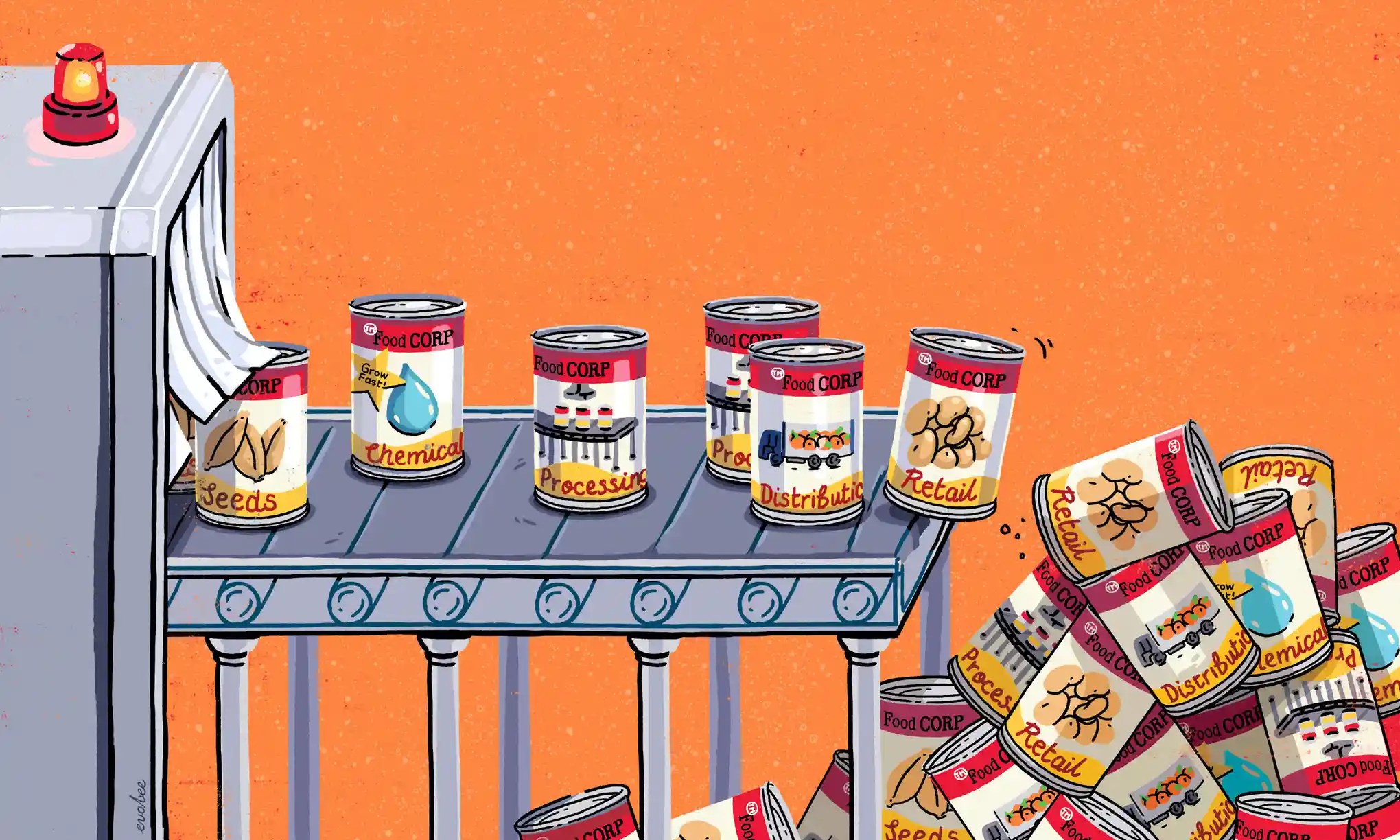
Staying yesterday’s agribusiness theme: George Monbiot on the extraordinary challenges facing the world’s food system…
For the past few years, scientists have been frantically sounding an alarm that governments refuse to hear: the global food system is beginning to look like the global financial system in the run-up to 2008.
While financial collapse would have been devastating to human welfare, food system collapse doesn’t bear thinking about. Yet the evidence that something is going badly wrong has been escalating rapidly. The current surge in food prices looks like the latest sign of systemic instability.
Many people assume that the food crisis was caused by a combination of the pandemic and the invasion of Ukraine. While these are important factors, they aggravate an underlying problem. For years, it looked as if hunger was heading for extinction. The number of undernourished people fell from 811 million in 2005 to 607 million in 2014. But in 2015, the trend began to turn. Hunger has been rising ever since: to 650 million in 2019, and back to 811 million in 2020. This year is likely to be much worse.
Now brace yourself for the really bad news: this has happened at a time of great abundance. Global food production has been rising steadily for more than half a century, comfortably beating population growth. Last year, the global wheat harvest was bigger than ever. Astoundingly, the number of undernourished people began to rise just as world food prices began to fall. In 2014, when fewer people were hungry than at any time since, the global food price index stood at 115 points. In 2015, it fell to 93, and remained below 100 until 2021.
Only in the past two years has it surged. The rise in food prices is now a major driver of inflation, which reached 9% in the UK last month. [Current estimates are that it will be 9% in the U.S. as well.] Food is becoming unaffordable even to many people in rich nations. The impact in poorer countries is much worse.
So what has been going on?…
Spoiler alert: massive food producers hold too much power – and regulators scarcely understand what is happening. Sound familiar? “The banks collapsed in 2008 – and our food system is about to do the same,” from @GeorgeMonbiot in @guardian. Eminently worth reading in full.
Then iris out and consider how agricultural land is used: “Half of the world’s habitable land is used for agriculture.”

… and consider the balance between agriculture aimed at producing food directly and agriculture aimed at producing feed and fuel: “Redefining agricultural yields: from tonnes to people nourished per hectare.”

###
As we secure sustenance, we might send carefully-observed birthday greetings to Dorothea Lange; she was born on this date in 1885. A photographer and photojournalist, she is best known for her Depression-era work for the Farm Security Administration (FSA). Lange’s photographs influenced the development of documentary photography and humanized the consequences of the Great Depression.


“This City is what it is because our citizens are what they are”*…

Joel Stein on the ascendance of Miami…
The last time Miami was relevant, it wasn’t important. In the 1980s, Miami provided nothing more than drugs, clubs, pastel blazers, jai alai gambling and, most notably, a hit TV show about all four.
But now Miami is the most important city in America. Not because Miami stopped being a frivolous, regulation-free, climate-doomed tax haven dominated by hot microcelebrities. It became the most important city in America because the country became a frivolous, regulation-free, climate-doomed tax haven dominated by hot microcelebrities…
How a refuge for the retired, divorced, bankrupt, and unemployed has evolved into a “paradise of freedom”: “How Miami became the most important city in America,” from @thejoelstein in @FinancialTimes. (A “gifted” article, so should be free of the paywall.)
An apposite look at ascendant cities worldwide, but especially in Africa: “Africa’s rising cities” (also “gifted”).
* Plato
###
As we investigate epicenters, we might recall that it was on this date in 1986 that figure skater Debi Thomas, a Stanford undergraduate, became the first African American to win the Women’s Singles event in the U.S. National Figure Skating Championship competition. She went on to win a gold medal in the World Championships later that year, and then (after battling Achilles tendinitis in both ankles) to earn a Bronze in the 1988 Olympics.
Thomas then attended medical school at Northwestern, and has since practiced as a surgeon.

“There are two times in a man’s life when he shouldn’t speculate: when he can afford to and when he can’t.”*…

Robinhood, the trading platform supposedly meant “to democratize finance for all”: not all change is progress; not all “disruption” is for the good…
… What is Robinhood?
The company operates a mobile app that enables consumers to trade stocks, options, and crypto. These orders are the company’s inventory, which it sells to “market makers” — large financial institutions that pare (execute) the trades in the market. As with Google or Facebook, Robinhood’s users are not its customers, but its supply.
This means Robinhood is incentivized to keep its users trading … a lot. The goal: make stock trading as addictive as social media scrolling. RH has enjoyed success here. The proportion of users who check it daily rivals those of Twitter, Snapchat, and Facebook.
…
The transaction at the heart of the company’s model is “Payment for Order Flow” or PFOF. Because RH generates its revenue by selling orders to market makers, it doesn’t charge commissions to its consumer users. But this also creates a conflict of interest for the company, which is motivated to sell orders to the market maker that offers the highest payment for the trade rather than the best price. It’s like affiliate marketing, but for your financial future.
PFOF goes back to the 1980s, when it was pioneered by, wait for it … Bernie Madoff. Madoff relied on the practice to make his firm one of the leading market makers of its day, and when regulators raised questions about whether it presented a conflict of interest, he used his position as the chairperson of Nasdaq to prevent restrictions. (PFOF is illegal in the U.K.) There was no conflict of interest, Madoff assured his colleagues, because “there are very strict rules that I would assume most firms comply with.”
Robinhood is the latest example of an increasing trend: tech companies for whom illegality is a feature, not a bug. Uber is an $86 billion gypsy cab company. Facebook and Google have received so many fines, it’s likely the companies internally classify them as a cost of doing business. This is tantamount to replacing civics courses with prison training, because … well … that’s how we roll.
For its part, RH has racked up: a $70 million settlement with FINRA, a $65 million SEC fine (for failing to properly disclose PFOF), and a separate $1.25 million FINRA fine. And on Wednesday, on the eve of pricing its IPO, the company disclosed that its senior executives are under investigation by FINRA for failing to acquire broker-dealer licenses. In addition, another inquiry is under way into the possibility that RH employees made illegal insider trades during the GameStop frenzy early this year.
Once, that type of disclosure would have dismembered an IPO. Instead, 48 hours after it made the disclosure, Robinhood was publicly trading at $32 billion. Telling point: The company paid its chief legal officer, Daniel Gallagher, more than $30 million in 2020, even though it hired him halfway through the year. From 2011 to 2015, Gallagher was an SEC Commissioner. Our business environment has morphed from capitalism, which depends on the rules of fair play, into cronyism.
Flouting the law is now a signal to investors that a firm is “disruptive.” Established companies, which believe they have too much to lose, have spent years investing in a culture of compliance to protect themselves. Disrupters, with access to cheap capital and few legacy assets, have no such constraints. In Robinhood’s case, no less an establishment bulwark than Goldman Sachs has blessed its approach to business by taking the lead on the company’s IPO. Forget orange — criminality without consequence is the new black.
…
In practice, Robinhood’s activities look more like the dispersion of financial risk than the “democratization of finance” — kind of like if a for-profit prison claimed to be “democratizing housing.” As both an app and as an investment, RH makes more sense in the context of gambling than investing. Its business model depends on active traders, but research shows the more active traders are, the more money they lose. Likewise, the casino isn’t making much off the blackjack player who sits at the $5 table cadging free drinks, but it hopes the lure of easy money (and the lubrication of those free drinks) will loosen his pockets eventually.
Greater gambling access is becoming a trend. The illegal sports betting market, estimated at $150 billion a year, is rapidly moving to legal online forums. You can now place a sports bet from your couch in 20 states and counting, and mobile gambling apps are reaping the rewards. Since its SPAC listing in April 2020, DraftKings’ stock is up 160%. I don’t have a problem with this, as these firms state what they’re made for: gambling.
Another market that’s benefited from our insatiable appetite for risk? Crypto. Robinhood caught that trend early and introduced crypto trading to its platform in February 2018. Since then, the global crypto market has grown from $450 billion to $1.9 trillion. In the first three months of 2021, 6% of RH’s revenue came from Dogecoin trades. If that sounds like an unstable business model, trust your instincts.
Here’s what we’re saddled with: A trend of companies that prey on our financial naiveté, with no regard for law or morality and infinite amounts of capital. What can we do?
First, it’s long past time for the rule of law to reassert itself. Five years ago, admissions to elite universities were awash in bribery and fraud. Then the feds put some wealthy lawyers, investors, and television stars in jail. Did it work? I’d venture that if any parent receives an offer of a “side door” for their kid to get into an elite university today, the parent hangs up, crisply.
Second, we need to arm ourselves, and particularly our young people, with financial literacy. Everyone should be fluent in the basics of markets and how to build financial security. My NYU colleague Aswath Damodaran believes the best regulation is life lessons. Perhaps basic lessons in finance (e.g., not to trade on an app that harvests its orders for revenue) would lessen the pain of these lessons. If we can offer computer science and Mandarin in schools, we should offer courses in financial literacy. The English-as-a-second language course in any capitalist society ought to be in money.
…
We’ve implemented policies in the U.S. that have resulted in a halving of the wealth of Americans under the age of 40 (as a percentage of household wealth) over the past three decades. With so much less to lose, today’s young Americans are justifiably looking for new asset classes and embracing volatility. Put another way, there is cause for a rebellion. The food industrial complex wants you to be fat, social media wants you to be divided, and RH wants you to believe you can get rich quick by day trading. Rebel.
When the democratization of finance isn’t: “$HOOD.” Scott Galloway (@profgalloway) on the dangerously disingenuous Robinhood.
* Mark Twain
###
As we reconcile ourselves to the fact that if it seems to be too good to be true, it is, we might recall that it was on this date in 2018 that Apple became the first U.S.-based company with a $1 trillion market cap. Shares of Apple rose 2.9% on the day, closing at $207.39, giving the company a $1.002 trillion valuation. Shares of Apple’s stock were up about 40,000% since Apple computer’s IPO on December 12th, 1980.
Amazon broke the $1 trillion milestone a month later on September 4th, 2018. Microsoft reached the milestone nearly a year later, on April 25th, 2019.

“Create more value than you capture”*…

As Donald Trump’s presidency careened to its ignominious end, with a mob of his supporters storming of the US Capitol, Facebook and Twitter banned the US president for inciting the violence. With that act, the scope of the political power wielded by Big Tech became impossible to ignore.
Whether these platforms have too much political power is a debate that is just beginning. Their outsize economic power, though, is unquestionable. The combined market capitalization of the five largest US tech platforms – Alphabet (Google), Amazon, Apple, Facebook, and Microsoft – rose by $2.7 trillion in 2020. Following the addition of Tesla to the S&P 500, the Big Six tech firms now represent nearly one-quarter of the index’s valuation. And with the spread of COVID-19, the leading digital platforms have become de facto essential service providers, enabling a mass transition to remote and isolated living.
And yet the political pressure on Big Tech has continued to rise. There is a growing consensus that platforms have been abusing their power, driving profits by exploiting consumer privacy, crushing the competition, and buying up potential rivals.
…
The economics of platforms is different from the economics of traditional offline and one-sided markets. Policymakers therefore need to reconsider some of their most basic assumptions, asking themselves whether they are even focusing on the right things.
A key challenge is to determine how the value of data diverges from the value created by providing a data-generating service. Platforms have the power to shape how decisions are made, which in turn can alter the value of the data being amassed. The implication, as Google co-founders Larry Page and Sergey Brin foresaw in a 1998 paper, is that advertisers or any other third-party interest can embed mixed motives into the design of a digital service. In the case of internet search, the advertising imperative can distract from efforts to improve the core service, because the focus is on the value generated for advertisers rather than for users.
As this example shows, it is necessary to ask who benefits the most from the design of a given service. If a platform’s core mission is to maximize profits from advertising, that fact will shape how it pursues innovation, engages with the public, and designs its products and services.
Moreover, it is important to understand that even if antitrust authorities were empowered to break up companies like Google and Facebook, that would not eliminate the data extraction and monetization that lie at the heart of their business models. Creating competition among a bunch of mini-Facebooks would not weed out such practices, and may even entrench them further as companies race to the bottom to extract the most value for their paying customers…
Digital markets do not have to be extractive and exploitative. They could be quite different, but only if we ourselves start to think differently. We need to recognize, as Adam Smith did, that there is a difference between profits and rents – between the wealth generated by creating value and wealth that is amassed through extraction. The first is a reward for taking risks that improve the productive capacity of an economy; the second comes from seizing an undue share of the reward without providing comparable improvements to the economy’s productive capacity.
For the past half-century, corporate governance has rested on the notion of shareholder value. The result is an economy in which it is increasingly important to differentiate firms that are actually driving innovation from those that are not. There is no shortage of firms that are engaged merely in financial engineering, share buy-backs, and rent-seeking, extracting gains from actual risk takers while under-investing in the goods and services that generate value.
The digital economy has accelerated this conflation of wealth creation and rent extraction, making it all the more difficult to differentiate between the two. The issue is not just that financial intermediaries are shaping how value is created and distributed across firms, but that these extractive mechanisms are embedded within user interfaces; they are baked into digital markets by design…
The proliferation of such practices shows why we need to focus more on the “how” of wealth creation, and less on the “bottom line.” An economy that produces wealth from privacy-respecting innovations would not function anything like one that encourages the systematic exploitation of private data.
But building a new economic foundation will require a shift from the shareholder model to a stakeholder model that embodies a deeper appreciation of public value creation. Wealth and other desirable market outcomes are collectively co-created among public, private, and civic domains, and should be understood as such. Policy analysis and corporate decision-making can no longer be guided solely by concerns about maximizing efficiency. We now also must consider whether wealth generation is actually improving society and strengthening the ability to respond to social challenges.
After all, the fact that platforms are creating wealth does not mean they are creating public value. A firm with access to massive amounts of data and network effects could, in theory, use its position to improve social well-being. But it is unlikely to do so if it is operating under a framework that prizes the generation of advertising revenue over everything else, including the performance of products and services…
Today’s digital economy has grown up around a business model of data and wealth extraction, confounding traditional antitrust paradigms and undermining the public and social value that otherwise could be derived from technological innovation. An acute diagnosis of a fundamental structural challenge, and thoughts on steps to address it– Mariana Mazzucato (@MazzucatoM), Tim O’Reilly (@timoreilly), and colleagues: “Reimagining the Platform Economy.” Do click through to read piece read the entire piece.
* Tim O’Reilly
###
As we dig deep, we might recall that it was on this date in 2005 that YouTube was founded and registered (though it didn’t launch until November of that year). The creation of three PayPal vets (Chad Hurley, Steve Chen, and Jawed Karim), it was bought by Google one year after launch (in November 2006) for $1.65 billion. Operating as one of Google’s subsidiaries, it is now (per Alexa Internet Rankings) the second most trafficked web site, after its parent’s search page.

“All history is the history of unintended consequences”*…
Your correspondent confesses that this piece is mildly geeky in an “inside baseball” kind of way. But beyond its importance in its own right, it raises a possible broader systemic issue worth pondering…
Urged on by broadband giants such as Charter Communications, Senate Majority Leader Mitch McConnell (R-KY) is pushing to confirm a Republican to the Federal Communications Commission. However, McConnell’s goal seems to extend further: creating a deadlocked Biden FCC 2–2, then blocking confirmation of a third Democrat. What McConnell intends as a gift to his corporate patrons could turn into a nightmare for them.
McConnell and his allies believe they can force the Biden FCC into a business friendly “consensus agenda” that will move forward on 5G and corporate consolidation while blocking Democratic priorities such as net neutrality and broadband subsidies for the poor. And perhaps that is how the Democrats will respond. But in this new world of total war between Democrats and Republicans, this deadlock creates the incentive and ability for the Democratic FCC Chair to use her authority over the agency’s bureaus to push back and pressure anyone standing in the way of a full commission.
Not everything at the FCC requires a vote of the Commission. The vast majority of day-to-day work happens through the FCC’s many offices and bureaus — all of which report to the Chair. These actions must be appealed to the full Commission before parties can go to the courts. Absent the usual rulemaking process, a Democratic FCC Chair can — and should — take large (and largely unreviewable) steps to advance a consumer protection agenda without a single Commission vote.
Even more powerfully, the Chair can effectively shut down the agency until Republicans approve a third Democrat. While this sounds like an industry dream, this would quickly devolve into an industry nightmare as the necessary work of the FCC grinds to a halt. Virtually every acquisition by a cable provider, wireless carrier, or broadcaster requires FCC approval. Unlike in antitrust law, there is no deadline for the agency to act. The Chair of a deadlocked FCC could simply freeze all mergers and acquisitions in the sector until Democrats have a majority.
If that does not work, the FCC Chair could essentially put the FCC “on strike,” cancelling upcoming spectrum auctions and suspending consumer electronics certifications (no electronic equipment of any type, from smartphones to home computers to microwave ovens, can be sold in the United States without a certification from the FCC that it will not interfere with wireless communications). Such actions would have wide repercussions for the wireless, electronics, and retail industries. But the FCC Chair could slowly ratchet up the pressure until industry lobbyists pushed Republicans to confirm a third Democrat.
Finally, we come to net neutrality. Stopping the Biden FCC from restoring the Obama-era legal framework for broadband is the grand prize that supposedly justifies McConnell’s unprecedented obstructionism. Even here, the next FCC Chair can act. At present, the FCC is suing the state of California to block California’s own net neutrality law. The FCC can switch sides in the litigation, throwing its weight against the industry and supporting the right of states to pass their own net neutrality laws. The FCC can do the same in the D.C. Circuit — no Commission vote required.
Political observers might question whether a Biden FCC Chair would take such brazenly political action and put at risk so much of the economy. Admittedly, Democrats often seem to lack the same willingness as Republicans to engage in Mutually Assured Destruction. But we live in a time of unprecedented polarization and partisan division — as the last-minute campaign to deadlock the FCC shows. The only way for President-elect Biden and Democrats to work with Republicans is to show them at the outset that they can be just as destructive to Republican interests and constituencies as Republicans are to Democratic interests and constituencies. And there’s no better way to do that than to threaten the corporate chieftains at the top of the Republican food chain, the ones currently urging Republicans to deadlock the FCC.
Rather than an industry-friendly “consensus agenda,” Senator McConnell and his Wall Street allies are setting the stage for a war of total destruction. Wise investors should sell now and wait for the dust to clear — if it ever does.
Harold Feld (@haroldfeld), Senior Vice President of Public Knowledge, on how Senator McConnell’s strategy of obstruction might backfire: “In the Republican War on the Biden FCC, Wall Street May End Up the Biggest Loser.”
* historian T.J. Jackson Lears
###
As we focus on Georgia, we might recall that it was on this date in 1948 that the United Nations adopted the Universal Declaration of Human Rights. Of the 58 members of the U.N. at the time, 48 voted in favor, none against, eight abstained, and two did not vote. Considered a foundational text in the history of human and civil rights, the Declaration consists of 30 articles detailing an individual’s “basic rights and fundamental freedoms” and affirming their universal character as inherent, inalienable, and applicable to all human beings.
The full text– eminently worth reading– is here.

You must be logged in to post a comment.