Posts Tagged ‘photography’
“When it comes to privacy and accountability, people always demand the former for themselves and the latter for everyone else”*…

As we contend with ‘answers” from AI’s that, with few exceptions, use source material with no credit nor recompense, we might ponder the experience of our Gilded Age ancestors…
In 1904, a widow named Elizabeth Peck had her portrait taken at a studio in a small Iowa town. The photographer sold the negatives to Duffy’s Pure Malt Whiskey, a company that avoided liquor taxes for years by falsely advertising its product as medicinal. Duffy’s ads claimed the fantastical: that it cured everything from influenza to consumption, that it was endorsed by clergymen, that it could help you live until the age of 106. The portrait of Peck ended up in one of these dubious ads, published in newspapers across the country alongside what appeared to be her unqualified praise: “After years of constant use of your Pure Malt Whiskey, both by myself and as given to patients in my capacity as nurse, I have no hesitation in recommending it.”
Duffy’s lies were numerous. Peck (misleadingly identified as “Mrs. A. Schuman”) was not a nurse, and she had not spent years constantly slinging back malt beverages. In fact, she fully abstained from alcohol. Peck never consented to the ad.
The camera’s first great age—which began in 1888 when George Eastman debuted the Kodak—is full of stories like this one. Beyond the wonders of a quickly developing art form and technology lay widespread lack of control over one’s own image, perverse incentives to make a quick buck, and generalized fear at the prospect of humiliation and the invasion of privacy…
… Early cameras required a level of technical mastery that evoked mystery—a scientific instrument understood only by professionals.
All of that changed when Eastman invented flexible roll film and debuted the first Kodak camera. Instead of developing their own pictures, customers could mail their devices to the Kodak factory and have their rolls of film developed, printed, and replaced. “You press the button,” Kodak ads promised, “we do the rest.” This leap from obscure science to streamlined service forever transformed the nature of looking and being looked at.
By 1905, less than 20 years after the first Kodak camera debuted, Eastman’s company had sold 1.2 million devices and persuaded nearly a third of the United States’ population to take up photography. Kodak’s record-setting yearly ad spending—$750,000 by the end of the 19th century (roughly $28 million in today’s dollars)—and the rapture of a technology that scratched a timeless itch facilitated the onset of a new kind of mass exposure…
…
… Though newspapers across the country cautioned Americans to “beware the Kodak,” as the cameras were “deadly weapons” and “deadly little boxes,” many were also primary facilitators of the craze. The perfection of halftone printing coincided with the rise of the Kodak and allowed for the mass circulation of images. Newly empowered, newspapers regularly published paparazzi pictures of famous people taken without their knowledge, paying twice as much for them as they did for consensual photos taken in a studio.
Lawmakers and judges responded to the crisis clumsily. Suing for libel was usually the only remedy available to the overexposed. But libel law did not protect against your likeness being taken or used without your permission unless the violation was also defamatory in some way. Though results were middling, one failed lawsuit gained enough notoriety to channel cross-class feelings of exposure into action. A teenage girl named Abigail Roberson noticed her face on a neighbor’s bag of flour, only to learn that the Franklin Mills Flour Company had used her likeness in an ad that had been plastered 25,000 times all over her hometown.
After suffering intense shock and being temporarily bedridden, she sued. In 1902, the New York Court of Appeals rejected her claims and held that the right to privacy did not exist in common law. It based its decision in part on the assertion that the image was not libelous; Chief Justice Alton B. Parker wrote that the photo was “a very good one” that others might even regard as a “compliment to their beauty.” The humiliation, the lack of control over her own image, the unwanted fame—none of that amounted to any sort of actionable claim.
Public outcry at the decision reached a fever pitch, and newspapers filled their pages with editorial indignation. In its first legislative session following the court’s decision and the ensuing outrage, the New York state legislature made history by adopting a narrow “right to privacy,” which prohibited the use of someone’s likeness in advertising or trade without their written consent. Soon after, the Supreme Court of Georgia became the first to recognize this category of privacy claim. Eventually, just about every state court in the country followed Georgia’s lead. The early uses and abuses of the Kodak helped cobble together a right that centered on profiting from the exploitation of someone’s likeness, rather than the exploitation itself.
Not long after asserting that no right to privacy exists in common law, and while campaigning to be the Democratic nominee for president, Parker told the Associated Press, “I reserve the right to put my hands in my pockets and assume comfortable attitudes without being everlastingly afraid that I shall be snapped by some fellow with a camera.” Roberson publicly took him to task over his hypocrisy, writing, “I take this opportunity to remind you that you have no such right.” She was correct then, and she still would be today. The question of whether anyone has the right to be free from exposure and its many humiliations lingers, intensified but unresolved. The law—that reactive, slow thing—never quite catches up to technology, whether it’s been given one year or 100…
Early photographers sold their snapshots to advertisers, who reused the individuals’ likenesses without their permission: “How the Rise of the Camera Launched a Fight to Protect Gilded Age Americans’ Privacy,” from @myHNN and @SmithsonianMag.
The parallels with AI usage issues are obvious. For an example of a step in the right direction, see Tim O’Reilly‘s “How to Fix “AI’s Original Sin”
* David Brin
###
As we ponder the personal, we might recall that it was on this date in 1789 that partisans of the Third Estate, impatient for social and legal reforms (and economic relief) in France, attacked and took control of the Bastille. A fortress in Paris, the Bastille was a medieval armory and political prison; while it held only 8 inmates at the time, it resonated with the crowd as a symbol of the monarchy’s abuse of power. Its fall ignited the French Revolution. This date is now observed annually as France’s National Day.
See the estimable Robert Darnton’s “What Was Revolutionary about the French Revolution?“
Happy Bastille Day!

“A horse! a horse! my kingdom for a horse!”*…

The horse transformed human history—and now, as Christina Larson reports, scientists have a clearer idea of when humans began to transform the horse…
Around 4,200 years ago, one particular lineage of horse quickly became dominant across Eurasia, suggesting that’s when humans started to spread domesticated horses around the world, according to research published [recently] in the journal Nature.
There was something special about this horse: It had a genetic mutation that changed the shape of its back, likely making it easier to ride.
“In the past, you had many different lineages of horses,” said Pablo Librado, an evolutionary biologist at the Spanish National Research Council in Barcelona and co-author of the new study. That genetic diversity was evident in ancient DNA samples the researchers analyzed from archaeological sites across Eurasia dating back to 50,000 years ago.
But their analysis of 475 ancient horse genomes showed a notable change around 4,200 years ago.
That’s when a specific lineage that first arose in what’s known as the Pontic-Caspian Steppe, a plains region that stretches from what is now northeastern Bulgaria across Ukraine and through southern Russia, began to pop up all across Eurasia and quickly replaced other lineages. Within three hundred years, the horses in Spain were similar to those in Russia.
“We saw this genetic type spreading almost everywhere in Eurasia—clearly this horse type that was local became global very fast,” said co-author Ludovic Orlando, a molecular archaeologist at the Centre for Anthropobiology and Genomics of Toulouse in France.
The researchers believe that this change was because a Bronze Age people called the Sintashta had domesticated their local horse and begun to use these animals to help them dramatically expand their territory.
Domesticating wild horses on the plains of Eurasia was a process, not a single event, scientists say.
Archaeologists have previously found evidence of people consuming horse milk in dental remains dating to around 5,500 years ago, and the earliest evidence of horse ridership dates to around 5,000 years ago. But it was the Sintashta who spread the particular horses they had domesticated across Eurasia, the new study suggests…
People had domesticated other animals several thousand years before horses—including dogs, pigs, cattle, goats and sheep. But the new research shows that the shrinking genetic diversity associated with domestication happened much faster in horses.
“Humans changed the horse genome stunningly quickly, perhaps because we already had experience dealing with animals,” said Laurent Frantz, who studies the genetics of ancient creatures at the Ludwig Maximilian University of Munich and was not involved in the study.
“It shows the special place of horses in human societies.”…
“Scientists have traced the origin of the modern horse to a lineage that emerged 4,200 years ago,” from @larsonchristina in @physorg_com.
* Shakespeare, Richard III
###
As we mount up, we might recall that it was on this date in 1878 that Eadweard Muybridge took a series of photographs to prove that all four feet of a horse leave the ground when it runs. He had been retained by former California Governor (and university founder) Leland Stanford to help settle a bet. While Muybridge was best known in his own day for his large photographs of Yosemite Valley, he did seminal early work on motion picture projection, and the approaches he developed for the study of motion are at the heart of both animation and computer analysis today.

“We moralize among ruins”*…
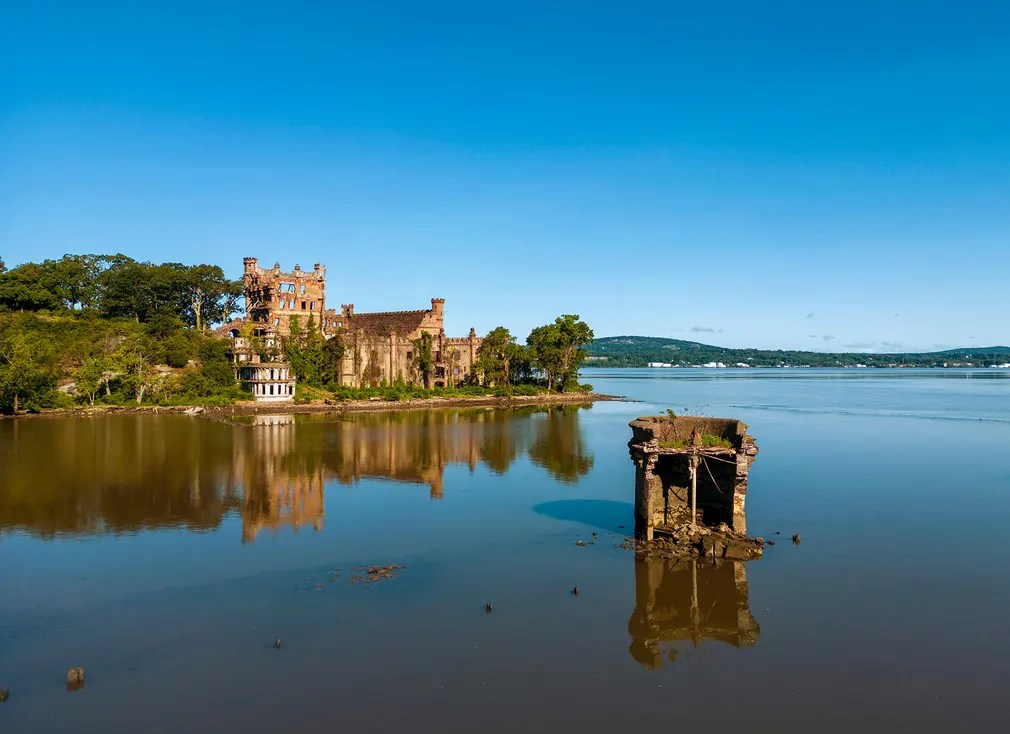
Via The Guardian…
Photographer Phillip Buehler, who captured the death of the American mall in a 2022 photo series, has a new exhibition of pictures from the last 50 years that trace the often forgotten history of the islands surrounding Manhattan. No Man Is an Island: Poetry in the Ruins of the New York Archipelago is now on show until 23 June at the Front Room Gallery in Hudson, New York…
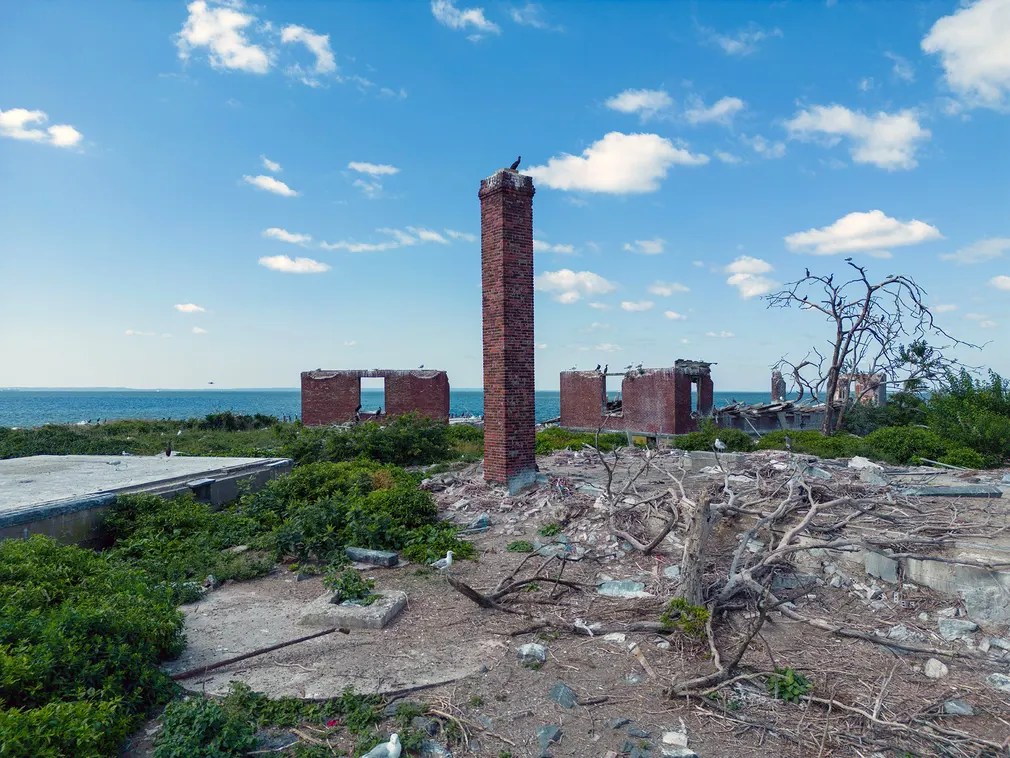

All photos by Phillip Buehler (and here). More of this series: “The inaccessible and abandoned islands of New York – in pictures,” via @guardian.
And for companions to Buehler’s earlier series on abandoned malls, see here and here.
* Benjamin Disraeli
###
As we ponder passage, we might recall that it was on this date in 1878, the original Tay Bridge was officially opened by Queen Victoria. It carried a single rail line across the Forth of Tay on the east coast of Scotland. At almost 2 miles in overall length, it was the world’s longest bridge at the time.
It’s designer, Sir Thomas Bouch, a railway engineer and executive, was knighted for engineering and overseeing the building of the bridge— on which an estimated 75 people died when, the following year, unable to withstand high winds, it collapsed. An enquiry found Bouch to be liable, by virtue of bad design and construction; he died four months after the verdict.
Bouch and his creation are thus also indirectly responsible for the best-known poem, “The Tay Bridge Disaster,” by the gentleman widely considered to have been the worst published poet in British history, William Topaz McGonagall (and here).

“We used to build civilizations. Now we build shopping malls.”*

Through the second half of the 20th century, the mall became more than a fixture of American life; it became a hub. And, as Matthew Christopher explains, while malls remain, the bloom has come off of the “rows”…
I’ve visited hundreds of abandoned places in my life—factories to asylums, schools to churches—but suburban malls might be the most surreal and striking. They captivate the imagination in a way few other types of environments can: with an almost imperceptible layer of fog that forms between the first and second floors of an atrium, endless reflections of vacant storefronts, or a chance encounter with a groundhog in the remains of a food court. Stripped of signage and wares, they are nearly perfectly liminal spaces. Malls have become a part of the modern collective unconscious, through both the haze of half-buried memories of any American over the age of 20 and their ubiquity in popular media. They reflect the American consumer’s identity, and to see a suburban mall in ruins warps nostalgia into something nightmarish and forlorn in a way that abandoned factories, hospitals, or even churches don’t quite do.
We are all, to some extent, intimately familiar with the mall experience. Many of us in America had an indoor shopping center that was “our mall” at some point in our lives. Those memories are shared, because even though we weren’t all going to the same mall, we were: franchise stores—Auntie Anne’s, Sbarro, The Gap—share the same layout and inoffensive color palette and logo lettering across the country. To know one of these malls is to know them all. It’s a powerful magic I’m not sure I can fully explain, even after wandering the deserted storefronts of many vacant shopping hubs.
Much has been written on the phenomenon of the collapse of the American mall and the reasons for it. The most obvious—the rise of online retail—is undeniably a significant factor, but it also masks a rot that had been spreading before Amazon gutted brick-and-mortar. It’s hard to think of any comparable social institution that cost so much and covered so much physical space and then imploded so quickly. As always, the story is far more complex than any tidy summary can encompass…
The indoor suburban shopping center is a special kind of abandoned place; read on for more of the story and more photos: “The Life and Death of the American Mall,” @AbandonedAmerica@mastodon.social in @atlasobscura.
* Bill Bryson
###
As we fool around in the food court, we might note that today is Teddy Day, a celebration of Teddy Bears…
The Teddy Bear appeared in a shop window in Brooklyn, New York, on February 15, 1903, but the story of the cuddly toy began a few months before that.
It really started when President Theodore Roosevelt took up an invitation to go bear hunting, in Mississippi with the Governor of the state, Andrew Longino, in November 1902. I can tell you two things about President Teddy Roosevelt – 1. He hated being called Teddy, and 2. he was an avid hunter – he had trophies and hunted for both meat and sport. That first day of his hunting trip, he was really disappointed because he and the governor didn’t find any Bears, but the governor DID NOT want to disappoint the President, so he had the hunting guide go out and find a bear, which he did. He found an old bear and tied it to a tree; they brought the president, but he didn’t want to hunt a trapped bear – it was unsportsmanlike.
Whenever any President does anything, it’s kind of newsworthy, and Clifford Berryman, a cartoonist heard the story, made the old bear a cub, and made a cartoon of Teddy freeing a Bear Cub from a tree. The cartoon made the rounds and inspired Morris Michtom and his wife Rose, to make a little toy bear cub, just to decorate the window of their hand-made toy shop. Most toys were handmade still in the early 1900s. A bunch of people offered to buy it, but he didn’t sell it right away. He actually sent it to the President and asked permission to sell what he called The Teddy Bear. Teddy Roosevelt approved, with no strings attached, so the Mitchums started making them, and put them on sale.
The Teddy Bear really represented the start of more than just the first stuffed non-human toy with arms and legs, it changed the whole toy industry. The earliest toys were usually something with wheels, a ball, a human baby doll, or sports-oriented. In 1892, there was a cat toy, basically the outline of a cat with stuffing, called Ithaca Cat (US patent 483727A). It was more like a shaped pillow, they still make reproductions today. That caused a mini-craze for other stuffed pillow toys like bunnies, kittens, puppies, and the Teddy Bear came out at just about the right time.
The stuffed Bear was the biggest toy of the last century. Change a few things, and give the bear a personality, and the toy becomes Winnie The Pooh, or Paddington Bear, Teddy Ruxpin, The Care Bears, or Corduroy. Teddy Bears introduced the whole idea of anthropomorphic toys- animals having human features and personalities.
The Mitchums went on to found the IDEAL Toy Company, which up until Barbie & GI Joe, was the largest Toy Company in the World. IDEAL is also the company that gave us The Rubik’s Cube in the 1980s. If the Miitchums didn’t start by giving us the Teddy Bear, we’d probably still be rolling hoops (hooping) with a stick like people did for most of the past 2000 years…
“The Teddy Bear“
We might further note that a recent incarnation of the Teddy was an avatar of late Mall culture: Build-a-Bear Workshop… which, from its founding in 1997) grew to over 500 (largely mall-based) locations around the U.S… but that has now moved aggressively on-line.

“Today everything exists to end in a photograph”*…

Or so it seems. Indeed, as the ability- and the impulse– to take pictures becomes ubiquitous, we risk losing a sense of how rarefied, how special photos once were. By way of a reminder, from Her Moments, a collection of 35 photographic firsts…
If not for the invention of the camera, many of the greatest moments in human history would have been lost forever. What would the world be like without images of unforgettable moments like the flag being raised over Iwo Jima or the man facing down a tank in Tiananmen Square? Throughout the history of photography, there have been plenty of incredible milestones. These rare photographic firsts may be some of the most impactful pictures ever taken…

Many more at “35 Photography Firsts That Paint A Fascinating Portrait Of Human History.”
For an overlapping but different collection of photographic firsts, see “First images from atoms to the universe.”
And for more on three of the photos in the first collection, covered in earlier (R) D posts, see “First Takes” and “Time and tide wait for no man.”
* Susan Sontag
###
As we point and click, we might recall that it was on this date in 1982 that Def Leppard and their producer Mutt Lange completed production on “Photograph,” the lead single from their next album, Pyromania; the album and the single were released the following month. ”Photograph” reached No. 1 on the Billboard Top Tracks chart, where it stayed for six weeks.


You must be logged in to post a comment.