Posts Tagged ‘NASA’
“Memento mori”*…

Via Matt Muir and his wonderful newsletter, Web Curios…
Do YOU want to feel INCREDIBLY OLD? I mean, I imagine you already feel incredibly old, what with, well, your age, and the terrifying pace of everything, and the fact that nothing makes sense, but if you would like to feel EVEN OLDER then you will ‘enjoy’ this site which presents a whole load of ‘XX was closer to WWII than Y’-type facts to help you realise quite how much time has passed since you’ve been alive and how transient and ephemeral your existence in fact is. You can even plug in your birthday to get personalised horrordata…
Try it for yourself at: “Another day closer to the end.” No extra points for guessing that the example illustrated in the pic above was generated with your (very old) correspondent’s birthday.
On the other hand?: “Your future self has good news: you’re doing pretty well.”
* Latin phrase: “remember that you will die”
###
As we muse on mutability and mortality, we might note that this is Good Friday… and that in 1983, British scholars Colin Humphreys and W.G. Waddington used NASA research into historical eclipse to place the Crucifixion on this date in 33 CE.

“Nothing is built on stone; all is built on sand”*…

(Roughy) Daily has looked before at that most common– and essential– of substances, sand. (See here, here, and here.) Today, via Michaela Büsse, an update…
After water, sand is the second most used material in the world. Each year, approximately 40-50 billion metric tons of sand are consumed worldwide.
This accounts for 79% of all aggregates extracted and traded, making sand the literal foundation for global human infrastructure. Sand plays a vital role in the production of glass, steel, and concrete. Silica, one of the most common minerals found in sand, is the key ingredient in silicon chips and thus for the development of digital technologies. But sand is also fundamental to the creation and maintenance of land itself, rendering it constitutive to processes of urbanization. Artificial islands, port expansions, and beach nourishment projects consume vast quantities of sand. As the bedrock of urban infrastructures, sand is embedded in the very fabric of modern life. Yet, its ubiquity belies its complexity. As a sediment, sand is foundational for the functioning of ecosystems. The relentless expansion and intensification of cities is starving rivers and coasts of sediment, depleting sand at a rate that far exceeds its natural replenishment.
Intensive dredging of rivers and seabeds has fundamentally altered sedimentation patterns, disrupting the delicate equilibrium that governs ecosystems. Rivers, which once carried sand from mountains to coastlines, now struggle to replenish beaches and wetlands. This depletion has far-reaching consequences. Without sufficient sand deposits, coastlines are left vulnerable to erosion, rising sea levels, and the devastating impact of extreme weather events. In ecosystems already on the front lines of climate change—like deltas, wetlands, and estuaries—the effects of sand extraction are compounded. Delta regions, for instance, rely on continuous sediment deposits to counteract the natural sinking of land. When sand is removed faster than it can be replaced, these regions are exposed to subsidence, where land sinks at an accelerated rate, amplifying flood risk and increasing the salinization of freshwater resources. Such impacts are often delayed, manifesting years or even decades after extraction, making them challenging to monitor and mitigate effectively.
As global sand consumption surges to unprecedented heights, the profound and far-reaching consequences of extraction come sharply into focus. Numerous journalistic and scientific accounts warn of the “looming tragedy of the sand commons,” highlighting environmental concerns related to dredging and mining sand, such as pollution, biodiversity loss, and soil disturbance, as well as illegal practices in the sand trade. The reality of the sand trade is both dirty and messy, intertwining national and transnational politics. In regions like Southeast Asia, rapid urbanization and investments in large-scale infrastructure projects have spurred an unprecedented demand for this essential resource. Here, land reclamation has emerged as a flashpoint where extraction practices intersect with issues of sovereignty, livelihoods, and environmental justice, transforming sand into a highly sought-after and contested commodity. Building new land for some means taking old land from others. The exploitation of sand goes hand in hand with exploitative labor and geopolitical maneuvering.
Sand’s impending scarcity has fueled a black market, giving rise to “sand mafias”—criminal organizations that exploit extraction and trade through corruption, violence, and intimidation, often circumventing national mining and export bans. It is not uncommon for sand to become a matter of life and death for those who mine it as well as for those who seek to prevent it from being mined. Across the world, activists and local communities have mobilized against sand extraction and land reclamation, fighting the prevailing narratives of development and progress that often justify environmental exploitation. However, these initiatives are rarely successful, resulting (at best) in compensation payments to the affected communities. A transboundary governance of sand would require international standards, which many researchers and organizations have requested. Even so, it is nearly impossible to control the natural flow of sand.
As sand transitions from a sediment to a precious resource, it has become instrumental in urban ideals of late modernity. Cities like Dubai and Singapore epitomize how architectural ambitions is built on vast quantities of imported sand. Land built from scratch, towering skyscrapers, and sprawling infrastructure are testaments to sand’s transformative potential. Yet, these urban landscapes are haunted by their materiality: each grain is a silent witness to the ecological and social disruptions that enabled its journey. The sand in these structures embodies the persistence of environmental degradation, displaced labor, and the exploitation that made them possible. In this way, sand is both an architect and a specter of modernity’s unrestrained ambitions, leaving us to confront the shadows cast by our own constructions…
Eminently worth reading in full: “Granular Power: The Gritty Politics of Sand,” from @michaelabussey.bsky.social and @eflux.bsky.social.
* Jorge Luis Borges
###
As we get grainy, we might send insightful birthday greetings to James Hansen; he was born on this date in 1941. An atmospheric physicist, he was Director of the NASA Goddard Institute for Space Studies (from 1981-2013). He is best known for his (June, 1988) testimony to the Senate Energy and Natural Resources Committee that there was 99% certainty the cause of climate change was known with 99% certainty to be the buildup of carbon dioxide and other artificial gases in the atmosphere– helping raise broad awareness of global warming– and for his advocacy of action to avoid dangerous climate change. (Hansen has since proposed a revised explanation of global warming, where the 0.7°C global mean temperature increase of the last 100 years can be to some extent explained by the effect of greenhouse gases other than carbon dioxide (such as methane).
Currently the Director of the Program on Climate Science, Awareness and Solutions of the Earth Institute at Columbia University, he remains a climate activist.

“The sacred moon overhead / Has taken a new phase”*…
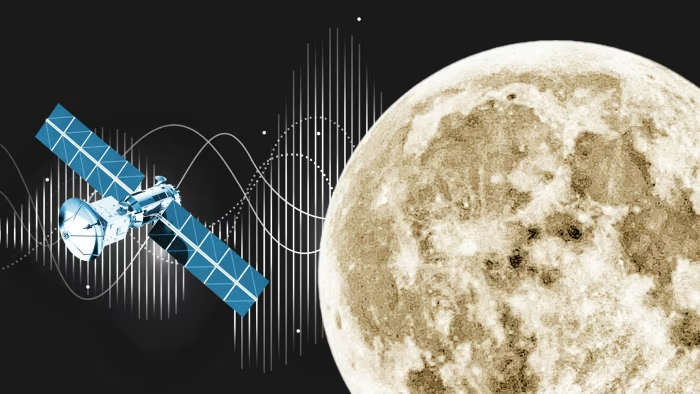
As Oliver Hawkins and Peggy Hollinger report, an analysis of commercial radio spectrum filings shows a growing number of players– government agencies, but increasingly private companies– bettting on the emergence of a lunar economy…
Private companies are staking claims to radio spectrum on the Moon with the aim of exploiting an emerging lunar economy, Financial Times research has found.
More than 50 applications have been filed with the International Telecommunication Union since 2010 to use spectrum, the invisible highway of electromagnetic waves that enable all wireless technology, on or from the Moon.
Last year the number of commercial filings to the global co-ordinating body for lunar spectrum outstripped those from space agencies and governments for the first time, according to FT research. The filings cover satellite systems as well as missions to land on the lunar surface.
“We will look back and see this as an important inflection point,” said Katherine Gizinski, chief executive of spectrum consultancy River Advisers, which has filed for lunar spectrum for three satellite systems on behalf of other companies since 2021.
Although total registrations were lower in 2024 than the previous year, the increased proportion of commercial filings reflects a race to build the infrastructure that will enable the “cislunar economy”, the area between the Earth and Moon…
More on the players and the game: “The race to claim the Moon’s airwaves” (gift article), from @financialtimes.com. See also:
* William Butler Yeats, “The Cat and the Moon”
###
As we linger over the lunar, we might recall that it was on this date in 1971 that NASA accomplished the third lunar EVA: Commander Alan B. Shepard and Lunar Module pilot Edgar D. Mitchell became the fifth and sixth men to walk on the Moon (in the lunar highlands near the crater Fra Mauro) as part of the Apollo 14 mission.
During this four-hour “activity,” they deployed the Apollo Lunar Surface Experiments Package (ALSEP)– scientific experiments that were left on the lunar surface and other scientific and sample collection apparatus. B efore lifting off on the next day, the astronauts went on another moonwalk almost to the rim of nearby Cone crater, collecting 42.9 kg of samples along the traverse. At the end of this 3.45 km walk, Shepard used a contingency sampler with a Wilson 6-iron connected to the end to hit two golf balls.
“A time will come when men will stretch out their eyes. They should see planets like our Earth.”*…

Not long ago the search for extraterrestrials was considered laughable nonsense. Today, as Adam Frank explains, it’s serious and scientific…
Suddenly, everyone is talking about aliens. After decades on the cultural margins, the question of life in the Universe beyond Earth is having its day in the sun. The next big multibillion-dollar space telescope (the successor to the James Webb) will be tuned to search for signatures of alien life on alien planets and NASA has a robust, well-funded programme in astrobiology. Meanwhile, from breathless newspaper articles about unexplained navy pilot sightings to United States congressional testimony with wild claims of government programmes hiding crashed saucers, UFOs and UAPs (unidentified anomalous phenomena) seem to be making their own journey from the fringes.
What are we to make of these twin movements, the scientific search for life on one hand, and the endlessly murky waters of UFO/UAP claims on the other? Looking at history shows that these two very different approaches to the question of extraterrestrial life are, in fact, linked, but not in a good way. For decades, scientists wanting to think seriously about life in the Universe faced what’s been called the ‘giggle factor’, which was directly related to UFOs and their culture. More than once, the giggle factor came close to killing off the field known as SETI (the search for extraterrestrial intelligence). Now, with new discoveries and new technologies making astrobiology a mainstream frontier of astrophysics, understanding this history has become important for anyone trying to understand what comes next. But for me, as a researcher in the field of technosignatures (signs of advanced alien tech) – the new face of SETI – getting past the giggle factor poses an existential challenge.
I am the principal investigator of NASA’s first ever grant to study signatures of intelligent life from distant exoplanets. My colleagues and I are tasked with developing a library of technosignatures or evidence of technology-wielding life forms on distant planets. Taking on that role has been the culmination of a lifetime fascination with the question of life and the Universe, a fascination that formed when I was a kid in the 1970s, drinking deep from the well of science fiction novels, UFO documentaries and Star Trek reruns. Early on, as a teenager reading both Carl Sagan and Erich von Däniken (the author of Chariots of the Gods), I had to figure out how to separate the wheat from the chaff. This served as a kind of training ground for dealing with questions facing me and my colleagues about proper standards of evidence in astrobiology. It’s also why, as a public-facing scientist, I must work to understand how people not trained in science come to questions surrounding UFOs as aliens. That is what drove me, writing a recent popular-level account of astrobiology’s frontiers called The Little Book of Aliens (2023), to stare hard into the entangled history of UFOs, the scientific search for life beyond Earth, and the all-important question of standards of evidence…
[Frank explains the efforts underway, their history, and the rigor being applied in sifting for credible evidence…]
… With the giggle factor receding for the scientific search for life, where does that leave UFOs and UAPs? There, the waters remain muddied. It is a good thing that pilots feel they can report sightings without fear of reprisal as a matter of air safety and national defence. And an open, transparent and agnostic investigation of UAPs could offer a masterclass in how science goes about its business of knowing rather than just believing. In The Little Book of Aliens, I even explained how such an investigation might be conducted (the recent NASA UAP panel and the Galileo Project are exploring these kinds of options). But if my colleagues and I claimed we’d found life on another world, we’d be required to provide evidence that meets the highest scientific standards. While we should let future studies lead us where they may, there is simply no such evidence surrounding UFOs and UAPs that meets these standards today. In fact, at a recent hearing conducted by NASA’s UAP panel, it was revealed that government studies show only a small percentage of reported sightings failed to find a reasonable explanation. Many of the remaining cases did not have enough data to even begin an attempt at identification. The sky is simply not awash in unexplained phenomena.
In the end, what matters is that, after thousands of years of arguing over opinions about life in the Universe, our collective scientific efforts have taken us to the point where we can finally begin a true scientific study of the question. The next big space telescope NASA is planning will be called the Habitable Worlds Observatory. The name tells you all you need to know. We’re going all in on the search for life in the Universe because we finally have the capabilities to search for life in the Universe. The giggle factor is finally history.
How UFOs almost killed the search for life in the universe: “Alien life is no joke,” from @AdamFrank4 in @aeonmag.
For more on a related field, see Astrobiology (@carnegiescience)
Also apposite (and typically for him, both informative and very amusing): John Oliver on UFOs
* the foresightful Christopher Wren
###
As we look up, we might recall that it was on this date in 1930 that Pluto was announced to be the name chosen for the newly-discovered ninth planet (previously known as Planet X) by Roger Lowell Putnam, trustee of Lowell Observatory, Flagstaff, Arizona, (and nephew of the late Percival Lowell who had established the observatory and initiated the search there for the ninth planet). Pluto had been located there on in February of that year at that institution by Clyde Tombaugh.
Putnam was quoted on the front page of the New York Times, saying, “We felt in making our choice of a name for Planet X, that the line of Roman gods for whom the other planets are named should not be broken, and we believe that Dr. Lowell, whose researches led directly to its discovery, would have felt the same way.” Pluto in mythology was the ruler of the underworld, regions of darkness. “P.L.” is also Lowell’s monogram.
While it’s still known as Pluto, in 2006 the International Astrophysical Union demoted it from a “planet” to a “dwarf planet.”

“It is impossible to contemplate the spectacle of the starry universe without wondering how it was formed”*…

Paul Constance on how Chile, a country riven by inequality and political conflict, has become a global sanctuary for the long science that drives astronomical discovery, and on the questions that raises…
… The next era of astronomy will depend on instruments so complicated and costly that no single nation can build them. A list of contributors to the James Webb Space Telescope, for example, includes 35 universities and 280 public agencies and private companies in 14 countries. This aggregation of design, engineering, construction and software talent from around the planet is a hallmark of “big science” projects. But large telescopes are also emblematic of the outsized timescales of “long science.” They depend on a fragile amalgam of trust, loyalty, institutional prestige and sheer endurance that must sustain a project for two or three decades before “first light,” or the moment when a telescope actually begins to gather data.
“It takes a generation to build a telescope,” Charles Alcock, director of the Harvard-Smithsonian Center for Astrophysics and a member of Giant Magellan Telescope (GMT) board, said some years ago. Consider the logistics involved in a single segment of the GMT’s construction: the process of fabricating its seven primary mirrors, each measuring 27 feet in diameter and using 17 metric tons of specialized Japanese glass. The only facility capable of casting mirrors this large (by melting the glass inside a clam-shaped oven at 2,100 degrees Fahrenheit) is situated deep beneath University of Arizona football stadium. It takes three months for the molten glass to cool. Over the next four years, the mirror will be mounted, ground and slowly polished to a precision of around one millionth of an inch. The GMT’s first mirror was cast in 02005; its seventh will be finished sometime in 02027. Building the 1,800-ton steel structure that will hold these mirrors, shipping the enormous parts by sea, assembling the telescope atop Cerro Las Campanas, and then testing and calibrating its incommunicably delicate instruments will take several more years.
Not surprisingly, these projects don’t even attempt to raise their full budgets up front. Instead, they operate on a kind of faith, scraping together private grants and partial transfers from governments and universities to make incremental progress, while constantly lobbying for additional funding. At each stage, they must defend nebulous objectives (“understanding the nature of dark matter”) against the claims of disciplines with more tangible and near-term goals, such as fusion energy. And given the very real possibility that they will not be completed, big telescopes require what private equity investors might describe as the world’s most patient risk capital.
Few countries have been more successful at attracting this kind of capital than Chile. The GMT is one of three colossal observatories currently under construction in the Atacama Desert. The $1.6 billion Extremely Large Telescope, which will house a 128-foot main mirror inside a dome nearly as tall as the Statue of Liberty, will be able to directly image and study the atmospheres of potentially habitable exoplanets. The $1.9 billion Vera T. Rubin Telescope will use a 3.500 megapixel digital camera to map the entire night sky every three days, creating the first 3-D virtual map of the visible cosmos while recording changes in stars and events like supernovas. Two other comparatively smaller projects, the Fred Young Sub-millimeter Telescope and the Cherenkov Telescope Array, are also in the works.
Chile is already home to the $1.4 billion Atacama Large Millimeter Array (ALMA), a complex of 66 huge dish antennas some 16,000 feet above sea level that used to be described as the world’s largest and most expensive land-based astronomical project. And over the last half-century, enormous observatories at Cerro Tololo, Cerro Pachon, Cerro Paranal, and Cerro La Silla have deployed hundreds of the world’s most sophisticated telescopes and instruments to obtain foundational evidence in every branch of astronomy and astrophysics.

By the early 02030s, a staggering 70 percent of the world’s entire land-based astronomical data gathering capacity is expected to be concentrated in a swath of Chilean desert about the size of Oregon.
Collectively, this cluster of observatories represents expenditures and collaboration on a scale similar to “big science” landmarks such as the Large Hadron Collider or the Manhattan Project. Those enterprises were the product of ambitious, long-term strategies conceived and executed by a succession of visionary leaders. But according to Barbara Silva, a historian of science at Chile’s Universidad Alberto Hurtado, there has been no grand plan, and no one can legitimately take credit for turning Chile into the global capital of astronomy…
“Stumbling Toward First Light,” from @presentbias and @longnow.
* Henri Poincaré
###
As we look up, we might recall that it was on this date in 2001 that NASA launched the Mars Odyssey, sending back stunning images from its tv cameras during its fiery ascent. Odyssey traveled 286 million miles before entering orbit around the red planet the following October.
Its mission was (and is– at 22-and-a-half years, it’s the longest-serving spacecraft at Mars) to use its spectrometers and a thermal imager to detect evidence of past or present water and ice, as well as study the planet’s geology and radiation environment in a quest to help answer the question of whether life once existed on Mars and to create a risk-assessment of the radiation that future astronauts on Mars might experience. (As a bonus, it acts as a relay for communications between the Curiosity rover [and previously the Mars Exploration Rovers and Phoenix lander] and Earth.)

You must be logged in to post a comment.