Posts Tagged ‘Moon’
“The real war will never get in the books”*…

Still, historians try. And as Anton Jäger argues in his consideration of Charles S. Maier‘s The Project-State and Its Rivals- A New History of the Twentieth and Twenty-First Centuries, that’s a challenging, frustrating, but ultimately very useful thing…
“We thought we knew the story of the twentieth century,” Charles Maier notes in an announcement for his new book The Project State and Its Rivals. Both haunting and tantalizing, the sentence’s past tense speaks to a profoundly contemporary mood. As the twenty-first century progresses, confident visions about the previous century conceived from the vantage point of the 1990s—the “age of extremes” resolved by a set of liberal settlements—no longer seem safe and secure. In 2023, the European extreme Right is establishing itself as a force of government, populism is going global, and inter-imperial tensions have ushered in a new arms race. In Germany, the Alternative für Deutschland is currently polling above 20 percent, while Modi is set to win another term in India with an approval rating near 80 percent. To the desperation of liberals nostalgic for the 1990s, the “end of the end of history” has arrived.
As Maier surmises, there might be a connection between this sense of surprise and the comfortable judgments we tend to make about humanity’s last hundred years. “If the twentieth century meant the triumph of liberalism,” he asks, “why have the era’s darker impulses—ethnic nationalism, racist violence, and populist authoritarianism—revived?” The question provides the working hypothesis for Maier’s new monograph, a self-described “rethinking of the long twentieth century,” which aims to “explain the fraying of our own civic culture” while also “allowing hope for its recovery.” Provocatively, Maier’s focus is on “both democracies and dictatorships that sought not just to retain power but to transform their societies,” next to “new forms of imperial domination,” “global networks of finance,” and “international associations” that both challenged and shaped the state. The ambition is nothing less than a new general theory of the twentieth century, one that would allow us to deal with an unmastered past, but also to gain proper self-understanding in a new and confusing century.
Readers would be hard-pressed to find a more suitable candidate for the task than Charles S. Maier. At eighty-four, Maier—still teaching European and international history at Harvard—remains a scholar with panoramic disciplinary reach. His 1975 debut, Recasting Bourgeois Europe: Stabilization in France, Germany, and Italy in the Decade after World War I, swiftly established itself a masterpiece of comparative political history. Based on a prior Harvard dissertation complemented with a decade of additional archival research, it examined the fraught resolution of the crises of liberalism after 1918, and what factors determined the potential emergence and stymieing of authoritarian regimes. After works on Germany’s collective memory of the Holocaust and an elite-driven account of the fall of East Germany, he waded into historical political science with Leviathan 2.0: Inventing Modern Statehood in 2014, followed by Once within Borders: Territories of Power, Wealth, and Belonging since 1500 in 2016. Clearly a product of a buoyant Cold War academe, Maier has always been locked in an uneasy pas-à-deux with Marxism: attentive to the class content of political life, but never taken to monolithic views of business interests and overly abstract notions of capital. His work on political economy looked closely at the class coalitions that gave way to divergent corporatist settlements in the 1920s and ’30s, and how these national blocs interlocked with differing international arrangements—a Marxist historiography despite itself. He also took the force of ideas seriously, weaving a tapestry of conceptual, political, and economic history, which explains the unique force of his writing. Yet unlike cultural historians, Maier has retained an interest in causality through the construction of comparative counterfactuals—what Britain and Germany shared in 1918, for instance, or why English Tories did not need a Duce and why the American South was different from the Mezzogiorno—a sensibility that also informed his consistently transnational approach to the twentieth century.
The Project State and Its Rivals exudes a similarly boundless ambition. As the book’s announcements make clear, Maier is on the lookout for a unifying category to cohere our historical experience of the twentieth century—or, more specifically, the forms of statehood that emerged in the interwar period, and that still present such vexing challenges to our intellectual imagination…
A critical account of Maier’s hypothesis, eminently worth reading in full: “The Rise and Fall of the Project State: Rethinking the Twentieth Century,” from @AntonJaegermm in @AmericanAffrs. Via Adam Tooze/@adam_tooze.
* Walt Whitman
###
As we keep searching, we might pause to contrast the rigorously serious with the frivolously venal: it was on this date in 1835 that the New York Sun began a series of six articles detailing the discovery of civilized life on the moon; circulation soared. Now known as “The Great Moon Hoax,” the articles attributed the “discovery” to Sir John Herschel, the greatest living astronomer of the day. Herschel was initially amused, wryly noting that his own real observations could never be as exciting. But ultimately he tired of having to answer questioners who believed the story. The series was not discovered to be a hoax for several weeks after its publication and, even then, while the paper did admit (on September 16, 1835) that the whole thing was a “satire,” it never issued a retraction (and didn’t suffer a drop in sales).

“There is a limit to thinking about even a small piece of something monumental”*…
Still, we can try…

Via Jason Kottke, who is reminded…
of Ben Terrett’s calculation of how many helveticas from here to the Moon and my subsequent calculations about the point size of the Earth and the Moon (50.2 billion and 13.7 billion, respectively).
* Jeff VanderMeer, Annihilation
As we size up scale, we might recall that it was on this date (the feast day of St. Mary Magdalene) in 1342, that Central Europe’s worst flood ever occurred. Following the passage of a Genoa low, the rivers Rhine, Moselle, Main, Danube, Weser, Werra, Unstrut, Elbe, Vltava, and their tributaries inundated large areas. Many towns such as Cologne, Mainz, Frankfurt am Main, Würzburg, Regensburg, Passau, and Vienna were seriously damaged, with water levels exceeding those of the 2002 European floods. Even the river Eider north of Hamburg flooded the surrounding land; indeed, the affected area extended to Carinthia and northern Italy.

“Time and tide wait for no man”*…
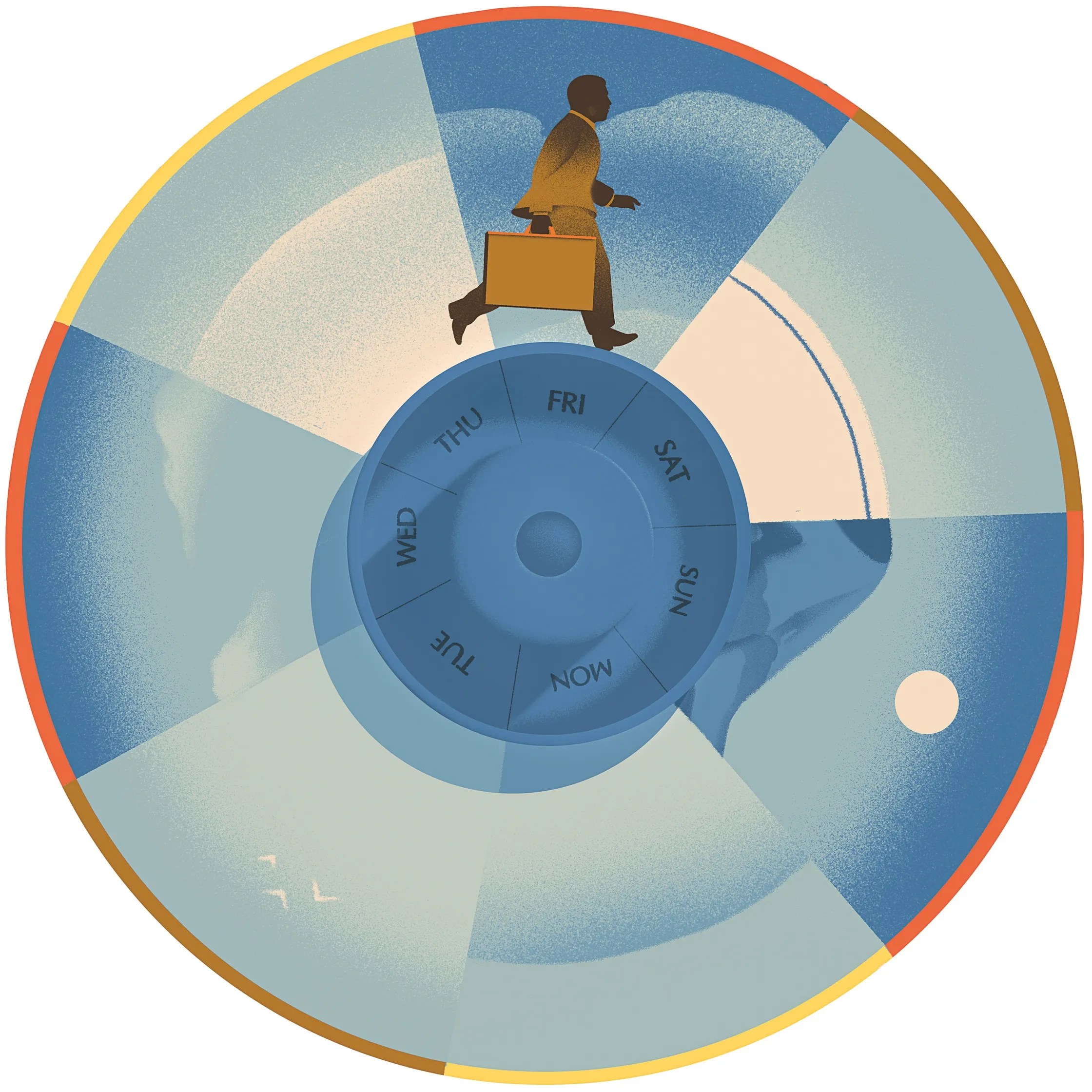
The week both arranges and imposes on our time…
Among many collective discoveries during the pandemic confinement of 2020, Americans learned just how attached we are to our seven weekdays. As complaints about temporal disorientation mounted that April, we focused not on the clock – the classic metonym for the power and experience of time – but rather on the calendar, and specifically the weekly one. A Cleveland news station affiliated with the Fox Media network entertained viewers with a daily feature, much circulated on the internet, entitled ‘What Day Is It? With Todd Meany’ – the answer to which was always a weekday, not a Gregorian calendar date…
Weeks serve as powerful mnemonic anchors because they are fundamentally artificial. Unlike days, months and years, all of which track, approximate, mimic or at least allude to some natural process (with hours, minutes and seconds representing neat fractions of those larger units), the week finds its foundation entirely in history. To say ‘today is Tuesday’ is to make a claim about the past rather than about the stars or the tides or the weather. We are asserting that a certain number of days, reckoned by uninterrupted counts of seven, separate today from some earlier moment. And because those counts have no prospect of astronomical confirmation or alignment, weeks depend in some sense on meticulous historical recordkeeping. But practically speaking, weekly counts are reinforced by the habits and rituals of other people. When those habits and rituals were radically obscured or altered in 2020, the week itself seemed to unravel…
The history of weekly timekeeping, which is only about 2,000 years old. Although taboos and cosmologies in several different cultures attached significance to seven-day cycles much earlier, there is no clear evidence of any society using such cycles to track time in the form of a common calendar before the end of the 1st century CE. As the scholars Ilaria Bultrighini and Sacha Stern have recently documented, it was in the context of the Roman Empire that a standardised weekly calendar emerged out of a combination and conflation of Jewish Sabbath counts and Roman planetary cycles. The weekly calendar, from the moment of its effective invention, reflected a union of very different ways of counting days…
The crucial formation of our modern experience of weekly time took place around the first half of the 1800s, with the rising prominence of… the differentiated weekly schedule…
The week is the most artificial and most recent of the ways we account for time, but it’s effectively impossible to imagine our shared lives without it: “How we became weekly,” by David Henkin in @aeonmag.
See also Jill Lepore‘s characteristically informative review of Henkin’s book on the week: “How the Week Organizes and Tyrannizes Our Lives” (source of the image above)
* Geoffrey Chaucer
###
As we mark time, we might recall that it was on this date in 1839 that John William Draper took a daguerreotype of the moon (the “governor” of months, while the sun determines days, seasons, and years); it was the first celestial photograph (or astrophotograph) made in the U.S. (He exposed the plate for 20 minutes using a 5-inch telescope and produced an image one inch in diameter.) Draper’s picture of his sister, taken the following year, is the oldest surviving photographic portrait.

“Fools ignore complexity. Pragmatists suffer it… Geniuses remove it.”*…

World War II bomber planes returned from their missions riddled with bullet holes. The first response was, not surprisingly, to add armor to those areas most heavily damaged. However, the statistician Abraham Wald made what seemed like the counterintuitive recommendation to add armor to those parts with no damage. Wald had uniquely understood that the planes that had been shot where no bullet holes were seen were the planes that never made it back. That’s, of course, where the real problem was. Armor was added to the seemingly undamaged places, and losses decreased dramatically.
The visible bullet holes of this pandemic are the virus and its transmission. Understandably, a near-universal response to the COVID-19 pandemic has been to double down on those disciplines where we already possess deep and powerful knowledge: immunology and epidemiology. Massive resources have been directed at combating the virus by providing fast grants for disciplinary work on vaccines. Federal agencies have called for even more rapid response from the scientific community. This is a natural reaction to the immediate short-term crisis.
The damage we are not attending to is the deeper nature of the crisis—the collapse of multiple coupled complex systems.
Societies the world over are experiencing what might be called the first complexity crisis in history. We should not have been surprised that a random mutation of a virus in a far-off city in China could lead in just a few short months to the crash of financial markets worldwide, the end of football in Spain, a shortage of flour in the United Kingdom, the bankruptcy of Hertz and Niemann-Marcus in the United States, the collapse of travel, and to so much more.
As scientists who study complex systems, we conceive of a complexity crisis as a twofold event. First, it is the failure of multiple coupled systems—our physical bodies, cities, societies, economies, and ecosystems. Second, it involves solutions, such as social distancing, that involve unavoidable tradeoffs, some of which amplify the primary failures. In other words, the way we respond to failing systems can accelerate their decline.
We and our colleagues in the Santa Fe Institute Transmission Project believe there are some non-obvious insights and solutions to this crisis that can be gleaned from studying complex systems and their universal properties…
The more complicated and efficient a system gets, the more likely it is to collapse altogether. Scientists who study complex systems offer solutions to the pandemic: “The Damage We’re Not Attending To.”
See also: “Complex Systems Theory Explains Why Covid Crushed the World.”
###
As we think systemically, we might recall that it was on this date in 1835 that the New York Sun began a series of six articles detailing the discovery of civilized life on the moon. Now known as “The Great Moon Hoax,” the articles attributed the “discovery” to Sir John Herschel, the greatest living astronmer of the day. Herschel was initially amused, wryly noting that his own real observations could never be as exciting. But ultimately he tired of having to answer questioners who believed the story. The series was not discovered to be a hoax for several weeks after its publication and, even then, the newspaper did not issue a retraction.
 The “ruby amphitheater” on the Moon, per the New York Sun (source)
“I’m still learning”*…

1) Each year humanity produces 1,000 times more transistors than grains of rice and wheat combined. [Mark P Mills]…
24) “Mushrooms and truffles are fungi, more closely related to humans than they are to plants.” [Lynne Peskoe-Yang]…
51) Fast fashion is hitting the wiping rags businesses, because some clothing is just too badly made to be sold as rags. [Adam Minter]…
From Tom Whitwell (@TomWhitwell) of Fluxx, the sixth of his annual lists: “52 things I learned in 2019.”
[image above: source]
* “Ancora imparo,” Michelangelo
###
As we continue our educations, we might recall that it was on this date in 1839 that John William Draper took a daguerreotype of the moon, the first celestial photograph (or astrophotograph) made in the U.S. (He exposed the plate for 20 minutes using a 5-inch telescope and produced an image one inch in diameter.) Draper’s picture of his sister, taken the following year, is the oldest surviving photographic portrait.

An 1840 shot of the moon by Draper– the oldest surviving “astrophotograph,” as his first is lost
You must be logged in to post a comment.