Thomas Pynchon as a high school senior, age 16, at Oyster Bay High School. The image is cropped from a group photo of the staff of the school’s yearbook, The Oysterette, of which Pynchon was the editor. (source)
But here, I offer a much older piece from Pynchon, and non-fiction at that: an essay he wrote for The New YorkTimes in 1984… one resonant with themes that run through his novels; one that speaks to that moment– the mid-Eighties– even as it speaks to ours…
As if being 1984 weren’t enough, it’s also the 25th anniversary this year of C. P. Snow’s famous Rede Lecture, ”The Two Cultures and the Scientific Revolution,” notable for its warning that intellectual life in the West was becoming increasingly polarized into ”literary” and ”scientific” factions, each doomed not to understand or appreciate the other. [See almanac entry here.] The lecture was originally meant to address such matters as curriculum reform in the age of Sputnik and the role of technology in the development of what would soon be known as the third world. But it was the two-culture formulation that got people’s attention. In fact it kicked up an amazing row in its day. To some already simplified points, further reductions were made, provoking certain remarks, name-calling, even intemperate rejoinders, giving the whole affair, though attenuated by the mists of time, a distinctly cranky look.
Today nobody could get away with making such a distinction. Since 1959, we have come to live among flows of data more vast than anything the world has seen. Demystification is the order of our day, all the cats are jumping out of all the bags and even beginning to mingle. We immediately suspect ego insecurity in people who may still try to hide behind the jargon of a specialty or pretend to some data base forever ”beyond” the reach of a layman. Anybody with the time, literacy and access fee these days can get together with just about any piece of specialized knowledge s/he may need. So, to that extent, the two-cultures quarrel can no longer be sustained. As a visit to any local library or magazine rack will easily confirm, there are now so many more than two cultures that the problem has really become how to find the time to read anything outside one’s own specialty.
What has persisted, after a long quarter century, is the element of human character. C. P. Snow, with the reflexes of a novelist after all, sought to identify not only two kinds of education but also two kinds of personality. Fragmentary echoes of old disputes, of unforgotten offense taken in the course of long-ago high- table chitchat, may have helped form the subtext for Snow’s immoderate, and thus celebrated, assertion, ”If we forget the scientific culture, then the rest of intellectuals have never tried, wanted, or been able to understand the Industrial Revolution.” Such ”intellectuals,” for the most part ”literary,” were supposed, by Lord Snow, to be ”natural Luddites.”
Except maybe for Brainy Smurf, it’s hard to imagine anybody these days wanting to be called a literary intellectual, though it doesn’t sound so bad if you broaden the labeling to, say, ”people who read and think.” Being called a Luddite is another matter. It brings up questions such as, Is there something about reading and thinking that would cause or predispose a person to turn Luddite? Is it O.K. to be a Luddite? And come to think of it, what is a Luddite, anyway?…
[Pynchon explains, and puts the “movement” into both socio-political and literary context…]
… The Gothic attitude in general, because it used images of death and ghostly survival toward no more responsible end than special effects and cheap thrills, was judged not Serious enough and confined to its own part of town. It is not the only neighborhood in the great City of Literature so, let us say, closely defined. In westerns, the good people always win. In romance novels, love conquers all. In whodunitsses we know better. We say, ”But the world isn’t like that.” These genres, by insisting on what is contrary to fact, fail to be Serious enough, and so they get redlined under the label ”escapist fare.”
This is especially unfortunate in the case of science fiction, in which the decade after Hiroshima saw one of the most remarkable flowerings of literary talent and, quite often, genius, in our history. It was just as important as the Beat movement going on at the same time, certainly more important than mainstream fiction, which with only a few exceptions had been paralyzed by the political climate of the cold war and McCarthy years. Besides being a nearly ideal synthesis of the Two Cultures, science fiction also happens to have been one of the principal refuges, in our time, for those of Luddite persuasion.
By 1945, the factory system – which, more than any piece of machinery, was the real and major result of the Industrial Revolution – had been extended to include the Manhattan Project, the German long-range rocket program and the death camps, such as Auschwitz. It has taken no major gift of prophecy to see how these three curves of development might plausibly converge, and before too long. Since Hiroshima, we have watched nuclear weapons multiply out of control, and delivery systems acquire, for global purposes, unlimited range and accuracy. An unblinking acceptance of a holocaust running to seven- and eight-figure body counts has become – among those who, particularly since 1980, have been guiding our military policies – conventional wisdom.
To people who were writing science fiction in the 50’s, none of this was much of a surprise, though modern Luddite imaginations have yet to come up with any countercritter Bad and Big enough, even in the most irresponsible of fictions, to begin to compare with what would happen in a nuclear war. So, in the science fiction of the Atomic Age and the cold war, we see the Luddite impulse to deny the machine taking a different direction. The hardware angle got de-emphasized in favor of more humanistic concerns – exotic cultural evolutions and social scenarios, paradoxes and games with space/ time, wild philosophical questions – most of it sharing, as the critical literature has amply discussed, a definition of ”human” as particularly distinguished from ”machine.” Like their earlier counterparts, 20th-century Luddites looked back yearningly to another age – curiously, the same Age of Reason which had forced the first Luddites into nostalgia for the Age of Miracles.
But we now live, we are told, in the Computer Age. What is the outlook for Luddite sensibility? Will mainframes attract the same hostile attention as knitting frames once did? I really doubt it. Writers of all descriptions are stampeding to buy word processors. Machines have already become so user-friendly that even the most unreconstructed of Luddites can be charmed into laying down the old sledgehammer and stroking a few keys instead. Beyond this seems to be a growing consensus that knowledge really is power, that there is a pretty straightforward conversion between money and information, and that somehow, if the logistics can be worked out, miracles may yet be possible. If this is so, Luddites may at last have come to stand on common ground with their Snovian adversaries, the cheerful army of technocrats who were supposed to have the ”future in their bones.” It may be only a new form of the perennial Luddite ambivalence about machines, or it may be that the deepest Luddite hope of miracle has now come to reside in the computer’s ability to get the right data to those whom the data will do the most good. With the proper deployment of budget and computer time, we will cure cancer, save ourselves from nuclear extinction, grow food for everybody, detoxify the results of industrial greed gone berserk – realize all the wistful pipe dreams of our days.
The word ”Luddite” continues to be applied with contempt to anyone with doubts about technology, especially the nuclear kind. Luddites today are no longer faced with human factory owners and vulnerable machines. As well-known President and unintentional Luddite D. D. Eisenhower prophesied when he left office, there is now a permanent power establishment of admirals, generals and corporate CEO’s, up against whom us average poor bastards are completely outclassed, although Ike didn’t put it quite that way. We are all supposed to keep tranquil and allow it to go on, even though, because of the data revolution, it becomes every day less possible to fool any of the people any of the time. If our world survives, the next great challenge to watch out for will come – you heard it here first – when the curves of research and development in artificial intelligence, molecular biology and robotics all converge. Oboy. It will be amazing and unpredictable, and even the biggest of brass, let us devoutly hope, are going to be caught flat-footed. It is certainly something for all good Luddites to look forward to if, God willing, we should live so long. Meantime, as Americans, we can take comfort, however minimal and cold, from Lord Byron’s mischievously improvised song, in which he, like other observers of the time, saw clear identification between the first Luddites and our own revolutionary origins. It begins:
As the Liberty lads o’er the sea Bought their freedom, and cheaply, with blood, So we, boys, we Will die fighting, or live free, And down with all kings but King Ludd!
As we hang onto our humanity, we might recall that it was on this date in 2006 that review copies of Against the Daywere distributed; it published later that year. At 1,085 pages, it is the longest of Pynchon’s novels to date (note that there is a rumor that Pynchon, who is now 88, completed another book alongside Shadow Ticket (only 304 pages long)… so who knows if Against the Day will hold its “title”…)
Pynchon has “teased” the novel with a synopsis:
Pynchon’s synopsis states that the novel’s action takes place “between the 1893 Chicago World’s Fair and the years just after World War I”. “With a worldwide disaster looming just a few years ahead, it is a time of unrestrained corporate greed, false religiosity, moronic fecklessness, and evil intent in high places. No reference to the present day is intended or should be inferred.” Pynchon promises “cameo appearances by Nikola Tesla, Bela Lugosi and Groucho Marx”, as well as “stupid songs” and “strange sexual practices”.
The novel’s setting “moves from the labor troubles in Colorado to turn-of-the-century New York City, to London and Göttingen, Venice and Vienna, the Balkans, Central Asia, Siberia at the time of the mysterious Tunguska Event, Mexico during the Revolution, postwar Paris, silent-era Hollywood, and one or two places not strictly speaking on the map at all.”
Like several of Pynchon’s earlier works, Against the Day includes both mathematicians and drug users. “As an era of certainty comes crashing down around their ears and unpredictable future commences, these folks are mostly just trying to pursue their lives. Sometimes they manage to catch up; sometimes it’s their lives that pursue them.”
The synopsis concludes: “If it is not the world, it is what the world might be with a minor adjustment or two. According to some, this is one of the main purposes of fiction. Let the reader decide, let the reader beware. Good luck…”
It is probably Pynchon’s most debated novel. Some readers and critics find it too scattered; others believe it to be his masterpiece (a title more commonly awarded to Gravity’s Rainbow). FWIW, Against the Day is your correspondent’s favorite, which, given how much I’ve admired and enjoyed and learned from all of Pynchon’s work, is saying something…
One punctuation mark in particular is having a moment… a not-altogether-welcome one…
Of the many tips and tricks people are coming up with to determine whether a piece of writing has been written with a little help from AI, the world seems to have homed in on the use of one particular punctuation mark: the em dash.
Though some writers have rushed in to defend the dash — the overuse of which sits alongside pizza glue and bluebberrygate in the pantheon of things people laugh at AI about — perhaps a key reason the prevalence of the punctuation mark seems so bot-like to readers is that, as writers, Americans hardly use it.
Indeed, per a recent YouGov survey, dashes are some of the least used pieces of punctuation in Americans’ arsenals, ranking just ahead of colons and semicolons, per the poll.
As you might imagine, the survey revealed that American adults who describe themselves as “good” or “very good” writers are more likely to use the rarer forms of punctuation on the list. However, for the majority of Americans, marks like the semicolon and the em dash remain mostly reserved for esteemed authors and English teachers… or those who aren’t above enlisting a chatbot for a little help to jazz up their communications.
Interestingly, the vast majority of Americans said they do little writing outside of sending texts and emails, with journaling, nonfiction and fiction writing, and other forms of creative or academic writing all falling by the wayside in 2025, according to YouGov’s research…
As we muse on marks, we might that it was on this date in 1956 that Fortran was introduced to the world. A third-generation, compiled, imperative computer programming language that is especially suited to numeric computation and scientific computing. Developed by an IBM team led by John Backus, it became the go-to language for high-performance computing and is used for programs that benchmark and rank the world’s fastest supercomputers.
In a 1979 interview with Think, the IBM employee magazine, Backus explained Fortran’s origin: “Much of my work has come from being lazy. I didn’t like writing programs, and so, when I was working on the IBM 701, writing programs for computing missile trajectories, I started work on a programming system to make it easier to write programs.”
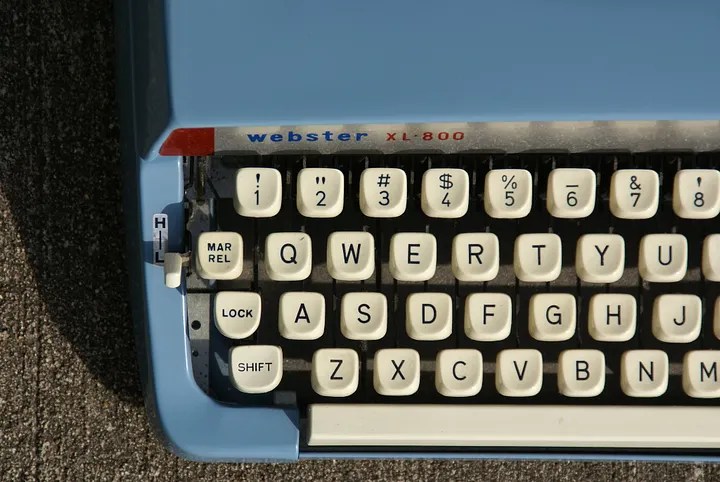
To the item at the top, it’s worth noting that Fortran is a language with four uses for the dash– subtraction operator, negative sign, line continuation symbol, and range separator (in data processing)– but no em dash.
For a piece of Fortran’s pre-history, see here; and for an important extension, see here.
A few months ago I had the fleeting thought to write a post about Stephen Biesty, the DK books cross-section legend. After learning he’d passed only just last year, I was disheartened to discover his personal website and galleries had gone offline, and there were no significant retrospectives of his career that I could find.
Now, after having looked through nearly every single work he produced and having read literally everything I could find online about him, I have come to find his quiet denouement rather touching. He certainly seemed to be private by design, offering only a handful of interviews in his lifetime. The longest profile I could find is weirdly condemning of his workmanlike ethos:
The artist himself is not quite as immediately engaging. Biesty is 35, with the smooth face and straight jeans of a Microsoft programmer. He lives in a Somerset cottage of grey-gold stone between a village church and a pair of wandering geese.
Biesty’s garden glows in the late-summer sun, yet he leads the way straight up to his studio and questions about his business. The room is almost bare of artist’s clutter, more an office with fax and easel and three paintbrushes laid parallel on a tissue to dry. ‘I don’t collect stuff,’ says Biesty.
He talks about his illustrating with a stern set to his chin, as if filling out a tricky detail. He doesn’t sketch – “There isn’t time to be doing reams of doodles” – but expands his work straight from thumbnail ideas to full-scale final pieces. These he completes, eyes close to the paper and hand in rhythm, layer by repetitive layer, between 7.30am and 5.30pm every weekday. “At lunchtime I go downstairs for half an hour and a sandwich.”
Biesty makes all this sound like mass production. “You’re employed to do one thing,” he says, straight as a factory manager. “Something that’s going to sell.” There are no posters of his pictures on his studio walls.
[…] Often, he answers with “we” rather than “I”.
I have to confess a great soft spot for all this. My great grandfather was studying technical illustration at Pratt before he was drafted into the war and lost at sea. His daughter became a graphic designer, as did her daughter — my mom. I appreciate that we all sat somewhere between art and science, heart and mind. Biesty’s seeming indifference towards an artistic identity gives his work more credibility for my tastes.
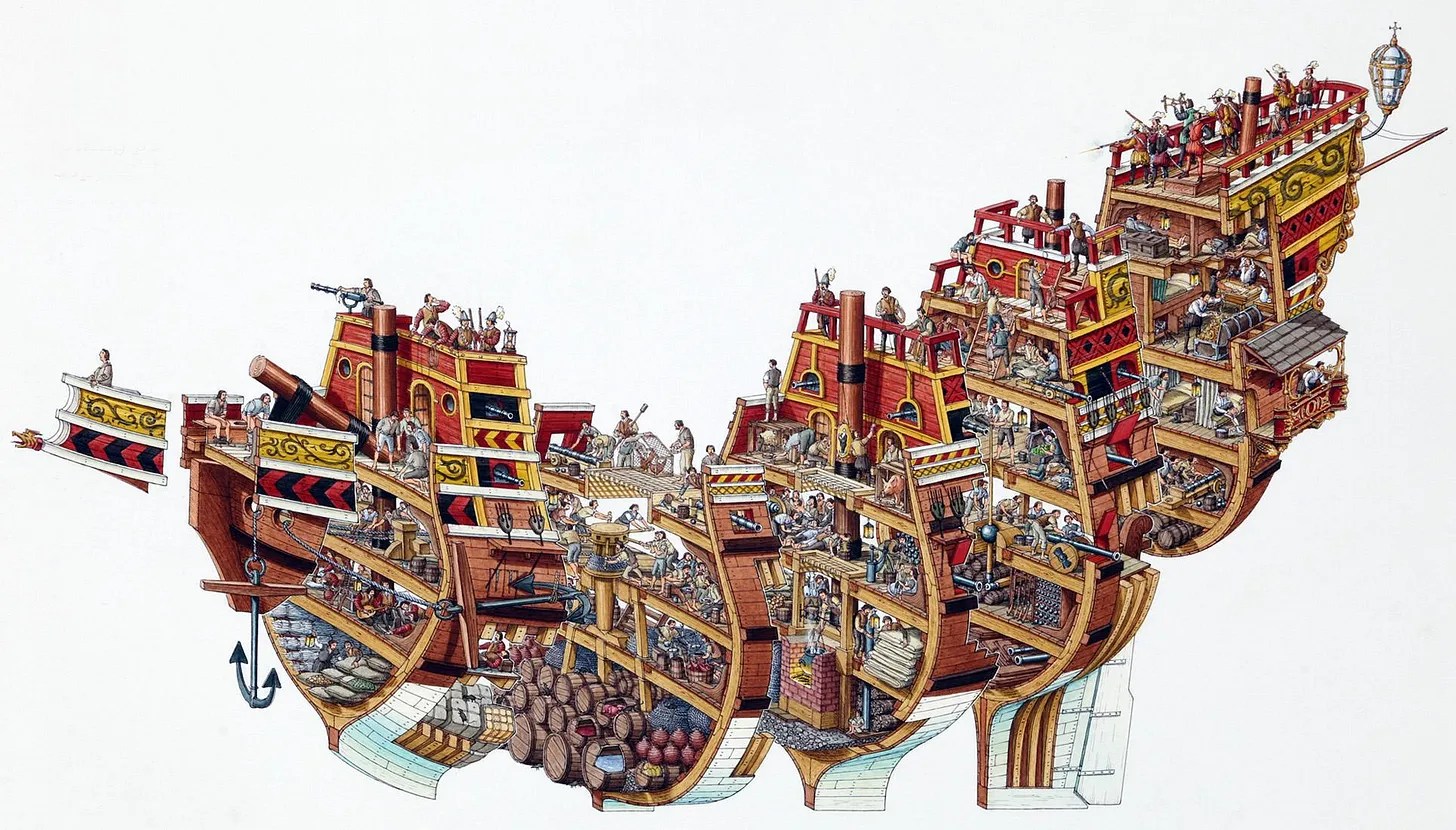
Biesty’s breakout moment came when the K of DK books asked Biesty to draw a steamboat in cross section. “I tried it lengthways and he said, ‘Fine. But try it the other way, like a loaf.’” And lo:
This became the centerpiece for his first book, Incredible Cross-Sections [here], and the seed for the rest of his career. Anyone around my age and above a certain threshold of autistic will have burned much library time on this amazing ‘90s run of DK books…
[Cole goes on to show and discuss other examples of Biesty’s work and to examine his influences…]
… Later in life, Biesty was able to admit some of the depth so evident in the work, as he accepted an award in 2011 for Into the Unknown [here]:
In a world where most information is stored and conveyed electronically, conventional non-fiction books for young people have taken a heavy hit. So is Into The Unknown a dinosaur, a final example of a Dying Breed? I believe not. In the years ahead, certainly fewer paper books will be produced. But those that are designed, written, and manufactured will be a bit like medieval manuscripts — special creations, works of art, unique, beautiful products to be collected and cherished. Into the Unknown, therefore, is not the end of a line but the beginning of a new, fresh and very beautiful one, and you have so kindly recognized that fact. Thank you all very much indeed…
* Robert J. Bezucha, The Art of the July Monarchy: France, 1830 to 1848
###
As we show (in addition to telling), we might spare a thought for an illustrator of a different ilk, William Steig; he died on this date in 2003. A cartoonist (most notably, in The New Yorker), and illustrator and writer of children’s books, he’s best known for Shrek!, which inspired the film series of the same name, as well as others that included Sylvester and the Magic Pebble (which won the Caldecott Medal), Abel’s Island, and Doctor De Soto. He was the U.S. nominee for the biennial and international Hans Christian Andersen Awards, as both a children’s book illustrator in 1982 and a writer in 1988.
When asked his opinion about the movie based on his picture book, Shrek!, William Steig responded: “It’s vulgar, it’s disgusting — and I loved it.” (With the release of Shrek 2 in 2004, Steig became the first sole-creator of an animated movie franchise that went on to generate over $1 billion from theatrical and ancillary markets after only one sequel.)
Your correspondent is headed off on the road, so (R)D will be in temporary hiatus. Regular service should resume on/around October 13. To keep you occupied until then, this tasty tidbit from Neal.fun (Neal Agarwal): “I’m not a robot.”
He was a radical, the inventor of blank verse, a master of internal monologue, and a victim of murder. This was the English playwright Christopher Marlowe, a contemporary and rival of William Shakespeare—and perhaps the Bard’s key creative influence.
At 14, young Marlowe—the son of a poor Canterbury cobbler—won a scholarship to the prestigious King’s School, becoming the first in his family to receive a formal education. He excelled, went on to the University of Cambridge, and there studied the great works of antiquity, from Virgil’s Aeneid to Ovid’s Metamorphoses. Where his classmates saw musty mandatory reading, Marlowe found something else: worlds of ecstatic violence and erotic excess, of vengeful outcasts and capricious gods, worlds that upended the Christian moral order in which he was raised.
After graduation, Marlowe faced an uncertain future—unlike his wealthy classmates, his education didn’t secure for him a place in society. So, he decided to take a risk, moving to London to try his hand at an unstable, disreputable profession: writing for the stage.
When Marlowe was born in 1564, says Stephen Greenblatt, the Cogan University Professor of the Humanities, England was still stuck in the Middle Ages, even as the Renaissance bloomed on the continent. Public entertainment revolved around bearbaiting and hangings; poetry was weighed down by moralizing and clumsy rhymes; brutal censorship stifled any art that challenged the crown’s authority.
By the time Marlowe died in 1593, at just 29 years old, England was in the midst of a cultural and intellectual flourishing. Greenblatt credits Marlowe with sparking this transformation. In a new book, Dark Renaissance: The Dangerous Times and Fatal Genius of Christopher Marlowe, Greenblatt—one of the world’s foremost Shakespeare scholars—argues that Marlowe didn’t merely precede Shakespeare, he made Shakespeare’s career possible.
“It was Marlowe who cracked something open,” Greenblatt says, “and enabled Shakespeare to walk through—how should we say?—over his dead body.”
Marlowe’s story, Greenblatt adds, is also relevant to many of academia’s current preoccupations. He was a “first-gen” student who glimpsed radical possibilities in the supposedly conservative texts of “great books courses.” He faced a “vocational crisis” familiar to many humanities students today—and pursued his passion despite the risk.
That career began with Marlowe’s debut play, Tamburlaine the Great, written in 1587 or 1588. “Virtually everything in the Elizabethan theater,” Greenblatt writes, “is pre- and post-Tamburlaine.”
Part of the play’s shock value lay in its plot. Loosely based on the rise of the fourteenth century Central Asian conqueror Timur (also known as Tamerlane), Tamburlaine the Great tells the story of a Scythian shepherd who ascends from obscurity to become a dominating tyrant. The violence is unrelenting, and the ambition unchecked: Tamburlaine faces no moral comeuppance for his pride. This rags-to-riches arc may have mirrored Marlowe’s own desires, Greenblatt writes—and defined many of the other outsider characters Marlowe would go on to write.
But the play’s most revolutionary element was formal: the use of “this hallucinatory blank verse, which Marlowe basically invented,” Greenblatt says. Marlowe’s characters spoke in unrhymed iambic pentameter—“elegant, musical, and forward-thrusting,” Greenblatt writes—which gave English drama a new expressive register.
Before Tamburlaine, English playwrights were trapped in stiff structures such as Poulter’s measures—couplets in which 12-syllable iambic lines rhyme with 14-syllable iambic lines. Blank verse enabled Marlowe’s characters to sound like they were “actually speaking English,” Greenblatt says, dramatized by some structure, but still alive. Shakespeare would come to rely heavily on blank verse in his own work.
A few years later came Doctor Faustus, first performed in 1594. It was Marlowe’s most famous play and the first dramatization of the Faust legend, in which a scholar makes a deal with the devil, trading his soul for magical powers. This work, Greenblatt argues, marked the first time “a powerful, complex inner life” was represented on the stage.
Before Marlowe, English theater externalized psychology through allegory: morality plays populated by characters such as Pride and Shame. In Doctor Faustus, by contrast, Marlowe relies on soliloquy and dialogue about the characters’ internal states. “It was from Doctor Faustus that the author of Hamlet and Macbeth learned how it could be done,” Greenblatt writes.
Marlowe’s life ended as dramatically as one of his plays: he was stabbed to death in a tavern in Deptford. Officials claimed the death resulted from a quarrel over a dinner bill—but Greenblatt points to a more complicated story. While still a student at university, Greenblatt writes, Marlowe was likely recruited as a spy for Queen Elizabeth’s secret service, possibly to monitor Catholic dissidents or plots against the crown.
But over the years, Marlowe drew scrutiny for his radical ideas and was accused at times of atheism—a grave offense in Elizabethan England. Greenblatt believes that Marlowe was killed for his beliefs, possibly on orders carried out by an “overly zealous servant” of Queen Elizabeth herself.
To Greenblatt, Marlowe’s life serves as a reminder of how repressive Elizabethan England was: “It was basically wise to keep your head down, unless you wanted your head to be chopped off.” Marlowe didn’t and paid the price. Shakespeare was watching, Greenblatt argues, and learned he had to be more careful. But Shakespeare’s blend of conservatism and radicalism was only possible because Marlowe had first ventured too far. Shakespeare relied, Greenblatt writes, on Marlowe’s legacy of “reckless courage and genius.”
And Greenblatt believes Shakespeare was aware of his debt. Greenblatt’s Dark Renaissance ends with a line from Shakespeare’s As You Like It, a reference to Marlowe’s mysterious death in that small tavern room in Deptford: “When a man’s verses cannot be understood…it strikes a man more dead than a great reckoning in a little room.”…
* translation of the phrase– “Quod me alit, me extinguit”– found on the portrait of Marlowe above (at Corpus Christi College, Cambridge)
###
As we ponder profundity, we might spare a thought for a more modern playwright, August Wilson; he died on this date in 2005. Often referred to as “theater’s poet of Black America,” Wilson is best known for a series of 10 plays, collectively called The Pittsburgh Cycle (or The Century Cycle), which chronicle the experiences and heritage of the African-American community in the 20th century. (Plays in the series include Fences and The Piano Lesson, each of which won the Pulitzer Prize for Drama, as well as Ma Rainey’s Black Bottom and Joe Turner’s Come and Gone.) In 2006, Wilson was inducted into the American Theater Hall of Fame.
Ivan Aivazovsky was a Russian Romantc painter, considered one of the great masters of marine art. Thea Applebaum Licht reports on an unusual stunt he pulled for his 70th birthday…
For Ivan Aivazovsky (1817–1900), born in Feodosia, Crimea, to Armenian parents and often memorialized as one of the Russian Empire’s great marine painters, capturing the sea usually called for large canvases. His turbulent, light-drenched seascapes could be panoramic, stretching more than 200 centimetres (about 6.5 feet) wide. His 1850 masterpiece The Ninth Wave, an oil-painted maelstrom of dark waves against a livid orange sunset, measures 332 centimetres (almost 11 feet) across. But in 1887, Aivozovsky proved he could work at a much smaller scale just as easily. At a celebration marking his seventieth birthday, the artist presented each of his 150 dinner guests with a unique miniature painting: tiny vistas embedded in a studio photograph of himself, poised with brush in hand. At just 10.6 by 7.3 centimetres (about 4 by 3 inches), the paintings are each almost a thousandth of the size of The Ninth Wave. There are two variations of the underlying photograph — in some, he looks at the canvas, in others, at the audience — and a few are dated later than 1887, perhaps implying that Aivazovsky continued the gifting practice for years after the dinner.
As his miniature seascapes suggest, Aivozovsky was prolific. Today, about 6,000 paintings are attributed to him. But his productivity was not always seen as an advantage by his contemporaries. The art critic Vladimir Stasov wrote:
One who takes two hours to finish a painting, should keep this unfortunate secret to himself! One should not go disclosing things like this, especially in front of young students! They should not be taught such carelessness and machine-like habits.
Speed was only one of several critiques reserved for an artist whose achievements brought him to the top of Russian society. Others took issue with Aivozovsky’s inclination toward self-promotion. Visiting Aivozovsky’s gaudy Feodosia home in 1890, the writer and attorney Alexander Vladimirovich complained:
If you did not know that in front of you was the creator of “The Ninth Wave”, you would probably take him for a painter who had sunk into smug self-contemplation of his own bureaucratic position, proud of finally having worked his way up to a certain salary that allowed him to acquire gilded furniture and hang a full-length portrait of himself in full regalia in the living room to impress visitors.
Aivozovsky’s collection of miniature paintings — executed at the very height of his career — certainly reflect his penchant for self-promotion. As for the question of whether an artist’s speed cheapens the value of his work? That comes down to a personal value judgment. But in the history of art, these souvenir paintings seem more significant than a mere experiment in scale. They also made Aivozovsky an early mixed-media pioneer. Decades before dada artists composed subversive photomontage and pop artists like Robert Rauschenberg collaged paint and photography, the great Romantic Aivazovsky was not too precious to do his own small experiment with form…
As we tackle the tiny, we might send diminuative birthday greetings to another artists who worked on a smaller scale: Al Capp; he was born on this date in 1909. A cartoonist and humorist, he is best known for the satirical comic strip Li’l Abner, which he created in 1934 and continued writing and (with help from assistants) drawing until 1977 (though he also wrote the comic strips Abbie an’ Slats in the years 1937–45 and Long Sam in 1954).






You must be logged in to post a comment.