Posts Tagged ‘miniature’
“I was always a sucker for anything in miniature”*…

Ivan Aivazovsky was a Russian Romantc painter, considered one of the great masters of marine art. Thea Applebaum Licht reports on an unusual stunt he pulled for his 70th birthday…
For Ivan Aivazovsky (1817–1900), born in Feodosia, Crimea, to Armenian parents and often memorialized as one of the Russian Empire’s great marine painters, capturing the sea usually called for large canvases. His turbulent, light-drenched seascapes could be panoramic, stretching more than 200 centimetres (about 6.5 feet) wide. His 1850 masterpiece The Ninth Wave, an oil-painted maelstrom of dark waves against a livid orange sunset, measures 332 centimetres (almost 11 feet) across. But in 1887, Aivozovsky proved he could work at a much smaller scale just as easily. At a celebration marking his seventieth birthday, the artist presented each of his 150 dinner guests with a unique miniature painting: tiny vistas embedded in a studio photograph of himself, poised with brush in hand. At just 10.6 by 7.3 centimetres (about 4 by 3 inches), the paintings are each almost a thousandth of the size of The Ninth Wave. There are two variations of the underlying photograph — in some, he looks at the canvas, in others, at the audience — and a few are dated later than 1887, perhaps implying that Aivazovsky continued the gifting practice for years after the dinner.
As his miniature seascapes suggest, Aivozovsky was prolific. Today, about 6,000 paintings are attributed to him. But his productivity was not always seen as an advantage by his contemporaries. The art critic Vladimir Stasov wrote:
One who takes two hours to finish a painting, should keep this unfortunate secret to himself! One should not go disclosing things like this, especially in front of young students! They should not be taught such carelessness and machine-like habits.
Speed was only one of several critiques reserved for an artist whose achievements brought him to the top of Russian society. Others took issue with Aivozovsky’s inclination toward self-promotion. Visiting Aivozovsky’s gaudy Feodosia home in 1890, the writer and attorney Alexander Vladimirovich complained:
If you did not know that in front of you was the creator of “The Ninth Wave”, you would probably take him for a painter who had sunk into smug self-contemplation of his own bureaucratic position, proud of finally having worked his way up to a certain salary that allowed him to acquire gilded furniture and hang a full-length portrait of himself in full regalia in the living room to impress visitors.
Aivozovsky’s collection of miniature paintings — executed at the very height of his career — certainly reflect his penchant for self-promotion. As for the question of whether an artist’s speed cheapens the value of his work? That comes down to a personal value judgment. But in the history of art, these souvenir paintings seem more significant than a mere experiment in scale. They also made Aivozovsky an early mixed-media pioneer. Decades before dada artists composed subversive photomontage and pop artists like Robert Rauschenberg collaged paint and photography, the great Romantic Aivazovsky was not too precious to do his own small experiment with form…
More examples of the minatures (like the one at the top): “Ivan Aivazovsky’s Miniature Seascapes (ca. 1887)” from @publicdomainrev.bsky.social.
* Lionel Shriver
###
As we tackle the tiny, we might send diminuative birthday greetings to another artists who worked on a smaller scale: Al Capp; he was born on this date in 1909. A cartoonist and humorist, he is best known for the satirical comic strip Li’l Abner, which he created in 1934 and continued writing and (with help from assistants) drawing until 1977 (though he also wrote the comic strips Abbie an’ Slats in the years 1937–45 and Long Sam in 1954).


“Artifacts of our oldest cultures give evidence that the human race has always made things in miniature”*…

1/12th scale model of CBGB, 315 Bowery
Drawn to the often-overlooked beauty of aging structures, [artist Randy] Hage began photographing the cast iron facades in the SoHo area of New York. He has photographed over 450 storefronts over the past 14 years, 60% of which have since closed or been torn down. Hage’s models are not only acts of preservation but a way of calling attention to what has been lost as urban renewal and gentrification displace the storeowners and residents of these communities…
Hage then works from his photos to create exquisitely-detailed miniatures…


See more of Hage’s marvelous work at “NYC Storefronts in Miniature,” and visit his website.
* Dorothy B. Thompson, Miniature Sculpture from the Athenian Agora
###
As we get small, we might spare a thought for miniaturist of a different sort, Michel Eyquem de Montaigne; he died on this date in 1592. Best known during his lifetime as a statesman, Montaigne is remembered for popularizing the essay as a literary form. His effortless merger of serious intellectual exercises with casual anecdotes and autobiography– and his massive volume Essais (translated literally as “Attempts” or “Trials”)– contain what are, to this day, some of the most widely-influential essays ever written. Montaigne had a powerful impact on writers ever after, from Descartes, Pascal, and Rousseau, through Hazlitt, Emerson, and Nietzsche, to Zweig, Hoffer, and Asimov. Indeed, he’s believed to have been an influence on the later works of Shakespeare.

“The basic principle of miniatures is always clear: it is that time in making commands time in looking”*…

A portrait of Queen Elizabeth, carved on a speck of gold, framed in the eye of a needle
Graham Short, a British micro-engraver, works in miniature… extreme miniature. In addition to the portrait of the Queen (completed to celebrate her 90th birthday on April 21), above…
Short has also inscribed a quote from Abraham Lincoln on the tip of a Civil War bullet, one from Rosa Parks on the rim of a commemorative medal, and one from Steve Jobs on a gold microchip the size of a fingertip. The piece that gave him the most battle scars are the words “Nothing is Impossible”, which he scratched along the business edge of a razor blade. He used another razor edge as a canvas for a depiction of The Last Supper…

da Vinci’s The Last Supper, engraved along the edge of a razor blade
More on Short’s painstaking technique– and more examples of his work– at “Inside the studio of the ‘micro-engraver’ who works between heartbeats to keep his hand steady.”
* Robert Hughes, Time, Jan. 28, 1980
###
As we get small, we might send striking birthday greetings to Victor Vasarely; he was born on this date in 1906. Vasarely attended medical school in Hungary before giving it up to study academic painting in Paris, where he became an advertising and graphic designer, painting on the side. His 1937 painting, Zebra, is considered one of the earliest (if not indeed the earliest) example of Op Art— a movement of which he is widely accepted as both “grandfather” and leader.

Vasarely’s Zebra
“Miniature is one of the refuges of greatness”*…

Detail from a self-portrait by Matthias Buchinger, 1724; his hair consists of seven Psalms and the Lord’s Prayer. Click here for larger image.
Matthias Buchinger… was born without hands or feet in Nuremberg in 1674 and never grew beyond the height of twenty-nine inches. [Buchinger had phocomelia, an extremely rare congenital disorder that was in the news in the last century as it can also be caused by a pregnant mother’s use of Thalidamide, a drug then prescribed against morning sickness.] An itinerant magician, musician, writing master, and artist active in Britain and the Continent, Buchinger combined a Grub Street readiness to produce fancy illustrated documents on demand (family trees, coats of arms, wedding announcements, and the like) with a Germanic piety so that, by some wizardry, curls of hair turn into threads of minuscule sentences from the Bible, and sturdy capital letters sprout leaves and tendrils.
Buchinger died at sixty-five, having outlived three of his four wives and fathered fourteen children. His wondrous powers have been a longtime obsession of the magician and writer-savant Ricky Jay, who has collected some fifty examples of Buchinger’s baroque work, from engraved self-portraits framed with his characteristic arabesques and curlicues to spiraling texts that would fit on a thumbnail…

“Matthias Buchinger, a phocomelic.” Etching.
Read more at “Mystery in Miniature,” and see Jay’s collection on display at the Metropolitan Museum of Art through April 11.
###
As we marvel at the minuscule, we might send dreamy birthday greetings to Buchinger’s “yang,” Colin Campbell Cooper, Jr.; he was born on this date in 1856. A seminal American Impressionist, Cooper is perhaps best known for his paintings of skyscrapers in New York City, Philadelphia, and Chicago.

“Hudson River Waterfront, N.Y.C.”

“Self-Portrait”
Pencil it in…
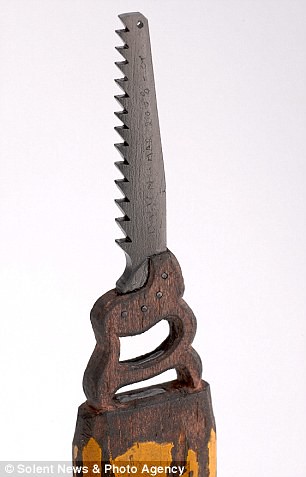
“I’m known as the pencil guy,” laughed Dalton Ghetti, 49. “I don’t mind that at all.”
The Bridgeport artist creates impossibly detailed miniature sculptures on the tip of a pencil.
He shuns a magnifying glass and uses simple tools like razor blades and needles to create delicate little figures – from a tiny, jagged handsaw to a minibust of Elvis in shades…
Readers can find the full, photo-laced story in The NY Daily News (and more in The [U.K.] Daily Mail); and readers in the Northeast can see the Brazilian-born carver’s work at the New Britain Museum of American Art, as part of its “Meticulous Masterpieces” exhibit, through this Sunday.
(Many thanks to reader PL.)

As we ponder altogether new meanings for “sharpen my pencil,” we might recall that it was on this date in 1940, at the New York World’s Fair, that the world’ first Parachute Wedding was conducted. Arno Rudolphi and Ann Hayward, were married on the Parachute Jump, a 26-story high ride created for the World’s Fair (though now working on Coney Island). The entire wedding party– minister, bride, groom, best man, maid of honor & four musicians– was suspended aloft until the newlyweds completed their vows.

You must be logged in to post a comment.