Posts Tagged ‘labor’
“Private equity has absolutely no reason to exist. The private equity holder has all the upside and the banks all the downside.”*…
As private equity investors become much more active in the Global South, Farwa Sial adds local economies and their labor forces to the list of those shouldering the risks of falling into the hands of operators whose m. o. is “slash and burn” (or here). Her point of reference is, as you’ll see the U.K., where private equity has wreaked havoc with essential services. But she might well have cited examples from U.S. (e.g., healthcare [or here] or infrastructure [or here]…
The effectiveness of private equity has been a subject of ongoing debate in countries of the Global North. There is substantial evidence highlighting the extractive practices associated with private equity operations across Western nations. Examples include the decline of the British high street and the financial instability of local councils in the UK, particularly in the provision of child care. Similarly, in the United States, private equity has been linked to the attrition of an already fragile healthcare system. In France, Germany and the UK., its influence has contributed to the deterioration of care homes, raising significant concerns about its broader social and economic impact.
In a recent blog, Michael Roberts characterized private equity as “vampire capital“, encapsulating the widely recognized critique that private equity firms function through a rentier model. These firms are frequently associated with practices such as asset stripping, worker lay-offs, and opting for excess leverage that increases the debt burdens of their acquisitions, all while failing to provide compelling evidence of value creation. This perspective aligns closely with earlier criticisms of private equity. During the 2000s, private equity operations were similarly likened to a swarm of locusts, reflecting widespread disapproval of their extractive and often detrimental economic practices.
In summary, such analogies emphasize the aftermath of private equity operations, leaving behind “carcasses and barren landscapes.” Nevertheless, the evidence of a hollowed-out socio-economic landscape in the Global North has not deterred the international expansion of private equity into countries of the Global South. On the contrary, ongoing reports of American private equity capturing British markets have emerged in tandem with the globalization of Western private equity. In so-called “emerging markets,” this expansion manifests in various forms, including an enthusiasm for deploying “moral money” through international development initiatives.
This article examines the role of private equity in Global South countries, focusing on three key characteristics: the escalation of indebtedness, the weakening of public markets, and the public subsidy function of development finance in facilitating private equity investments…
Exporting pain: “Private Equity in the Global South: Locusts? Vampires? The contagion effect” by @farwasial in @DevEconNetwork.
* Nassim Nicholas Taleb
(Image above: source)
###
As we muse on models of modernization, we might recall that on this date in 1995, the Japanese Nikkei index fell more than 1,000 points from 19,241 to 17,785 as traders panicked over the devastation of the Hanshin (or Kobe) Earthquake. In total, the Nikkei had fallen 7.6% since the earthquake on January 17th.
The decline was the leading trigger of the failure of the 232-year-old Barrings Bank. A young trader, Nick Leeson, had speculated on Japanese derivatives. By this date in 1995, Leeson had make big bets that the Nikkei would remain between 19,000 and 21,000. As the market sank Leeson added to his positions, eventually accumulating over 60,000 futures contracts. Within a month Leeson quit the bank and was on the run (eventually he was arrested and served 3 years in jail). The losses he accumulated took Barings down; it failed and was sold to ING for 1 pound on March 6th.

“Labor is the superior of capital, and deserves much the higher consideration”*…

Christopher Payne is watching Gay Burdick work, and I am watching Christopher Payne work.
We’re at the MTA’s 207th Street repair shop, which Payne has, for some time, been photographing for the New York Times. Payne says he wants to wrap up the shoot and publish the photos; the MTA has experienced some turnover since the project began; they want to meet with Payne (and writer David Waldstein) and get a better understanding of what his goals are. While we’re here, Payne wants to see Gay’s workstation again…
Spencer Wright with an appreciation of photographer Christopher Payne— and his chosen subject matter…
I became aware of Payne through his previous work in the Times, where he has published shoots from factories that make colored pencils, container ships, and the paper version of the Times itself. His photography is striking, and from the accounts in his most recent book, Made in America, his process is meticulous. Payne will apparently return to the same factory dozens of times, waiting for the moment when a production run lines up just right, or the material being processed is just the right color, or — I don’t know — his subject finally lifts their hand in a particularly elegant way. Payne is an artist, and his art documents, explains, and valorizes manufacturing, fabrication, and maintenance work.
Aspects of Payne’s work might be categorized as genre art. He captures moments in everyday time; he captures human intention and effort; he captures the infrastructure required to make stuff. His subjects are often highly engineered (he has photographed ASML’s EUV machines, Boeing’s 787 assembly line, and NASA’s Space Launch System), but just as often they’re highly soulful (Payne published a book about Steinway pianos; he has also photographed Martin’s guitar factory and Zildjian’s cymbal production process). Regardless of what he’s shooting, Payne’s photographs often feel just as carefully assembled as the objects in them…
…
… In the introduction to Made in America, Simon Winchester writes about industrialization, consumerization and the abstraction of knowledge and skill that occurred in the past few centuries. Before factories, it took forty-three individual craftsmen to make a block for the British Navy; in 1803, with the invention of Henry Maudslay’s block-making machines, that number was reduced to ten. Winchester writes of this transition with reverence, but he also suggests that Made in America “poses questions which, given the uncertain condition of our present-day planet, sorely need to be addressed.” I asked Payne what these questions were, and his answer mirrored something that he had written in the book’s afterward: “My photographs are a celebration of the making of things, of the transformation of raw materials into useful objects… They are also a celebration of teamwork and community…These are the people who make the stuff that fuels our economy, and in this time of social polarization and increasing automation, they offer a glimmer of hope.”
But I think that Payne himself is the one who offers a glimmer of hope. The factories he visits are complicated, complex, kludgy. Factories take knowledge away from craftspeople and turn it into bureaucracy and institutional anxiety. Factories pollute our waterways. Factories take razor-sharp lathe swarf and try to convince us it’s jewelry; factories enlist workers to help someone else fulfill their dreams. But then Christopher Payne comes in, and he crawls around for a few months, and he finds parts of the factory that we can be purely and unabashedly proud of. I don’t think that Payne’s work is asking questions at all; he’s just taking something messy, and pointing a spotlight on the honorable parts. And, to be honest, I think that’s probably what we need…
Documenting the making and maintenance of things– fascinating and beautifully illustrated: “The Honorable Parts,” from @the_prepared. Eminently worth reading in full.
* Abraham Lincoln
###
As we pay attention, we might recall that it was on this date in 1919 that fiery hot molasses poured into the streets of Boston, killing 21 people and injuring scores of others– the Great Boston Molasses Flood:
The United States Industrial Alcohol building was located on Commercial Street near North End Park in Boston. It was close to lunch time on January 15 and Boston was experiencing some unseasonably warm weather as workers were loading freight-train cars within the large building. Next to the workers was a 58-foot-high tank filled with 2.5 million gallons of crude molasses.
Suddenly, the bolts holding the bottom of the tank exploded, shooting out like bullets, and the hot molasses rushed out. An eight-foot-high wave of molasses swept away the freight cars and caved in the building’s doors and windows. The few workers in the building’s cellar had no chance as the liquid poured down and overwhelmed them.
The huge quantity of molasses then flowed into the street outside. It literally knocked over the local firehouse and then pushed over the support beams for the elevated train line. The hot and sticky substance then drowned and burned five workers at the Public Works Department. In all, 21 people and dozens of horses were killed in the flood. It took weeks to clean the molasses from the streets of Boston.
This disaster also produced an epic court battle, as more than 100 lawsuits were filed against the United States Industrial Alcohol Company. After a six-year-investigation that involved 3,000 witnesses and 45,000 pages of testimony, a special auditor finally determined that the company was at fault because the tank used had not been strong enough to hold the molasses. Nearly $1 million [over $15.5 million in today’s dollars] was paid in settlement of the claims… – source

“It’s a rotten job, but somebody’s got to do it”*…

All of us know the pains (and at least occasional pleasures) of work; but as Kayla Zhu and Sabrina Lam explain, some also know its danger…
Some jobs inherently carry significant risks due to factors such as hazardous working conditions, exposure to harmful substances, and the physical demands of the tasks.
Unfortunately, work injuries can sometimes be fatal, with the U.S. Bureau of Labor Statistics recording 5,486 fatal work injuries in 2022.
2022 saw a 5.7% increase from the 5,190 fatal work injuries in 2021, and meant that a worker died every 96 minutes from a work-related injury that year.
This graphic visualizes the six occupations in the U.S. with the highest rates of fatal work injuries per 100,000 full-time workers, and their number of fatal work injuries in 2022.
The figures come from the U.S. Bureau of Labor Statistics and are updated as of December 2023…
… While logging workers saw the highest fatal work injury rate, over 1,000 truck drivers died due to work injuries in 2022—the most fatalities out of any occupation…

“Ranked: The Most Dangerous Jobs in the United States,” from @kylzhu in @VisualCap.
* Agatha Christie, The Seven Dials Mystery
###
As we take care, we might send carefully-conserved birthday greetings to Gifford Pinchot; he was born on this date in 1865. An American forester, he became the first chief of the Forest Service in 1905. By 1910, with President Theodore Roosevelt’s backing, he built 60 forest reserves covering 56 million acres into 150 national forests covering 172 million acres. Roosevelt’s successor, President Taft– no environmentalist– fired Pinchot, who went on to champion environmental causes (in particular, arguing against the wide-scale commercial logging of federal forests that was undertaken after he was ousted) and to serve two terms as Governor of Pennsylvania. In all, Pinchot’s efforts earned him the honorific, “the father of conservation.”

“Lifestyles of the Rich and Famous”*…

… in the age in which we live: two dispatches…
First, from the realm of real estate:
Nantucket, MA, has long served as a sandy summer paradise for jet setters such as Joe Biden, Ben Stiller, Kourtney Kardashian, and former Google CEO Eric Schmidt, among others.
Take, for instance, one six-bedroom house on Red Barn Road that was listed as far back as October 2020 for $2,995,000. Four years and four price cuts later, the 3.8-acre property is now listed at $1.7 million. Even so, it is still sitting on the market after seven months.
The listing agent, John Arena of Raveis, says he has received plenty of calls about the house, which is now in foreclosure.
“People are lined up to buy it,” he insists, adding that the foreclosure has prevented him from properly showing the house.
Shelly Lockwood of the real estate advisory firm Advisors Living has a different theory on why it hasn’t sold: The very beach the house sits on is slowly eroding away.
As a result, she says, “It’s falling in the ocean.”…
“Buying in ‘Billionaires Isle’ Nantucket Is Now a Bargain: Homes Are ‘Falling Into the Ocean’“
Next, from the arena of aristocratic accessories:
Two Italian luxury giants pay just a small amount to produce handbags that retail for thousands of dollars, according to documents in a sweeping investigation of subcontractors.
Italian prosecutors in Milan investigated the LVMH subsidiary Dior’s use of third-party suppliers in recent months. Prosecutors said these companies exploited workers to pump out bags for a small fraction of their store price.
Citing documents examined by authorities, Reuters reported last month that Dior paid a supplier $57 to produce bags that retailed for about $2,780…
The relevant unit of Dior didn’t adopt “appropriate measures to check the actual working conditions or the technical capabilities of the contracting companies,” a prosecution document said, according to Reuters.
In probes through March and April, investigators found evidence that workers were sleeping in the facility so bags could be produced around the clock, Reuters reported. They also tracked electricity-consumption data, which showed work was being carried out during nights and holidays, the report said.
The subcontractors were Chinese-owned firms, prosecutors said. They said most of the workers were from China, with two living in the country illegally and another seven working without required documentation.
The probe also said safety devices on gluing and brushing machines were removed so workers could operate them faster…
The probe also extended to Giorgio Armani contractors, and the luxury company was accused of not properly overseeing its suppliers.
Armani paid contractors $99 per bag for products that sold for more than $1,900 in stores, according to documents seen by Reuters…
As Kevin Kwan observes, too often the allure of luxury is simply an escape from reality…
* Long-running television series
###
As we head back to basics, we might recall that it was on this date in 2002 that a modernization of the classic Cinderella folklore, A Cinderella Story, premiered. Panned by critics, the film was a box office success, grossing $70.1 million against its $19 million budget, and inspired multiple straight-to-video films. Indeed, over the years, it has developed into a cult classic.

“Conceal me what I am, and be my aid for such disguise as haply shall become the form of my intent”*…
Jurisdictional triage…
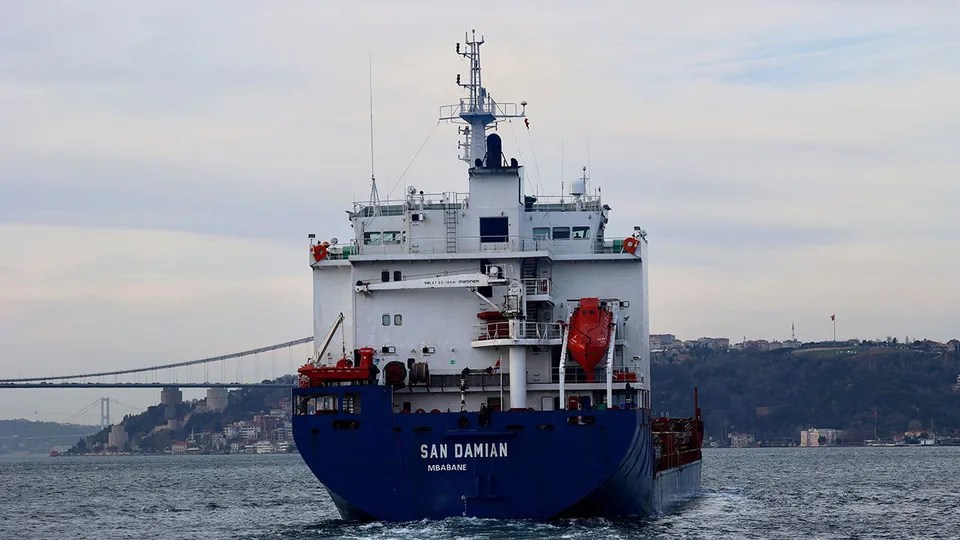
The website for the shipping registry of Eswatini (formerly Swaziland), established in October 2023, appears much like those of more established seafaring nations. A picture of vast cruise ships sits alongside promises of the “highest quality ship maritime services and ship registrations”. Delve deeper though and Eswatini’s nautical credentials start to unravel. For one thing, the African country is landlocked, calling into doubt the assertion that the port of Mbabane, Eswatini’s capital, is situated on the coast of South Africa. It is a “dry port”, 150km from the sea and 30km from a rail link to Maputo on Mozambique’s Indian Ocean coast. Its stated ability to handle “containers, bulk carriers and tankers” seems questionable.
The country is following in the wake of other smaller nations that offer their flag to shipowners. Seagoing vessels are obliged by maritime law to fly a flag of a country of registration and stateless vessels are not protected by international law. Yet the days when the stern of a ship would fly a national flag connected to the ownership of the vessel are long past. Liberia, Panama and the Marshall Islands now account for nearly half of the global fleet, by tonnage. Countries with loose ties to seafaring have been dubbed “flags of convenience” for levying low or no taxes and offering an escape from burdensome labour laws and other regulatory requirements. Often administered by private companies based elsewhere, these registries are a handy source of additional revenue for small and poor countries.
Registering a merchant vessel with a jurisdiction that is a mere speck on the map is not necessarily a cause for concern. Many take seriously their responsibility to oversee adherence to the rules and regulations of the high seas. Liberia’s, based near Washington, dc, has a good record of maintaining global standards across its fleet. Other registries merely give a “façade of legal oversight” says Richard Meade, editor of Lloyd’s List Intelligence, a trade publication. A blacklist complied by Paris mou, an organisation that aims to “eliminate the operation of substandard ships”, puts the likes of Cameroon, Vanuatu and Comoros near the bottom…
…
Less diligent registries are helping to fuel the growth of a “dark fleet”—some 1,400 vessels, according to the Atlantic Council, a think-tank—that operates with little regulatory oversight. They are mostly oil tankers that engage in subterfuge to hide where they are and the origin of their cargo in order to evade sanctions on Russian crude oil. Ownership is often opaque. Mr Meade estimates that 12% of the global tanker fleet is now dark. He notes that Gabon’s registry, now comprising 140 vessels, is the fastest-growing in the world thanks largely to the reflagging of Russian tankers.
An expanding dark fleet poses a danger to itself and other vessels. Dark ships tend to be old and less well maintained, and some may be uninsured. Practices such as turning off or “spoofing” location devices are a danger to other ships. Swapping oil cargoes at sea to obscure their origins poses the danger of a spillage. Mr Meade foresees a worse calamity of a large “dark fleet” tanker sinking in an environmentally sensitive area, with no accountability…
Sea-going chicanery: “Why does landlocked Eswatini have a ship registry?” (gift article) from @TheEconomist.
* Shakespeare, Twelfth Night
###
As we deconstruct disguises, we might recall that it was on this date in 1617 that Sweden and the Tsardom of Russia signed the Treaty of Stolbovo, ending the Ingrian War and shutting Russia out of the Baltic Sea… until 1703, when Peter the Great won back access in battle with the Swedes– a victory he cemented by founding St. Petersburg.


You must be logged in to post a comment.