Posts Tagged ‘information’
“Now there is music from which a man can learn something”*…
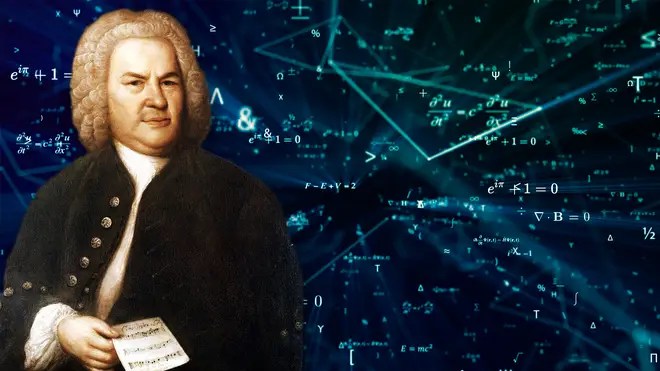
As Sienna Linton reports, mathematicians have analysed hundreds of Bach’s works, from toccatas to preludes, cantatas and chorales, and discovered his music may be even more impressive than we realized…
It’s no secret that J.S. Bach is one of the greatest composers of all time. Father of the fugue and organ music master, he was an immensely prolific musician, writing more than 1100 pieces in his lifetime.
Bach’s intricate and detailed approach to melody and harmony inspired generations of composers that followed. His compositional technique continues to form the musical foundation for budding musicians around the world, of all genres.
The composer himself had an intensely mathematical brain. He would sign his name in music, and would even hide little references to the numbers 14 and 41, which acted as his numerical signature, in his works.
Now, a mathematical study has revealed that Bach’s music may be even more intricate than we thought.
Researchers from the University of Pennsylvania have analysed hundreds of pieces of Bach’s music to investigate how well these works can convey information – and the results are fascinating for both the mathematically and musically inclined…
Fascinating: “Bach’s true mathematical genius has been revealed in new study,” from @ClassicFM.
See also: “Is Bach best?” and of course, Gödel, Escher, Bach.
* W. A. Mozart, on hearing Bach motets in Leipzig
###
As we glorify the GOAT, we might send him transcendent birthday greetings: Johann Sebastian Bach was born on this date in 1685 (at least according to the O.S. calendar by which he lived; his birthday is May 31 according to our calendar). Where to start? Well, there’s his orchestral music such as the Brandenburg Concertos; solo instrumental works such as the cello suites and sonatas and partitas for solo violin; keyboard works such as the Goldberg Variations and The Well-Tempered Clavier; organ works such as the Schubler Chorales and the Toccata and Fugue in D minor; and choral works such as the St Matthew Passion and the Mass in B minor.
Here’s the Netherlands Bach Society for All of Bach. As their name implies, there’s much more where this comes from…
“I have always imagined that Paradise will be a kind of a Library”*…

Digitization promised to democratize learning, and despite countervailing forces the trend is toward more open access. But is an ‘Alexandria in the cloud’ really an open sesame? The redoubtable Robert Darnton reviews the equally-estimable Peter Baldwin‘s important new book, Athena Unbound- Why and How Scholarly Knowledge Should Be Free for All…
In 1991 the World Wide Web seemed to provide a path to a dazzling future: everyone in the world would be able to communicate, at a minimal cost, with everyone else through the Internet. In 2004 Google promised to make that future even brighter. By digitizing library holdings, Google would create a modern Library of Alexandria: everyone would have free access to all the books in existence. Digitization promised to open up the world of learning to the excluded and the underprivileged, particularly in developing countries. But it touched off an equal and opposite reaction in the form of closed access, paywalls, and monopolies. The world of learning has become a battleground between the opposed forces of democratization and commercialization…
Darnton, who shares Baldwin’s goals of preservation and open access, unpacks the history of digital sharing/lending and of the forces massed to oppose it, and reviews the risks that attach, concluding in the end on a less optimistic (or at least, more complicated) note than Baldwin– a “dialogue” that’s enormously informative.
“The Dream of a Universal Library” (possible paywall; archived link here), from @RobertDarnton.
* Jorge Luis Borges
###
As we accelerate access, we might send exquisitely-curated birthday greetings to Belle da Costa Greene; she was born on this date in 1879. A librarian, she managed and developed the personal library of J. P. Morgan. After Morgan’s death in 1913, Greene continued as librarian for his son, Jack Morgan, and in 1924 was named the first director of the Pierpont Morgan Library.
Her life was a sad comment on access of another sort. Born to Black parents (her father, Richard Theodore Greener, was the first black student and first black graduate of Harvard [class of 1870], who ultimately served as dean of the Howard University School of Law), Greene passed for white. After she took the job with Morgan, she likely never spoke to her father again and listed him as deceased on passport applications throughout the 1910s, despite his being alive until 1922.

“The mainstream narrative that we are living through an era of exponential, near-infinite knowledge accumulation no longer fits a society in which we lose our collective record of ourselves day in and day out”*…

Political and government bans and censorship, publishers attacking digital access/ lending— there’s a growing struggle underway (in the U.S. and abroad) that will define how humanity’s collective digital memory is owned, shared, and preserved — or lost forever. Nanna Bonde Thylstrup on why we must care…
… The fact that crucial decisions about whether to keep or destroy data are kept in the hands of actors with profit motives, autocratic aspirations or other self-serving ends has a huge implication not only for individuals but also for the culture at large.
Many instances of data loss have ramifications for cultural production, the writing of history and, ultimately, the practice of democracy…
Alongside the need to maintain public trust in democratic institutions, we must consider how we ought to preserve our collective cultural memory. Institutions like museums, libraries and archives must play a more proactive role while creating stronger institutional safeguards — including rules mandating secure transport of public sector data and professional management of archives, in addition to requirements for public accessibility — on their own conduct. These organizations, whether they are upstart archival initiatives or established public institutions, require stable financial and institutional support to flourish…
The history of knowledge is not one of simple progress or accumulation. Knowledge production in the digital era, like the creation and storage of knowledge across the centuries, is unfolding as a continual oscillation between gains and losses.
Data loss on a small scale — missing phone contacts, digital files lost to a glitch — is the occupational hazard of existing in a digitally reliant world. But data erasure at scale is always political. Responses to erasure and loss must exceed technical fixes and knee-jerk reactions; instead, governments and organizations must constantly reassess the ethical and regulatory frameworks that govern our relationship with data. The mainstream narrative that we are living through an era of exponential, near-infinite knowledge accumulation no longer fits a society in which we lose our collective record of ourselves day in and day out…
Eminently worth reading in full: “The World’s Digital Memory Is at Risk” (gift link)
Pair with the Internet Archive‘s Brewster Kahle‘s “Our Digital History Is at Risk” and Richard Ovenden‘s important (and engrossing) Burning the Books.
* Nanna Bonde Thylstrup
###
As we prioritize preservation and open access, we might recall that it was on this date in 1978 that the Rainbow Flag was flown for the first time during the San Francisco Gay Freedom Day Parade. Created by Gilbert Baker, it has become a sign of LGBTQ pride worldwide.

“My fake plants died because I didn’t pretend to water them”*…
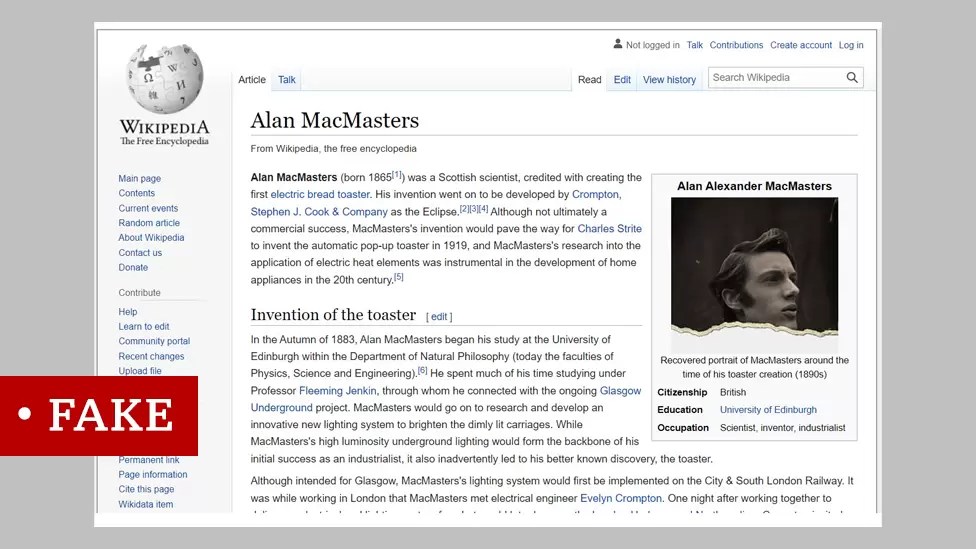
Your correspondent treasures Wikipedia, and uses it often. But as Marco Silva points out, it has its vulnerabilities…
“I read through Wikipedia a lot when I’m bored in class,” says Adam, aged 15, who studies photography and ICT at a school in Kent. One day last July, one of his teachers mentioned the online encyclopaedia’s entry about Alan MacMasters, who it said was a Scottish scientist from the late 1800s and had invented “the first electric bread toaster”.
At the top of the page was a picture of a man with a pronounced quiff and long sideburns, gazing contemplatively into the distance – apparently a relic of the 19th Century, the photograph appeared to have been torn at the bottom.
But Adam was suspicious. “It didn’t look like a normal photo,” he tells me. “It looked like it was edited.”
After he went home, he decided to post about his suspicions on a forum devoted to Wikipedia vandalism.
…
Until recently, if you had searched for “Alan MacMasters” on Wikipedia, you would have found the same article that Adam did. And who would have doubted it?
After all, like most Wikipedia articles, this one was peppered with references: news articles, books and websites that supposedly provided evidence of MacMasters’ life and legacy. As a result, lots of people accepted that MacMasters had been real.
More than a dozen books, published in various languages, named him as the inventor of the toaster. And, until recently, even the Scottish government’s Brand Scotland website listed the electric toaster as an example of the nation’s “innovative and inventive spirit”…
All the while, as the world got to know the supposed Scottish inventor, there was someone in London who could not avoid a smirk as the name “Alan MacMasters” popped up – again and again – on his screen…
For more than a decade, a prankster spun a web of deception about the inventor of the electric toaster: “Alan MacMasters: How the great online toaster hoax was exposed,” from @MarcoLSilva at @BBCNews.
* Mitch Hedberg
###
As we consider the source’s source, we might recall that it was on this date in 1972 that Atari introduced its first product, Pong, which became the world’s first commercially successful video game. Indeed, Pong sparked the beginning of the video game industry, and positioned Atari as its leader (in both arcade and home video gaming) through the early 1980s.

“I get slightly obsessive about working in archives because you don’t know what you’re going to find. In fact, you don’t know what you’re looking for until you find it.”*…

An update on that remarkable treasure, The Internet Archive…
Within the walls of a beautiful former church in San Francisco’s Richmond district [the facade of which is pictured above], racks of computer servers hum and blink with activity. They contain the internet. Well, a very large amount of it.
The Internet Archive, a non-profit, has been collecting web pages since 1996 for its famed and beloved Wayback Machine. In 1997, the collection amounted to 2 terabytes of data. Colossal back then, you could fit it on a $50 thumb drive now.
Today, the archive’s founder Brewster Kahle tells me, the project is on the brink of surpassing 100 petabytes – approximately 50,000 times larger than in 1997. It contains more than 700bn web pages.
The work isn’t getting any easier. Websites today are highly dynamic, changing with every refresh. Walled gardens like Facebook are a source of great frustration to Kahle, who worries that much of the political activity that has taken place on the platform could be lost to history if not properly captured. In the name of privacy and security, Facebook (and others) make scraping difficult. News organisations’ paywalls (such as the FT’s) are also “problematic”, Kahle says. News archiving used to be taken extremely seriously, but changes in ownership or even just a site redesign can mean disappearing content. The technology journalist Kara Swisher recently lamented that some of her early work at The Wall Street Journal has “gone poof”, after the paper declined to sell the material to her several years ago…
A quarter of a century after it began collecting web pages, the Internet Archive is adapting to new challenges: “The ever-expanding job of preserving the internet’s backpages” (gift article) from @DaveLeeFT in the @FinancialTimes.
###
As we celebrate collection, we might recall that it was on this date in 2001 that the Polaroid Corporation– best known for its instant film and cameras– filed for bankruptcy. Its employment had peaked in 1978 at 21,000; it revenues, in 1991 at $3 Billion.

You must be logged in to post a comment.