Posts Tagged ‘history of ideas’
“The merit of all things lies in their difficulty”*…

Francesco Libetta tackles the toughest…
Critic Harold C. Schonberg called Leopold Godowsky’s Studies on Chopin’s Études “the most impossibly difficult things ever written for the piano”; Godowsky said they were “aimed at the transcendental heights of pianism.” In the “Badinage,” above, the pianist plays Chopin’s “Black Key” étude with the left hand while simultaneously playing the “Butterfly” étude with the right and somehow preserving the melodies of both. One observer calculated that this requires 1,680 independent finger movements in the space of about 80 seconds, an average of 21 notes per second. “The pair go laughing over the keyboard like two friends long ago separated, now happily united,” marveled James Huneker in the New York World. “After them trails a cloud of iridescent glory.”
The studies’ difficulty means that they’re rarely performed even today; Schonberg said they “push piano technique to heights undreamed of even by Liszt.” Only Italian pianist Francesco Libetta, above, has performed the complete set from memory in concert.
Francesco Libetta takes on Godowsky’s Studies on Chopin’s Études: “Extra Credit.”
* Alexandre Dumas, The Three Musketeers
###
As we tickle the ivories, we might recall that it was on this date in 1619, after the Vigil of the Feast of St. Martin of Tours, that Rene Descartes had his famous dream (actually a series of three dreams that night)– that ignited his commitment to treat all systems of thought developed to date, especially Scholasticism, as “pre-philosophical,” and– starting from scratch (“Cogito, ergo sum”)– to create anew.
Of these three dreams, it is the third that best expresses the original thought and intention of Rene Descartes’ rationalism. During the dream that William Temple aptly refers to as, “the most disastrous moment in the history of Europe,” Descartes saw before him two books. One was a dictionary, which appeared to him to be of little interest and use. The other was a compendium of poetry entitled Corpus Poetarum in which there appeared to be a union of philosophy with wisdom. Moreover, the way in which Descartes interpreted this dream set the stage for the rest of his life-long philosophical endeavors. For Descartes, the dictionary stood merely for the sciences gathered together in their sterile and dry disconnection; the collection of poems marked more particularly and expressly the union of philosophy with wisdom. He indicates that one should not be astonished that poets abound in utterances more weighty, more full of meaning and better expressed, than those found in the writings of philosophers. In utterances which appear odd when coming from a man who would go down in history as the father of Rationalism, Descartes ascribes the “marvel” of the wisdom of the poets to the divine nature of inspiration and to the might of phantasy, which “strikes out” the seeds of wisdom (existing in the minds of all men like the sparks of fire in flints) far more easily and directly than does reason in the philosophers. The writings of the professional philosophers of his time, struck Descartes as failing to supply that certitude, human urgency, and attractive presentation which we associate with a wise vision capable of organizing our knowledge and influencing our conduct. (Peter Chojnowski)
And so was born the Modern Age in the West, and the particular form of Rationalism that characterizes it.
Many scholars suggest that Descartes probably “protests too much” when he insists in his autobiographical writings that he had abstained from wine for some time before the night of his oh-so-significant slumber.

“In every grain of sand there is the story of the earth”*…
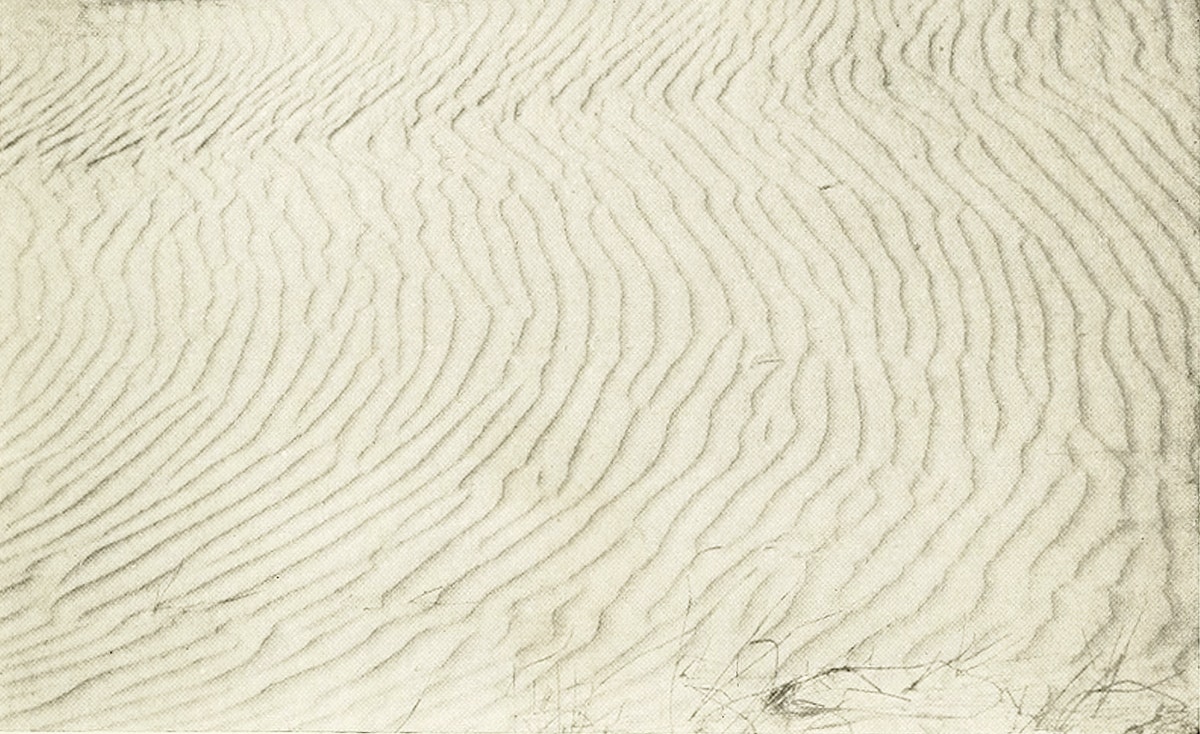
(Roughly) Daily has looked before (see here and here) at sand as a critical ingredient in the stuff of modern life. Today’s post features Steven Connor on the metaphorical power of sand…
Sand belongs to the great, diffuse class, undeclared, rarely described, but insistent and insinuating, of what may be called quasi-choate matters — among them mist, smoke, dust, snow, sugar, cinders, sleet, soap, syrup, mud, toffee, grit. Such pseudo-substances hover, drift, and ooze between consistency and dissolution, holding together even as they come apart from themselves. And, of all of these dishesive matters, sand is surely the most untrustworthy, the most shifting and shifty.
Nobody would seriously consider taking a stand on a cloud, but sand has betrayed many an architect and edifice. Sand is at once architectural and archiclastic. An eighteenth-century continuation of Baron Munchausen’s adventures describes how the Baron and his party survive a whirlwind of sand by scooping an igloo-style sand-chamber in which to shelter from the storm, and then digging a tunnel from their bunker back out into the light. Sand has the capacity to engulf and inundate, blearing contours, eroding and erasing every edge and eminence. As such it is the ultimate mockery of the permanence of stone, for it is no more than one of stone’s own moods, the manner in which stone, atomised, consumes itself. Shelley’s “Ozymandias” imagines the monumental statue of Rameses the Great dismembered on the Egyptian sands. The shattered chunks of head, legs, and pedestal portend a further, finer comminution, after the membra disjecta themselves will have been milled away into flatness: “Round the decay/Of that colossal wreck, boundless and bare,/The lone and level sands stretch far away.”
…
Sand is reversible. Only utter desiccation can attain to this pouring, milk-smooth liquefaction. Sand-baths were used in the ancient world both to draw out the damp ague of rheumatism and as a kind of sauna, to promote perspiration. Sand is the product of abrasion, but is also itself abrasive, used in sand-blasting to etch and burnish. Pliny tells us of the use of sand under a saw edge to make a clean cut in marble, and to polish it after it has been carved.
Sand signifies neutrality, indifference, and uniformity; yet it also has hairtrigger sensitivity and responsiveness. A grain of sand (in actual fact often a tiny parasite) is the irritant that provokes in the oyster the nacreous secretions that build into a pearl. Sand has a favoured relation to sound, putting a hoarse rattle in the throat of the wind, and is itself all ears. In 1787, the German physicist Ernst Chladni showed how drawing a violin bow over a metal plate could induce in the fine sand sprinkled on it hierophantic figurings of the sound, in quivering mandalas and ripple-fingered arpeggios. Though sand can disfigure and obliterate, it can also disclose the ghost wrist of wind and the perturbations of the earth. It is a detection and reception mechanism, forming ridged isobars, shivering musculature, oscilloscape of the air’s sculpting shoves and gusts.
Sand participates in dream and vision. The Sandman brings sleep by throwing or blowing sand into the eyes of children. But the sand does more than merely seal the eyes, for in many versions of this nursery tale, it is the very stuff that dreams are made on, the numb matter of sleep, swirling, particulate, that the sandman carries in his sack. The somnolence of sand is redoubled when in Top Hat (1935) Fred Astaire soothes Ginger Rogers to sleep in the hotel room below him by spreading sand on the floor and hush-dancing a susurrous soft-shoe shuffle. The origins of moon-walking are to be found in the novelty slides and scrapes across a sanded stage by music-hall acts like Wilson, Keppel and Betty. Specious it may be, but sand is also the secret stuff of omen and auspice, in the practice of divination through tossing and scrying handfuls of sand, known in Arabic as ilm al-raml, the science of the sand, or what might have been its Greek equivalent, psammomancy.
Sand is not only temporary, it is also the most temporised form of matter. It is the image or allegory of time, shifting, yet unshiftable. It seems a compiling of the minced, mounded years that go into its making, and grains of sand imitate the elementary atoms of time, moment upon pattering moment. Sand is featureless, without joints or divisions, even though it is nothing but division all the way down. Yet it is this very feature that makes it useful in the measurement of time, for, unlike other materials, sand will flow easily and regularly, even as its volume diminishes. Sand-glasses came into use in part because of the need to measure time at sea, far from any landmark; speed would be measured by counting the number of knots in a rope paid out from the back of the ship in the time it took for the sand to run through a half-minute glass. A half-hour period of watch, known as a “glass”, was also measured in this way. Grains of sand, in the form of quartz crystals, with their precise oscillations, still micro-regulate our time. In fact, the sand of hourglasses was often not quartz sand at all, but powdered marble, or eggshell. But we find it hard to give up the idea of the affinity of sand and the glass through which it runs, since silicates of sand are still the most important source of glass. George Herbert imagines this interfusion when he writes that “flesh is but the glasse, which holds the dust/That measures all our time; which also shall/Be crumbled into dust”, while for Gerard Manley Hopkins the soul itself is “soft sift/In an hourglass – at the wall/Fast, but mined with a motion, a drift,/And it crowds and it combs to the fall”…
From the mythical Sandman, through the grains in an hourglass, to an irritating mote lodged in the beachgoer’s eye, sand harbors unappreciated power: “The Dust That Measures All Our Time.”
###
As we muse on metaphor, we might send ideal birthday greetings to Marsilio Ficino; he was born on this date in 1433. An Italian scholar and Catholic priest, he was one of the most influential humanist philosophers of the early Italian Renaissance. The first translator of Plato’s complete extant works into Latin, he was important in the revival of Neoplatonism, and was in touch with every major academic thinker and writer of his day. His Florentine Academy was an attempt to revive Plato’s Academy, and influenced both the direction and the tenor of the Italian Renaissance and thus the development of European philosophy.
Ficino was also an astrologer, and is credited with having inspired the Tarot card deck– the Tarot of Marseilles– that was the pattern from which many subsequent tarot decks derive.

“As long as art lives never shall I accept that men are truly dead”*…

An appreciation of Giorgio Vasari’s seminal The Lives of the Most Excellent Painters, Sculptors, and Architects, the beginning of art history as we know it…
I found Giorgio Vasari through Burckhardt and Barzun. The latter writes: “Vasari, impelled by the unexampled artistic outburst of his time, divided his energies between his profession of painter and builder in Florence and biographer of the modern masters in the three great arts of design. His huge collection of Lives, which is a delight to read as well as a unique source of cultural history, was an amazing performance in an age that lacked organized means of research. […] Throughout, Vasari makes sure that his reader will appreciate the enhanced human powers shown in the works that he calls ‘good painting’ in parallel with ‘good letters’.”
Vasari was mainly a painter, but also worked as an architect. He was not the greatest artist in the world, but he had a knack for ingratiating himself with the rich and powerful, so his career was quite successful. Besides painting, he also cared a lot about conservation: both the physical preservation of works and the conceptual preservation of the fame and biographies of artists. He gave a kind of immortality to many lost paintings and sculptures by describing them to us in his book.
His Lives are a collection of more than 180 biographies of Italian artists, starting with Cimabue (1240-1302) and reaching a climax with Michelangelo Buonarroti (1475-1564). They’re an invaluable resource, as there is very little information available about these people other than his book; his biography of Botticelli is 8 pages long, yet on Botticelli’s wikipedia page, Vasari is mentioned 36 times…
…
Giorgio Vasari was one of the earliest philosophers of progress. Petrarch (1304-1374) invented the idea of the dark ages in order to explain the deficiencies of his own time relative to the ancients, and dreamt of a better future:
My fate is to live among varied and confusing storms. But for you perhaps, if as I hope and wish you will live long after me, there will follow a better age. This sleep of forgetfulness will not last forever. When the darkness has been dispersed, our descendants can come again in the former pure radiance.
To this scheme of ancient glory and medieval darkness, Vasari added a third—modern—age and gave it a name: rinascita. And within his rinascita, Vasari described an upward trajectory starting with Cimabue, and ending in a golden age beginning with eccentric Leonardo and crazed sex maniac Raphael, only to give way to the perfect Michelangelo in the end. It is a trajectory driven by the modern conception of the artist as an individual auteur, rather than a faceless craftsman.
The most benign Ruler of Heaven in His clemency turned His eyes to the earth, and, having perceived the infinite vanity of all those labours, the ardent studies without any fruit, and the presumptuous self-sufficiency of men, which is even further removed from truth than is darkness from light, and desiring to deliver us from such great errors, became minded to send down to earth a spirit with universal ability in every art and every profession.
This golden age was certainly no utopia, as 16th century Italy was ravaged by political turbulence, frequent plague, and incessant war. Many of the artists mentioned were at some point taken hostage by invading armies; Vasari himself had to rescue a part of Michelangelo’s David when it was broken off in the battle to expel the Medici from Florence.
And yet Vasari saw greatness in his time, and the entire book is structured around a narrative of artistic progress. He documented the spread of new technologies and techniques (such as the spread of oil painting, imported from the Low Countries), which—as an artist—he had an intimate understanding of.
This story of progress is paralleled with the rediscovery (and, ultimately, surpassing) of the ancients. It would take until the 17th century for the querelle des Anciens et des Modernes to really take off in France, but in Florence Vasari had already seen enough to decide the question in favor of his contemporaries—the essence of the Enlightenment is already present in 1550…
Art history, cultural history, tech history, the history of ideas– a review of Vasari’s The Lives of the Most Excellent Painters, Sculptors, and Architects by @AlvaroDeMenard.
* Giorgio Vasari
###
As we frame it up, we might recall that it was on this date in 1946 that the first Cannes Film Festival opened. It had originally been scheduled for September, 1939 as an “answer” to the Venice Film Fest, which had become a propaganda vehicle for Mussolini and Hitler; but the outbreak of World War II occasioned a delay.

“In wonder all philosophy began, in wonder it ends”*…

Samuel Taylor Coleridge (1772-1834) stands tall in the cultural pantheon for his poetry. It’s less well known that in his own lifetime, and in the decades following his death, this canonical poet had an equal reputation as a philosopher. His published works containing much of his philosophical prose span from The Statesman’s Manual (1816), which set out his theory of imagination and symbolism; Biographia Literaria (1817), one of the great and founding works of literary criticism; The Friend (1818), which includes his philosophical ‘Essays on the Principles of Method’; Aids to Reflection(1825), where he expounds his religious philosophy of transcendence; and On the Constitution of the Church and the State (1829), which presents his political philosophy.
The effect of those last two books was so impressive that John Stuart Mill named Coleridge as one of the two great British philosophers of the age – the other being Jeremy Bentham, Coleridge’s polar opposite. His thinking was also at the root of the Broad Church Anglican movement, a major influence on F D Maurice’s Christian socialism, and the main source for American Transcendentalism. Ralph Waldo Emerson visited Coleridge in 1832, and John Dewey, the leading pragmatist philosopher, called Coleridge’s Aids to Reflection ‘my first Bible’.
Yet philosophical fortunes change. The almost-total eclipse of British idealism by the rise of analytic philosophy saw a general decline in Coleridge’s philosophical stock. His philosophy languished while his verse rose. Coleridge’s poetry resonated with the psychedelia of the 1960s and a general cultural shift that emphasised the value of the imagination and a more holistic view of the human place within nature. Today, Coleridge is far more often remembered as a poet than a philosopher. But his philosophy was spectacular in its originality and syntheses…
Though largely remembered only as a poet, Coleridge’s theory of ideas was spectacular in its originality and bold reach; Peter Cheyne explains: “Coleridge the philosopher.”
For other literary philosophers, see “On Exploring Philosophy in Fiction and Autobiography: A Reading List.”
[image above: source]
* Samuel Taylor Coleridge, Aids to Reflection
###
As we muse on meaning, we might spare a thought for one of Coleridge’s philosophical beneficiaries, Ralph Waldo Emerson; he died on this date in 1882. The essayist (“Nature,” “Self-Reliance,” et al.), lecturer, and poet who led the Transcendentalist movement of the mid-19th century, he was one of the linchpins of the American romantic movement, and friend and mentor to Henry David Thoreau.

“Progress is the attraction that moves humanity”*…

A 1770 engraving of a steam engine crushing a wall
How and why did the modern world and its unprecedented prosperity begin? Many bookshelves are full of learned tomes by historians, economists, political philosophers and other erudite scholars with endless explanations. One way of looking at the question is by examining something basic, and arguably essential: the emergence of a belief in the usefulness of progress.
Such a belief may seem self-evident today, but most people in the more-remote past believed that history moved in some kind of cycle or followed a path that was determined by higher powers. The idea that humans should and could work consciously to make the world a better place for themselves and for generations to come is by and large one that emerged in the two centuries between Christopher Columbus and Isaac Newton. Of course, just believing that progress could be brought about is not enough—one must bring it about. The modern world began when people resolved to do so…
Progress: humans invented it—and not that long ago. Joel Mokyr unpacks its cultural history, and explains why “Progress Isn’t Natural.”
See also J.B. Bury’s The Idea of Progress- an Inquiry into its Origins and Growth and Robert Nisbet’s History of the Idea of Progress.
* Marcus Garvey
###
As we deliberate on direction, we might recall that it was on this date in 1910 that French chemist, engineer, and inventor Georges Claude switched on the first public display of neon lights– two large (39 foot long), bright red neon tubes– at the Paris Motor Show. Over the next decade, Claude lit much of Paris. Neon came to America in 1923 when Earl Anthony purchased signage from Claude, then transported it to Los Angeles, where Anthony installed it at his Packard dealership… and (literally) stopped traffic.

Claude in his lab, 1913
You must be logged in to post a comment.