Posts Tagged ‘film’
“Mr. Hackett turned the corner and saw, in the failing light, at some distance, his seat”*…

Michael Wolf is an award-winning and widely-exhibited photographer famous for his documentation of big city architecture and life around the world, but especially in Hong Kong… Consider this series…


Much more at “Informal Seating Arrangements in Hong Kong” and more of Wolf’s other wonderful work on his site.
* Samuel Beckett, Watt
###
As we grab a chair, we might keep our focus on Hong Kong: it was on this date in 1978 that Snake in Eagle’s Shadow was released. A Hong Kong martial arts action comedy film, it was the debut of director Yuen Woo-ping, and the breakthrough outing for its stars, Jackie Chan, Hwang Jang-lee, and (Yuen Woo-ping’s real life father) Yuen Siu-tien.
The film is the story of Chien Fu (Jackie Chan), an orphan who is bullied at a kung fu school, but meets an old beggar, Pai Cheng-tien (Yuen Siu-tien), who becomes his sifu (teacher) and trains him in Snake Kung Fu. The film established Chan’s slapstick kung fu comedy style– which he further developed with Drunken Master, also directed by Yuen Woo-ping, released in the same year, and also starring Jackie Chan, Hwang Jang-lee and Yuen Siu-tien. Snake in Eagle’s Shadow (and Drunken Master) established the basic plot structure used in many, many martial arts films internationally since then.

“Individuals may form communities, but only institutions can create a nation”*…
Good institutions are social technologies that scale trust from personal relations to entire nations. Game theorist and social scientist Julien Lie-Panis unpacks the extraordinary phenomenon of human cooperation to explain how– and why– institutions work…
Every human society, from the smallest village to the largest nation, faces the same fundamental challenge: how to get people to act in the interests of the collective rather than their own. Fishermen must limit their catch so fish stocks don’t collapse. People must respect others’ property and safety. Citizens must pay taxes to fund roads, schools and hospitals. Left to pure self-interest, no community could endure; the bonds of collective life would quickly unravel.
The solutions we’ve devised are remarkably similar across cultures and centuries. We create rules. Then we appoint guardians to enforce them. Those who break the rules are punished. But there’s a problem with this approach, one that the Roman poet Juvenal identified nearly 2,000 years ago: Quis custodiet ipsos custodes? Who will guard the guards themselves?
Fisheries appoint monitors to prevent overfishing – but what if the monitors accept bribes to look the other way? Police officers exist to protect everyone’s property and safety – but who ensures that they don’t abuse their power? Governments collect taxes for public services – but how do we stop officials from diverting the funds to their own accounts?
Every institution faces the same fundamental paradox. Institutions foster cooperation by rewarding good behaviour and punishing rule-breakers. Yet they themselves depend on cooperative members to function. We haven’t solved the cooperation problem – we’ve simply moved it back one step. So why do institutions work at all? To understand this puzzle, we need to first ask what makes human cooperation so extraordinary in the natural world…
[Lie-Panis explores human cooperation, and examines the ways in which, while it follows the same evolutionary rules as cooperation among other species, humans have expanded the ambit of their coordination. He explains the ways in which institutions depend on “a present-future trade-off,” on its constituents’ patience as it works through problems. And he illustrates the ways in which constituents’ concerns with material security and social capital can generate that patience. He concludes…]
… Institutions can thus be understood as social technologies. We engineer them constantly, often without realising it. When neighbours organise to maintain a shared garden or playground, they appoint a small committee to manage funds and decisions. The arrangement works because it transforms the hard problem of coordinating dozens of contributors into the easier problem of trusting a few visible people who can be praised for diligence or blamed for misuse.
Like any tool, institutions cannot create what isn’t already there; they can only amplify existing cooperative capacity. Institutions rest on the conditions that make cooperation rational: material security and social capital. Where those conditions hold, reputation can work at scale. One layer of accountability supports the next, until cooperation extends far beyond the limits of familiarity. From the same force that binds vampire bats and coral reef fish, we have built cities, markets, and nations. Institutions are how trust is scaled to millions of strangers.
Eminently worth reading in full: “Guarding the Guardians,” from @jliep.bsky.social in @aeon.co.
Apposite (albeit a bit orthogonal): “Culture Is the Mass-Synchronization of Framings,” from @marco-giancotti.bsky.social.
* Benjamin Disraeli
###
As we get along, we might recall that it was on this date in 1938 that a film poking fun at a plethora of institutions, Howard Hawks’ comedy Bringing Up Baby, premiered at the Golden Gate Theater in San Francisco. Featuring Cary Grant, Katherine Hepburn, and a leopard, the film earned good reviews but suffered at the box office. Indeed, Hepburn’s career fell into a slump– she was one of a group of actors labeled as “box office poison” by the Independent Theatre Owners of America– that she broke with The Philadelphia Story (again with Grant) in 1940.
As for Bringing Up Baby, the film did well when re-released in the 1940s, and grew further in popularity when it began to be shown on television in the 1950s. Today it is recognized as the authentic screwball classic that it is; it sits at 94% on Rotten Tomatoes, and ranks among “Top 100” on lists from the American Film Institute and the National Society of Film Critics.

“What wonder that gigantic corporations employ their enormous wealth and the highest legal talent to strain the laws to their upmost! What wonder that ill-gotten fortunes menace the liberties of the people!”

Tech billionaires are building a post-democratic America. Francesca Bria and a team of researchers supported by the Friedrich-Ebert-Stiftung (FES, the oldest political foundation in Germany) warn that Europe is next…
In late July 2025, deep within the Pentagon’s bureaucratic machinery, the U.S. Army quietly signed away a piece of its sovereignty.
A ten-billion-dollar contract with Palantir Technologies—one of the largest in the Department of Defense’s history—was framed as a move toward “efficiency.”
It consolidated seventy-five procurement agreements into a single contract: a strategic handover of core military functions to a private company whose founder, Peter Thiel, has declared that “freedom and democracy are no longer compatible.”…
… J.D. Vance, propelled to the vice-presidency by $15 million from Peter Thiel, became the face of tech-right governance. Behind him, Thiel’s network moved into the machinery of the state.
Under the banner of “patriotic tech“, this new bloc is building the infrastructure of control—clouds, AI, finance, drones, satellites—an integrated system we call the Authoritarian Stack. It is faster, ideological, and fully privatized: a regime where corporate boards, not public law, set the rules.
Our investigation shows how these firms now operate as state-like powers—writing the rules, winning the tenders, and exporting their model to Europe, where it poses a direct challenge to democratic governance…
[Bria an the team use elegant interactive infographics to map and explain the what’s happened so far in the U.S, then turns to Europe…]
… By mid-2025, its reverberations were already felt across Europe. In Rome, Italian defense officials moved to integrate Elon Musk’s Starlink into military communications. In Berlin, Rheinmetall and Anduril expanded their joint venture to deploy autonomous drone swarms for NATO. The German variants of its drones still run on Californian code. Musk livestreams with the AfD’s Alice Weidel, endorsing the German far-right while supplying NATO infrastructure.
In London, the NHS scaled Palantir’s £330 million Federated Data Platform across tens of millions of patient records, By May 2025, the government had to pay KPMG £8 million just to encourage hospital adoption. Meanwhile, a £1.5 billion defense partnership binds Britain to Palantir’s AI systems.
None of these decisions provoked real debate. Few reached front pages. Together, they reveal the systematic outsourcing of European sovereignty to American oligarchs whose ideology openly undermines democracy.
It is a paradox with devastating implications: pursuing digital sovereignty while ceding control through every signed contract.
Each new contract deepens the trap. Once Palantir becomes indispensable, once Anduril’s drones are NATO standard, once nuclear facilities power AI that runs everything else— the transformation is irreversible. Europe faces an existential choice: build genuine technological sovereignty now, or accept governance by platforms whose architects view democracy as an obsolete operating system.Silicon Valley’s Authoritarian Tech Right is not theorizing this world. They are already building it. The pipelines are operational. The feedback loops are functioning. The sovereignty transfers are completing.
Democracy persists as a legacy interface— maintained for stability, while being systematically hollowed out and replaced.
The question now is whether democratic societies can recognize this formation for what it is—and build alternatives before the infrastructure of control becomes too deeply embedded to dislodge…
Eminently worth reading in full: “The Authoritarian Stack,” @francescabria.bsky.social, @fesonline.bsky.social.
* President Theodore Roosevelt, in his 1907 “Provincetown Speech“
###
As we reclaim the rudiments of our republic, we might recall that it was on this date in 1970 that The Magic Christian premiered in the U.S. (having premiered in London two months earlier). Starring Peter Sellers and Ringo Starr (with appearances by John Cleese, Graham Chapman, Raquel Welch, Spike Milligan, Christopher Lee, Richard Attenborough and Roman Polanski), it was a scathing farce/satire of capitalism, greed, and human vanities, based on Terry Southern‘s 1959 novel of the same name.

“Mangoes will make you forget anything but mangoes”*…
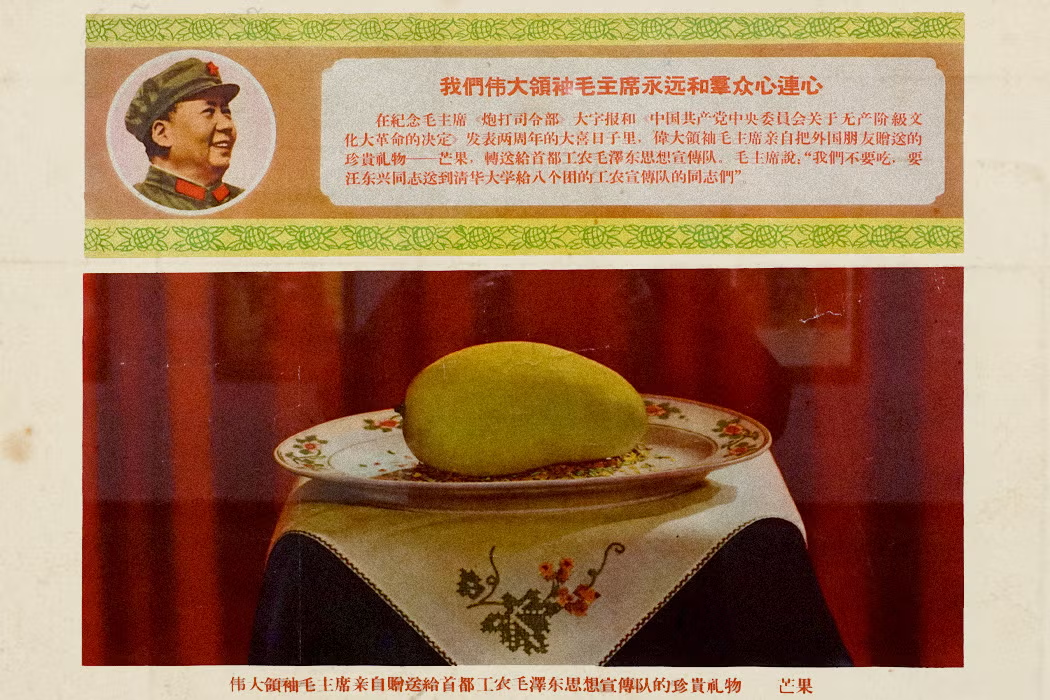
… Or not. As Christin Bohnke explains, sometimes a mango is more than just a mango…
What happens when ideologies are destroyed? When beliefs that shaped generations dissolve overnight? In the wreckage of old traditions, new symbols are created, and meaning is projected onto what was previously trivial. But not all of these new symbols are coherent or easily legible. Some are outright weird. Few events in history demonstrate the absurdity of political symbolism as clearly as the Mao Mango Mania that swept China during the infancy of the Cultural Revolution.
In 1966, Mao Zedong, Chairman of the Communist Party and China’s supreme leader, set in motion the Great Proletarian Cultural Revolution, a campaign to realign China with his revolutionary vision. His goal was to transform society, both economically and ideologically, by purging everything deemed traditional or capitalist. Over the next ten years, the Cultural Revolution changed the country in profound and painful ways, leading to more than a million estimated deaths as well as to immense human suffering.
Historian Lü Xiuyuan describes the period between 1966 and 1968 as the most destructive years of the entire movement. Following Mao’s directive to destroy the “Four Olds” (ideas, cultures, customs, and habits), his paramilitary youth groups, the Red Guards, swept the country with violence. They identified, tortured, and killed so-called “counterrevolutionaries,” raided temples and schools, and destroyed priceless artifacts. In 1968, university campuses, middle schools, and other public spaces became the sites of bloody battles, not only between Red Guards and alleged counterrevolutionaries but also between revolutionary factions. The chaos of the “Red Terror” couldn’t continue indefinitely, so Mao determined that Chinese workers would help suppress the Red Guard, restore order, and continue the revolution in a more measured manner. In this endeavor, Mao was helped, improbably, by a box of yellow-fleshed fruit.
In August 1968, a visiting foreign minister from Pakistan, Mian Arshad Hussain, gave Mao a box of mangoes as a gift during a state visit. Presenting mangoes has a long tradition in Pakistan, but in China, the fruit was virtually unknown. Mao passed the box to workers occupying the Tsinghua campus in Beijing, who were attempting to control the Red Guards stationed there. The scholar of Chinese visual culture Alfreda Murck writes that the mangoes carried an implicit message: from now on, the workers, not the Red Guards, would be in charge of education and the transformation of China in Mao’s image.
According to Murck, even Mao could not have anticipated the consequences of his gift. Because the mangoes came from the supreme leader, they were transformed, in the eyes of the workers, from a simple fruit into an object endowed with attributes of the divine. William H. Hinton, the author of Fanshen, compiled eyewitness accounts of workers who reported staying up all night, touching the mangoes, and marveling at their new station as protégés of the Chairman. Using the momentum, the official party cadres concocted a propaganda campaign surrounding the mangoes, workers, and Mao, and in doing so, according to the political scientist Richard Baum, effectively signed “the death warrant of the Red Guards.”
Quickly, the Red Guards were disbanded, many of them sent for reeducation in the countryside where they labored and lived alongside rural peasants. By contrast, the workers who received Mao’s mangoes, a sign of his favor, were energized and became Cultural Revolution leaders. Yet, their promotion was an illusion. True power lay with the People’s Liberation Army. Despite, or because of that, the workers—and the mangoes—played a significant role in official propaganda in the months to come.
When the workers returned to their factories after putting down the Red Guards, Mao had a fresh mango delivered to them. Workers held welcoming ceremonies for the fruit, preserved it in wax, placed it on altars, and bowed to it when walking by. In one factory, the fruit was boiled down into sacred mango water; each devotee drank a spoonful. From there on, the cult of the mango escalated. Wax and even plastic mangoes were quickly produced in Chinese factories and appeared all over the country, often displayed in glass cases. Images of the mango adorned plates, wedding gifts, and cigarette packages. It was stitched onto blankets, and propaganda teams armed with wax replicas were sent into the remotest corners of the country to spread its lore. More than seventy different types of mango badges to stitch onto clothes were given away for free or sold at a low price to those who couldn’t afford more expensive mango-themed items. Alongside the mangoes were mentions of Mao’s selflessness and love for the people (though no reference to the fate of the Red Guards), and many badges bore the slogan “With each mango profound kindness.”…
… During the 1968 National Day parade in Beijing, the mango was front and center. At least three mango-themed floats participated in the parade, decorated with slogans that emphasized the significance of the working class, as well as a colossal white statue of Mao. The parade reinforced the importance of Mao as the supreme leader and the mango as a symbol of his power.
According to development studies scholar Xing Li, Mao viewed ideology as the primary means of mobilizing the masses and driving change, putting special emphasis on themes such as dedication, self-sacrifice, and hard work. The mango was a perfect vessel for Mao’s “love” for the workers. Unlike already established symbols such as the peony, peach, or pomegranate, the mango had no preexisting meaning in China and, importantly, no association with emperors or divinity. Quickly, rumors spread that mango trees only blossom every century—or every thousand years, according to others—and that eating the fruit would bring about a long life, similar to the peaches of immortality that feature prominently in Chinese legends. Mao’s refusal to keep the mangoes for himself was therefore seen as a great sacrifice on behalf of his people.
The veneration of the mango coincided with a high point in Mao’s personality cult. In the 1960s, one billion copies of the “Little Red Book,” a collection of Mao’s quotes, were printed. The book had to be waved and quoted at the beginning of each workday and whenever someone made a political statement. Mao was everywhere. And so were his mangoes. They became inextricably linked, and criticism of one meant criticism of the other. Murck tells of a dentist in Sichuan province, for example, who, after seeing a mango paraded through his town, said that the fruit resembled a sweet potato. He was arrested, tried as a counterrevolutionary, marched through the streets, and executed. His children were sent to the countryside for reeducation. Given the serious consequences of even the slightest criticism, it’s impossible to say how many people genuinely participated in the mango cult and how many complied out of fear.
Political movements need symbols to foster cohesion and emotional connection, but for these to thrive and remain, they must have at least some internal logic, cultural coherence, or tradition. The mango was an artificial symbol, created randomly, and the people’s devotion to the fruit must have been at least partially performative. By 1969, the mango cult had already begun to decline; it was no longer featured in official campaigns, although the sheer volume of mango-themed products ensured that it didn’t disappear entirely until the mid-1970s. After Mao’s death in 1976 and the 1980s reassessment of his personality cult, it became acceptable to discard mango ephemera that some Chinese still kept in their homes, or more prudently, to repurpose the wax mangoes as candles. Because the mango was so closely linked to Mao, it couldn’t remain a meaningful symbol without him.
Still, the mango as a political symbol never entirely faded. US-based Chinese author Ha Jin, who served in the Chinese army at the time of the Cultural Revolution and has been an outspoken critic of the Chinese government, wrote in his 2019 poem “A Sacred Mango:”
The mango was exhibited in the center of the hall.
We lined up to look at it
and to show our gratitude and respect.But that night some curious child tasted the fruit
and was not caught.
Our mayor, frightened and outraged, said,
“Damn it, if I knew which son of a rabbit bit the mango
I would turn his whole family
into counter-revolutionaries!”But what could we do?
We substituted a wooden mango for a real one.For Ha Jin, as for others, the mango remains not a sign of Mao’s power, but a reminder of the Cultural Revolution’s absurdity and the arbitrary labeling of counterrevolutionaries. Despite being a short-lived propaganda tool, the mango’s symbolism endures as a testament to the irrationality of Mao’s extreme personality cult.
Commercial production of the mango in China began around that time, but only really accelerated in the 1980s. Although some people still recall the mango cult and spoke about it in their interviews with Murck, today the meaning of this particular fruit is largely forgotten, and the mango, far from symbolizing Mao’s eternal love and sacrifice for the working class, has transformed once again. This time, into a refreshing summer treat…
A fleeting cult built around a fruit exposes the logic, and illogic, of Mao’s personality cult: “When Mao’s Mango Mania Took Over China,” from @jstordaily.bsky.social.
* Eve Babitz
###
As we pare away the peel, we might send decorative birthday greetings to Maria do Carmo Miranda da Cunha; she was born on this date in 1909. Better known by her stage name, Carmen Miranda (and her nickname, “the Brazilian Bombshell”), she was a successful singer, dancer, and actress.
As a young woman, Miranda designed clothes and hats in a boutique before making her debut as a singer, recording with composer Josué de Barros in 1929. Miranda’s 1930 recording of “Taí (Pra Você Gostar de Mim),” written by Joubert de Carvalho, catapulted her to stardom in Brazil as the foremost interpreter of samba. In 1939 she was invited to Broadway by producer Lee Shubert, and quickly lured from there to Hollywood, where she made 14 films in as many years.
Miranda did much to popularize Brazilian music and raise American awareness of Latin culture, for which she has been honored (e.g., with a museum) in Brazil. Here, she is largely remebered for her style, in particular for her large “fruit hats.”

“[They] would think that the truth is nothing but the shadows cast by the artifacts.”*…

How do AI models “understand” and represent reality? Is the inside of a vision model at all like a language model? As Ben Brubaker reports, researchers argue that as the models grow more powerful, they may be converging toward a singular “Platonic” way to represent the world…
Read a story about dogs, and you may remember it the next time you see one bounding through a park. That’s only possible because you have a unified concept of “dog” that isn’t tied to words or images alone. Bulldog or border collie, barking or getting its belly rubbed, a dog can be many things while still remaining a dog.
Artificial intelligence systems aren’t always so lucky. These systems learn by ingesting vast troves of data in a process called training. Often, that data is all of the same type — text for language models, images for computer vision systems, and more exotic kinds of data for systems designed to predict the odor of molecules or the structure of proteins. So to what extent do language models and vision models have a shared understanding of dogs?
Researchers investigate such questions by peering inside AI systems and studying how they represent scenes and sentences. A growing body of research has found that different AI models can develop similar representations, even if they’re trained using different datasets or entirely different data types. What’s more, a few studies have suggested that those representations are growing more similar as models grow more capable. In a 2024 paper, four AI researchers at the Massachusetts Institute of Technology argued that these hints of convergence are no fluke. Their idea, dubbed the Platonic representation hypothesis, has inspired a lively debate among researchers and a slew of follow-up work.
The team’s hypothesis gets its name from a 2,400-year-old allegory by the Greek philosopher Plato. In it, prisoners trapped inside a cave perceive the world only through shadows cast by outside objects. Plato maintained that we’re all like those unfortunate prisoners. The objects we encounter in everyday life, in his view, are pale shadows of ideal “forms” that reside in some transcendent realm beyond the reach of the senses.
The Platonic representation hypothesis is less abstract. In this version of the metaphor, what’s outside the cave is the real world, and it casts machine-readable shadows in the form of streams of data. AI models are the prisoners. The MIT team’s claim is that very different models, exposed only to the data streams, are beginning to converge on a shared “Platonic representation” of the world behind the data.
“Why do the language model and the vision model align? Because they’re both shadows of the same world,” said Phillip Isola, the senior author of the paper.
Not everyone is convinced. One of the main points of contention involves which representations to focus on. You can’t inspect a language model’s internal representation of every conceivable sentence, or a vision model’s representation of every image. So how do you decide which ones are, well, representative? Where do you look for the representations, and how do you compare them across very different models? It’s unlikely that researchers will reach a consensus on the Platonic representation hypothesis anytime soon, but that doesn’t bother Isola.
“Half the community says this is obvious, and the other half says this is obviously wrong,” he said. “We were happy with that response.”…
Read on: “Distinct AI Models Seem To Converge On How They Encode Reality,” from @quantamagazine.bsky.social.
Bracket with: “AGI is here (and I feel fine),” from Robin Sloan and “We Need to Talk About How We Talk About ‘AI’,” from Emily Bender and Nanna Inie.
* from Socrates “Allegory of the Cave,” in Plato’s Republic (Book VII)
###
As we interrogate ideas and Ideas, we might recall that it was on this date that the fictional HAL 9000 computer became operational, according to Arthur C. Clarke’s 2001: A Space Odyssey., in which the artificially-intelligent computer states: “I am a HAL 9000 computer, Production Number 3. I became operational at the HAL Plant in Urbana, Illinois, on January 12, 1997.” (Kubrik’s 1968 movie adaptation put his birthdate in 1992.)

You must be logged in to post a comment.