Posts Tagged ‘Cultural Revolution’
“Mangoes will make you forget anything but mangoes”*…
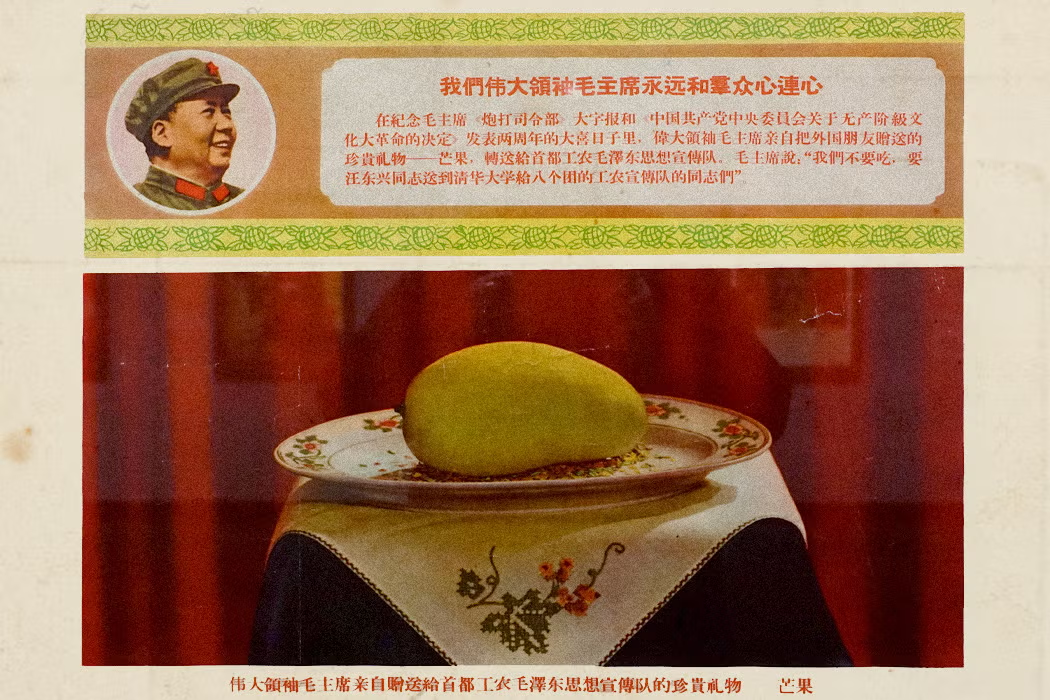
… Or not. As Christin Bohnke explains, sometimes a mango is more than just a mango…
What happens when ideologies are destroyed? When beliefs that shaped generations dissolve overnight? In the wreckage of old traditions, new symbols are created, and meaning is projected onto what was previously trivial. But not all of these new symbols are coherent or easily legible. Some are outright weird. Few events in history demonstrate the absurdity of political symbolism as clearly as the Mao Mango Mania that swept China during the infancy of the Cultural Revolution.
In 1966, Mao Zedong, Chairman of the Communist Party and China’s supreme leader, set in motion the Great Proletarian Cultural Revolution, a campaign to realign China with his revolutionary vision. His goal was to transform society, both economically and ideologically, by purging everything deemed traditional or capitalist. Over the next ten years, the Cultural Revolution changed the country in profound and painful ways, leading to more than a million estimated deaths as well as to immense human suffering.
Historian Lü Xiuyuan describes the period between 1966 and 1968 as the most destructive years of the entire movement. Following Mao’s directive to destroy the “Four Olds” (ideas, cultures, customs, and habits), his paramilitary youth groups, the Red Guards, swept the country with violence. They identified, tortured, and killed so-called “counterrevolutionaries,” raided temples and schools, and destroyed priceless artifacts. In 1968, university campuses, middle schools, and other public spaces became the sites of bloody battles, not only between Red Guards and alleged counterrevolutionaries but also between revolutionary factions. The chaos of the “Red Terror” couldn’t continue indefinitely, so Mao determined that Chinese workers would help suppress the Red Guard, restore order, and continue the revolution in a more measured manner. In this endeavor, Mao was helped, improbably, by a box of yellow-fleshed fruit.
In August 1968, a visiting foreign minister from Pakistan, Mian Arshad Hussain, gave Mao a box of mangoes as a gift during a state visit. Presenting mangoes has a long tradition in Pakistan, but in China, the fruit was virtually unknown. Mao passed the box to workers occupying the Tsinghua campus in Beijing, who were attempting to control the Red Guards stationed there. The scholar of Chinese visual culture Alfreda Murck writes that the mangoes carried an implicit message: from now on, the workers, not the Red Guards, would be in charge of education and the transformation of China in Mao’s image.
According to Murck, even Mao could not have anticipated the consequences of his gift. Because the mangoes came from the supreme leader, they were transformed, in the eyes of the workers, from a simple fruit into an object endowed with attributes of the divine. William H. Hinton, the author of Fanshen, compiled eyewitness accounts of workers who reported staying up all night, touching the mangoes, and marveling at their new station as protégés of the Chairman. Using the momentum, the official party cadres concocted a propaganda campaign surrounding the mangoes, workers, and Mao, and in doing so, according to the political scientist Richard Baum, effectively signed “the death warrant of the Red Guards.”
Quickly, the Red Guards were disbanded, many of them sent for reeducation in the countryside where they labored and lived alongside rural peasants. By contrast, the workers who received Mao’s mangoes, a sign of his favor, were energized and became Cultural Revolution leaders. Yet, their promotion was an illusion. True power lay with the People’s Liberation Army. Despite, or because of that, the workers—and the mangoes—played a significant role in official propaganda in the months to come.
When the workers returned to their factories after putting down the Red Guards, Mao had a fresh mango delivered to them. Workers held welcoming ceremonies for the fruit, preserved it in wax, placed it on altars, and bowed to it when walking by. In one factory, the fruit was boiled down into sacred mango water; each devotee drank a spoonful. From there on, the cult of the mango escalated. Wax and even plastic mangoes were quickly produced in Chinese factories and appeared all over the country, often displayed in glass cases. Images of the mango adorned plates, wedding gifts, and cigarette packages. It was stitched onto blankets, and propaganda teams armed with wax replicas were sent into the remotest corners of the country to spread its lore. More than seventy different types of mango badges to stitch onto clothes were given away for free or sold at a low price to those who couldn’t afford more expensive mango-themed items. Alongside the mangoes were mentions of Mao’s selflessness and love for the people (though no reference to the fate of the Red Guards), and many badges bore the slogan “With each mango profound kindness.”…
… During the 1968 National Day parade in Beijing, the mango was front and center. At least three mango-themed floats participated in the parade, decorated with slogans that emphasized the significance of the working class, as well as a colossal white statue of Mao. The parade reinforced the importance of Mao as the supreme leader and the mango as a symbol of his power.
According to development studies scholar Xing Li, Mao viewed ideology as the primary means of mobilizing the masses and driving change, putting special emphasis on themes such as dedication, self-sacrifice, and hard work. The mango was a perfect vessel for Mao’s “love” for the workers. Unlike already established symbols such as the peony, peach, or pomegranate, the mango had no preexisting meaning in China and, importantly, no association with emperors or divinity. Quickly, rumors spread that mango trees only blossom every century—or every thousand years, according to others—and that eating the fruit would bring about a long life, similar to the peaches of immortality that feature prominently in Chinese legends. Mao’s refusal to keep the mangoes for himself was therefore seen as a great sacrifice on behalf of his people.
The veneration of the mango coincided with a high point in Mao’s personality cult. In the 1960s, one billion copies of the “Little Red Book,” a collection of Mao’s quotes, were printed. The book had to be waved and quoted at the beginning of each workday and whenever someone made a political statement. Mao was everywhere. And so were his mangoes. They became inextricably linked, and criticism of one meant criticism of the other. Murck tells of a dentist in Sichuan province, for example, who, after seeing a mango paraded through his town, said that the fruit resembled a sweet potato. He was arrested, tried as a counterrevolutionary, marched through the streets, and executed. His children were sent to the countryside for reeducation. Given the serious consequences of even the slightest criticism, it’s impossible to say how many people genuinely participated in the mango cult and how many complied out of fear.
Political movements need symbols to foster cohesion and emotional connection, but for these to thrive and remain, they must have at least some internal logic, cultural coherence, or tradition. The mango was an artificial symbol, created randomly, and the people’s devotion to the fruit must have been at least partially performative. By 1969, the mango cult had already begun to decline; it was no longer featured in official campaigns, although the sheer volume of mango-themed products ensured that it didn’t disappear entirely until the mid-1970s. After Mao’s death in 1976 and the 1980s reassessment of his personality cult, it became acceptable to discard mango ephemera that some Chinese still kept in their homes, or more prudently, to repurpose the wax mangoes as candles. Because the mango was so closely linked to Mao, it couldn’t remain a meaningful symbol without him.
Still, the mango as a political symbol never entirely faded. US-based Chinese author Ha Jin, who served in the Chinese army at the time of the Cultural Revolution and has been an outspoken critic of the Chinese government, wrote in his 2019 poem “A Sacred Mango:”
The mango was exhibited in the center of the hall.
We lined up to look at it
and to show our gratitude and respect.But that night some curious child tasted the fruit
and was not caught.
Our mayor, frightened and outraged, said,
“Damn it, if I knew which son of a rabbit bit the mango
I would turn his whole family
into counter-revolutionaries!”But what could we do?
We substituted a wooden mango for a real one.For Ha Jin, as for others, the mango remains not a sign of Mao’s power, but a reminder of the Cultural Revolution’s absurdity and the arbitrary labeling of counterrevolutionaries. Despite being a short-lived propaganda tool, the mango’s symbolism endures as a testament to the irrationality of Mao’s extreme personality cult.
Commercial production of the mango in China began around that time, but only really accelerated in the 1980s. Although some people still recall the mango cult and spoke about it in their interviews with Murck, today the meaning of this particular fruit is largely forgotten, and the mango, far from symbolizing Mao’s eternal love and sacrifice for the working class, has transformed once again. This time, into a refreshing summer treat…
A fleeting cult built around a fruit exposes the logic, and illogic, of Mao’s personality cult: “When Mao’s Mango Mania Took Over China,” from @jstordaily.bsky.social.
* Eve Babitz
###
As we pare away the peel, we might send decorative birthday greetings to Maria do Carmo Miranda da Cunha; she was born on this date in 1909. Better known by her stage name, Carmen Miranda (and her nickname, “the Brazilian Bombshell”), she was a successful singer, dancer, and actress.
As a young woman, Miranda designed clothes and hats in a boutique before making her debut as a singer, recording with composer Josué de Barros in 1929. Miranda’s 1930 recording of “Taí (Pra Você Gostar de Mim),” written by Joubert de Carvalho, catapulted her to stardom in Brazil as the foremost interpreter of samba. In 1939 she was invited to Broadway by producer Lee Shubert, and quickly lured from there to Hollywood, where she made 14 films in as many years.
Miranda did much to popularize Brazilian music and raise American awareness of Latin culture, for which she has been honored (e.g., with a museum) in Brazil. Here, she is largely remebered for her style, in particular for her large “fruit hats.”

“Mastering others is strength; mastering yourself is true power”*…

After skipping last year (presumably to finish his best-seller Breakneck: China’s Quest to Engineer the Future), Dan Wang is back with his “annual letter.” An excerpt…
… I think the US continues to systematically underrate China’s industrial progress for several reasons.
First, too many western elites retain hope that China’s efforts will run out of fuel by its own accord. Industrial progress will be weighed down by demographic drag, the growing debt load, maybe even a political collapse. I won’t rule these out, but I don’t think they are likely to break China’s humming tech engine. Demographics in particular don’t matter for advanced technology — you don’t need a workforce of many millions to have robust production of semiconductors or EVs. South Korea, for example, has one of the world’s fastest shrinking populations while retaining its success in electronics production. And though China suffers broader economic headwinds, technology firms like Xiaomi continue to develop new products and enjoy rising revenues. Technology breakthroughs can occur even in a suffering society. Especially if the state continues to lavish resources on chips or anything that could represent an American chokepoint.
Second, western elites keep citing the wrong reasons for China’s success. When members of Congress get around to acknowledging China’s tech advancements, they do not fail to attribute causes to either industrial subsidies (also known as cheating) or IP theft (that is, stealing). These are legitimate claims, but China’s advantages extend far beyond them. That’s the creation of deep infrastructure as well as extensive industrial ecosystems that I describe above.
Probably the most underrated part of the Chinese system is the ferocity of market competition. It’s excusable not to see that, given that the party espouses so much Marxism. I would argue that China embodies both greater capitalist competition and greater capitalist excess than America does today. Part of the reason that China’s stock market trends sideways is that everyone’s profits are competed away. Big Tech might enjoy the monopolistic success smiled upon by Peter Thiel, coming almost to genteel agreements not to tread too hard upon each other’s business lines. Chinese firms have to fight it out in a rough-and-tumble environment, expanding all the time into each other’s core businesses, taking Jeff “your margin is my opportunity” Bezos with seriousness.
Third, western elites keep holding on to a distinction between “innovation,” which is mostly the remit of the west, and “scaling,” which they accept that China can do. I want to dissolve that distinction. Chinese workers innovate every day on the factory floor. By being the site of production, they have a keen sense of how to make technical improvements all the time. American scientists may be world leaders in dreaming up new ideas. But American manufacturers have been poor at building industries around these ideas. The history books point out that Bell Labs invented the first solar cell in 1957; today, the lab no longer exists while the solar industry moved to Germany and then to China. While Chinese universities have grown more capable at producing new ideas, it’s not clear that the American manufacturing base has grown stronger at commercializing new inventions…
Eminently worth reading in full: “2025 letter.”
Pair with “U.S.-China Economic Competition” (from Rand) and “The Outlook for China-US Strategic Competition in 2026” (an interview with Sarah M. Beran in The Diplomat)
* Lao Tzu
###
As we grapple with geoeconomics and geopolitics, we might remind ourselves just how fast China’s rise has been: on this date in 1967, in the midst of the Cultural Revolution, the Shanghai People’s Commune was established following the seizure of power from local city officials by revolutionaries. Shenzen was, at the time, a sleepy backwater, just off what was then the British colony of Hong Kong.

“Wonder is the beginning of wisdom”*…

An argument for curiosity, openness, and the humility that underlies them both…
Philosophers aren’t the only ones who love wisdom. Everyone, philosopher or not, loves her own wisdom: the wisdom she has or takes herself to have. What distinguishes the philosopher is loving the wisdom she doesn’t have. Philosophy is, therefore, a form of humility: being aware that you lack what is of supreme importance. There may be no human being who exemplified this form of humility more perfectly than Socrates. It is no coincidence that he is considered the first philosopher within the Western canon.
Socrates did not write philosophy; he simply went around talking to people. But these conversations were so transformative that Plato devoted his life to writing dialogues that represent Socrates in conversation. These dialogues are not transcripts of actual conversations, but they are nonetheless clearly intended to reflect not only Socrates’s ideas but his personality. Plato wanted the world to remember Socrates. Generations after Socrates’s death, warring philosophical schools such as the Stoics and the Skeptics each appropriated Socrates as figurehead. Though they disagreed on just about every point of doctrine, they were clear that in order to count themselves as philosophers they had to somehow be working in the tradition of Socrates.
What is it about Socrates that made him into a symbol for the whole institution of philosophy? Consider the fact that, when the Oracle at Delphi proclaims Socrates wisest of men, he tries to prove it wrong. As Plato recounts it in the Apology:
I went to one of those reputed wise, thinking that there, if anywhere, I could refute the oracle and say to it: “This man is wiser than I, but you said I was.” Then, when I examined this man—there is no need for me to tell you his name, he was one of our public men—my experience was something like this: I thought that he appeared wise to many people and especially to himself, but he was not. I then tried to show him that he thought himself wise, but that he was not. As a result he came to dislike me, and so did many of the bystanders. So I withdrew and thought to myself: “I am wiser than this man; it is likely that neither of us knows anything worthwhile, but he thinks he knows something when he does not, whereas when I do not know, neither do I think I know; so I am likely to be wiser than he to this small extent, that I do not think I know what I do not know.”
If Socrates’s trademark claim is this protestation of ignorance, his trademark activity is the one also described in this passage: refuting the views of others. These are the conversations we find in Plato’s texts. How are the claim and the activity related? Socrates denies that his motivations are altruistic: he says he is not a teacher, and insists that he is himself the primary beneficiary of the conversations he initiates. This adds to the mystery: What is Socrates getting out of showing people that they don’t know what they take themselves to know? What’s his angle?
Over and over again, Socrates approaches people who are remarkable for their lack of humility—which is to say, for the fact that they feel confident in their own knowledge of what is just, or pious, or brave, or moderate. You might have supposed that Socrates, whose claim to fame is his awareness of his own ignorance, would treat these self-proclaimed “wise men” (Sophists) with contempt, hostility, or indifference. But he doesn’t. The most remarkable feature of Socrates’s approach is his punctilious politeness and sincere enthusiasm. The conversation usually begins with Socrates asking his interlocutor: Since you think you know, can you tell me, what is courage (or wisdom, or piety, or justice . . .)? Over and over again, it turns out that they think they can answer, but they can’t. Socrates’s hope springs eternal: even as he walks toward the courtroom to be tried—and eventually put to death—for his philosophical activity, he is delighted to encounter the self-important priest Euthyphro, who will, surely, be able to say what piety is…
Socrates seemed to think that the people around him could help him acquire the knowledge he so desperately wanted—even though they were handicapped by the illusion that they already knew it. Indeed, I believe that their ill-grounded confidence was precisely what drew Socrates to them. If you think you know something, you will be ready to speak on the topic in question. You will hold forth, spout theories, make claims—and all this, under Socrates’s relentless questioning, is the way to actually acquire the knowledge you had deluded yourself into thinking you already had…
It’s one thing to say, “I don’t know anything.” That thought comes cheap. One can wonder, “Who really and truly knows anything?” in a way that is dismissive, uninquisitive, detached. It can be a way of saying, “Knowledge is unattainable, so why even try?” Socratic humility is more expensive and more committal than that. He sought to map the terrain of his ignorance, to plot its mountains and its rivers, to learn to navigate it. That, I think, is why he speaks of knowledge of his own ignorance. He’s not just someone who acknowledges or admits to his ignorance, but someone who has learned to dwell within it.
Admittedly, this may seem like a paradoxical project. It’s one thing to be missing your wallet—you will know it once you’ve found it. But suppose you’re missing not only your wallet, but also the knowledge that you ever had a wallet, and the understanding of what a wallet is. One of Socrates’s interlocutors, Meno, doubts whether it’s possible to come to know anything if you know so little to begin with. If someone doesn’t know where she’s going, it doesn’t seem as though she can even take a first step in the right direction. Can you map in total darkness?
Socrates’s answer was no. Or at least: you can’t do it alone. The right response to noticing one’s own ignorance is to try to escape it by acquiring someone else’s knowledge. But the only way to do that is to explain to them why you aren’t yet able to accept this or that claim of theirs as knowledge—and that is what mapping one’s ignorance amounts to. Socrates stages an exhibition of this method for Meno by demonstrating how much geometrical progress he can make with a young slave boy by doing nothing but asking questions that expose the boy’s false assumptions. It is when he refutes others’ claims to knowledge that Socrates’s own ignorance takes shape, for him, as something he can know. What appears as a sea of darkness when approached introspectively turns out to be navigable when brought into contact with the knowledge claims of another…
Socrates saw the pursuit of knowledge as a collaborative project involving two very different roles. There’s you or I or some other representative of Most People, who comes forward and makes a bold claim. Then there’s Socrates, or one of his contemporary descendants, who questions and interrogates and distinguishes and calls for clarification. This is something we’re often still doing—as philosophers, as scientists, as interviewers, as friends, on Twitter and Facebook and in many casual personal conversations. We’re constantly probing one another, asking, “How can you say that, given X, Y, Z?” We’re still trying to understand one another by way of objection, clarification, and the simple fact of inability to take what someone has said as knowledge. It comes so naturally to us to organize ourselves into the knower/objector pairing that we don’t even notice we are living in the world that Socrates made. The scope of his influence is remarkable. But equally remarkable is the means by which it was achieved: he did so much by knowing, writing, and accomplishing—nothing at all.
And yet for all this influence, many of our ways are becoming far from Socratic. More and more our politics are marked by unilateral persuasion instead of collaborative inquiry. If, like Socrates, you view knowledge as an essentially collaborative project, you don’t go into a conversation expecting to persuade any more than you expect to be persuaded. By contrast, if you do assume you know, you embrace the role of persuader in advance, and stand ready to argue people into agreement. If argument fails, you might tolerate a state of disagreement—but if the matter is serious enough, you’ll resort to enforcing your view through incentives or punishments. Socrates’s method eschewed the pressure to persuade. At the same time, he did not tolerate tolerance. His politics of humility involved genuinely opening up the question under dispute, in such a way that neither party would be permitted to close it, to settle on an answer, unless the other answered the same. By contrast, our politics—of persuasion, tolerance, incentives, and punishment—is deeply uninquisitive…
Knowing takes radical collaboration: an openness to being persuaded as much as an eagerness to persuade: “Against Persuasion,” from Agnes Callard (@AgnesCallard)
* Socrates
###
As we listen and learn, we might recall that it was on this date in 1966 that the Eleventh Plenum of the Eighth Central Committee of the Chinese Communist Party was hastily convened to advance Mao Zedong’s by then decidedly radical agenda for China– teeing up “Red August,” a series of purges of reactionary or otherwise impure thinkers. According to official statistics published in 1980, from August to September in 1966, a total of 1,772 people—including teachers and principals of many schools—were killed in Beijing by Red Guards; 33,695 homes were ransacked and 85,196 families were forced to leave the city. (1985 statistics, which included the areas immediately around Beijing, put the death toll at around 10,000.)
Red August kicked off the Great Proletarian Cultural Revolution, or as we tend to know it, The Cultural Revolution, which lasted until Mao’s death in 1976. Its stated goal was to preserve Chinese communism by purging alternative thought– remnants of capitalist and traditional elements– from Chinese society, and to impose Mao Zedong Thought (known outside China as Maoism) as the dominant ideology in the PRC. A selection of Mao’s sayings, compiled in Little Red Book, became a sacred text in what was, essentially a personality cult.
Estimates of the death toll from the Cultural Revolution, including civilians and Red Guards, vary greatly, ranging from hundreds of thousands to to 20 million. The exact figure of those who were persecuted or died during the Cultural Revolution, however, may never be known, as many deaths went unreported or were actively covered up by the police or local authorities. Tens of millions of people were persecuted (especially members of ethnic minorities): senior officials were purged or exiled; millions were accused of being members of the Five Black Categories, suffering public humiliation, imprisonment, torture, hard labor, seizure of property, and sometimes execution or harassment into suicide; intellectuals were considered the “Stinking Old Ninth” and were widely persecuted—notable scholars and scientists were killed or committed suicide. Schools and universities were closed. And over 10 million urban “intellectual youths“ were sent to rural areas in the Down to the Countryside Movement.

“Disbelief in magic can force a poor soul into believing in government and business”*…

The Harry Ransom Center at the University of Texas at Austin has recently digitized ten scrapbooks belonging to Harry Houdini. The books are divided into three groups: volumes compiled by other magicians about their careers; scrapbooks holding Houdini’s clippings on the practice of magic in general; and books that chart Houdini’s investigations of fakes, frauds, and conjurers. (Later in his life, Houdini became fascinated with the post-WWI fad for spiritualism—mediums, séances, and psychics—and took on a role as skeptical debunker of spiritualist performers.)…

Read more about Houdini’s scrapbooks at the always-illuminating Open Culture. And read more about the broader scrapbooking craze of which they were a part at “Writing With Scissors.”
* Tom Robbins
###
As we reach for the paste, we might recall that it was on this date in 1957 that Chairman Mao delivered his speech, “On the Correct handling of Contradictions Among the People,” to the Eleventh Session (Enlarged) of the Supreme State Conference in China. Calling for the free expression of criticisms of the Communist regime, Mao instigated what he called the “Hundred Flowers era” (as in “let a hundred flowers bloom…”).
It was a short-lived era. Some historians suggest that the outpouring of criticism that resulted spooked the powers-that-be; others believe that Mao’s invitation was from the outset a calculated move to draw out critics. (Mao later said that he was trying to coax snakes out of their dens so he could chop off their heads… but he may well have been saving face.) Either way, within months, the Hundred Flowers campaign had given way to the Anti-Rightest Campaign: 300-600,000 intellectuals were labeled as rightists, stripped of their jobs, and sent to labor camps, most on the evidence of their Hundred Flowers comments.

“Bring every positive factor into play, correctly handle contradictions among the people, 1958”: a poster for the Hundred Flowers campaign.
You must be logged in to post a comment.