Posts Tagged ‘ENIAC’
“Man is not disturbed by events, but by the view he takes of them”*…

From Stripe Partners, a framework for rethinking the way we talk about the AI future…
AI is both a new technology and a new type of technology. It is the first technology that learns and that has the potential to outstrip its makers’ capabilities and develop independently.
As Large Language Models bring to life the realities of AI’s potential to operate at unprecedented, ‘human’ levels of sophistication, projections about its future have gained urgency. The dominant framework being applied to identify AI’s potential futures is 165 years old: Charles Darwin’s theory of evolution.
Darwin’s evolutionary framework is rendered most clearly in Dan Hendycks work for the Center for AI Safety which posits a future where natural selection could cause the most influential future AI agents to have selfish tendencies that might see AI’s favour their own agendas over the safety of humankind.
The choice of Natural Selection as a framework makes sense given AI’s emerging status as a quasi-sentient, highly adaptive technology that can learn and grow. The choice is a response to the limitations inherent in existing models for technological adoption which treat technologies as inert tools that only come to life when used by people.
The risk in applying this lens to AI is that it goes too far in assigning independent agency to AI. Estimates on the timing of the emergence of ‘Artificial General Intelligence’ vary, but spending some time with the current crop of Generative AI platforms confirms the view that AI’s with intelligences that are closer to humans are some way off. In the interim using natural selection as a lens to understand AI positions humans as further out of the developmental loop than is actually the case. Competitive forces whether market or military will shape AI’s development, but these will not be the only forces at play and direct interaction with humans will be the principal driver for AI’s progress in the near term.
A year ago we wrote about the opportunity to reframe the impact of AI on organisations through the lens of Actor Network Theory (ANT). More than a singular theory, ANT describes an approach to studying social and technological systems developed by Bruno Latour, Michel Callon, Madeleine Akrich and John Law in the early 1980s.
ANT posits that the social and natural world is best understood as dynamic networks of humans and nonhuman actors… In our 2023 piece we suggested that ANT, with its focus on framing society and human-technology interactions in terms of dynamic networks where every actor whether human or machine impacts the network, was a useful way of exploring the ways in which AI will impact people, and people will impact AI.
A year on the value of ANT as a framework for exploring AI’s future has become clearer. The critical point when comparing an ANT frame to an evolutionary one is the way in which the ANT framing highlights how AI will progress with and through people’s interactions with it. When viewed as an actor in a network, not a technology in isolation, AI will never be separate from human interventions…
A provocative argument, well worth reading in full: “Why the debate about the future of AI needs less Darwin and more Latour,” from @stripepartners.
Apposite: “Whose risks? Whose benefits?” from Mandy Brown.
* Epictetus
###
As we reframe, we might recall that it was on this date in 1946 that an ancestor of today’s AIs, the ENIAC (Electronic Numerical Integrator And Computer), was first demonstrated in operation. (It was announced to the public the following day.) The first general-purpose computer (Turing-complete, digital, and capable of being programmed and re-programmed to solve different problems), ENIAC was begun in 1943, as part of the U.S’s war effort (as a classified military project known as “Project PX“); it was conceived and designed by John Mauchly and Presper Eckert of the University of Pennsylvania, where it was built. The finished machine, composed of 17,468 electronic vacuum tubes, 7,200 crystal diodes, 1,500 relays, 70,000 resistors, 10,000 capacitors and around 5 million hand-soldered joints, weighed more than 27 tons and occupied a 30 x 50 foot room– in its time the largest single electronic apparatus in the world. ENIAC’s basic clock speed was 100,000 cycles per second (or Hertz). Today’s home computers have clock speeds of 3,500,000,000 cycles per second or more.

“They laughed at Columbus and they laughed at the Wright brothers. But they also laughed at Bozo the Clown.”*…

Most technologies that grow up to be important, Benedict Evans observes, start out looking like toys with little or no practical application.
Some of the most important things of the last 100 years or so looked like this. Aircraft, cars, telephones, mobile phones and personal computers were all dismissed as toys. “Well done Mr Wright – you flew over a few sand dunes. Why do we care?”
But on the other hand, plenty of things that looked like useless toys never did become anything more than that. The fact that people laughed at X and X then started working does not tell us that if people now laugh Y or Z, those will work too.
So, we have a pair of equal and opposite fallacies. There is no predictive value in saying ‘that doesn’t work’ or ‘that looks like a toy’, and there is also no predictive value in saying ‘people always say that.’ As [Wolfgang] Pauli put it, statements like this are ‘not even wrong’ – they give no insight into what will happen.
Instead, you have to go one level further. You need a theory for why this will get better, or why it won’t, and for why people will change their behaviour, or for why they won’t…
That’s to say, Evans suggests, you need to be able to envision a roadmap from “toy” to wide, practical use…
These roadmaps can come in steps. It took quite a few steps to get from the [Wright Flier, pictured above left] to something that made ocean liners obsolete, and each of those steps were useful. The PC also came in steps – from hobbyists to spreadsheets to web browsers. The same thing for mobile – we went from expensive analogue phones for a few people to cheap GSM phones for billions of people to smartphones that changed what mobile meant. But there was always a path. The Apple 1, Netscape and the iPhone all looked like impractical toys that ‘couldn’t be used for real work’, but there were obvious roadmaps to change that – not necessarily all the way to the future, but certainly to a useful next step.
Equally, sometimes the roadmap is ‘forget about this for 20 years’. The Newton or the IBM Simon were just too early, as was the first wave of VR in the 80s and 90s. You could have said, deterministically, that Moore’s Law would make VR or pocket computers useful at some point, so there was notionally a roadmap, but the roadmap told you to work on something else. This is different to the Rocket Belt [pictured above right], where there was no foreseeable future development that would make it work…
Much the same sort of questions apply to the other side of the problem – even if this did get very cheap and very good, who would use it? You can’t do a waterfall chart of an engineering roadmap here, but you can again ask questions – what would have to change? Are you proposing a change in human nature, or a different way of expressing it? What’s your theory of why things will change or why they won’t?
The thread through all of this is that we don’t know what will happen, but we do know what could happen – we don’t know the answer, but we can at least ask useful questions. The key challenge to any assertion about what will happen, I think, is to ask ‘well, what would have to change?’ Could this happen, and if it did, would it work? We’re always going to be wrong sometimes, but we can try to be wrong for the right reasons…
A practical approach to technology forecasting: “Not even wrong: predicting tech,” from @benedictevans.
* Carl Sagan
###
As we ponder prospects, we might send carefully-calculated birthday greetings to J. Presper Eckert; he was born on this date in 1919. An electrical engineer, he co-designed (with John Mauchly) the first general purpose computer, the ENIAC (see here and here) for the U.S. Army’s Ballistic Research Laboratory. He and Mauchy went on to found the Eckert–Mauchly Computer Corporation, at which they designed and built the first commercial computer in the U.S., the UNIVAC.

“Information was found to be everywhere”*…

A newly-proposed experiment could confirm the fifth state of matter in the universe—and change physics as we know it…
Physicist Dr. Melvin Vopson has already published research suggesting that information has mass and that all elementary particles, the smallest known building blocks of the universe, store information about themselves, similar to the way humans have DNA.
Now, he has designed an experiment—which if proved correct—means he will have discovered that information is the fifth form of matter, alongside solid, liquid, gas and plasma…
Dr. Vopson said: “This would be a eureka moment because it would change physics as we know it and expand our understanding of the universe. But it wouldn’t conflict with any of the existing laws of physics. It doesn’t contradict quantum mechanics, electrodynamics, thermodynamics or classical mechanics. All it does is complement physics with something new and incredibly exciting.”
Dr. Vopson’s previous research suggests that information is the fundamental building block of the universe and has physical mass. He even claims that information could be the elusive dark matter that makes up almost a third of the universe…
Is information is a key element of everything in the universe? “New experiment could confirm the fifth state of matter in the universe.”
* James Gleick, The Information: A History, a Theory, a Flood
###
As we go deep, we might send thoroughly-modeled birthday greetings to Stanislaw Ulam; he was born on this date in 1909. A mathematician and nuclear physicist, he originated the Teller–Ulam design of thermonuclear weapons, discovered the concept of the cellular automaton, and suggested nuclear pulse propulsion.
But his most impactful contribution may have been his creation of the the Monte Carlo method of computation. While playing solitaire during his recovery from surgery, Ulam had thought about playing hundreds of games to estimate statistically the probability of a successful outcome. With ENIAC in mind, he realized that the availability of computers made such statistical methods very practical, and in 1949, he and Nicholas Metropolis published the first unclassified paper on the Monte Carlo method… which is now widely used in virtually every scientific field, in engineering and computer science, finance and business, and the law.

“We know the past but cannot control it. We control the future but cannot know it.”*…
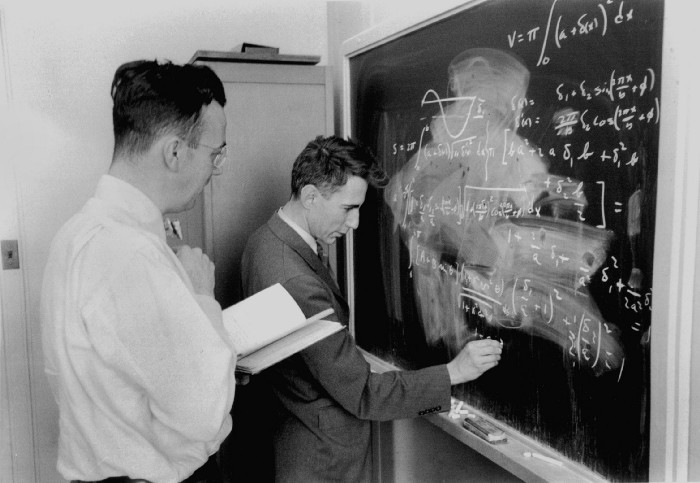
Readers will know of your correspondent’s fascination with– and admiration for– Claude Shannon…
Within engineering and mathematics circles, Shannon is a revered figure. At 21 [in 1937], he published what’s been called the most important master’s thesis of all time, explaining how binary switches could do logic and laying the foundation for all future digital computers. At the age of 32, he published A Mathematical Theory of Communication, which Scientific American called “the Magna Carta of the information age.” Shannon’s masterwork invented the bit, or the objective measurement of information, and explained how digital codes could allow us to compress and send any message with perfect accuracy.
But Shannon wasn’t just a brilliant theoretical mind — he was a remarkably fun, practical, and inventive one as well. There are plenty of mathematicians and engineers who write great papers. There are fewer who, like Shannon, are also jugglers, unicyclists, gadgeteers, first-rate chess players, codebreakers, expert stock pickers, and amateur poets.

Shannon worked on the top-secret transatlantic phone line connecting FDR and Winston Churchill during World War II and co-built what was arguably the world’s first wearable computer. He learned to fly airplanes and played the jazz clarinet. He rigged up a false wall in his house that could rotate with the press of a button, and he once built a gadget whose only purpose when it was turned on was to open up, release a mechanical hand, and turn itself off. Oh, and he once had a photo spread in Vogue.
Think of him as a cross between Albert Einstein and the Dos Equis guy…
From Jimmy Soni (@jimmyasoni), co-author of A Mind At Play: How Claude Shannon Invented the Information Age: “11 Life Lessons From History’s Most Underrated Genius.”
* Claude Shannon
###
As we learn from the best, we might recall that it was on this date in 1946 that an early beneficiary of Shannon’s thinking, the ENIAC (Electronic Numerical Integrator And Computer), was first demonstrated in operation. (It was announced to the public the following day.) The first general-purpose computer (Turing-complete, digital, and capable of being programmed and re-programmed to solve different problems), ENIAC was begun in 1943, as part of the U.S’s war effort (as a classified military project known as “Project PX”); it was conceived and designed by John Mauchly and Presper Eckert of the University of Pennsylvania, where it was built. The finished machine, composed of 17,468 electronic vacuum tubes, 7,200 crystal diodes, 1,500 relays, 70,000 resistors, 10,000 capacitors and around 5 million hand-soldered joints, weighed more than 27 tons and occupied a 30 x 50 foot room– in its time the largest single electronic apparatus in the world. ENIAC’s basic clock speed was 100,000 cycles per second. Today’s home computers have clock speeds of 1,000,000,000 cycles per second.
“It is likely that libraries will carry on and survive, as long as we persist in lending words to the world that surrounds us, and storing them for future readers”*…

Many visions of the future lie buried in the past. One such future was outlined by the American librarian Charles Ammi Cutter in his essay “The Buffalo Public Library in 1983”, written a century before in 1883.
Cutter’s fantasy, at times dry and descriptive, is also wonderfully precise:
The [library], when complete, was to consist of two parts, the first a central store, 150 feet square, a compact mass of shelves and passageways, lighted from the ends, but neither from sides nor top; the second an outer rim of rooms 20 feet wide, lighted from the four streets. In front and rear the rim was to contain special libraries, reading-rooms, and work-rooms; on the sides, the art-galleries. The central portion was a gridiron of stacks, running from front to rear, each stack 2 feet wide, and separated from its neighbor by a passage of 3 feet. Horizontally, the stack was divided by floors into 8 stories, each 8 feet high, giving a little over 7 feet of shelf-room, the highest shelf being so low that no book was beyond the reach of the hand. Each reading-room, 16 feet high, corresponded to two stories of the stack, from which it was separated in winter by glass doors.
The imagined structure allows for a vast accumulation of books:
We have now room for over 500,000 volumes in connection with each of the four reading-rooms, or 4,000,000 for the whole building when completed.
If his vision for Buffalo Public Library might be considered fairly modest from a technological point of view, when casting his net a little wider to consider a future National Library, one which “can afford any luxury”, things get a little more inventive.
[T]hey have an arrangement that brings your book from the shelf to your desk. You have only to touch the keys that correspond to the letters of the book-mark, adding the number of your desk, and the book is taken off the shelf by a pair of nippers and laid in a little car, which immediately finds its way to you. The whole thing is automatic and very ingenious…
But for Buffalo book delivery is a cheaper, simpler, and perhaps less noisy, affair.
…for my part I much prefer our pages with their smart uniforms and noiseless steps. They wear slippers, the passages are all covered with a noiseless and dustless covering, they go the length of the hall in a passage-way screened off from the desk-room so that they are seen only when they leave the stack to cross the hall towards any desk. As that is only 20 feet wide, the interruption to study is nothing.
Cutter’s fantasy might appear fairly mundane, born out of the fairly (stereo)typical neuroses of a librarian: in the prevention of all noise (through the wearing of slippers), the halting of the spread of illness (through good ventilation), and the disorder of the collection (through technological innovations)…
Far from a wild utopian dream, today Cutter’s library of the future appears basic: there will be books and there will be clean air and there will be good lighting. One wonders what Cutter might make of the library today, in which the most basic dream remains perhaps the most radical: for them to remain in our lives, free and open, clean and bright.
More at the original, in Public Domain Review: “The Library of the Future: A Vision of 1983 from 1883.” Read Cutter’s essay in its original at the Internet Archive.
Pair with “Libraries of the future are going to change in some unexpected ways,” in which IFTF Research Director (and Boing Boing co-founder) David Pescovitz describes a very different future from Cutter’s, and from which the image above was sourced.
The Library at Night
###
As we browse in bliss, we might recall that it was on this date in 1946 that the most famous early computer– the ENIAC (Electronic Numerical Integrator And Computer)– was dedicated. The first general-purpose computer (Turing-complete, digital, and capable of being programmed and re-programmed to solve different problems), ENIAC was begun in 1943, as part of the U.S’s war effort (as a classified military project known as “Project PX”); it was conceived and designed by John Mauchly and Presper Eckert of the University of Pennsylvania, where it was built. The finished machine, composed of 17,468 electronic vacuum tubes, 7,200 crystal diodes, 1,500 relays, 70,000 resistors, 10,000 capacitors and around 5 million hand-soldered joints, weighed more than 27 tons and occupied a 30 x 50 foot room– in its time the largest single electronic apparatus in the world. ENIAC’s basic clock speed was 100,000 cycles per second. Today’s home computers have clock speeds of 1,000,000,000 cycles per second.

You must be logged in to post a comment.