Posts Tagged ‘economics’
“Where’s the beef?”*…

There’s been some consternation over the FDA’s new food pyramid, with nutritionists arguing that, while the emphasis on “whole foods” (as opposed to processed) is a plus, the guidance overstresses satured-fat-rich foods and under-recommends gut-healthy fermented foods, and beans and grains (see also here).
There could be material economic costs as well. The Federal goverment already spends over $72 Billion subsidizing livestock— not counting the reduced cost grazing permits offered ranchers on Federal land. And as ranch and farm land ownership has become more and more concentrated in fewer and fwer hands, the benifits are flowing to fewer, wealthier “ranchers” (like Bill Gates, Warren Buffett, Jeff Bezos, a clutch of large corporations, and foreign investors).
Then there are the environmental implications. Oliver Milman ponders the potential scale of that impact if the new pyramid is followed…
The Trump administration’s new dietary guidelines urging Americans to eat far more meat and dairy products will, if followed, come at a major cost to the planet via huge swathes of habitat razed for farmland and millions of tons of extra planet-heating emissions.
A new inverted food pyramid recently released by Donald Trump’s health department emphasizes pictures of steak, poultry, ground beef and whole milk, alongside fruits and vegetables, as the most important foods to eat.
The new guidelines are designed to nearly double the amount of protein currently consumed by Americans. “Protein and healthy fats are essential and were wrongly discouraged in prior dietary guidelines,” said Robert F Kennedy Jr, the US health secretary. “We are ending the war on saturated fats.”
But a surge in meat-eating by Americans would involve flattening vast tracts of ecosystems such as forests to make way for the hefty environmental hoofprint of raised livestock, emitting large quantities of greenhouse gases in the process, experts have warned.
Even a 25% increase in the amount of protein consumed in this way in the US would require about 100m acres of additional agricultural land each year, an area about the size of California, and add hundreds of millions of tons of extra pollution to an already overheating planet, according to an estimate by the World Resources Institute (WRI), a non-profit research body.
“We are seeing millions of acres of forest cut down and agricultural expansion is the lead driver of that – adding 100m acres to that to feed the US means additional pressure on the world’s remaining ecosystems,” said Richard Waite, the director of agriculture initiatives at WRI.
“It’s already hard to feed the global population while reducing emissions and stopping deforestation, and a shift in this direction would make the challenge even harder. We need to reduce the impact of our food systems urgently and the US is an important piece of the puzzle in doing that.”
While many Americans will simply ignore the guidelines, the new framework will probably influence institutions such as schools and federal workplaces. The average American already eats about 144kg (317lb) of meat and seafood a year, second globally only to Portugal, and ingests more protein than previous federal government guidelines recommended.
Any further increase will be felt in places such as the Amazon rainforest, which is already being felled at a rapid rate for cattle ranches and to grow livestock feed.
Red meat, in particular, has an outsized impact upon the planet – beef requires 20 times more land and emits 20 times more greenhouse gas emissions per gram of protein than common plant proteins, such as beans. The raising of cows, pigs, lamb and other animals for slaughter is also associated with significant localized air and water pollution.
“To the extent that people follow these guidelines and eat more animal protein foods, particularly beef and dairy, they will negatively impact our environment, since the production of these foods emits way more greenhouse gases than vegetable protein foods, or even other animal foods,” said Diego Rose, a director of nutrition at Tulane University.
Choosing beef over beans and lentils is “a big choice we make that has real consequences”, said Waite. “If people want more protein there are ways to do that via eating plant-based foods without the environmental impacts. We can have our protein and our forests, too.”
Animal agriculture is responsible for about a fifth of global emissions, with little progress made in recent years to reduce its impact as more of the world starts to demand meat products. Worldwide consumption of pork, beef, poultry and meat is projected to reach over 500m tonnes by 2050 –double what it was in 2000.
In the US, much of this meat-eating is concentrated in a relatively small group of avid carnivores – just 12% of Americans consume nearly half of the country’s beef, a 2024 study found. But plant-based options, including “fake meat” burgers, have suffered a slump in sales in recent years amid a resurgent trend in meat-eating, fueled by online “meatfluencers” and a broader desire to consume more protein.
The environmental problems associated with the meat industry were previously highlighted by Kennedy himself, when he was a campaigner on green issues. At one point, Kennedy even said the pork industry was an even bigger threat to the US than Osama bin Laden, the terrorist mastermind.
“The factory meat industry has polluted thousands of miles of America’s rivers, killed billions of fish, pushed tens of thousands of family farmers off their land, sickened and killed thousands of US citizens, and treated millions of farm animals with unspeakable and unnecessary cruelty,” Kennedy wrote in 2004.
However, since becoming Trump’s health secretary, Kennedy has sought to elevate meat-eating, dismissing an independent scientific committee’s advice to emphasize plant-based proteins to instead favor meat.
“The Trump administration will no longer weaponize federal food policy to destroy the livelihoods of hard-working American ranchers and protein producers under the radical dogma of the Green New Scam,” a spokesperson for the Department of Health and Human Services said in response to questions about the knock-on environmental impacts of the new guidelines.
“Americans already eat a lot of meat, so this promotion of more meat and things like beef tallow is puzzling to me,” said Benjamin Goldstein, a researcher at the University of Michigan who has studied the huge emissions associated with meat-eating by city-dwellers in the US.
“We needed to be addressing climate change two decades ago and we are still not doing enough now. If we are adding more greenhouse gases to impose unnecessary ideas of protein intake, that’s going to destabilize the climate further. It’s going to have a big impact.”…
Even 25% increase in meat and dairy consumption would require 100m more acres of agricultural land: “Huge amounts of extra land needed for RFK Jr’s meat-heavy diet guidelines,” from @olliemilman.bsky.social in @theguardian.com.
* Wendy’s advertising tagline (from 1984)
###
As we deconstruct diet, we might send bibulous birthday greetings to William Claude Dukenfield; he was born on this date in 1880. Better known by his stage name, W.C. Fields, an actor, comedian, juggler, and writer, became a vaudeville headliner, “the world’s greatest juggler” [which he may have been], then transitioned to Broadway (e.g., the Ziegfeld Follies revue and Poppy, wherein he perfected his persona as a colorful small-time con man) and began appearing in silent films. In the 1930s, Fields wrote and starred in a series of successful short films for (his golf buddy) Mack Sennett, then appeared in 13 feature films for Paramount. An illness sidelined him in the late 30s, but he roared back in the early 40s with Universal classics like My Little Chickadee, The Bank Dick, and Never Give a Sucker an Even Break.
Now widely regarded one of the comic geniuses of the 20th century, the Surrealists loved Fields’ absurdism and anarchistic pranks. Max Ernst painted a Project for a Monument to W. C. Fields (1957), and René Magritte made an Homage to Mack Sennett (1934).
The Firesign Theatre titled the second track of their 1968 album Waiting for the Electrician or Someone Like Him “W. C. Fields Forever,” a riff on the Beatles song “Strawberry Fields Forever.”
“I personally stay away from natural foods. At my age I need all the preservatives I can get.”
– W. C. Fields

“Two possibilities exist: Either we are alone in the Universe or we are not. Both are equally terrifying.”*…
Happy Charles Dodgson’s (Lewis Carroll’s) Birthday!
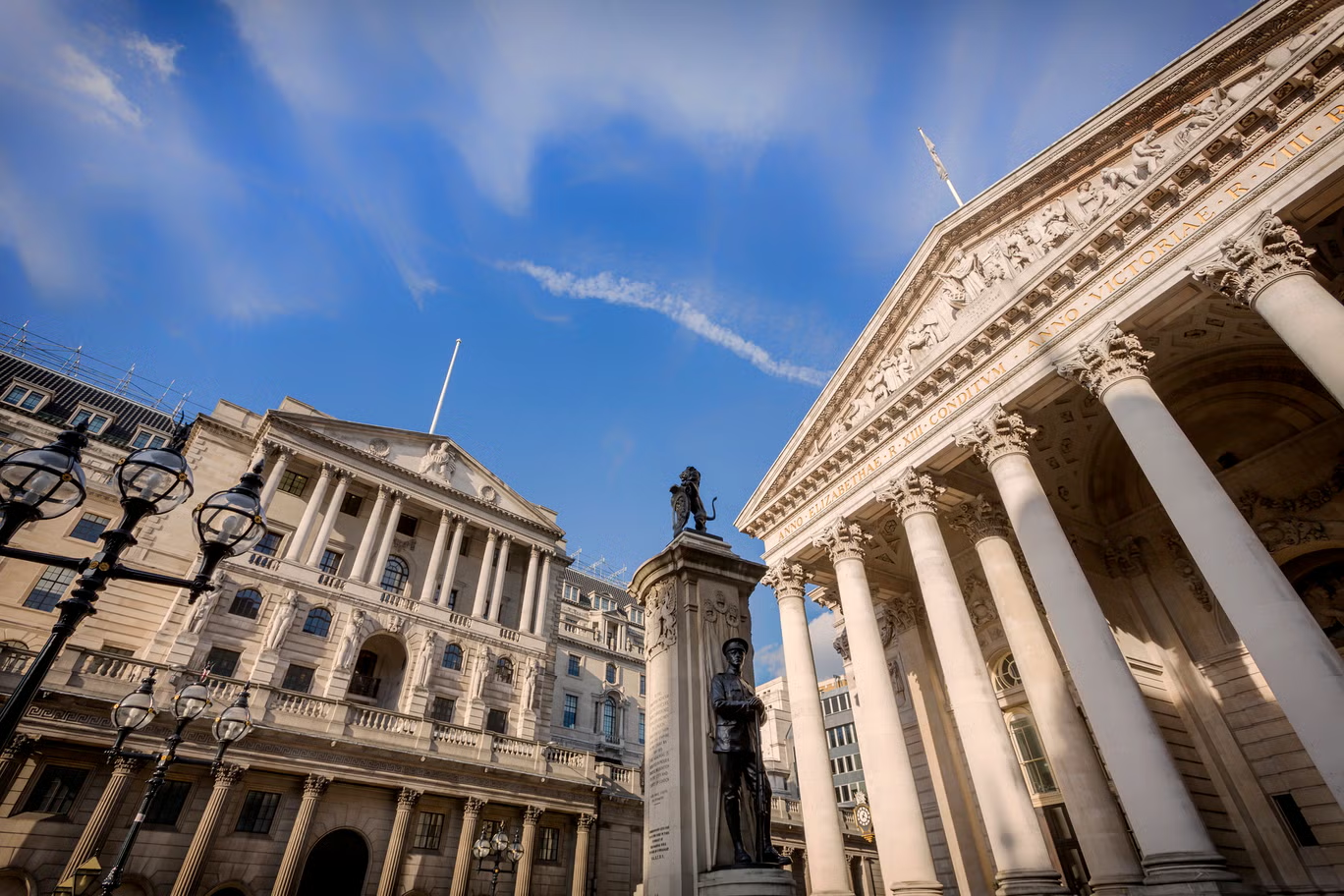
Just when we thought that there was nothing else about which to worry, a different kind of “alien” concern: Helen McCaw, and economist and former senior analyst at the Bank of England, has written to her former employer with a warning…
The UK must plan for a financial crisis that would be triggered if the US government announces that aliens exist, a former Bank of England expert has said.
Helen McCaw, who served as a senior analyst in financial security at the UK’s central bank, has written to Andrew Bailey, the Bank of England’s governor, urging him to set out contingencies in case the White House ever confirms the existence of alien life, according to The Times.
Ms McCaw, who worked for the Bank of England for 10 years until 2012, said politicians and bankers can no longer afford to dismiss talk of alien life, and warned a declaration of this nature could trigger bank collapses…
Read on: “Bank of England must plan for a financial crisis triggered by aliens, says former policy expert,” from @the-independent.com.
* often attributed to Arthur C. Clarke (but likely from Stanley Kubrick, quoting Carl Sagan [who was riffing on a Walt Kelly Pogo quote])
###
As we acclimate to chaos, we might recall that it was on this date in 2021 that Resident Alien debuted (on Syfy).
Resident Alien is based on a comic book of the same name [by Peter Hogan and Steve Parkhouse]. Created by Chris Sheridan, Alan Tudyk plays an alien who crash-lands in Patience, Colorado and immediately goes on a killing spree including the town’s doctor, Harry Vanderspeigle.
Taking on the form of Harry, the alien continued killing thinking that by doing so, it would be good for planet Earth. But then, he was overcome with human emotions and started questioning the morality of it all…
– source

“But I don’t want to go among mad people,” Alice remarked.
“Oh, you can’t help that,” said the Cat: “we’re all mad here. I’m mad. You’re mad.”
“How do you know I’m mad?” said Alice.
“You must be,” said the Cat, “or you wouldn’t have come here.”
– Lewis Carroll
“Ritual and ceremony in their due times kept the world under the sky and the stars in their courses. It was astonishing what ritual and ceremony could do.”*…

The estimable Henry Farrell, responding to thoughts from Adam Tooze (here and here) and Paul Krugman (here) in trying to make sense of what happened in Davos last week, draws on the thinking of Michael Chwe’s Rational Ritual: Culture, Coordination and Common Knowledge (on why a game theoretic account of why ritual is important) to suggest that Europe and Carney disrupted Trump’s ceremony of self-anointment…
… I take two lessons from his book. First, that Davos fits very clearly into his definition of `ritual.’ Second, that rituals are important because they create common knowledge.
What we have seen at Davos over the last few days was an effort by the Trump administration to create new common knowledge in the world, an agreement that Trump was in charge, and that politics revolved around him. That effort has failed because of pushback from politicians, both Europeans who were furious at Trump, and Canada’s prime minister, Mark Carney who gave a quite extraordinary speech. However, the result is most certainly not a decisive victory for Europe, Canada, and the other forces allied with them. Instead, it is one significant moment in a longer story of struggle and contention…
… Rituals often take place in consecrated places. British kings are crowned in Westminster Abbey. They also often take place at a particular time of the year (see churches and organized religion, passim). So it is not at all a stretch to see the Davos meeting as a ritual that is held in the same overcrowded place at much the same time every year. Like many rituals, its boredom and its ceremony go hand in hand. For many years, Davos’s most obvious social purpose was to reinforce the consensus about globalization, in predictable ceremonial language. Its very dullness and lack of surprise was a side effect of its power.
That was then; this is now. I don’t think that it is at all implausible to see Trump’s planned descent on Davos this year as a version of a royal progress (see Stacie Goddard and Abe Newman on “neo-royalism”). Swooping into Davos, and making the world’s business and political elite bend their knees, would have created collective knowledge that there was a new political order, with Trump reigning above it all.
Business elites would be broken and cowed into submission, through the methods that Adam describes. The Europeans would be forced to recognize their place, having contempt heaped on them, while being obliged to show their gratitude for whatever scraps the monarch deigned to throw onto the floor beneath the table. The “Board of Peace” – an alarmingly vaguely defined organization whose main purpose seems to be to exact fealty and tribute to Trump – would emerge as a replacement for the multilateral arrangements that Trump wants to sweep away. And all this would be broadcast to the world. Adam’s combination of stage, convening and acting would provide a means to shape the collective understanding of a global audience that Trump was now in charge.
That, of course, is not what happened. First, the Europeans were finally pushed to the point where they pushed back. As Belgium’s prime minister put it, “Living as a happy vassal is one thing, existing as a miserable slave is another.” It was clear that the Europeans were finally becoming willing to retaliate against Trump. That in turn had consequences for business.
As Adam suggests, businesses are unwilling to visibly step up to oppose Trump one on one. But businesses are not only individual participants in the ceremony. They are also members of a vast and depersonalized audience, via the anonymizing mechanism of the market, and, as Chwe suggests, it is the collective understanding of the audience that is most important. Just as the ouija board allows individuals to express their desires without being held accountable to them (thanks to the ‘ideomotor effect’ so too, the invisible hand of the market moves the planchette of stock prices in ways that no business can be held accountable for. When stock markets fall, even at the prospect of trade conflict between Europe and the United States, politicians pay attention. “Market fundamentals” (a loaded and problematic term) provided a very different understanding of the shared consensus than the one Trump sought to impose.
Second, Carney’s speech laid out an entirely different understanding of what was happening, and what had gone before. In his words:
Let me be direct: We are in the midst of a rupture, not a transition. Over the past two decades, a series of crises in finance, health, energy and geopolitics have laid bare the risks of extreme global integration. But more recently, great powers have begun using economic integration as weapons. Tariffs as leverage. Financial infrastructure as coercion. Supply chains as vulnerabilities to be exploited.
… from Chwe’s more immediate perspective, what is more important than the vision of the past and future is where Carney said it and how he framed it. If you are planning a grand coronation ceremony, which is supposed to create collective knowledge that you are in charge, what happens when someone stands up to express their dissent in forceful terms?
The answer is that collective knowledge turns into disagreement. By giving the speech at Davos, Carney disrupted the performance of ritual, turning the Trumpian exercise in building common knowledge into a moment of conflict over whose narrative ought prevail…
… He wasn’t telling people anything that they didn’t know as individuals. He was, instead, turning that private knowledge into a putative collective understanding that countered the alternative collective understanding that Trump wanted to impose upon the world…
… The ceremony was disrupted by European threats of retaliation, which in turn led the market audience to express its unhappiness, and by Carney’s quite deliberate and self-conscious effort to crack the illusion of inevitability.
That does not mean that the Trump political project has been defeated. It is going to be very hard for Europe and Carney to build a viable counter-consensus. Already, Trump is looking to discipline Canada and seize back control of the narrative. What we have seen was a battle, not a war. But to appreciate the weapons that the battle was fought with, and understand the prize that was contended for, it is really helpful to emphasize the relationship between ritual and collective expectations. Chwe’s book is the clearest account of this relationship that I know of…
Eminently worth reading in full: “Davos is a rational ritual,” from @himself.bsky.social.
[Image above: source]
* Terry Pratchett, Pyramids
###
As we grapple with geopolitics, we might send illicit birthday greetings to Frank Costello; he was born Francesco Castiglia on this date in 1891. Having gotten his start in bootlegging during Prohibition, Costello became the head of the the Luciano crime family. a position he held (albeit for a few years in the 1950s remotely, as he served a federal prision sentence for tax evasion) until his retirement in 1957 after he had survived an assassination attempt ordered by Vito Genovese.
Costello had an “unusual” relationship with the man who could/should have been his primary antagonist, J. Edgar Hoover.
During the 1930s, Hoover persistently denied the existence of organized crime, despite numerous organized crime shootings as Mafia groups struggled for control of the lucrative profits deriving from illegal alcohol sales during Prohibition, and later for control of prostitution, illegal drugs and other criminal enterprises. Hoover [protested that] was reluctant to pursue the Mafia as he knew that organized crime investigations typically required excessive man hours while resulting in a relatively small number of arrests. He also feared that placing underpaid FBI agents—who had a starting annual salary $5,500 in the mid 1950s—in close contact with wealthy mobsters could undermine the FBI’s reputation of incorruptibility.
Many writers believe Hoover’s denial of the Mafia’s existence and his failure to use the full force of the FBI to investigate it were due to Mafia gangsters Meyer Lansky and Frank Costello‘s possession of embarrassing photographs of Hoover in the company of his protégé, FBI Deputy Director Clyde Tolson. [E.g., here] Other writers believe Costello corrupted Hoover by providing him with horseracing tips, passed through a mutual friend, gossip columnist Walter Winchell. Hoover had a reputation as “an inveterate horseplayer” and was known to send Special Agents to place $100 bets for him. Hoover once said the Bureau had “much more important functions” than arresting bookmakers and gamblers…
– source

“A commodity appears at first sight an extremely obvious, trivial thing. But its analysis brings out that it is a very strange thing”*…

Prices are on everyone’s minds these days. Brian Potter looks underneath the costs of the finished products and services that we typically track to examine the costs of the commodities that go into them…
This American Enterprise Institute chart [above], which breaks down price changes for different types of goods and services in the consumer price index, has by now become very widely known. A high-level takeaway from this chart is that labor-intensive services (education, healthcare) get more expensive in inflation-adjusted terms over time, while manufactured goods (TVs, toys, clothing) get less expensive over time.
But there are many types of goods that aren’t shown on this chart. One example is commodities: raw (or near-raw) materials mined or harvested from the earth. Commodities have many similarities with manufactured goods: they’re physical things that are produced (or extracted) using some sort of production technology (mining equipment, oil drilling equipment), and many of them will go through factory-like processing steps (oil refineries, blast furnaces). But commodities also seem distinct from manufactured goods. For one, because they’re often extracted from the earth, commodities can be subject to depletion dynamics: you run out of them at one location, and have to go find more somewhere else. In my book I talk about how iron ore used to be mined from places like Minnesota, but as the best deposits were mined out steel companies increasingly had to source their ore from overseas. And the idea of “Peak Oil” is based on the idea that society will use up the easily accessible oil, and be forced to obtain it from increasingly marginal, expensive-to-access locations.
(Some commodities, particularly agricultural commodities that can be repeatedly grown on a plot of land, don’t have the same sort of depletion dynamics, though bad farming practices can degrade a plot of land over time. Other commodities get naturally replenished over time, but can still get used up if the rate of extraction exceeds the rate of replenishment; non-farmed timber harvesting and non-farmed commercial fishing come to mind as examples.)
Going into this topic, I didn’t have a great sense of what price trends look like for commodities in general. Julian Simon famously won a 1980 bet with Paul Ehrlich that several raw materials — copper, chromium, nickel, tin, and tungsten — would be cheaper (in inflation-adjusted terms) after 10 years, not more expensive. But folks have pointed out that if the bet had been over a different 10-year window, Ehrlich would have won the bet.
To better understand how price tends to change for different commodities and raw materials, I looked at historical prices for over a hundred different commodities. Broadly, agricultural commodities tend to get cheaper over time, while fossil fuels have a slight tendency to get more expensive. Minerals (chemicals, metals, etc.) have a slight tendency towards getting cheaper, with a lot of variation — 15 minerals more than doubled in price over their respective time series. But this has shifted over the last few decades, and recently there’s been a greater tendency for commodities to rise in price…
[Potter offers a thorough– and fascinating– analysis, concluding…]
… historically commodities have generally fallen in price over time, but recently this trend has increasingly shifted towards rising prices. Natural gas and oil got cheaper until the 1950s and the 1970s, respectively, and since then have gotten more expensive. Beef and pork both got cheaper from 1970 until the 1990s, and since then have risen in price. Agricultural products were almost uniformly falling in price until around 2000, and have almost uniformly risen in price since then.
My general sense looking at historical commodity price data is that the more that production of some commodity looks like manufacturing — produced by a repetitive process that can be steadily improved and automated, from a supply that can be scaled up in a relatively straightforward fashion, without being subject to severe depletion dynamics — the more you’ll tend to see prices fall over time. The biggest decline in price of any commodity I looked at is industrial diamonds, which fell in price by 99.9% between 1900 and 2021d ue to advances in lab-grown diamonds production. This effectively replaced mined diamonds with manufactured ones for industrial uses; roughly 99% of industrial diamonds today are synthetic. Many other commodities had major price declines that were the result of production process improvements — aluminum got cheaper thanks to the invention (and subsequent improvements) of the Hall-Heroult smelting process, titanium’s price declined following the introduction of the Kroll process, and so on. (Steel also got much cheaper following the introduction of the Bessemer process, but that predates USGS price data.) And of course agriculture, which has evolved from crops being harvested manually to being harvested with highly automated, continuous process machinery, closely mirrors the sorts of process improvements we see in manufacturing.
Of course, this trend alone can’t explain changes in commodity prices over time, and there are plenty of commodities — steel, cement, silicon — that are produced in a manufacturing-type operation but which haven’t seen substantially declining prices over their history. And even commodities which resemble manufactured goods have risen in price recently. More generally, there are plenty of things that can shift supply and demand curves to the right or left: cartels, national policies, a spike or collapse in demand, and so on. But the question of “how much, over time, does the production of this commodity resemble a manufacturing process?” seems like a useful lens on understanding the dynamics of commodity prices…
“Do Commodities Get Cheaper Over Time?” from @constructionphysics.skystack.xyz.
* Karl Marx
###
As we brush up on the basics, we might recall that this date in the anniversary of two events that spurred commodity consumption.
Alexander Graham Bell spurred a boom on copper consumption when, on this date in 1915, he placed the first transcontinental phone call, from New York to San Francisco, where the Panama–Pacific International Exposition celebrations were underway and his assistant, his assistant Thomas Augustus Watson stood by. Bell repeated his famous first telephonic words, “Mr. Watson, come here. I want you,” to which Watson this time replied “It will take me five days to get there now!” Bell’s call officially initiated AT&T’s transcontinental service.

And, on this date 45 years later, in 1959, the aluminum market got a boost when the first non-stop transcontinental commercial jet trip was made by an American Airlines Boeing 707, from Los Angeles to New York. The sleek silver plane made the flight in airline official time of 4 hours and 3 minutes, half the usual scheduled time for the prop-driven DC- 7Cs then in regular use on that route.

“Stercus accidit”*…
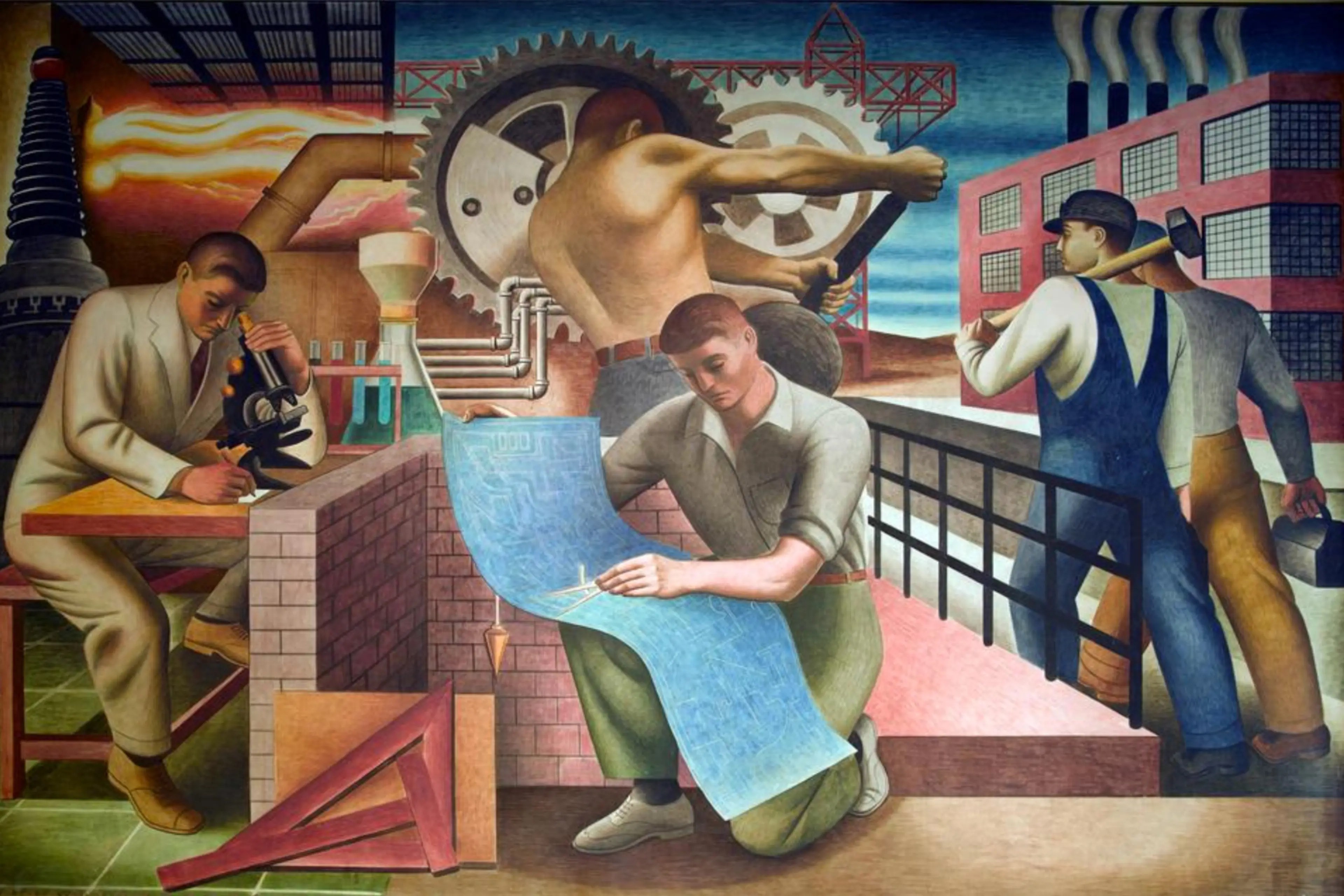
As we try to understand the rifts afflicting our nation and world, many turn to Marx and his framework of class. But in a provocative essay, Catherine Nichols suggests that it was David Hume (in an 1752 essay that identified the unfettering of wealth from land) who identified the origin of our political divisions…
Describing the political map in terms of Left and Right is an accepted convention all over the world, almost to the point of cliché. Yet it is surprisingly complicated to explain whose interests lie on each side of this spectrum. For example, if the Left supports the interests of workers over the interests of employers, why are Left-leaning regions of the United States and elsewhere in the world among the richest? When Japan and South Korea sought to become economic powerhouses in the later 20th century, they adopted Leftist policies such as strong public education, universal healthcare and increased gender equality – if countries seeking to compete in capitalist arenas adopt broadly Leftist policies, then how do we explain why Leftists are always talking about overthrowing capitalism? And if the Left is somehow both the party of workers’ rights and the party of material wealth, then whose interests are supported by the Right? Given such contradictions, how did these terms become so central to modern politics?
The terms ‘left’ and ‘right’ come from the seating arrangements in the National Assembly during the French Revolution, where the combatants used the medieval estate groupings to define their battle lines. According to their writings, land-owning aristocrats (the Second Estate) were the party of the Right, while the interests of nearly everyone else (the Third Estate) belonged to the Left. This Third Estate included peasants working for the landowners but also every other kind of business owner and worker. Decades later, Karl Marx offered a different analysis of capitalism: he put owners of both land and businesses together on one side (the bourgeoisie), while grouping workers from fields and factories on the other side (the proletariat) in a single, world-wide class struggle. The trouble with both these ways of parsing Left and Right is that voting patterns never seem to line up with class. Both historic analyses leave us with questions about the contemporary world – and not just the paradox of why so many Left-leaning places are so rich. Why, for example, do working-class conservatives appear to vote against their material interests, year in and year out, across generations?
The 18th-century philosopher and political theorist David Hume had answers to these questions, though he was writing decades before the French Revolution. While his essay ‘Of Public Credit’ (1752) was a warning about the dangers of Britain’s increasing reliance on debt financing, his apocalyptic vision of the future turned out to describe some features of our current political map surprisingly well. Hume was writing because he believed that debt financing had the power to upend Europe’s traditional power structure and culture by creating a new source of money divorced from tradition or responsibility: stocks and bonds. Unlike land, anyone with some cash could buy war bonds and get an immediate passive income in the form of interest. This was the thin end of the wedge caused by the debt financing that Hume believed was destroying every part of society. The governments of antiquity, Hume argued, saved money to use in battle and then waged wars in self-defence, or else to expand their territory. But the British had invented a new form of warfare that Hume saw no precedent for, even in the merchant states of Nicollò Machiavelli’s Italy: war for trade, funded with money borrowed from private stockholders…
[Nichols unpacks Hume’s observations (centrally, that three groups with stakes in the status quo, heretability, and the sanctity of “family and family hierarchy”tradition”– landowners, aging parents, and want to preserve old power structures, including the family– and traces their relevance, from Hume’s time to ours…]
… There are many reasons for people aligning Right or Left, which is why analyses of class and material interests fall short of describing the realities of people’s politics. Hume foresaw that these specific groups would resent the economic sea-change of the 18th century – and he was correct. Many people would rather have land and power than money and liberty.
Still, the power of the Right hasn’t doomed the Left – no more than the Spanish Inquisition doomed the rise of the Left in 18th-century England and France. As long as governments want to keep the value of their currencies from falling, someone in their ranks will be using the methods of the Left and inventiveness that brought us everything from our banking system to gay marriage. We don’t need to resurrect communism or focus narrowly on class, following Marx. The experiments are far from over, and we should remember that the Left is generally where money comes from in modern times. We give away too much power when we forget it…
Rethinking Right and Left: “Landholder vs stockholder,” from @catherinenichols.bsky.social in @aeon.co.
As for how it’s going at the moment (and further to Hume and the quote in this post’s title), see: “MAGA’s Betrayal of Small Business,” from @pkrugman.bsky.social.
* “shit happens”– often attributed to David Hume, reflecting his skeptical view that human understanding, particularly of cause-and-effect, is limited to habitual belief from experience, implying that unforeseen, messy outcomes (“shit”) inevitably occur in life despite our reasoning.
###
As we sort the Whigs from the Tories, we might recall that it was on this date 1656 that Blaise Pascal (writing under the pseudonym Louis de Montalte) published the first of his Provential Letters (Lettres provinciales), a series of eighteen polemical letters using humor to attack Jesuits for their use of casuistry and their moral laxity. Though the Letters were a popular success, they had little immediate effect on politics or the clergy. But they influenced later French writers like Voltaire and Jean-Jacques Rousseau and ultimately persuaded Pope Alexander to condemn “laxity” in the church and order a revision of casuistic texts.

You must be logged in to post a comment.