Why is the most dangerous political crisis in modern American history being met with emotional denial, moral distortion, and cultural distraction? Mike Brock, with a bracing essay…
Two plus two equals four. There are twenty-four hours in a day. And the United States is experiencing a constitutional crisis that threatens to end our democratic experiment.
That sentence—stark, unqualified, devoid of hedging—causes a peculiar form of discomfort. It demands we confront a reality most of us are psychologically unprepared to process: We are living through a slow-motion collapse of constitutional democracy in the United States, and most people—not just average citizens but intellectuals, journalists, and elected officials—are emotionally and cognitively incapable of grasping the scale of this threat.
This is not merely a political problem. It is a moral and psychological crisis of coherence—a collective failure to align our emotional response with objective reality. The distance between the magnitude of what is happening and our capacity to feel its significance represents one of the most dangerous disconnects in American history.
We treat an existential threat to self-governance as if it were merely another election cycle. We discuss the potential end of constitutional democracy in the same register we might debate tax policy or infrastructure spending. We have normalized what should never be normal, accommodated what should never be accommodated, and rationalized what should have provoked immediate, sustained resistance.
The gap between the emergency and our feeling of emergency is not accidental. It is the product of specific psychological defenses, media failures, and deliberate manipulation—all combining to protect us from the emotional and moral burden of confronting our situation honestly…
[Brock unpacks the nature of the emergency and then enumerates the “defenses against reality” that are in play: denial (disguised as normalcy), deflection, bothsidesism and cynicism, performative objectivity, and moral equivalence. Having explained each of these, he locates them in what he calls “The Arendtian Frame: The Banality of Complicity” and explains the ways in which they create a series of “collapses in coherence” that keep us from feeling the gravity of the situation…]
… In the face of this psychological and moral crisis, clarity becomes not just an intellectual virtue but a form of resistance. We must name what is happening, without euphemism, without equivocation, and without the false comfort of neutrality.
This is fascism.
I understand the reluctance to use this word. I acknowledge that it has sometimes been misused by the left, applied too broadly to policies they simply dislike rather than to genuine authoritarian movements. This overuse has created an understandable allergic reaction among many thoughtful people.
But the misuse of a term doesn’t invalidate its proper application. The fact that some have incorrectly diagnosed pneumonia doesn’t mean pneumonia doesn’t exist. And what we face now—the cult of personality, the manipulation of law to serve power, the demonization of minorities, the glorification of strength over principle, the explicit rejection of constitutional constraints—these are the defining features of fascism as a political form.
To refuse this word is not moderation but evasion. It is not caution but complicity. It reflects not intellectual rigor but psychological denial—the desperate need to believe we remain within the bounds of normal politics when we have already crossed into darker territory.
Fascism doesn’t arrive announcing itself with swastikas and goose-stepping troops. It comes draped in familiar symbols, speaking the language of tradition, order, and national renewal. It maintains the forms of democratic governance while hollowing out their substance. It works through existing institutions rather than immediately abolishing them.
What makes our current moment particularly dangerous is how it combines traditional authoritarian features with technological capabilities for surveillance, propaganda, and control that previous fascist movements couldn’t imagine. The fusion of authoritarian intent with algorithmic power creates possibilities for sustained oppression that exceed historical precedents.
This is why clarity matters so urgently. Without the proper diagnosis, we cannot formulate the proper response. If we persist in treating an authoritarian movement as merely another iteration of conservative governance, we will deploy inadequate tools against an existential threat.
The appropriate response to fascism is not normal opposition but moral resistance. Not tactical accommodation but principled confrontation. Not private diplomacy but public witness.
This resistance begins with moral courage—the willingness to speak truth despite social costs, professional risks, or personal discomfort. It requires moral clarity—the capacity to distinguish between normal political disagreement and fundamental threats to democratic governance. And it demands civic resistance—the refusal to normalize or accommodate authoritarian consolidation.
In practical terms, this means:
Refusing to center the wrong stories. When media coverage focuses on trivia while constitutional violations go unremarked, we must insist on proper perspective. When commentators treat fascist rhetoric as merely “controversial” rather than dangerous, we must restore moral clarity.
Refusing to indulge fascist spectacles. The strategy of overwhelming our attention with constant outrages, contradictory claims, and manufactured controversies works only if we allow ourselves to be manipulated by it. We must maintain focus on the core threat rather than chasing each new distraction.
Refusing to treat a slow coup as normal politics. We must reject the pressure to discuss authoritarian consolidation as if it were merely another policy dispute. We must insist on the fundamental distinction between governance within constitutional boundaries and the systematic dismantling of those boundaries.
Most importantly, we must be witnesses—not passive observers but active participants in the maintenance of truth. When someone dismisses constitutional violations as mere politics, we must speak up. When someone equates democratic flaws with authoritarian assaults, we must correct them. When someone retreats into cynicism or bothsidesism, we must insist on moral distinction.
These acts of witness may seem small compared to the scale of our crisis. They may feel inadequate in the face of constitutional collapse. But they represent the essential foundation for any larger resistance. Without the maintenance of truth, without the preservation of moral clarity, no other form of opposition is possible…
… the center cannot hold through denial or deflection. It can only be held through clarity—through the painful but necessary acknowledgment of our true situation.
This clarity begins with saying what is true, even when others aren’t ready to hear it. It continues through the patient, persistent defense of coherence against the forces that would dissolve it. And it culminates in the courage to act on that truth, to align our response with the reality we face rather than the reality we wish existed.
The wire still holds—but only if we walk it. Only if we maintain the tension between truth and power, between principle and expediency, between the republic we’ve inherited and the responsibility to preserve it.
This is not about partisanship. It is not about policy preferences. It is about whether the American experiment in self-governance will continue or whether it will join history’s long list of failed republics—remembered not for what it achieved but for what it surrendered.
The emergency we cannot feel is no less real for our failure to feel it. The collapse we struggle to acknowledge is no less imminent for our reluctance to face it. And the responsibility to resist, to bear witness, to hold the center—that responsibility falls to each of us, whether we’re emotionally prepared for it or not.
And for an extraordinary series of conversations about democracy and authorianism in our moment (and what we can do), visit The Civic Forum, created and moderated by Rory Truex. (TotH to MKM)
As we face reality, we might recall that it was on this date in 1775 that King George II of Great Britain issued the Proclamation of Rebellion (officially, A Proclamation for Suppressing Rebellion and Sedition), in repsonse to the news of the Battle of Bunker Hill at the outset of the American Revolutionary War. It declared elements of the American colonies in a state of “open and avowed rebellion” and ordered officials of the empire “to use their utmost endeavours to withstand and suppress such rebellion.”
As part of his work in revising the laws of Virginia during the late 1770s and early 1780s, Thomas Jefferson put forth a bill that has become one of his most enduring works on the subject of education: Bill 79, “A Bill for the More General Diffusion of Knowledge.” Its oft-quoted preamble reads as follows:
Whereas it appeareth that however certain forms of government are better calculated than others to protect individuals in the free exercise of their natural rights, and are at the same time themselves better guarded against degeneracy, yet experience hath shewn, that even under the best forms, those entrusted with power have, in time, and by slow operations, perverted it into tyranny; and it is believed that the most effectual means of preventing this would be, to illuminate, as far as practicable, the minds of the people at large, and more especially to give them knowledge of those facts, which history exhibiteth, that, possessed thereby of the experience of other ages and countries, they may be enabled to know ambition under all its shapes, and prompt to exert their natural powers to defeat its purposes; And whereas it is generally true that that people will be happiest whose laws are best, and are best administered, and that laws will be wisely formed, and honestly administered, in proportion as those who form and administer them are wise and honest; whence it becomes expedient for promoting the publick happiness that those persons, whom nature hath endowed with genius and virtue, should be rendered by liberal education worthy to receive, and able to guard the sacred deposit of the rights and liberties of their fellow citizens, and that they should be called to that charge without regard to wealth, birth or other accidental condition or circumstance; but the indigence of the greater number disabling them from so educating, at their own expence, those of their children whom nature hath fitly formed and disposed to become useful instruments for the public, it is better that such should be sought for and educated at the common expence of all, than that the happiness of all should be confided to the weak or wicked: …
The Bill was presented in the House of Delegates in 1778 and 1780, but was not passed; James Madison presented the bill several more times to the state legislature while Jefferson was serving in Paris as Minister to France. A much-revised version was finally passed into law in 1796 as an “Act to Establish Public Schools.”
As we prioritize pedagogy, we might send enlightened birthday greetings to a women whose work exemplified Jefferson’s dictum: Septima Poinsette Clark; she was born on this date in 1898. educator and civil rightsactivist. Clark developed the literacy and citizenship workshops that played an important role in the drive for voting rights and civil rights for African Americans in the Civil Rights Movement. While her work was commonly under-appreciated by Southern male activists, she became known as the “Queen Mother” or “Grandmother” of the Civil Rights Movement in the United States. Martin Luther King Jr. commonly referred to Clark as “The Mother of the Movement.”
Clark’s explained her position in the Civil Rights Movement as one that claimed “knowledge could empower marginalized groups in ways that formal legal equality couldn’t.”
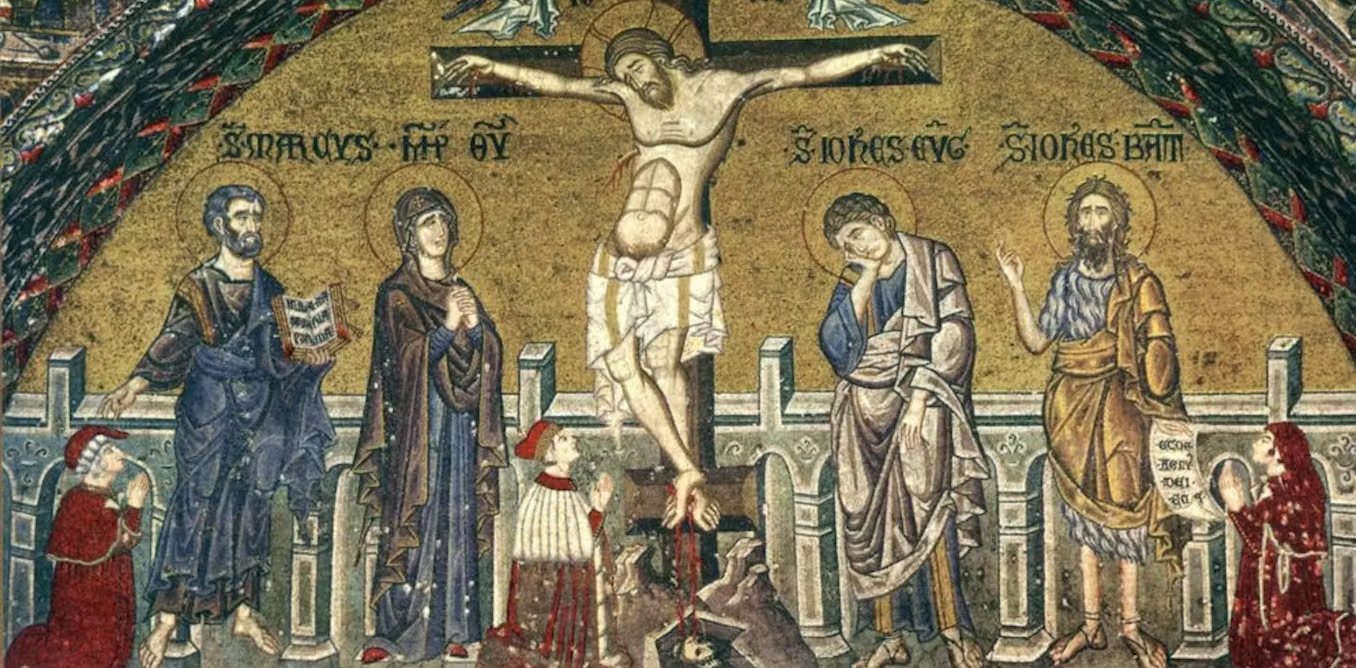
The 14th-century mosaic in the baptistery of Venice’s San Marco basilica showing the crucifixion scene with the Venetian doge and two officers of the city beneath
In an increasingly polarised world, the arts and humanities play a key role in sustaining democracy. They foster critical thinking, open dialogue, emotional intelligence and understanding across different perspectives, all of which are essential for a healthy democratic society. Also, people who participate in cultural activities are much more likely to engage in civic and democratic life.
Yet the way the arts are funded differs widely from country to country, especially in times of economic hardship or significant change. During and after the pandemic, for instance, some EU countries increased public spending on culture, while others made significant cuts.
The reasons for these contrasting attitudes are many, from local cultural values, to shifting economic priorities and politics. But at their core, different funding strategies express different attitudes towards two questions: what contribution does art make in times of crisis? And how do communities express their experiences of uncertainty?…
… the medieval city of Venice provides a remarkable historical example for addressing these questions.
Between the sixth and 12th centuries, Venice grew into an independent city-state ruled by an elected council and an elected head of state, called the doge.
Set on an island, the city lacked some of the resources necessary to its survival, so it quickly established strong maritime trade networks across the Mediterranean. It gradually developed into an international merchant empire, acquiring strategic territories along the eastern Adriatic Coast, Greece and the Aegean Sea.
By the mid-14th century, Venice was a leading global power. Yet, between 1340 and 1355, the city also faced famine, plague, a violent earthquake and fierce military conflicts with Genoa and the Ottomans.
Internally, Venice tackled dramatic political tensions (including a coup and the public execution of a doge in 1355), as non-noble citizens were gradually excluded from public office. Strikingly, it was during this period of acute crisis that the government initiated a series of ambitious artistic projects in the state church of San Marco.
A new baptistery and a chapel dedicated to Saint Isidore of Chios were lavishly decorated with mosaics. In addition, the high altar, which provided religious focus for the faithful, was revamped. This included turning its uniquely precious golden altarpiece into spectacular moving machinery that would open and close to reveal different images daily, and on feast days.
These projects, which required substantial public spending at a time of financial strain, hardly represented business as usual for Venetian policymakers. Instead, they were a central part of the government’s wider response to crisis.
On one level, these new projects revealed the range of pressing concerns that engulfed the Venetian government and people at the time. The painted altarpiece displayed on the altar of San Marco on non-festive days exhibits an emphasis on human suffering, miracles and saintly interventions that may relate the need for reassurance in uncertain times.
The bloody conflict against Genoa likely influenced the dedication of a chapel to St Isidore. The saint’s body was transported to Venice from the Greek island of Chios, a vital Genoese stronghold in the 14th century. To the people of Venice, the physical presence of St Isidore’s relics in San Marco provided reassurance and the promise of protection and victory as their state engaged in a risky conflict.
Finally, uncertainty about the nature and boundaries of citizenship and political authority – which the expansion of Venice’s overseas territories transformed into an ever more urgent problem – offer a valuable way to interpret the imagery in the baptistery. Here the apostles are rendered in mosaic as they baptise the “nations of the earth”, offering an idealised image of union in diversity.
Yet, on another level, the projects sponsored by the Venetian government during this period represented the active exercising of the political imagination. In ways that some of us may find alarmingly familiar, Venice’s ongoing instability made traditional approaches to decision-making, communication and control ineffective in dealing with the challenges it faced.
Venice’s governors responded to the crisis which threatened the very survival and stability of the city and its political foundations with a wide-ranging strategy of legal, institutional and historical revision, aimed at clarifying the nature and functions of the Venetian state.
The government reaffirmed Venice’s civic laws and reorganised its international treaties. The authority of the doge was progressively restricted, and over time, the government clarified the rules for holding public office. The first official history of Venice was completed in 1352.
In this context, the San Marco projects did not merely express the anxiety of the Venetian people, or their hopes for renewed stability. They represented the establishing of a new political landscape, which was envisioned most clearly on the east wall of the baptistery.
Three secular figures – a doge and two officers – are depicted as kneeling supplicants within a monumental mosaic of the crucifixion (see the main headline image above). Blending the sacred with the secular, this image offered an abstract “state portrait” that simultaneously expressed a political reality and suggested a new political ideal.
The mosaic now rendered Venice’s doge as a humble ruler, and it represented the business of government as a collective enterprise. In so doing, this image articulated a new vision of government as public service and shared responsibility. This idea, which developed through political reforms in Venice and from broader debates in other medieval Italian city states, has went on to influence western approaches to government and public life to this day.
Venice’s state-sponsored artistic commissions were not propaganda in the modern sense. Instead, they offered a compelling visual reflection on the nature of leadership and the necessary limits of authority. They kindled a new vision of government that enabled Venice to navigate one of the most turbulent phases of its history – reminding us, too, of the power of the arts to inspire and imagine new futures in difficult times…
As we appreciate art, we might send imaginative birthday greetings to Odilon Redon; he was born on this date in 1840. A lithographer, etcher, and painter, he was influential in the development of modern French art in two different ways. His prints explore haunted, fantastic, often macabre themes, earning him a leading place among emerging French Symbolists and foreshadowing the Surrealist and Dadaist movements. His oils and pastels, chiefly still lifes with flowers, won him the admiration of Henri Matisse and other painters as an important colorist.
Around half the world’s population live in places that held elections in 2024. Some 1.65bn ballots were cast across more than 70 countries. But while the number of democratic elections in a single year has never been higher, 2024 also brought big challenges. According to the latest democracy index published by EIU, our sister company, on February 27th, global democracy is in worse shape than at any point in the nearly two-decade history of the index.
Since 2006 EIU has scored 167 countries and territories on a scale of zero to ten based on five criteria: electoral process and pluralism, functioning of government, political participation, political culture, and civil liberties. The countries are then grouped into four categories: full democracies, flawed democracies, hybrid regimes and authoritarian regimes.
For the 16th consecutive year, Norway was named the most democratic country in the world, with a score of 9.81. New Zealand and Sweden followed. Afghanistan has been the lowest-ranked country since 2021, scoring just 0.25 points. The biggest change came from Bangladesh, which dropped 25 places. Rebuilding democracy there will be an enormous task after the ouster of Sheikh Hasina, the country’s longtime autocratic ruler. But there is cause for optimism. A temporary technocratic government, led by Muhammad Yunus, a Nobel peace prizewinner, has restored order and stabilised the economy. For those reasons, we named Bangladesh our country of the year in 2024.
The global average dropped to a new record low of 5.17, down from a high of 5.55 in 2015. Just 6.6% of the world’s population now lives in a full democracy, down from 12.5% ten years ago. And a large share of the world’s population—currently two in five people—lives under authoritarian rule.
Despite the promise of a global election extravaganza, some of the ballots were a farce. Polling day in Pakistan, for example, was marred by violence. The most popular politician, Imran Khan, whose own democratic credentials are questionable, was jailed shortly before the election took place. The country’s score dropped from 3.25 in 2023 to 2.84. In Russia another sham election gave Vladimir Putin a fifth term as president—it scored just two points on the index. In other countries—including Burkina Faso, Mali and Qatar—elections were cancelled altogether.
Even Europe—home to nine of the top ten countries in the index—saw some notable declines. France was downgraded from a full democracy to a flawed one. This mostly reflects a deterioration in its confidence-in-government score after president Emmanuel Macron’s snap election in June failed to secure a legislative majority for any single party or bloc. (Four different prime ministers during the course of the year did little to instil confidence either.) Romania was also downgraded after allegations of Russian interference, illegal social-media tactics and campaign-finance violations prompted the constitutional court to annul the presidential election and call for a new vote. In Asia, South Korea dropped out of the full-democracy category after President Yoon Suk Yeol declared—then hastily revoked—martial law, plunging the country into crisis.
America remained a flawed democracy, shifting only slightly from its position in 2023. But it could face bigger problems this year: the first month of President Donald Trump’s second term has already challenged the political independence of the civil service and seen a flurry of executive orders of questionable legal authority.
Mr Trump’s victory in 2024 was part of a broader global backlash against incumbents. The next test for global democracy in 2025 will be how these newly elected leaders choose to govern…
* John Adams, whose own handiwork as a Founding Father has been nicked, but so far evaded the fate he predicted (in an 1814 letter to John Taylor)
###
As we batten the hatches, we might recall that it was on this date in 1933 that RKO‘s King Kong premeired. Directed and produced by Merian C. Cooper and Ernest B. Schoedsack, with special effects by Willis H. O’Brien and music by Max Steiner, it received rave reviews, with praise for its stop-motion animation and score… and has only grown in esteem: in 1991, it was deemed “culturally, historically and aesthetically significant” by the Library of Congress and selected for preservation in the National Film Registry. In 2010 it was ranked by Rotten Tomatoes as the greatest horror film of all time and the fifty-sixth greatest film of all time.
Just over a decade ago, Nils Gilman wrote an essay, The Twin Insurgency,” in which he warned of an emerging confluence of strategies between the rising global plutocratic class, on the one hand, and transnational criminal organizations, on the other. For all our sins, as you’ll see in his piece, he nailed the fundamental disposition of the tech-libertarian broligarch class. And…
One other thing I think I correctly intuited a decade ago was that a key politico-spatial implication of the Twin Insurgency was that the space of the national was fragmenting into “kaleidoscopic microsovereignties,” an argument that my friend Quinn Slobodian has recently developed at monographic length in his marvelous book Crack-Up Capitalism.
Quinn’s thesis is that the ultimate goal of what I called the plutocratic insurgents (and their intellectual and high-end service-economy henchmen) is to end the constraints that democratic nation-states impose on the privileges of the rich. These are rich men (and it is almost entirely men) who believe that their wealth should be untouchable, and that the privileges that this wealth buys should be unlimited. With Elon Musk’s DOGE, the mask is off: they are hell-bent on destroying any institutions of social care or risk-sharing that might touch their money or their privileges.
I cannot recommend Crack-Up Capitalism enough. Methodologically, is an intellectual history of the most notorious radical libertarians — from well-known assholes** like Milton Friedman and Peter Thiel to a congeries of even more colorful crackpots and kakistocrats — and their quest to craft for the perfect space for unfettered capitalism by shattering the map of allegedly sovereign territories into a variety of “exceptional” legal spaces: free ports, tax havens, special economic zones, etc. It is also an historical travelogue, taking the reader (as its cover blurb says) “from Hong Kong in the 1970s to South Africa in the late days of apartheid, from the neo-Confederate South to the former frontier of the American West, from the medieval City of London to the gold vaults of right-wing billionaires, and finally into the world’s oceans and war zones, charting the relentless quest for a blank slate where market competition is unfettered by democracy.” Best of all, Crack-Up Capitalism is wonderfully written: erudite and droll in equal measure (as the punning title itself suggests).
** I use the term “assholes” in the technical sense elaborated by Aaron James, chair of the UC Irvine philosophy department, in his 2012 book Assholes: A Theory,namely someone who “allows himself to enjoy special advantages in social relations out of an entrenched sense of entitlement that immunizes him against the complaints of other people.” I was reading the book when I wrote “The Twin Insurgency” and, even though I didn’t cite it (the anxiety of influence?), I realize now looking back how much it informed my understanding of phenomenon of the plutocratic insurgency. Conversely, I suspect the empirical fact of the rising plutocratic insurgency may well have been part of what inspired James to write his own book.
… Democracy survived Trump’s first term because he had no experience, plan, or team. He did not control the Republican Party when he took office in 2017, and most Republican leaders were still committed to democratic rules of the game. Trump governed with establishment Republicans and technocrats, and they largely constrained him. None of those things are true anymore. This time, Trump has made it clear that he intends to govern with loyalists. He now dominates the Republican Party, which, purged of its anti-Trump forces, now acquiesces to his authoritarian behavior.
U.S. democracy will likely break down during the second Trump administration, in the sense that it will cease to meet standard criteria for liberal democracy: full adult suffrage, free and fair elections, and broad protection of civil liberties.
The breakdown of democracy in the United States will not give rise to a classic dictatorship in which elections are a sham and the opposition is locked up, exiled, or killed. Even in a worst-case scenario, Trump will not be able to rewrite the Constitution or overturn the constitutional order. He will be constrained by independent judges, federalism, the country’s professionalized military, and high barriers to constitutional reform. There will be elections in 2028, and Republicans could lose them.
But authoritarianism does not require the destruction of the constitutional order. What lies ahead is not fascist or single-party dictatorship but competitive authoritarianism—a system in which parties compete in elections but the incumbent’s abuse of power tilts the playing field against the opposition. Most autocracies that have emerged since the end of the Cold War fall into this category, including Alberto Fujimori’s Peru, Hugo Chávez’s Venezuela, and contemporary El Salvador, Hungary, India, Tunisia, and Turkey. Under competitive authoritarianism, the formal architecture of democracy, including multiparty elections, remains intact. Opposition forces are legal and aboveground, and they contest seriously for power. Elections are often fiercely contested battles in which incumbents have to sweat it out. And once in a while, incumbents lose, as they did in Malaysia in 2018 and in Poland in 2023. But the system is not democratic, because incumbents rig the game by deploying the machinery of government to attack opponents and co-opt critics. Competition is real but unfair.
Competitive authoritarianism will transform political life in the United States. As Trump’s early flurry of dubiously constitutional executive orders made clear, the cost of public opposition will rise considerably: Democratic Party donors may be targeted by the IRS; businesses that fund civil rights groups may face heightened tax and legal scrutiny or find their ventures stymied by regulators. Critical media outlets will likely confront costly defamation suits or other legal actions as well as retaliatory policies against their parent companies. Americans will still be able to oppose the government, but opposition will be harder and riskier, leading many elites and citizens to decide that the fight is not worth it. A failure to resist, however, could pave the way for authoritarian entrenchment—with grave and enduring consequences for global democracy.
The second Trump administration may violate basic civil liberties in ways that unambiguously subvert democracy. The president, for example, could order the army to shoot protesters, as he reportedly wanted to do during his first term. He could also fulfill his campaign promise to launch the “largest deportation operation in American history,” targeting millions of people in an abuse-ridden process that would inevitably lead to the mistaken detention of thousands of U.S. citizens.
But much of the coming authoritarianism will take a less visible form: the politicization and weaponization of government bureaucracy. Modern states are powerful entities. The U.S. federal government employs over two million people and has an annual budget of nearly $7 trillion. Government officials serve as important arbiters of political, economic, and social life. They help determine who gets prosecuted for crimes, whose taxes are audited, when and how rules and regulations are enforced, which organizations receive tax-exempt status, which private agencies get contracts to accredit universities, and which companies obtain critical licenses, concessions, contracts, subsidies, tariff waivers, and bailouts. Even in countries such as the United States that have relatively small, laissez-faire governments, this authority creates a plethora of opportunities for leaders to reward allies and punish opponents. No democracy is entirely free of such politicization. But when governments weaponize the state by using its power to systematically disadvantage and weaken the opposition, they undermine liberal democracy. Politics becomes like a soccer match in which the referees, the groundskeepers, and the scorekeepers work for one team to sabotage its rival…
[The authors explore the ways in which the government bureaucracy could be politicized: the threat of targeted prosecution, the weaponization of the IRS, and the mobilization of other executive departments to further the adminsistration’s agenda– which can, among them, punish identified opponents, reward loyalists, and operate like a “protection racket” on everyone else. For alll of that, they see a limit to the damage…]
… The Trump administration may derail democracy, but it is unlikely to consolidate authoritarian rule. The United States possesses several potential sources of resilience. For one, American institutions are stronger than those in Hungary, Turkey, and other countries with competitive authoritarian regimes. An independent judiciary, federalism, bicameralism, and midterm elections—all absent in Hungary, for instance—will likely limit the scope of Trump’s authoritarianism.
Trump is also weaker politically than many successful elected autocrats. Authoritarian leaders do the most damage when they enjoy broad public support: Bukele, Chávez, Fujimori, and Russia’s Vladimir Putin all boasted approval ratings above 80 percent when they launched authoritarian power grabs. Such overwhelming public support helps leaders secure the legislative supermajorities or landslide plebiscite victories needed to impose reforms that entrench autocratic rule. It also helps deter challenges from intraparty rivals, judges, and even much of the opposition.
Less popular leaders, by contrast, face greater resistance from legislatures, courts, civil society, and even their own allies. Their power grabs are thus more likely to fail. Peruvian President Pedro Castillo and South Korean President Yoon Suk-yeol each had approval ratings below 30 percent when they attempted to seize extraconstitutional power, and both failed. Brazilian President Jair Bolsonaro’s approval rating was well below 50 percent when he tried to orchestrate a coup to overturn his country’s 2022 presidential election. He, too, was defeated and forced out of office.
Trump’s approval rating never surpassed 50 percent during his first term, and a combination of incompetence, overreach, unpopular policies, and partisan polarization will likely limit his support during his second. An elected autocrat with a 45 percent approval rating is dangerous, but less dangerous than one with 80 percent support.
Civil society is another potential source of democratic resilience. One major reason that rich democracies are more stable is that capitalist development disperses human, financial, and organizational resources away from the state, generating countervailing power in society. Wealth cannot wholly inoculate the private sector from the pressures imposed by a weaponized state. But the larger and richer a private sector is, the harder it is to fully capture or bully into submission. In addition, wealthier citizens have more time, skills, and resources to join or create civic or opposition organizations, and because they depend less on the state for their livelihoods than poor citizens do, they are in a better position to protest or vote against the government. Compared with those in other competitive authoritarian regimes, opposition forces in the United States are well-organized, well-financed, and electorally viable, which makes them harder to co-opt, repress, and defeat at the polls. American opposition will therefore be harder to sideline than it was in countries such as El Salvador, Hungary, and Turkey.
Civil society is another potential source of democratic resilience. One major reason that rich democracies are more stable is that capitalist development disperses human, financial, and organizational resources away from the state, generating countervailing power in society. Wealth cannot wholly inoculate the private sector from the pressures imposed by a weaponized state. But the larger and richer a private sector is, the harder it is to fully capture or bully into submission. In addition, wealthier citizens have more time, skills, and resources to join or create civic or opposition organizations, and because they depend less on the state for their livelihoods than poor citizens do, they are in a better position to protest or vote against the government. Compared with those in other competitive authoritarian regimes, opposition forces in the United States are well-organized, well-financed, and electorally viable, which makes them harder to co-opt, repress, and defeat at the polls. American opposition will therefore be harder to sideline than it was in countries such as El Salvador, Hungary, and Turkey.
Weaponized states create a difficult collective action problem for establishment elites who, in theory, would prefer democracy to competitive authoritarianism. The politicians, CEOs, media owners, and university presidents who modify their behavior in the face of authoritarian threats are acting rationally, doing what they deem best for their organizations by protecting shareholders or avoiding debilitating lawsuits, tariffs, or taxes. But such acts of self-preservation have a collective cost. As individual actors retreat to the sidelines or censor themselves, societal opposition weakens. The media environment grows less critical. And pressure on the authoritarian government diminishes.
The depletion of societal opposition may be worse than it appears. We can observe when key players sideline themselves—when politicians retire, university presidents resign, or media outlets change their programming and personnel. But it is harder to see the opposition that might have materialized in a less threatening environment but never did—the young lawyers who decide not to run for office; the aspiring young writers who decide not to become journalists; the potential whistleblowers who decide not to speak out; the countless citizens who decide not to join a protest or volunteer for a campaign.
America is on the cusp of competitive authoritarianism. The Trump administration has already begun to weaponize state institutions and deploy them against opponents. The Constitution alone cannot save U.S. democracy. Even the best-designed constitutions have ambiguities and gaps that can be exploited for antidemocratic ends. After all, the same constitutional order that undergirds America’s contemporary liberal democracy permitted nearly a century of authoritarianism in the Jim Crow South, the mass internment of Japanese Americans, and McCarthyism. In 2025, the United States is governed nationally by a party with greater will and power to exploit constitutional and legal ambiguities for authoritarian ends than at any time in the past two centuries.
Trump will be vulnerable. The administration’s limited public support and inevitable mistakes will create opportunities for democratic forces—in Congress, in courtrooms, and at the ballot box.
But the opposition can win only if it stays in the game. Opposition under competitive authoritarianism can be grueling. Worn down by harassment and threats, many of Trump’s critics will be tempted to retreat to the sidelines. Such a retreat would be perilous. When fear, exhaustion, or resignation crowds out citizens’ commitment to democracy, emergent authoritarianism begins to take root…
As we deliberate on democracy, we might recall that it was on this date in 1945 that the first anti-discrimination law in the United States, the Alaska Equal Rights Act of 1945, was signed and went into effect. The product of the Alaska Native fight against segregation and other forms of discrimination, it abolished Jim Crow laws in Alaska, then a territory (not yet a state). One wonders if such an Act will be legal in our future…
Discrimination in a restaurant in Juneau in 1908: “All White Help.” (source)




You must be logged in to post a comment.