Posts Tagged ‘neoliberal’
“There’s class warfare all right, but it’s my class, the rich class, that’s making war, and we’re winning”*…

Trevor Jackson on Martin Wolf‘s new book, The Crisis in Democratic Capitalism, and a fundamental question it raises: if globalization has allowed elites to remove themselves from democratic accountability and regulation, is there any path toward a just economy?…
Something has gone terribly wrong. In his 2004 book Why Globalization Works, the economics journalist Martin Wolf wrote that “liberal democracy is the only political and economic system capable of generating sustained prosperity and political stability.” He was articulating the elite consensus of the time, a belief that liberal democratic capitalism was not only a coherent form of social organization but in fact the best one, as demonstrated by the West’s victory in the cold war. He went on to argue that critics who “complain that markets encourage immorality and have socially immoral consequences, not least gross inequality,” were “largely mistaken,” and he concluded that a market economy was the only means for “giving individual human beings the opportunity to seek what they desire in life.”
Wolf wrote those words midway through a four-decade global expansion of markets. Throughout the 1980s in Britain, the United States, and France, governments led by Margaret Thatcher, Ronald Reagan, and François Mitterrand set about privatizing public assets and services, cutting welfare state provisions, and deregulating markets. At the same time, a set of ten policies known as the “Washington Consensus” (because they were shared by the International Monetary Fund, the World Bank, and the US Treasury) brought privatization, liberalization, and globalization to Latin America following a series of sovereign debt crises. In the 1990s a similar set of policies, then known as “shock therapy,” suddenly converted the formerly Communist economies of Eastern Europe and the Soviet Union to free markets. Around the Global South, and especially in the rapidly industrializing countries of East Asia after the 1997 financial crisis, “structural adjustment” policies that were conditions for IMF bailouts again brought liberalization, privatization, and fiscal discipline. The same policies were enforced on the European periphery after 2009, in Portugal, Ireland, Italy, Greece, and Spain, again, either as conditions for bailouts or through EU fiscal restrictions and restrictive European Central Bank policy. Today there are far more markets in far more aspects of human life than ever before.
But the sustained prosperity and political stability that these policies were meant to create have proved elusive. The global economy since the 1980s has been riven by repeated financial crises. Latin America endured a “lost decade” of economic growth. The 1990s in Russia were worse than the Great Depression had been in Germany and the United States. The austerity and high-interest-rate policies after the 1997 East Asia crisis restored financial stability but at the cost of domestic recessions, and contributed to political instability and the repudiation of incumbent parties in Indonesia, the Philippines, and South Korea, as they did again across Europe after 2009–2010. Global economic growth rates in the era of globalization have been about half what they were in the less globalized postwar decades. Around the world, violent racist demagogues keep winning elections, and although they all seem very happy with the idea of private property, they are openly hostile to the rule of law, political liberalism, individual freedom, and other ostensible preconditions and cultural accompaniments to market economies. Both democracy and globalization seem to be in retreat in practice as well as in ideological popularity. Or, as Wolf writes in his new book, The Crisis of Democratic Capitalism:
Our economy has destabilized our politics and vice versa. We are no longer able to combine the operations of the market economy with stable liberal democracy. A big part of the reason for this is that the economy is not delivering the security and widely shared prosperity expected by large parts of our societies. One symptom of this disappointment is a widespread loss of confidence in elites.
What happened?
Martin Wolf is probably the most influential economics commentator in the English-speaking world. He has been chief editorial writer for the Financial Times since 1987 and their lead economics analyst since 1996. Before that he trained in economics at Oxford and worked at the World Bank starting in 1971, including three years as senior economist and a year spent working on the first World Development Report in 1978. This is his fifth book since moving to the Financial Times. The blurbs and acknowledgments are stuffed with central bankers, financiers, Nobel laureates, and celebrity academics. The bibliography contains ninety-six references to the author himself.
Wolf’s diagnosis is impossible to dispute: “Neither politics nor the economy will function without a substantial degree of honesty, trustworthiness, self-restraint, truthfulness, and loyalty to shared political, legal, and other institutions.” But, he observes, those values have run into crisis all over the world, and, especially since about 2008,
…people feel even more than before that the country is not being governed for them, but for a narrow segment of well-connected insiders who reap most of the gains and, when things go wrong, are not just shielded from loss but impose massive costs on everybody else…
He describes in detail the mistaken policies of austerity in the US and Europe, the rise of a wasteful and extractive financial sector, the atomization and immiseration of formerly unionized workers, the pervasiveness of tax avoidance and evasion, and the general accumulation of decades of elite failure…
Read on for Wolf’s proposed remedies and Jacksons critiques: “Never Too Much,” from @nybooks.com.
And for an interview with Jackson that elaborates on his thoughts and their historical context, see here.
* Warren Buffett
###
As we assess systems, we might send provocative birthday grretings to Founding Father Thomas Paine; he was born on this date in 1736 (O.S.; on February 9, 1737 per N.S., which accrued in Britain and its colonies in 1752). He is best known for Common Sense and The American Crisis, two influential pamphlets that helped to inspire colonial era American patriots in 1776 to declare independence from Great Britain.
But relevantly to the article above, in 1797 (after witnessing the birth and early years of the U.S. and spending time in France) he wrote Agrarian Justice, in which he proposed remedies for several of the (then nascent) ills discussed by Wolf and Jackson…
In response to the private sale of royal (or common) lands, Paine proposed a detailed plan to tax land owners [the “capitalists” of their day] once per generation to pay for the needs of those who have no land. Some consider this a precursor to the modern idea of citizen’s dividend or basic income. The money would be raised by taxing all direct inheritances at 10%, and “indirect” inheritances, those not going to close relations, at a somewhat higher rate. He estimated that to raise around £5,700,000 per year.
Around two-thirds of the fund would be spent on pension payments of £10 per year to every person over the age of 50, which Paine had taken as his average adult life expectancy.
Most of the remainder would be used to make fixed payments of £15 to every man and woman on reaching the age of 21, then the age of legal majority.
The small remainder of the money raised that was still unused would be used for paying pensions to “the lame and blind.”
For context, the average weekly wage of an agricultural labourer was around 9 shillings, which would mean an annual income of about £23 for an able-bodied man working throughout the year.
Paine’s proposal presaged the social safety net of later eras and governments, proposing seven entitlements to protect the poorest citizens from the ravages of market capitalism:
- Grants to subsidize schooling of 4 pounds per annum
- One-time payments to adults on reaching maturity
- One-time payments to newly married couples and new parents
- Eliminate taxes on working poor
- Back-to-work schemes
- Pensions for seniors
- Burial benefits to surviving spouses
and also provided a scheme of how to pay for them.
– source

“The crisis consists precisely in the fact that the old is dying and the new cannot be born; in this interregnum a great variety of morbid symptoms appear”*…
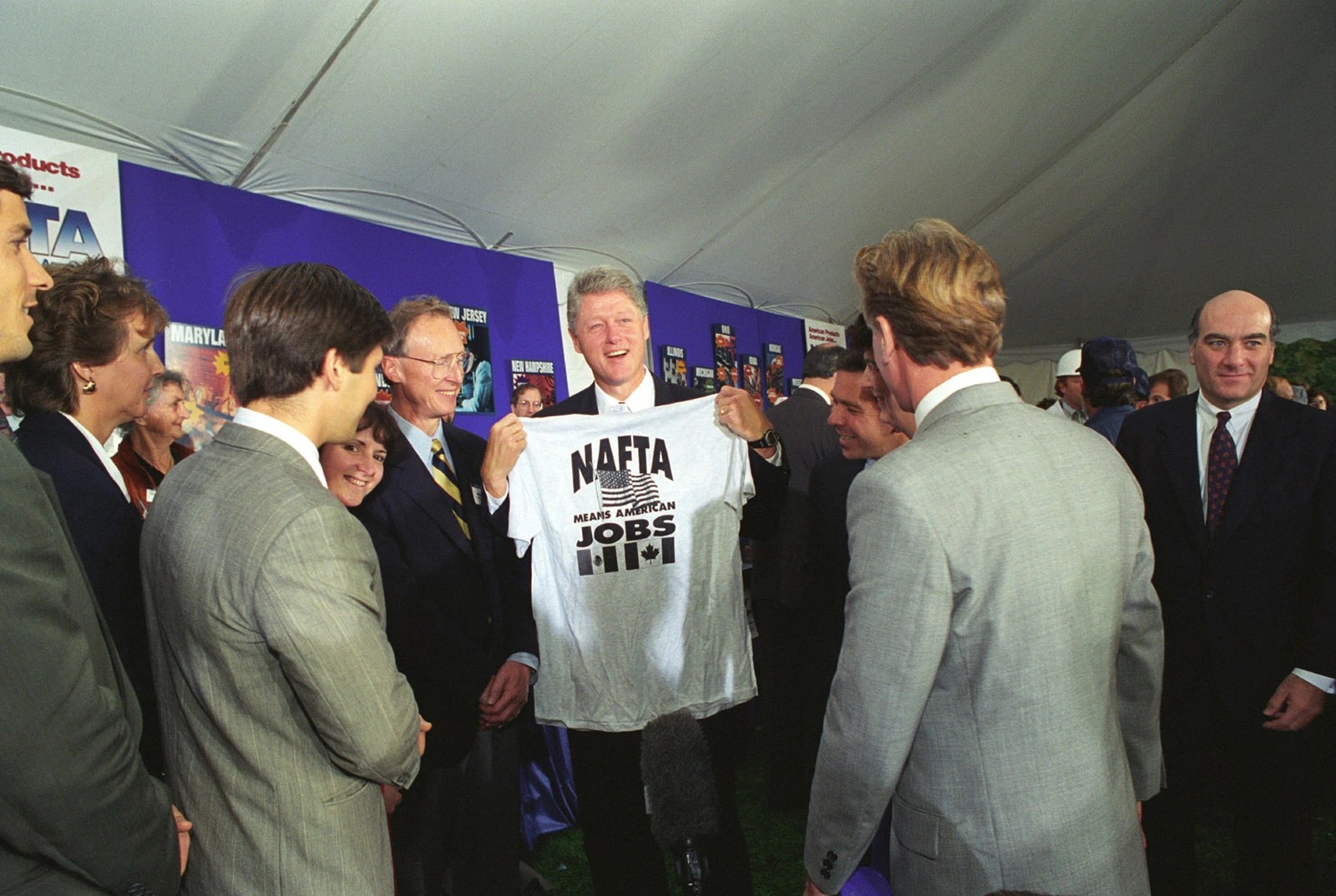
Three considerations of Gary Gerstle‘s important new book, The Rise and Fall of the Neoliberal Order: America and the World in the Free Market Era: First Robert Kuttner ponders why Democratic presidents embraced an economic credo that annihilated their own public philosophy and its appeal to the electorate…
Beginning with the presidency of Jimmy Carter, a succession of Democratic presidents joined Republicans in turning away from the New Deal model of regulated capitalism toward what has come to be known as neoliberalism. The neoliberal credo claims that markets work efficiently and that government attempts to constrain them via regulation and public spending invariably fail, backfire, or are corrupted by politics. As public policy, neoliberalism has relied on deregulation, privatization, weakened trade unions, less progressive taxation, and new trade rules to reduce the capacity of national governments to manage capitalism. These shifts have resulted in widening inequality, diminished economic security, and reduced confidence in the ability of government to aid its citizens.
The Republican embrace of this doctrine is hardly surprising. Given the lessons learned about the necessity of government interventions following the 1929 stock market collapse and the success of the Roosevelt administration as a model for the Democratic Party, the allure of neoliberalism to many Democrats is a puzzle worth exploring.
The term “neoliberalism” itself is confusing, because for at least a century “liberalism” in the United States has meant moderate left, not free-market right. Neoliberalism in its current economic sense draws on the older meaning of liberalism, which is still common in Europe and which holds that free markets are the counterpart of a free and democratic society. That was the claim of classical liberals like Adam Smith and Thomas Jefferson.
Only in the twentieth century, after the excesses of robber-baron capitalism, did modern liberals begin supporting extensive government intervention—the use of “Hamiltonian means” to carry out “Jeffersonian ends,” in the 1909 formulation of Herbert Croly, one of the founders of The New Republic. This view defined the ideology of both presidents Roosevelt and was reinforced by the economics of John Maynard Keynes. In Britain, the counterpart in the same era was the “radical liberalism” of social reform put forth by the Liberal prime minister David Lloyd George.
The term neoliberalism also gets muddled because some on the left use it as an all-purpose put-down of conservatism—to the point where one might wonder whether it is just an annoying buzzword. But neoliberalism does have a precise and useful meaning, as a reversion to the verities of classical economics, with government as guardian of unregulated markets…
“Free Markets, Besieged Citizens“
Brian Kettenring worries (with Gramsci, as quoted in this post’s title above) that the transition to what’s next could be treacherous…
In a contest among global models, one option is the state-authoritarian capitalist model represented by China. A second one would be a neoliberalism retooled for the 21st century. But because neoliberalism has failed on its most central promise (growth) and other important tests (climate, inequality, and race), it is increasingly marginalized, if still persistent in the public imagination and the structures of important national and international institutions. A third option—which seems ascendant—is the ethno-nationalism of Trump, Viktor Orbán, Jair Bolsonaro, and company. The economic track record of ethno-nationalism in power has often proved anti-neo-liberal—especially on trade, but often on public investment, the social safety net, and even industrial policy—but that hasn’t foreclosed tax cutting or deregulation. And while the racialist and exclusionary politics of ethno-nationalism are disqualifying, its record of governance is, with some exceptions, poor.
None of these geopolitical arrangements will serve America or the world well in the third decade of the 21st century. For those who share Gerstle’s critique of neoliberalism, the task is to chart a fourth way that is inclusive, sustainable, and consonant with strong democratic governance and pluralistic societies. At present, this fourth way appears to be the harder road. That said, Rise and Fall offers guidance for how it might still win the day.
Gerstle reminds us that geopolitics can have unpredictable economic side effects. The war in Ukraine has accelerated inflationary dynamics in the global economy, increasing the price of everything from energy to wheat. It’s too soon to assess the long-term consequences of the Russian invasion. Still, one optimistic reading of the potential by-products of the war might be accelerated investments—at least in Europe—in the green energy sector…
“Neoliberalism Is Dying. What Comes Next?“
And L. Benjamin Rolsky considers the moral– and spiritual– baggage that it carries…
… A moral code accompanied the neoliberal order to protect itself against its worst excesses and moral failures. Many Americans were perfect matches for neoliberalism’s entrepreneurial politics, its promises of unbridled freedom once remade in the image of homo economicus; many were not. For Gerstle, the neoliberal order produced two interrelated modes of citizenship within the body politic: conservative neo-Victorianism and liberal cosmopolitanism. The former encouraged self-discipline in the name of market austerity and the proverbial Christian family. The latter privileged diversity, self-expression, and socioeconomic mobility. As Gerstle describes, “It celebrated the cultural exchanges and dynamism that increasingly characterized the global cities — London, Paris, New York, Hong Kong, San Francisco, Toronto, and Miami among them — developing under the aegis of the neoliberal order.” This much is most certainly true circa 1975: the beginnings of neoliberalism’s deregulatory ascent.
Within the same moment, however, neoliberalism would also help give birth to additional forms of religiosity including the “Prosperity Gospel,” replete with global communication networks, acts of spiritual exuberance, and larger-than-life television personalities. While this tradition of health and wealth dates back to the late 19th century, it found its domestic stride in the United States within the postindustrial conditions of the neoliberal order in the 1980s and 1990s. The fact that prosperity gospel healer Paula White-Cain has rekindled her relationship with former president Donald Trump’s communications team speaks to the intimate relationship between neoliberal success, political freedom, and spiritual prosperity in American political life — especially in 2022.
The rise and fall of the neoliberal order has curtailed some religious ideals and formulations in the name of neo-Victorian morality, but it also cultivated equally powerful forces that promised to liberate true believers from their respective experiences of spiritual captivity. Until such forces of neoliberal freedom are understood and diagnosed as complex forms of economic captivity themselves, there is no telling how much longer the neoliberal order can remain fractured yet deeply informative of our collective political imaginations…
“Religion of the Market: On Gary Gerstle’s “The Rise and Fall of the Neoliberal Order”
How neoliberalism rose, fell, and what might replace it: @rkuttnerwrites, @bkettenring, and @LBRolsky on a powerful new book by @glgerstle.
* Antonio Gramsci, Prison Notebooks
###
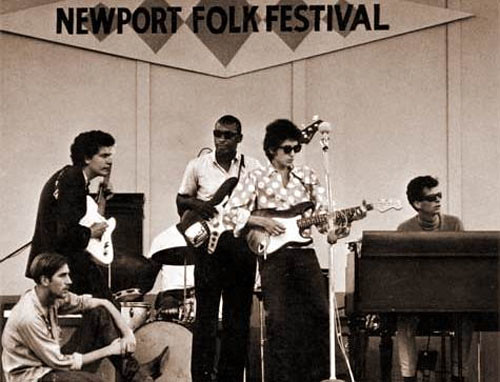
As we compose our selves for change, we might recall that it was on this date in 1965 that Bob Dylan was booed off stage at the Newport Folk Festival during his first public performance with electric instruments (and a band that included Michael Bloomfield and Al Kooper)… The cat-calling began with his opening number, “Maggie’s Farm,” and continued through three more songs, after which Dylan left the stage. As a peace offering to Pete Seeger and other aggrieved organizers, Dylan returned later to do two acoustic numbers… but the die was cast; thereafter, his career was electrically-powered… and both folk and rock music were forever changed.
“We forced our opponents to change their minds”*…

There are those who say this pandemic shouldn’t be politicised. That doing so is tantamount to basking in self-righteousness. Like the religious hardliner shouting it’s the wrath of God, or the populist scaremongering about the “Chinese virus”, or the trend-watcher predicting we’re finally entering a new era of love, mindfulness, and free money for all.
There are also those who say now is precisely the time to speak out. That the decisions being made at this moment will have ramifications far into the future. Or, as Obama’s chief of staff put it after Lehman Brothers fell in 2008: “You never want a serious crisis to go to waste.”
In the first few weeks, I tended to side with the naysayers. I’ve written before about the opportunities crises present, but now it seemed tactless, even offensive. Then more days passed. Little by little, it started to dawn that this crisis might last months, a year, even longer. And that anti-crisis measures imposed temporarily one day could well become permanent the next.
No one knows what awaits us this time. But it’s precisely because we don’t know because the future is so uncertain, that we need to talk about it…
In a crisis, what was once unthinkable can suddenly become inevitable. We’re in the middle of the biggest societal shakeup since the second world war…
In a fundamentally optimistic essay, historian Rutger Bregman peers through the Overton Window to explain the seemingly-sudden ripening of ideas that seemed impossible just months ago: “The neoliberal era is ending. What comes next?”
See also: “Bruno Latour: ‘This is a global catastrophe that has come from within’.”
And for some (more) historical context, in the form of a scientist’s computer model that tracks “cycles” he has detected in the U.S. since 1780– culminating (so far) in his prediction in Nature in 2010 that 2020 would see huge unrest– see “This Researcher Predicted 2020 Would Be Mayhem. Here’s What He Says May Come Next.”
* Margaret Thatcher in 2002, alluding to Tony Blair and New Labour when asked what she saw as her great achievement. (N.B., as the piece excerpted above explains, in 2020, Bernie Sanders’s “moderate” rival Joe Biden is proposing tax increases double what Hillary Clinton planned four years ago. Similarly, though Sanders ran on a more radical climate plan than Biden in 2020, Biden’s climate plan is more radical than that Sanders had in 2016.)
###
As we buckle up, we might recall that it was on this date in 1633 that Galileo delivered his Fourth (and final) Deposition to the court of the Inquisition, which had raised theological objections to his heliocentric view of the solar system (for the second time, he had been tried in 1616 for the same offense, and both censured and censored– his books were banned). This second trial, occasioned by his publication of Dialogue Concerning the Two Chief World Systems, which resurfaced his heliocentric view, ended the following day, when the Inquisitor issued these rulings:
- Galileo was found “vehemently suspect of heresy”, namely of having held the opinions that the Sun lies motionless at the center of the universe, that the Earth is not at its center and moves, and that one may hold and defend an opinion as probable after it has been declared contrary to Holy Scripture. He was required to “abjure, curse, and detest” those opinions.
- He was sentenced to formal imprisonment at the pleasure of the Inquisition. (On the following day this was commuted to house arrest, under which he remained for the rest of his life.)
- His offending Dialogue was banned; and in an action not announced at the trial, publication of any of his works was forbidden, including any he might write in the future

Galileo before the Holy Office, a 19th-century painting by Joseph-Nicolas Robert-Fleury
You must be logged in to post a comment.