Posts Tagged ‘crime’
“Nothing is built on stone; all is built on sand”*…

(Roughy) Daily has looked before at that most common– and essential– of substances, sand. (See here, here, and here.) Today, via Michaela Büsse, an update…
After water, sand is the second most used material in the world. Each year, approximately 40-50 billion metric tons of sand are consumed worldwide.
This accounts for 79% of all aggregates extracted and traded, making sand the literal foundation for global human infrastructure. Sand plays a vital role in the production of glass, steel, and concrete. Silica, one of the most common minerals found in sand, is the key ingredient in silicon chips and thus for the development of digital technologies. But sand is also fundamental to the creation and maintenance of land itself, rendering it constitutive to processes of urbanization. Artificial islands, port expansions, and beach nourishment projects consume vast quantities of sand. As the bedrock of urban infrastructures, sand is embedded in the very fabric of modern life. Yet, its ubiquity belies its complexity. As a sediment, sand is foundational for the functioning of ecosystems. The relentless expansion and intensification of cities is starving rivers and coasts of sediment, depleting sand at a rate that far exceeds its natural replenishment.
Intensive dredging of rivers and seabeds has fundamentally altered sedimentation patterns, disrupting the delicate equilibrium that governs ecosystems. Rivers, which once carried sand from mountains to coastlines, now struggle to replenish beaches and wetlands. This depletion has far-reaching consequences. Without sufficient sand deposits, coastlines are left vulnerable to erosion, rising sea levels, and the devastating impact of extreme weather events. In ecosystems already on the front lines of climate change—like deltas, wetlands, and estuaries—the effects of sand extraction are compounded. Delta regions, for instance, rely on continuous sediment deposits to counteract the natural sinking of land. When sand is removed faster than it can be replaced, these regions are exposed to subsidence, where land sinks at an accelerated rate, amplifying flood risk and increasing the salinization of freshwater resources. Such impacts are often delayed, manifesting years or even decades after extraction, making them challenging to monitor and mitigate effectively.
As global sand consumption surges to unprecedented heights, the profound and far-reaching consequences of extraction come sharply into focus. Numerous journalistic and scientific accounts warn of the “looming tragedy of the sand commons,” highlighting environmental concerns related to dredging and mining sand, such as pollution, biodiversity loss, and soil disturbance, as well as illegal practices in the sand trade. The reality of the sand trade is both dirty and messy, intertwining national and transnational politics. In regions like Southeast Asia, rapid urbanization and investments in large-scale infrastructure projects have spurred an unprecedented demand for this essential resource. Here, land reclamation has emerged as a flashpoint where extraction practices intersect with issues of sovereignty, livelihoods, and environmental justice, transforming sand into a highly sought-after and contested commodity. Building new land for some means taking old land from others. The exploitation of sand goes hand in hand with exploitative labor and geopolitical maneuvering.
Sand’s impending scarcity has fueled a black market, giving rise to “sand mafias”—criminal organizations that exploit extraction and trade through corruption, violence, and intimidation, often circumventing national mining and export bans. It is not uncommon for sand to become a matter of life and death for those who mine it as well as for those who seek to prevent it from being mined. Across the world, activists and local communities have mobilized against sand extraction and land reclamation, fighting the prevailing narratives of development and progress that often justify environmental exploitation. However, these initiatives are rarely successful, resulting (at best) in compensation payments to the affected communities. A transboundary governance of sand would require international standards, which many researchers and organizations have requested. Even so, it is nearly impossible to control the natural flow of sand.
As sand transitions from a sediment to a precious resource, it has become instrumental in urban ideals of late modernity. Cities like Dubai and Singapore epitomize how architectural ambitions is built on vast quantities of imported sand. Land built from scratch, towering skyscrapers, and sprawling infrastructure are testaments to sand’s transformative potential. Yet, these urban landscapes are haunted by their materiality: each grain is a silent witness to the ecological and social disruptions that enabled its journey. The sand in these structures embodies the persistence of environmental degradation, displaced labor, and the exploitation that made them possible. In this way, sand is both an architect and a specter of modernity’s unrestrained ambitions, leaving us to confront the shadows cast by our own constructions…
Eminently worth reading in full: “Granular Power: The Gritty Politics of Sand,” from @michaelabussey.bsky.social and @eflux.bsky.social.
* Jorge Luis Borges
###
As we get grainy, we might send insightful birthday greetings to James Hansen; he was born on this date in 1941. An atmospheric physicist, he was Director of the NASA Goddard Institute for Space Studies (from 1981-2013). He is best known for his (June, 1988) testimony to the Senate Energy and Natural Resources Committee that there was 99% certainty the cause of climate change was known with 99% certainty to be the buildup of carbon dioxide and other artificial gases in the atmosphere– helping raise broad awareness of global warming– and for his advocacy of action to avoid dangerous climate change. (Hansen has since proposed a revised explanation of global warming, where the 0.7°C global mean temperature increase of the last 100 years can be to some extent explained by the effect of greenhouse gases other than carbon dioxide (such as methane).
Currently the Director of the Program on Climate Science, Awareness and Solutions of the Earth Institute at Columbia University, he remains a climate activist.

“The violence of positivity does not deprive, it saturates; it does not exclude, it exhausts”*…

Scheduling note: your correspondent is hitting the road again, so regular service will be interrupted; it should resume on Friday the 7th…
Author and psychoanalyst Josh Cohen on Byung-Chul Han’s critiques of digital capitalism…
I came across Byung-Chul Han towards the end of the previous decade, while writing a book about the pleasures and discontents of inactivity. My first researches into our culture of overwork and perpetual stimulation soon turned up Han’s The Burnout Society, first published in German in 2010. Han’s descriptions of neoliberalism’s culture of exhaustion hit me with that rare but unmistakable alloy of gratitude and resentment aroused when someone else’s thinking gives precise and fully formed expression to one’s own fumbling intuitions.
At the heart of Han’s conception of a burnout society (Müdigkeitsgesellschaft) is a new paradigm of domination. The industrial society’s worker internalises the imperative to work harder in the form of superego guilt. Sigmund Freud’s superego, a hostile overseer persecuting us from within, comes into being when the infantile psyche internalises the forbidding parent. In other words, the superego has its origin in figures external to us, so that, when it tells us what to do, it is as though we are hearing an order from someone else. The achievement society of our time, Han argues, runs not on superego guilt but ego-ideal positivity – not from a ‘you must’ but a ‘you can’. The ego-ideal is that image of our own perfection once reflected to our infantile selves by our parents’ adoring gaze. It lives in us not as a persecutory other but as a kind of higher version of oneself, a voice of relentless encouragement to do and be more.
With this triumph of positivity, the roughness of the demanding boss gives way to the smoothness (a key Han term) of the relentlessly encouraging coach. On this view, depression is the definitive malaise of the achievement society: the effect of being always made to feel that we’re running hopelessly behind our own ego-ideal, exhausting ourselves in the process.
The figure of the achievement subject gives rise to some of Han’s most vivid evocations of psychic and bodily debilitation:
The exhausted, depressive achievement-subject grinds itself down … It is tired, exhausted by itself, and at war with itself. Entirely incapable of stepping outward, of standing outside itself, of relying on the Other, on the world, it locks its jaws on itself; paradoxically, this leads the self to hollow and empty out. It wears out in a rat race it runs against itself…
… Han’s critique of contemporary life centres on its fetish of transparency; the compulsion to self-exposure driven by social media and fleeting celebrity culture; the reduction of selfhood to a series of positive data-points; and the accompanying hostility to the opacity and strangeness of the human being…
… Under the rule of digital capitalism, time itself is severed from any ‘narrative or teleological tension’, that is, from any discernible purpose or meaning, and so, like the digital paintings in an immersive show, it ‘disintegrates into points which whizz around without any sense of direction.’ In such a regime of time, there is no possibility of Erfahrung, which depends on a sense of narrative continuum and duration. There is only the proliferation of its pale counterpart Erlebnis: the discrete event that ‘amuses rather than transforms’, as Han would later put it in The Palliative Society…
… Because power so often involves coercion, Han argues, there has been a tendency to see them as inextricable. But it is only when power is poor in mediation, felt as alien to our own lives and interests, that it resorts to threatened or actual violence. Whereas when power is at the ‘highest point of mediation’ – when it seems to speak from a recognition of its subjects’ needs and desires – it is more likely to receive those subjects’ willing consent. One could conceive of a power, therefore, that has no sanctions at its disposal, but which is nonetheless rendered absolute by its subjects’ full identification with it.
The less it relies on the threat of punitive measures to back it up, the more power maximises itself. ‘An absolute power,’ writes Han, ‘would be one that never became apparent, never pointed to itself, one that rather blended completely into what goes without saying.’ This is precisely what happens in digital capitalism’s burnout society, where the power of capital consists not in its power to oppress but in the voluntary surrender of its subjects to their own exploitation.
Han draws on the German-American theologian Paul Tillich’s conception of power as ipsocentric, that is, as Han puts it, centred around ‘a self whose intentionality consists of willing-itself’, cultivating and bolstering its own status. God is the ultimate embodiment of power because, in the words of G W F Hegel, ‘he is the power to be Himself’. This will to persist in one’s own existence, to cling to one’s own selfhood, is the basic premise of the Western mode of being. We can discern it at work in the empty narcissism of social media and the culture of self-display in which we’re all enjoined to participate. Self-exploitation is, in a sense, a twisted variant on the Cartesian cogito: I am seen therefore I am. In making myself perpetually visible, I may empty myself out, lose the last vestiges of my interiority. But, in cleaving to the bare bones of a self-image, some form of my existence survives.
The fundamental basis of this erosion of meaningful experience, argues Han, is felt at the level of temporality. The accelerated time of digital capitalism effectively abolishes the practice of ‘contemplative lingering’. Life is felt not as a temporal continuum but as a discontinuous pile-up of sensations crowding in on each other. One of the more egregious consequences of this new temporal regime is the atomisation of social relations, as other people are reduced to interchangeable specks in the same sensory pile-up. Trust between people, grounded in both the assumption of mutual continuity and reliability, and in a sense of knowing the other as singular and distinct, is inexorably corroded: ‘Social practices such as promising, fidelity or commitment, which are temporal practices in the sense that they commit to a future and thus limit the horizon of the future, thus founding duration, are losing all their importance.’…
Consumer culture, with its compulsion for novelty and perpetual stimulation, likewise erodes the bonds of shared experience that engender meaningful narratives. The fire around which human beings would once have gathered to hear stories has been displaced by the digital screen, ‘which separates people as individual consumers.’ Time, love, art, work, narrative; these are the key zones of experience hollowed out by the disintegrative logic of digital capitalism. Each is a rich store of transformative encounter, or Ehrfahrung, which the ‘non-time’ of the present has reduced to empty instances of Erlebnis…
How the “suffocating system” of digital capital creates hollowed-out lives: “The winter of civilization,” the thought of @byungchulhan.bsky.social in @aeon.co. Eminently worth reading in full.
* Byung-Chul Han, The Burnout Society
###
As we analyze ambition, we might send careful birthday greeting to Charles Ponzi; he was born on this date in 1882. A con artist, he swindled his way across Canada and the U.S. in the early 1920s, promising clients a 50% profit within 45 days or 100% profit within 90 days, by buying discounted postal reply coupons in other countries and redeeming them at face value in the U.S. as a form of arbitrage. In reality, Ponzi was paying earlier investors using the investments of later investors. While this type of fraudulent investment scheme wasn’t invented by Ponzi, it became so identified with him that it now is referred to as a “Ponzi scheme“. The scam for which he’s known ran for over a year before it collapsed, costing his “investors” $20 million (over $300 million at current value).
Ponzi schemes have grown since Ponzi’s time (Bernie Madoff‘s version is estimated to have totalled around $65 billion) and are alive and well in the U.S.

“It is mutual trust, even more than mutual interest, that holds human associations together”*…
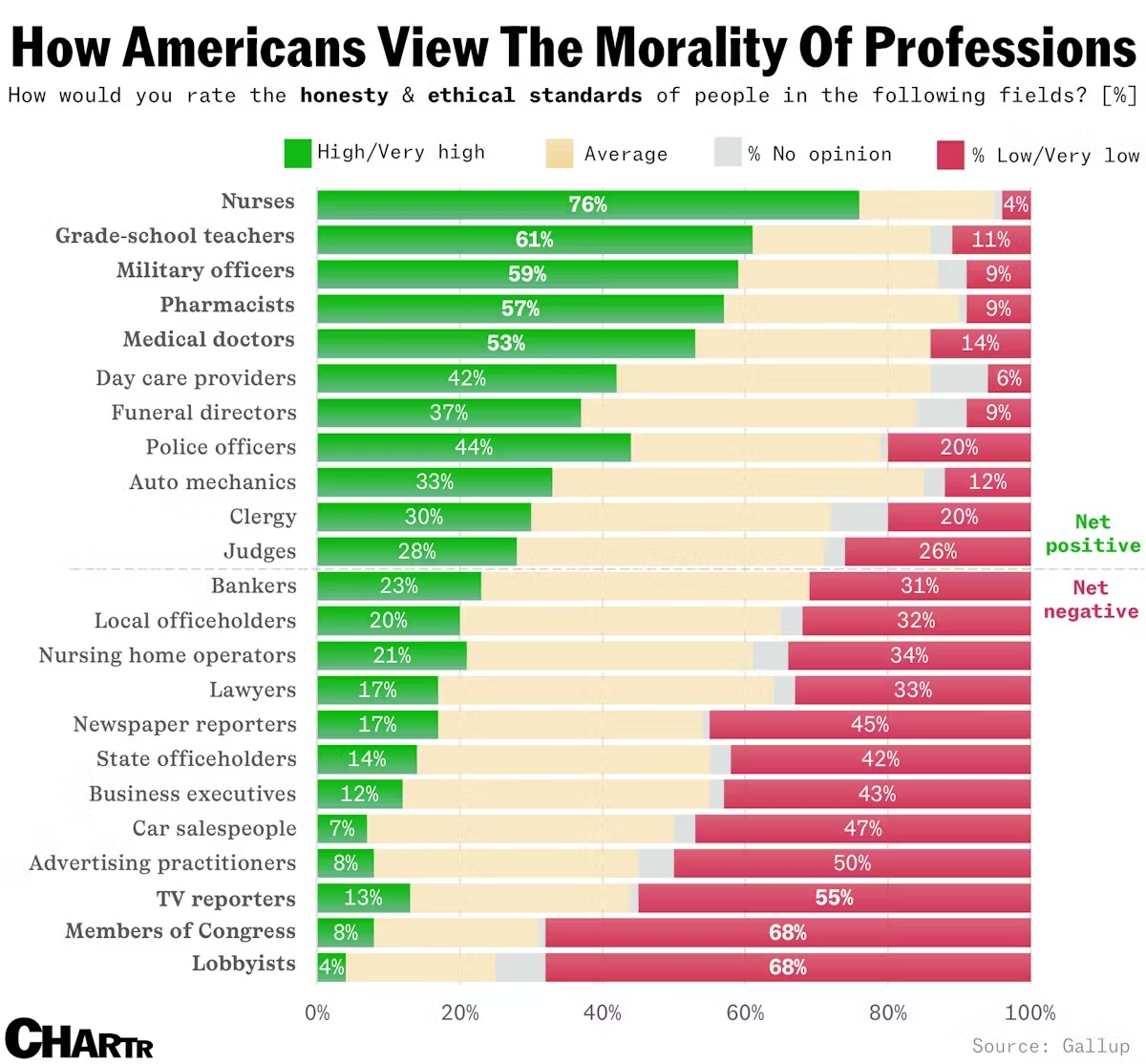
… and in its absence? Millie Giles on the state of trust in American professions…
When choosing a career, there are several (often contradictory) factors that determine people’s decisions: pay, of course; personal interests; work-life balance; location; public perception; and how a particular job might weigh on their conscience.
But which professions do Americans trust the most?
A recent Gallup poll, [published last Monday], found that 76% of US adults considered nurses to have high or very high honesty and ethical standards, with teachers, military officers, and pharmacists also scoring highly amongst those surveyed.
Conversely, Americans were skeptical about the ethical standards of TV reporters (55% considered low or very low), members of Congress (68%), and lobbyists (68%) — perhaps because the public perception of professionals in political and media-related fields is that many of them have ulterior motives, as is the case with stereotypically mercenary car salespeople and lawyers, which also ranked negatively overall.
Lloyd Blankfein, the former CEO of Goldman Sachs, infamously said in November 2009 — with the impacts of the global financial crisis still reverberating loudly — that he and his fellow bankers were “doing God’s work.” Ridiculed at the time, he might be pleased to see his once vilified profession ranked not far behind the clergy, per Gallup.
Zooming out: the average of high/very high ethical ratings across the core 11 professions sunk to just 30% in 2024, with trust in medical doctors in particular having dropped 14 percentage points since 2021…
“America’s most trusted professions,” from @sherwood.news @Gallup
* H. L. Mencken
###
As we contemplate confidence, we might recall that it was on this date in 1980 that news of the FBI’s Abscam operation, targeting corrupt Congress members and other elected officials, broke publicly. The two-year investigation had initially targeted trafficking in stolen property and illicit business people, but later evolved into a corruption investigation; it led to the convictions of six members of the United States House of Representatives and one member of the United States Senate, along with one member of the New Jersey State Senate, members of the Philadelphia City Council, the Mayor of Camden, New Jersey, and an inspector for the Immigration and Naturalization Service.
The Abscam operation wass dramatized in the 2013 feature film American Hustle, directed by David O. Russell, which received ten Academy Award nominations.

“Follow the Money”*…

Chinese crime syndicates are operating underground banks to launder the proceeds of fentanyl sales. But, as Miles Kellerman explains, their practices, and the risks they pose, are far from new…
One way of thinking about finance is to imagine it as an endless web of information assembly lines. Every transaction starts as a signal: some person wants to buy some thing. This is the raw material of demand. That material must, in turn, eventually make its way to whomever is in a position to supply. Sometimes this is easy. When you buy mangos at a farmers market, for example, you have direct communication with the supplier, handing over cash with one hand while receiving mangos with the other. But such direct interaction is rare. For most transactions, buyer demand must first travel along informational conveyor belts, where intermediaries shape, mold, and redirect that raw material before it reaches suppliers.
Take residential real estate. If a couple wants to purchase a beachfront bungalow in Santa Barbara, they probably aren’t going to just show up at the front door with a duffle-bag full of cash. That would be weird. Rather, they are much more likely to express their demand through a realtor. This information then makes its way down the assembly line, where it passes through a series of intermediaries: the seller’s realtor, title company, mortgage advisor, attorney, and, finally, the bank.
But buyers and sellers are not the only ones interested in this process. There is also the inquisitive eye of the state. Every stage of the information assembly line contains clues — about unpaid taxes, money laundering, terrorist financing, and all sorts of other shenanigans. The state would love to patrol every assembly line looking for these clues, like a mustached inspector peering over the shoulder of nervous factory workers. But this is expensive. And many of us would prefer that our information is assembled by intermediaries in private.
The state’s solution to this problem has been to outsource surveillance. It requires that certain intermediaries on the information assembly line look for signs of suspicion and report those suspicions to regulators. These are what is referred to as Anti-Money Laundering, or AML, obligations. At the risk of abusing the analogy, intermediaries with AML obligations are like factory produce inspectors. They spend all day staring at fruit as it travels across the conveyor belt, sorting out the rotten apples and tossing them into separate bins.
But what if, somewhere along the production line, the informational conveyor belt just…disappears? The Financial Times has reported that Chinese crime syndicates are capable of performing such sorcery. These syndicates, the FT writes, are using a “new” network to launder the proceeds of fentanyl sales, one that “…minimizes the movement of funds across borders.” The money simply disappears in one place and reappears in another, as if governed by quantum physics. But this is not magic. Nor is it new. It is instead an alternative conveyor belt of information, one that has operated outside the confines of the state for over a thousand years. And it goes by a simple yet ominous name: underground banking.
Imagine, for a moment, that you are a textile merchant somewhere along the 6,000 kilometer stretch of the ancient Silk Road. Every business has risks. But your risks are a bit more extreme. Large stretches of your trade routes are located in harsh desert climates where water is sparse. Nor is there any guarantee of security. Nomadic raiders could strike your caravans at any moment. And, even if you survive the trip, you could arrive to your destination only to find that it has been sacked by Attila the Hun (or, later, the roaming armies of Genghis Khan).
The last thing you want to do, in such a dangerous environment, is carry cash on you. Credit cards would be a great alternative. “No!” you might explain to Chase customer service after having your card stolen by Hun raiders, “I definitely did not order horse archers.” But it’s about 600 – 1,900 years too early for that. In this pre-electricity era, you need an alternative system. Specifically, one that allows you to manage your payments, settle outstanding balances, and avoid the perils of carrying money across the Persian desert. Enter Hawala.
Hawala is an Arabic term roughly meaning “to change” or “to transfer.” It refers to a system in which networks of brokers (hawaladars) facilitate the movement of value from one geographic location to another. Nobody really knows when Hawala was first used. But there is evidence from the 6th century that Muhammed, the founder of Islam, was familiar with at least some version. Similar systems, with equally ancient roots, have existed in India (Hundi), Thailand (phoe kuan), and China, whose term Fei-Chien translates to flying money. And they have collectively come to be referred to as different varieties of “underground banking.”
Here’s how a Hawala transaction might have worked on the Silk Road. Say you are a merchant in Iran who wants to import Aleppo pepper from Syria. Rather than drag heavy coins across the desert, you provide the necessary money (in whatever form was used at the time) to your local broker. In return, the broker would issue what was, in effect, a bill of exchange — a written order to pay an equivalent amount of money to the supplier at a later date. Once you arrive to Aleppo, you present that document to a Syrian broker, who honors the bill of exchange by issuing the money to the supplier in local currency. Each broker charges a commission for their services and settles their balances through repeated business.
With this simple maneuver, currency has been exchanged across borders. But rather than physically moving money from one place to the next, the brokers have received and distributed local currency from their respective pots. The only true transfer is one of information…
… Trust is also essential to contemporary Hawala systems. But today’s networks are more focused on facilitating cross-border payments and currency conversions rather than international trade. Remittances are one important example. If a worker in Belgium wants to send money to their family in Pakistan, they can do so through their local Hawala broker. But unlike their ancient predecessors, there is no need for these brokers to issue a bill of exchange. They can simply pick up the phone or text their foreign counterparts that the money has been deposited.
But how can the worker be sure that the person picking up the money is actually their family member? One common solution: secret codes. Hawala brokers will often require each party to express these pre-agreed codes, which could be as simple as reciting the same verse from the Quran. Another option, observed in a Chinese context, is to present a sugar cube with a specially imprinted symbol — and swallow it once the transaction is complete.
You might be thinking that, aside from the secret sugar cubes, this all sounds pretty familiar. And you would be correct. Hawala is, in essence, the earliest known form of trade finance. It is also a predecessor to “modern” payment institutions and foreign exchange providers…
… Wise [an “above-ground payment system] implies that Hawala is informal because it is not regulated by the state. This is the same logic often applied to characterize such networks as “underground” banking systems. There is a historical irony here. Hawala, Hundi, and similar networks operated for hundreds of years before ‘states’ were a thing. And in some situations, such as the British Raj, sovereigns endorsed their use as indigenous forms of payment. Thus ‘formality’ is probably better thought of as a spectrum here, one which depends on both the state’s desire to regulate and the market’s desire to be regulated.
Nevertheless, Wise is correct that hawaladars are largely unregulated. In fact, they are outlawed in many countries, something Wise — a competing service — is keen to emphasize. And the reason is simple: Hawaladars often maintain fewer records of the transactions they facilitate for their clients. They disrupt, in other words, the informational assembly lines of the ‘formal’ financial system, undermining the capacity of the state or its intermediaries to perform surveillance. And this is music to the ears of a particular clientele. Namely: human traffickers, terrorists, and other actors with nefarious motives to move their money in the dark…
[Kellerman describes how Hawala works and gives examples from the Underground Silk Road…]
Here we see both the benefits and limitations of Hawala as a mechanism for financial crime. Like their ancient predecessors, Chinese brokers can move money from one place to another without a trace, sidestepping the informational assembly line of the state-controlled financial system. But additional steps are needed to actually launder the cash. And these steps often involve re-entering the assembly line by interacting with regulated intermediaries. The Chinese businesses buying Mexican products for the cartel, for instance, would have done so through banks with standard obligations to perform AML checks. Thus Hawala can obscure the movement of cash but cannot protect that cash once it enters the ‘formal’ economy.
And there is another caveat: a big one. Chinese underground banks move money through alternative conveyor belts of information which rely on the use of ‘encrypted’ WeChat texts. But are these really so secure? It is commonly understood that the Chinese state surveils WeChat and other messaging services. This has led some to speculate that certain Chinese government officials must be participating in these underground networks. Perhaps we will never know.
What we can say for certain is that the use of app-based communication is a deep security vulnerability for underground banking. These networks are attractive to drug cartels and other bad actors because they disrupt transactional audit trails. Phrased differently: they disassemble information. But communication can undermine these benefits by creating another type of paper trail, one that reassembles how cash moves from one pot to another. Criminals should take note. And so too should any public officials that may be assisting them. To paraphrase the great Lester Freeman, if you follow the cash, you’ll find the money brokers. But if you start to follow the texts, you don’t know where it might take you…
The advantages– and risks– to criminals of underground banking: “The (Dis)assembly of Information,” from @Miles_Kellerman. Eminently worth reading in full.
* “Deep Throat” in All the President’s Men (though it’s not clear that the real deep throat ever actually said that…)
###
As we think about transnational transactions, we might recall that it was on this date in 1790 that an act of Congress, passed at the urging of Treasury Secretary Alexander Hamilton, created the United States Revenue Cutter Service– an armed maritime customs enforcement agency aimed at enforcing tariffs by reducing smuggling… which later became the U.S. Coast Guard.

“When the gods want to punish us, they answer our prayers”*…

… So, the estimable Rana Foroohar suggests, American business leaders should be careful what they wish for…
For months now, I’ve been watching with alarm how many top business leaders in the US are buying the line that Donald Trump II would somehow be just like the last time around — loud, but laissez-faire. It was so depressing to see some of America’s top CEOs giggling as the former president joked at his recent Business Roundtable event in Washington. Trump said that he’d polled waitresses and caddies (presumably at Mar-a-Lago) about removing taxes on tips and they were in favour. Sure, there were reports of some grumbling about hardline tariff talk, Trump’s inability to stay on point and his general blow-hardness. But for the most part, tax cuts, deregulation and an utter lack of imagination about political risk seems to be driving business sentiment around him.
It’s not just American business that has the blinders on. I did a Lunch with the FT [gift link] with Lloyd’s of London chief executive John Neal, and I was amazed that when I asked him to think about his top US political risks, he spoke first about Joe Biden’s money printing — rather than the risk to, say, the rule of law under Trump. When I pressed him on the Trump risk, his biggest worry seemed to be the differing policies of the two candidates around things like electric vehicle production, and the decision risk that this might introduce for companies.
Really folks? Let’s have a refresher course on Trumpian economics.
In 2016, Trump talked tough about Made in America and helping working people, but most of his economic policies (aside from tariffs on China) were basically business as usual. He rolled back regulation and lowered taxes on big corporations. Much of the money went to stock buybacks, not Main Street investment. That buoyed short-term stock prices, which were also helped along by low interest rates.
But, it’s VERY unlikely we would see the same phenomenon in a second Trump administration. His tenure marked the apex of financialised growth, which is now largely tapped out. As the Federal Reserve’s End of an Era paper from June 2023 laid out, more than 40 per cent of real corporate profit growth between 1989 and 2019 came from the secular fall in interest rates, and corporate tax rates being cut. That’s what has propelled so much growth in equities in recent years.
Today, the S&P is by some measures more overvalued than it was when the housing bubble burst. In this environment, it’s difficult to see equities rising even if the Fed were to begin cutting rates in the face of a recession. It’s much more likely they’d fall, despite any new Trump tax cuts. And that is the more benign scenario. A more likely possibility is that we’d get a harder-edged, even more insular, xenophobic and paranoid version of Trump this time around.
For starters, few of the more moderate business types that served with him the first time would be willing to come into a second administration given the January 6 2021 Capitol riots and Trump’s ongoing election-loss denial. Some smart people in the business community have concerns about his propensity for fiscal profligacy at a time when rising US deficit levels are worrying investors. It’s fascinating to me that people think about Biden when they think about debt, rather than Trump. Biden’s White House has made record fiscal investment, sure, but it is investing in the real economy, while Trump’s legacy was a classic Republican formula of boosting asset markets with financialisation.
Add to that the prospects of a 10 per cent tariff on imports across the board, and 60 per cent levy on China. This goes to what has been one of the biggest problems with Trump’s trade and economic strategies from the beginning — a tendency to blame China and employ tariffs as a standalone solution to the big, complex problem of slower secular growth and growing inequality in the US. Not that Trump seems to think in such nuanced terms. The fact is that America’s economic and political problems are only partly about the failings of globalisation and the neoliberal trading system in particular. They are also about a lack of investment at home, in basic infrastructure, skills and education, as well as core research and development.
I haven’t seen anything yet that makes me think that Trump or anyone in his orbit has a plan for a multipolar world, or any sense of how to manage complex supply chain de-risking or the politics of friendshoring. And yet, 10 or 60 per cent tariffs depending on the locale would require some kind of reshoring approach. None of that will square with an asset boom, but rather quite the opposite…
A warning to business leaders supporting Trump, from @RanaForoohar @FT.
(Image above: source)
* Oscar Wilde
###
As we study self-interest, we might recall that it was on this date in 1972 that an 18-1/2-minute gap appears in the tape recording of the conversations between U.S. President Richard Nixon and his advisers regarding the recent arrests of his operatives while breaking into the Watergate complex.
Still, the tapes were damming. The White House released the subpoenaed tapes on August 5. One tape, later known as the “Smoking Gun” tape, documented the initial stages of the Watergate coverup. On it, Nixon and Haldeman are heard formulating a plan to block investigations by having the CIA falsely claim to the FBI that national security was involved.
It’s a measure of how different those times were from ours that, once the “Smoking Gun” transcript was made public, Nixon’s political support practically vanished: the ten Republicans on the House Judiciary Committee who had voted against impeachment in committee announced that they would now vote for impeachment once the matter reached the House floor.

You must be logged in to post a comment.