Posts Tagged ‘agriculture’
“Make hay while the sun shines”*…
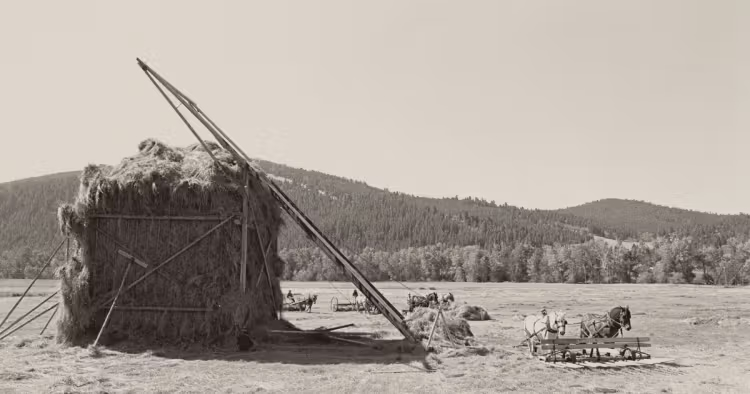
Hay, the foundation of the diet of grazing animals, is central to American agriculture. The USDA forecasts 2025 hay production at 123.5 million tons (grown on about 50 million acres countrywide), of which, about 3.24 tons are exported (generating over $1 Billion in revenue); the balance is consumed domestically.
Most of that hay is baled for storage and transport (in rectangular or round bales) using special (and increasingly expensive) equipment. But as Katie Hill reports, 115 years ago, before the advent of those motorized balers, a homegrown invention redefined stacking hay in the West. Some ranchers still see no reason to upgrade…
A scan of the horizon in Montana’s Big Hole Valley reveals plenty of examples of the land reclaiming what once belonged to it. Derelict jackleg fence. Log calving sheds with caving roofs. Rusting Chevrolets and spools of barbed wire. A giant compost pile of livestock carcasses, bones protruding from the mulch like seashells at low tide.
Then, every five miles or so, an old, spindly implement punctuates the scenery. It’s tall, maybe 30 feet, resembling a giant see-saw permanently out of balance. It’s not so much a stairway to heaven as it is a halted conveyor belt to nowhere; there’s no grain silo or corn crib nearby for a machine like this to fill up from above. Regardless, its efficacy in stacking giant piles of hay is clear from its construction. Grass grows tall around its base of rough-hewn lodgepoles, as if the earth might swallow it whole if it stayed put for another century.
This contraption [pictured at the top] is known as the beaverslide, patented in 1910 by Big Hole ranchers Herb Armitage and D.J. Stephens. The haystacking device consists of a wide, sliding fork at the base of a ramp and a cable pulley system rigged to the ramp’s underside. In practice, ranchers use a team of horses or a motorized vehicle with a winch to pull one of the cables perpendicular to the beaverslide, which in turn hoists the fork up the ramp, bringing a giant pile of hay up with it. (Ranchers rake cut hay onto the beaverslides with old buck rakes.) At the top of the ramp, the hay falls to the other side, forming three-story piles that can reach 25 tons in weight, depending on who you ask.
Details on the manufacturing and distribution of the beaverslide — named for its origins in Beaverhead County — are slim. The prevailing story is that ranchers often made their own, then made duplicates for neighboring ranches upon request, according to Big Hole rancher lore. Over the last few decades, the contraption has largely become a relic of a bygone era. But it’s not entirely obsolete, as some ranchers still use their old beaverslides today. With modern challenges like ballooning upgrade costs and the ever-present battle over a rancher’s right to repair their own equipment, the analog beaverslide makes more and more sense for those still using one with every passing hay season…
… he Kirkpatricks recall memories of neighbors being stuck in the middle of winter with broken-down bale processors and hungry cows. The closest repair shop in Jackson, an unincorporated community of roughly 20 people, is 42 miles south. The next closest shops or available technicians might be 53 miles away in Butte or 73 miles away in Dillon.
Many big-name mechanized implements run on trademarked chip technology that requires a trip to an authorized dealership for servicing. Even ranchers like Humbert who otherwise possess ample repair knowledge don’t have access to the diagnostic equipment necessary to solve problems on the fly. This might sound like sacrilege for an industry that lives and dies with rural, self-sufficient communities, but a bill calling for a rancher’s right to repair their own equipment died in the 2025 Montana legislature.
Score another point for the beaverslide…
Read on for more fascinating background: “Why Don’t You Beaverslide?” from @katiehillwriter.bsky.social
Watch the “technology” do it’s work here:
* A Tudor expression dating back to the mid-16th century, and used figuratively since 1673
###
As we honor old ways, we might recall that it was on this date in 1974 that Island Records released Country Life, the fourth studio album by Roxy Music.

“It’s not a bug, it’s a feature”*…

Anna Marija Helt reports that, as global warming challenges tradtional agriculture, scientists are looking to “probiotics” for crops as a new green revolution in agriculture…
Potatoes contain something about which most people are entirely unaware: endophytes, which means “within plants.” Endophytes can also be found in other vegetables, fruits, and grains. In fact, all plants harbor endophytes in the form of bacteria, fungi, and other microbes.
Endophytes eat plant-derived nutrients but typically don’t cause disease. Instead, they bolster plant growth, disease resistance, antioxidant status, or tolerance to stressors such as drought, heat, and cold. Endophytes enable plants to respond quickly to such stressors by expanding their genetic repertoire, according to a review by ecologist Christine Hawkes and colleagues. To improve crop health and sustainability, Hawkes studies how plants, their fungal residents, and such stressors interact.
Given climate-related drought and temperature extremes, declining soil quality, and a decrease in arable land, endophytes, argue Pankaj Trivedi, Chakradhar Mattupalli, Kellye Eversole, and Jan E. Leach, might undergird a sustainable “green revolution” to improve agricultural productivity while lessening reliance on environmentally damaging and health-threatening agricultural chemicals. Endophytes can have an impact, says plant biotechnologist Julissa Ek-Ramos, on “climate change, recovering the soil, and having more healthy food to eat.”…
… “It’s really amazing how strongly these endophytes can combat the fungal pathogens of crops,” [microbiologist Sharon] Doty says. And she notes regarding their growth-promoting effects, “It works in maize, in rice, in tomatoes, in bell peppers, and strawberries.” Her team has also isolated endophytes from sweet potatoes that improve the rooting of poplars, a promising biofuels crop.
Endophytes confer additional traits useful for a changing planet. For example, those from geothermal habitats can confer heat tolerance, based on studies led by geneticist Regina Redman. And crop physiologist K. M. Manasa demonstrated salt-tolerance in rice plants inoculated with an endophyte from seaside plants. Rice is salt-sensitive and one of the world’s main food crops. But increasing soil salinity is impacting a fifth of farmable land globally due to climate change and human water and land use practices…
Nitrogen is often the most limiting soil nutrient for crops, something nineteenth-century farmers recognized. Agronomist and Nobel Prize nominee Johanna Döbereiner discovered nitrogen-fixing endophytes in non-legume plants in the twentieth century that, like rhizobia, might reduce the need for financially and environmentally costly synthetic fertilizers. Many of the endophytes Doty has characterized over twenty-five years fix nitrogen and promote growth in lab, greenhouse, and field trials but have a much broader host range than rhizobia, extending from farm lands to forests…
… Developing real-world endophyte applications is a complicated challenge, but a necessary one given the need for more productive and sustainable agriculture. In the meantime, skeptical farmers are getting onboard.
“There’s a lot of conversations going on between researchers and farmers,” says Friesen, to “move the needle on our understanding of these processes that are so important for soil health but also plant health and the stability and security of our food supply.”…
More at “Better Farming Through Endophytes,” from @ahelt.bsky.social in @jstordaily.bsky.social.
###
As we muse on microbes, we might send healthy birthday greetings to John Boyd Orr (1st Baron Boyd-Orr); he was born on this date in 1880. A teacher, medical doctor, biologist, nutritional physiologist, politician, businessman, and farmer, he was awarded the Nobel Peace Prize in 1949 for his scientific research into nutrition and for his work as the first Director-General of the United Nations Food and Agriculture Organization.

“The duty of a good Cuisinier is to transmit to the next generation everything he has learned and experienced.”*…

Five years ago, we marked the passage of Lynn Olver, a reference librarian who pretty much single-handedly created and maintained The Food Timeline: history of human eating habits for 20,000 years. Worried that her life’s work might lie fallow and spoil, her family was searching for a new host.
Happily, one was found. Later in 2020, Virginia Tech University Libraries and the College of Liberal Arts and Human Sciences (CLAHS) offered Virginia Tech as a new home for the physical book collection and the web resource– and the site lives on…
Ever wonder how the ancient Romans fed their armies? What the pioneers cooked along the Oregon Trail? Who invented the potato chip…and why? So do we!!! Food history presents a fascinating buffet of popular lore and contradictory facts. Some experts say it’s impossible to express this topic in exact timeline format. They are correct. Most foods are not invented; they evolve…
Dive into “The Food Timeline,” courtesy of @vtliberalarts.bsky.social.
See also (the source of the almanac entry below) chef James T. Ehler‘s marvelous FoodReference.com– “on this date” history and more.
(Image above: source)
###
As we dig in, we might send healthy birthday greetings to Gilbert Blane; he was born on this date in 1749. A Scottish physician who served on the Sick and Wounded Board of the Admiralty, he instituted health reform in the Royal Navy. Perhaps most memorably, he was largely responsible for requiring citrus juice (lemons, later limes) on all naval vessel to prevent scurvy.

“Wheat feeds the West, rice sustains the East”

Tomas Pueyo on why this is so… and what that has meant for culture and history…
What’s your staple, bread or rice?
This is a momentous fact, for it might have determined politics, culture, and wealth.
How? Well, bread comes from wheat, and rice from… rice…
… Wheat and rice are not harvested in the same places. Rice and bread are the predominant food where rice and wheat are respectively the predominant crops. Here’s another way to look at the same data:

This, in turn, is determined mainly by this:

… But this doesn’t fully explain it since it also rains a lot in Ireland, for example, but nobody grows rice there. You need the heat found closer to the equator: Rice grows in hot, wet, flat, floodable areas, whereas wheat prefers cooler, drier, better drained areas.
Flooding rots wheat but can 3x the yields of rice. That makes wheat well adapted to hills, whereas rice can only survive on hills when they are terraced.
This sounds like just a fun fact, but it ain’t. Because rice generates twice as many calories per unit of area.
This means that rice nourishes families on half the land that wheat requires. Which means population density in rice areas can be twice as high as in wheat areas, or four times with double cropping. A hectare of land can feed 1.5 families with wheat and 6 with rice.
Yet rice paddies also require a lot of work—twice as much as wheat. And that work is almost year-round: preparing paddies, raising seedlings in nurseries, transplanting every single seedling by hand into flooded fields, managing water, pumping it, weeding, harvesting, and threshing—often followed by a second rice crop or a winter crop. These tasks peak during transplanting and harvest, creating critical seasons where a huge amount of work must be done in a short window of time.
Crucially, this labor cannot be delayed—if you miss the planting window or harvest late, the crop is ruined. As a result, rice farmers developed reciprocal labor exchange: neighbors help each other transplant and harvest in time. The timeliness pressure meant rice villages became tightly cooperative communities to ensure everyone’s fields were tended before it was too late.
Wheat farming historically had a more seasonal rhythm with periods of relative quiet. Wheat is typically sown in the fall or spring and then mainly just left to grow with the rain. Aside from episodic weeding or guarding the fields, there was less continuous labor until harvest time. Harvest itself was a crunch period requiring many hands with sickles—European villages would collaborate during harvest, and farmers might hire extra reapers.
These differences made these regions diverge across politics, culture, and economy…
Read on: “How Bread vs Rice Molded History,” from Pueyo’s Uncharted Territories.
* adage
###
As we deliberate on our diets and their destinies, we might recall that it was on this date in 1887 that Chester A. Hodge of Beloit, Wisconsin received patent No. 367,398 for ‘spur rowel’ barbed wire (consisting of spur shaped wheels with 8 or 10 points mounted between 2 wires). It was one of many patents for barbed wire (e.g., here), which spread across the American West rapidly (thanks, in no small measure to the guy featured in the almanac entry here)– and (by protecting farmers from foraging open-range cattle) paved the way for the expansion of wheat (and other kinds of) farming.

“Who knows whether it is not true that phosphorus and mind are not the same thing?”*…

In an excerpt from his book White Light, Jack Lohmann explores the rare and special element phosphorus…
In the moments that follow the death of a whale, when the light disappears and is swallowed by dark, the body’s weight draws to the base of the sea and compresses. It settles in mud. It forms an environment known as a whale fall, a world that will last for decades.
The whale fall grows in stages. The larger species come, the eels, the sharks. They rip apart the dead whale’s flesh. The tail, the head, the organs are consumed. The size of predator lessens as the length of time extends. Tiny mouths clean the bones dry. A skeleton remains; bacteria descend upon it. They turn bones into nutrition, consuming the whale in a process that is almost imperceptibly slow. Worms arrive and burrow through the skeleton. Other organisms come and eat the worms. Larger predators reinhabit the space. Within a barren, lightless plain, on the basis of decaying bones, a world is born.
Whalebone contains an element that is rare: phosphorus, a limiting ingredient in life on Earth. Of all the elements of the periodic table, phosphorus is one of six that are absolutely necessary for the existence of life. Of those six, phosphorus is the most limited. Because of its rarity, it controls life—it determines who grows and shrinks, who lives and dies, what areas become biologically wealthy and which ones will be biologically poor. “The maximum mass of protoplasm which the land can support, like the maximum that the sea can support, is dictated by the phosphorus content,” Isaac Asimov, the biochemist, wrote in 1959. Phosphorus, he wrote, “is life’s bottleneck.”
Each of the six essential elements performs a vital role. Carbon forms long chains, connecting compounds together to create large, complicated structures. Hydrogen and oxygen combine to form water. Nitrogen and sulfur create proteins, providing organisms with food. Phosphorus converts energy, carries information, constructs cell membranes, and performs a host of other actions that underpin life’s complexity. Phosphorus allows seeds to grow and fruit to ripen. It is the main ingredient in matches. It both enables life and destroys it. Sarin gas, created from white phosphorus, is a potent agent of chemical warfare.
When it is isolated, phosphorus emits a steady, menacing glow. Phosphorescence is the name that is applied to this phenomenon: it describes materials that glow without ignition. The glow of the upper ocean is phosphorescent. Some paint glows. One consistent feature of the near-death experience, reported by people whose hearts stopped beating and bodies began to fade, has been the presence of a peculiar brightness all around. Images flash, the soul floats, and the body is left behind. The mind feels calm. (It is, in fact, surging with electricity: its final moments are seemingly near.)
When phosphorus burns, it bonds with oxygen, creating phosphate: one atom phosphorus, four atoms oxygen. Phosphate is remarkably prevalent in all life forms, although it is otherwise comparatively rare throughout the world. It is crucial to our existence. Outside of life, phosphate exists in geological form, made up of condensed, crystalline structures that are hidden in the crevices of our planet. Inside of life, it exists in every cell. It forms the membranes that hold the parts of cells together. It provides energy, in the form of adenosine triphosphate, ATP, which powers the actions of all life-forms. Even before birth, each of us gained identities by way of the cumulative influences of small phosphate groups, which held together the strands of our DNA. As we grew from zygote to cellular zillionaire, those groups enabled the replication of DNA and the formation of more complex beings—us.
The phosphorus in our bodies came, at first, from molten lava, hardened into rock. That rock eroded out of mountains, flowed down rivers, and fertilised the land below. The land supported the growth of plants, which allowed the spread of animals. The human body is, roughly speaking, one percent phosphorus. Phosphorus is spread throughout our cells, but it is concentrated mainly in our bones. We are extensions of the planet—we forage for phosphorus by eating plants and animals, and we fertilise the soil through waste and death. Plants thrive on this natural fertiliser. Phosphorus moves through the bodies of plants and animals, fungi and bacteria, and ultimately, usually, makes its way to the water. It is deposited as sediment: it forms new rock on the seafloor. The rock is made of compressed bodies, phosphorus squeezed from lives that are no more. It is littered with phosphatic bones, with phosphate-encrusted bivalves, with fossilised phosphate scraps. These things are hidden, set to be released in geologic time. As this time passes, the Earth’s plates move. The underwater rock becomes land. The land erodes. The cycle continues.
The story of phosphorus runs through every strand of DNA in every organism in the world. It runs through every piece of food and waste, and every living thing. But the story of how humans changed the phosphorus cycle is rooted in a few specific spots. We first found phosphate rock in England, and the fertiliser industry began. The industry changed when rock of greater scale was found in Florida; but today, the Florida rock is almost gone. Our global agricultural system rests upon the dictates of Morocco’s monarch.
Already, in some places around the world, the end of phosphate rock has occurred. It happened on the island of Nauru, far out in the Pacific, and there we see a world that passed its limits. It peaked, declined, and fell to ruin. Amid those ruins, the story of our broken phosphorus cycle comes to a close.
But it does not need to end there. There is mass resistance to the modern expansion of corporate farming methods. The world’s small farmers, who produce half our food, work their land with the nuanced understanding that agriculture has always been an ecological effort. They safeguard phosphate and replenish it.
Scientists, economists, and engineers are working to make phosphorus recycling compatible with modern life. Food, we now know, feeds our bodies better when it comes from healthy soils, and healthy soils come from nature, not from machines. Supported by this understanding, people are working to create a better agriculture. Cities are composting food scraps. Disenfranchised farmers are fighting for their land. If we listen to those with knowledge—rather than those with money—it is possible to restore the cycles of the earth.
There was once, long ago, a different kind of phosphate problem. When life first started, 4.5 billion years ago, the problem was that phosphorus existed only in rocks—and then, of course, no one was available to mine them. Life needed concentrated pockets of phosphorus in order to form. In a century of study, scientists have not come to an agreement about how nature solved its problem. Something happened in a pond, around a vent, near a meteor strike—something. We do not know exactly. We do know something happened, though, because we are here.
Today, phosphorus remains a part of the mix of chemical elements present in the earth’s magma, and volcanic eruptions create sprawling beds of igneous rock that hold within them trace amounts of the mineral. Now, however, humanity has transferred large amounts of phosphorus onto farmland, into streams and ponds, into rivers, and, ultimately, into the ocean.
The result of this is somewhat murky, but it appears that humans are changing the geology of the world. We are leaving a legacy in stone, and we are doing it by creating anew a world that once existed—one overrun with algae in the waters, with dying fish, with widespread oxygen loss in the sea. This new world is not, for us, ideal. (For algae lovers, it may be paradise.) But it is conducive to the formation of phosphate rock. This new rock will be formed and buried over intervals of millions of years. It will be hidden beneath the ground, prepared to be discovered in the future.
Just as phosphate enables life in humans, so too does it feed the life of the whale fall. The destruction of the bones of the whale provides enough fat to support a community of bacteria, and it releases enough phosphate to support the expansion of the ecosystem. The whale fall lasts because of the barrenness that surrounds it: the cold temperatures and darkness of the deep ocean preserve the whale carcass for the creatures that can access it, allowing the ecosystem to exist without floating away or being quickly eaten. Instead, whale falls remain as they begin—remote, shadowed, and teeming with life.
The nutrients provided by a whale fall represent, in a single day, two thousand years of sustenance. Their effect, ecologically, is strong enough that biologists have identified dozens of species of ocean-dwelling organism that evolved to specialise only in whale falls, those thousands of little worlds beneath the sea. There are four-foot worms and hairy crabs, clinging shrimp and curious sharks, bacteria that float, fish that feast, a mess of life, growing and thriving, a community unto itself, separated from all other beings by a dark emptiness that extends in all directions.
This blip of abundance seems bound to recede, and eventually it will. Over a period of half a century, the whale fall’s nutrients begin to dwindle, and the organisms that feasted on them go away in turn. The ecosystem fades into the landscape that surrounds it. Barrenness overtakes the ground. Just decades after a new world of opportunity opened up, life disappears; this little spot of seafloor is unlikely to be visited by such prosperity ever again…
Of the six chemical elements necessary for life, phosphorus is the rarest. It determines what grows and shrinks, who lives and dies: “Life’s Ancient Bottleneck,” via @quillette.bsky.social.
* Stendhal
###
As we esteem an exquisite element, we might recall that it was on this date in 1897 that Jell-O was introduced in strawberry, raspberry, orange and lemon fruit flavours. The product is based on gelatin, derived from a protein produced from collagen– importantly (a la whalebone) composed in part of phosphorus— extracted from boiled bones, connective tissues, and other animal products.
Peter Cooper, inventor and founder of the Cooper Union for the Advancement of Science and Art, obtained the first American patent for the manufacture of gelatin in 1845. In 1895, cough syrup manufacturer Pearl B. Wait purchased the patent and developed a packaged gelatin dessert. Wait’s wife, May David Wait named it “Jell-O.” In 1899, Wait sold Jell-O to “Orator Francis Woodward”, whose Genesee Pure Food Company produced the successful Grain-O health drink. While sales were intitially slow, they grew steadily, and Walt’s company (which changed its name to Jell-O Company) merged first with Postum, then General Foods, then Kraft– which reports that they sell more than a million packages of Jell-O brand gelatin each day.

You must be logged in to post a comment.