Posts Tagged ‘scholarship’
“I didn’t study theology out of piety. I studied it because I wanted to know.”*…

Beatrice Marovich on a discipline declining…
People often assume that theology is only for true believers: those who want to defend the existence of God against the skepticism of secular outsiders. But there’s an old open secret in the field: theologians often have a complicated relationship with belief, and some theologians are even non-believers. I’ve always been a secular—or non-religious—person. That’s the “tradition” I was raised in. But I’m also a theologian.
I knew that it was a risk, going into the field of theology. There are conversations I’ve been shut out of because I’m not religious enough. And I’m often marked as a troubling outsider by scholars who see themselves taking a purely secular approach to the interdisciplinary study of religion. But as a graduate student, and even early in my career as a faculty member at a small liberal arts college, I believed the field of theology was opening up, and becoming more complex. It felt, to me, as if there were a creative disintegration happening that might make more room for scholars like me. But after more than a decade in the field, I’ve come to feel that something else is happening instead. It feels like the field is dying.
People are still doing theology in public (if, by doing theology we mean talking about gods, spirits, and other divine powers). But the field I was trained in as a scholar—academic theology—feels like it’s dying. It’s a field that’s often philosophical, but always theoretical. Because of this, theology can verge quickly into the abstract, and the speculative. Theologians might make use of anthropological, sociological, and historical studies of religion. But they tend not to feel beholden to any of those disciplines. Indeed, theologians are often wading into explicitly interdisciplinary conversations about science, politics, gender, and race (among other things). In its lack of clear focus, theology might be the most undisciplined discipline in the American academy today. And that undisciplined discipline feels like it’s dying. At least to me.
But is theology really dying? Or is this just the feeling I have, as I’m being squeezed out of the field? Or, perhaps I’m I fixated on the mortality of this collective project because I’ve been writing, thinking, and teaching about death. When I looked at enrollment numbers at seminaries and theological schools, the numbers aren’t necessarily damning. At least not yet. They don’t necessarily confirm my feeling, or my mood. Neither did Sean Larsen’s 2020 State of Theology study, funded by the Templeton Religion Trust. There were people, in that study, who remained optimistic about the discipline’s prospects. And while Ted Smith’s 2023 book The End of Theological Education does acknowledge that the institutions that built theology in America are collapsing, he remains optimistic about what the church can do for the future of theology.
I needed to know if others shared my feeling, or mood. So, I decided to have a conversation with my colleagues. I reached out to people in my network, to see who felt compelled to weigh in. I had three questions for them: Is academic theology really dying? If so, how do you feel about this death? And, finally, If you could save one thing from the sinking ship that is academic theology, what would it be? This essay is a kind of report: it’s what my colleagues told me.
What you’ll read here does reflect a bias: these are voices from within my network. Nevertheless, I think their words are worth sharing. Whether or not academic theology is really dying, it may still be worth thinking about its mortality. If I’ve learned any lesson from writing and thinking about death, it’s that when we acknowledge that it’s there, when we remember that we’re always living in death’s shadows, we take what’s in front of us much more seriously. We can see the full fragility of things, and we can try—against the odds—to resist entropy and protect what we think is worth saving, inheriting, or carrying on into the future. And we can think about what we’re ready to let go of. Because all things, in time, do die. It’s only a question of when…
[Marovich examines the state of the field v ia a recounting of highlights from her conversations with colleagues…]
… I conducted these interviews in the spring of 2024, in what feels to me (now) like a different world. What David Kline so succinctly described as the “institutional frameworks for intellectual life” seem more fragile and threatened than ever, as the Trump administration rapidly defunds education and research, and attacks media outlets. And we can’t forget, of course, about the many threats that Artificial Intelligence—in the form of Large Language Models like ChatGPT—poses to these fragile frameworks for intellectual life. I’m aware that it may seem small-minded and naïve to worry about my own obscure little academic discipline, when the whole structure is falling apart. So, it does seem important for me to clarify that I have spent (and will continue to spend) many hours grieving, as if in anticipation, what feels like the evaporation of intellectual possibilities—intellectual life itself!—in America. I am torn up about all of this. And yet, simultaneously, I do remain concerned about the strange little ecosystem that comprises my corner of the world.
As I think over these conversations with my colleagues, I find myself torn between letting go and holding on—or, perhaps better said, trying to hold space. I agree with Hanna Reichel when they suggest that letting go of the growth mindset is painful and difficult for Americans, perhaps more than anyone else. And this contributes to so much of the damage that American life does to the planet we share with others. I recognize that this is a problem. And I am compelled by Colby Dickinson’s suggestion that perhaps learning to die—learning an ars moriendi—might be the best thing that theology could do right now. So much of what is good about theology is probably already in diaspora, as Amaryah Armstrong has suggested. I do have a certain kind of faith that much of the power of theology will live on, in some shape and form, wherever it goes.
And yet Sameer Yadav’s point about academic theology existing as a kind of “nowhere” space strikes me as so deeply true. That nowhere space has given me so much room to explore, it’s opened dimensions of life to me that I would never have seen, and it’s introduced me to so many incredible people—living and dead. I am grateful for this community, and I feel like I owe it something. I feel compelled to somehow preserve that generative and undisciplined nowhere space for others. Like Meg Mercury, I would like to see this nowhere space open up and expand, for those people who don’t feel as if they belong in traditional religious structures. And yet, I also recognize that the cash value of this sort of space—for the church and for the academy—is more or less zero. The odds that it will survive, even if (as David Congdon noted) there is some educational New Deal that revives higher education, are slim. But perhaps this is one of the reasons why I felt compelled to speak with my colleagues, and write this piece, in the first place. Perhaps it was a gesture at letting go. Or perhaps it was a little leap of faith—a little gesture towards expanding space and time for this nowhere community to find new forms of shelter in which to gather…
On doing hospice care for an academic discipline: “Is Theology Dying?” from @beamarovich.bsky.social in The Other Journal.
###
As we ponder the preservation of perspicacity, we might send controversial birthday greetings to a man whose experience illustrates (one episode in) the long history of theology’s peril, Bernard Lamy; he was born on this date in 1640. A French Oratorian and mathematician, he was was also an important theologian… whose teachings were judged alternately either controversial or irrelevent at the series of institutions to which he was forced continually to move throughout his career.

“Having to read footnotes resembles having to go downstairs to answer the door while in the midst of making love”*…

Gertrude Himmelfarb begs to differ: “The footnote would seem to be the smallest detail in a work of history. Yet it carries a large burden of responsibility, testifying to the validity of the work, the integrity (and the humility) of the historian, and to the dignity of the discipline.”
Matthew Wills channels the estimable Anthony Grafton in defense of the oft-maligned marginalia…
“The history of the footnote may well seem an apocalyptically trivial topic,” writes historian Anthony Grafton. “Footnotes seem to rank among the most colorless and uninteresting features of historical practice.” And yet, Grafton—who has also written The Footnote: A Curious History (1999)—argues that they’re actually pretty important.
“Once the historian writes with footnotes, historical narrative becomes a distinctly modern” practice, Grafton explains. History is no longer a matter of rumor, unsubstantiated opinion, or whim.
“The text persuades, the note proves,” he avers. Footnotes do double duty, for they also “persuade as well as prove” and open up the work to a multitude of voices.
Leopold von Ranke (1795–1886), the founder of source-based history, is usually credited with the “invention” of the scholarly footnote in the European tradition. Grafton describes von Ranke’s theory as sharper than his practice: his footnoting was much too sloppy to be a model for scholars today. But various forms of footnotes were used long before von Ranke. Sources were of vital importance to both Roman lawyers and Christian theologians in late antiquity and the early Middle Ages, as they strove to back up their own arguments with the weight and gravitas of others…
The history– and importance– of annotation: “History’s Footnotes,” @scaliger via @JSTOR_Daily.
* Noel Coward
###
As we check our references, we might spare a thought for James MacGregor Burns; he died on this date in 2014. A historian and political scientist, he is best known for his biographies of American Presidents; his work on America’s 32nd president, Roosevelt: The Soldier of Freedom, won both the Pulitzer Prize and the National Book Award in History and Biography in 1971.
His work was influential in the field of leadership studies, shifting its focus from the traits and actions of “great men” to the interaction of leaders and their constituencies as collaborators working toward mutual benefit.

“All reality is a game”*…
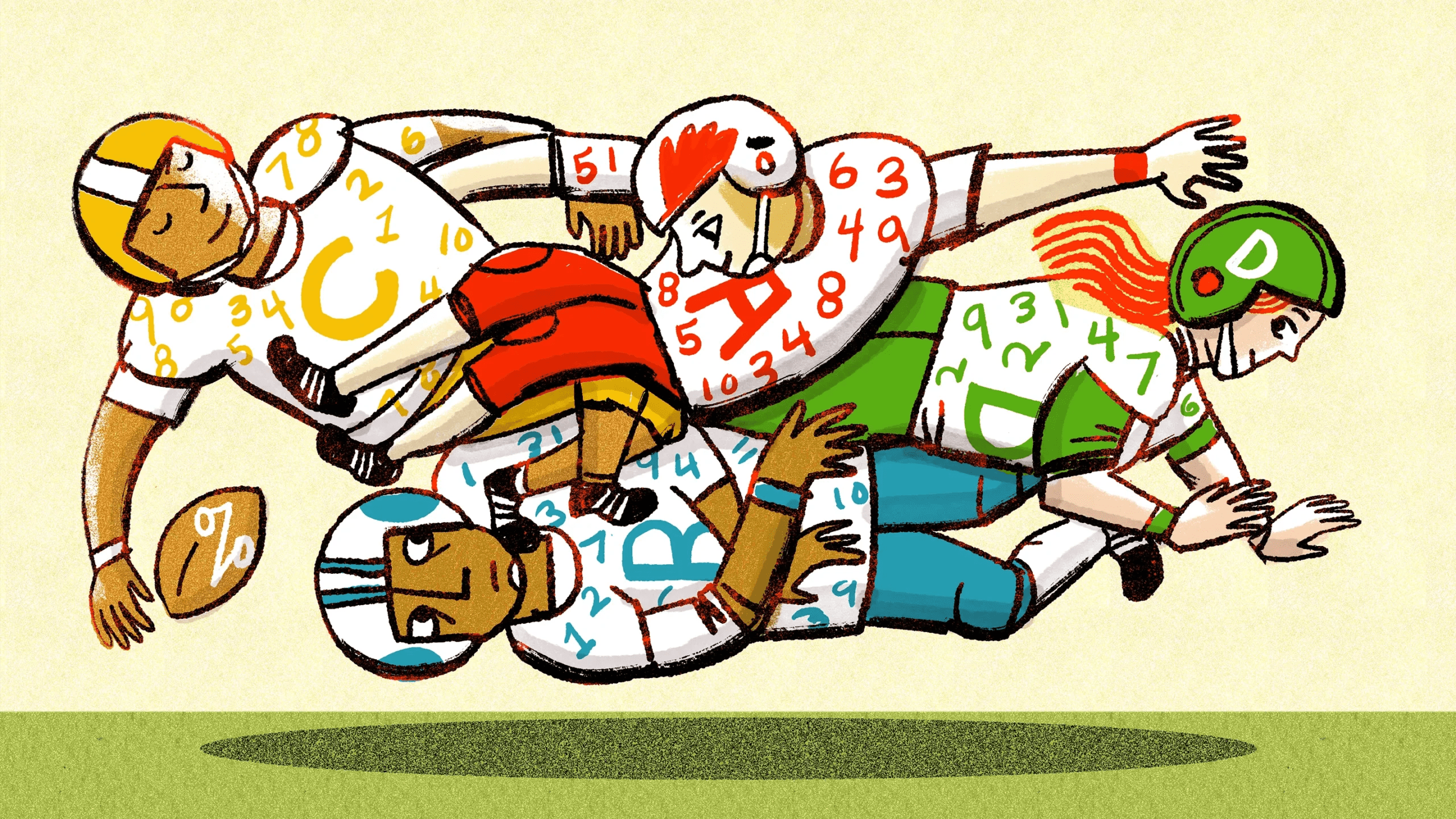
If Anna beats Benji in a game and Benji beats Carl, will Anna beat Carl? Patrick Honner unpacks the principle of transitivity…
It’s the championship game of the Imaginary Math League, where the Atlanta Algebras will face the Carolina Cross Products. The two teams haven’t played each other this season, but earlier in the year Atlanta defeated the Brooklyn Bisectors by a score of 10 to 5, and Brooklyn defeated Carolina by a score of 7 to 3. Does that give us any insight into who will take the title?
Well, here’s one line of thought. If Atlanta beat Brooklyn, then Atlanta is better than Brooklyn, and if Brooklyn beat Carolina, then Brooklyn is better than Carolina. So, if Atlanta is better than Brooklyn and Brooklyn is better than Carolina, then Atlanta should be better than Carolina and win the championship.
If you play competitive games or sports, you know that predicting the outcome of a match is never this straightforward. But from a purely mathematical standpoint, this argument has some appeal. It uses an important idea in mathematics known as transitivity, a familiar property that allows us to construct strings of comparisons across relationships. Transitivity is one of those mathematical properties that are so foundational you may not even notice it…
Read on: “The Surprisingly Simple Math Behind Puzzling Matchups,” from @MrHonner in @QuantaMagazine.
* Iain M. Banks, The Player of Games
###
As we tackle transitivity, we might spare a thought for Charlemagne; he died on this date in 814. A ruler who united the majority of western and central Europe (first as King of the Franks, then also King of the Lombards, finally adding Emperor of the Romans), he was the first recognized emperor to rule from western Europe since the fall of the Western Roman Empire three centuries earlier; the expanded Frankish state that he founded is called the Carolingian Empire, the predecessor to the Holy Roman Empire.
Committed to educational reform and extension, he began (in 789) the establishment of schools teaching the elements of mathematics, grammar, music, and ecclesiastic subjects; every monastery and abbey in his realm was expected to have a school for the education of the boys of the surrounding villages. The tradition of learning he initiated helped fuel the expansion of medieval scholarship in the 12th-century Renaissance.
Charlemagne is considered the father of modern Europe. At the same time, in accepting Pope Leo’s investiture, he set up ages of conflict: Charlemagne’s coronation as Emperor, though intended to represent the continuation of the unbroken line of Emperors from Augustus, had the effect of creating up two separate (and often opposing) Empires– the Roman and the Byzantine– with two separate claims to imperial authority. It led to war in 802, and for centuries to come, the Emperors of both West and East would make competing claims of sovereignty over the whole.

“Any fool can know. The point is to understand.”*…

… and, Rachael Scarborough King and Seth Rudy argue, to serve a clear purpose…
Right now, many forms of knowledge production seem to be facing their end. The crisis of the humanities has reached a tipping point of financial and popular disinvestment, while technological advances such as new artificial intelligence programmes may outstrip human ingenuity. As news outlets disappear, extreme political movements question the concept of objectivity and the scientific process. Many of our systems for producing and certifying knowledge have ended or are ending.
We want to offer a new perspective by arguing that it is salutary – or even desirable – for knowledge projects to confront their ends. With humanities scholars, social scientists and natural scientists all forced to defend their work, from accusations of the ‘hoax’ of climate change to assumptions of the ‘uselessness’ of a humanities degree, knowledge producers within and without academia are challenged to articulate why they do what they do and, we suggest, when they might be done. The prospect of an artificially or externally imposed end can help clarify both the purpose and endpoint of our scholarship.
We believe the time has come for scholars across fields to reorient their work around the question of ‘ends’. This need not mean acquiescence to the logics of either economic utilitarianism or partisan fealty that have already proved so damaging to 21st-century institutions. But avoiding the question will not solve the problem. If we want the university to remain a viable space for knowledge production, then scholars across disciplines must be able to identify the goal of their work – in part to advance the Enlightenment project of ‘useful knowledge’ and in part to defend themselves from public and political mischaracterisation.
Our volume The Ends of Knowledge: Outcomes and Endpoints Across the Arts and Sciences (2023) asks how we should understand the ends of knowledge today. What is the relationship between an individual knowledge project – say, an experiment on a fruit fly, a reading of a poem, or the creation of a Large Language Model – and the aim of a discipline or field? In areas ranging from physics to literary studies to activism to climate science, we asked practitioners to consider the ends of their work – its purpose – as well as its end: the point at which it might be complete. The responses showed surprising points of commonality in identifying the ends of knowledge, as well as the value of having the end in sight…
Read on for a provocative case that academics need to think harder about the purpose of their disciplines and a consideration of whether some of those should come to an end: “The Ends of Knowledge,” in @aeonmag.
* Albert Einstein
###
As we contemplate conclusions, we might recall that it was on this date in 1869 that the first issue of the journal Nature was published. Taking it’s title from a line of Wordsworth’s (“To the solid ground of nature trusts the Mind that builds for aye”), its aim was to “provide cultivated readers with an accessible forum for reading about advances in scientific knowledge.” It remains a weekly, international, interdisciplinary journal of science, one of the few remaining that publish across a wide array of fields. It is consistently ranked the world’s most cited scientific journal and is ascribed an impact factor of approximately 64.8, making it one of the world’s top academic journals.

“Taxonomy is described sometimes as a science and sometimes as an art, but really it’s a battleground”*…

In a 1995 interview with Linton Weeks of the Washington Post, the Howard University librarian, collector, and self-described “bibliomaniac” Dorothy Porter (1905–95) reflected on the focus of her 43-year career: “The only rewarding thing for me is to bring to light information that no one knows. What’s the point of rehashing the same old thing?” For Porter, this mission involved not only collecting and preserving a wide range of materials related to the global Black experience, but also addressing how these works demanded new and specific qualitative and quantitative approaches in order to collect, assess, and catalog them…
As Thomas C. Battle writes in a 1988 essay on the history of the Moorland-Spingarn Research Center, the breadth of the two collections showed the Howard librarians that “no American library had a suitable classification scheme for Black materials.” An “initial development of a satisfactory classification scheme,” writes Battle, was first undertaken by four women on the staff of the Howard University Library: Lula V. Allen, Edith Brown, Lula E. Conner, and Rosa C. Hershaw. The idea was to prioritize the scholarly and intellectual significance and coherence of materials that had been marginalized by Eurocentric conceptions of knowledge and knowledge production. These women paved the way for Dorothy Porter’s new system, which departed from the prevailing catalog classifications in important ways.
All of the libraries that Porter consulted for guidance relied on the Dewey Decimal Classification. “Now in [that] system, they had one number—326—that meant slavery, and they had one other number—325, as I recall it—that meant colonization,” she explained in her oral history. In many “white libraries,” she continued, “every book, whether it was a book of poems by James Weldon Johnson, who everyone knew was a black poet, went under 325. And that was stupid to me.”
Consequently, instead of using the Dewey system, Porter classified works by genre and author to highlight the foundational role of Black people in all subject areas, which she identified as art, anthropology, communications, demography, economics, education, geography, history, health, international relations, linguistics, literature, medicine, music, political science, sociology, sports, and religion.
This Africana approach to cataloging was very much in line with the priorities of the Harlem Renaissance, as described by Howard University professor Alain Locke in his period-defining essay of 1925, “Enter the New Negro.” Heralding the death of the “Old Negro” as an object of study and a problem for whites to manage, Locke proclaimed, “It is time to scrap the fictions, garret the bogeys and settle down to a realistic facing of facts.” Scholarship from a Black perspective, Locke argued, would combat racist stereotypes and false narratives while celebrating the advent of Black self-representation in art and politics. Porter’s classification system challenged racism where it was produced by centering work by and about Black people within scholarly conversations around the world.
How Dorothy Porter assembled and organized a premier Africana research collection– and helped change academia: “Cataloging Black Knowledge.”
See also “African American Print Culture.”
* Bill Bryson, A Short History of Nearly Everything
###
As we contemplate cataloguing, we might recall that it was on this date in 1909 that a group including W. E. B. Du Bois, Mary White Ovington, Moorfield Storey, and Ida B. Wells formed the NAACP— The National Association for the Advancement of Colored People– an interracial organization dedicated to advancing justice for African Americans. 112 years later, its work continues.

You must be logged in to post a comment.