Posts Tagged ‘Schrödinger’
“This was not that the subject was simple enough to be explained without mathematics, but rather that it was much too involved to be fully accessible to mathematics.”*…
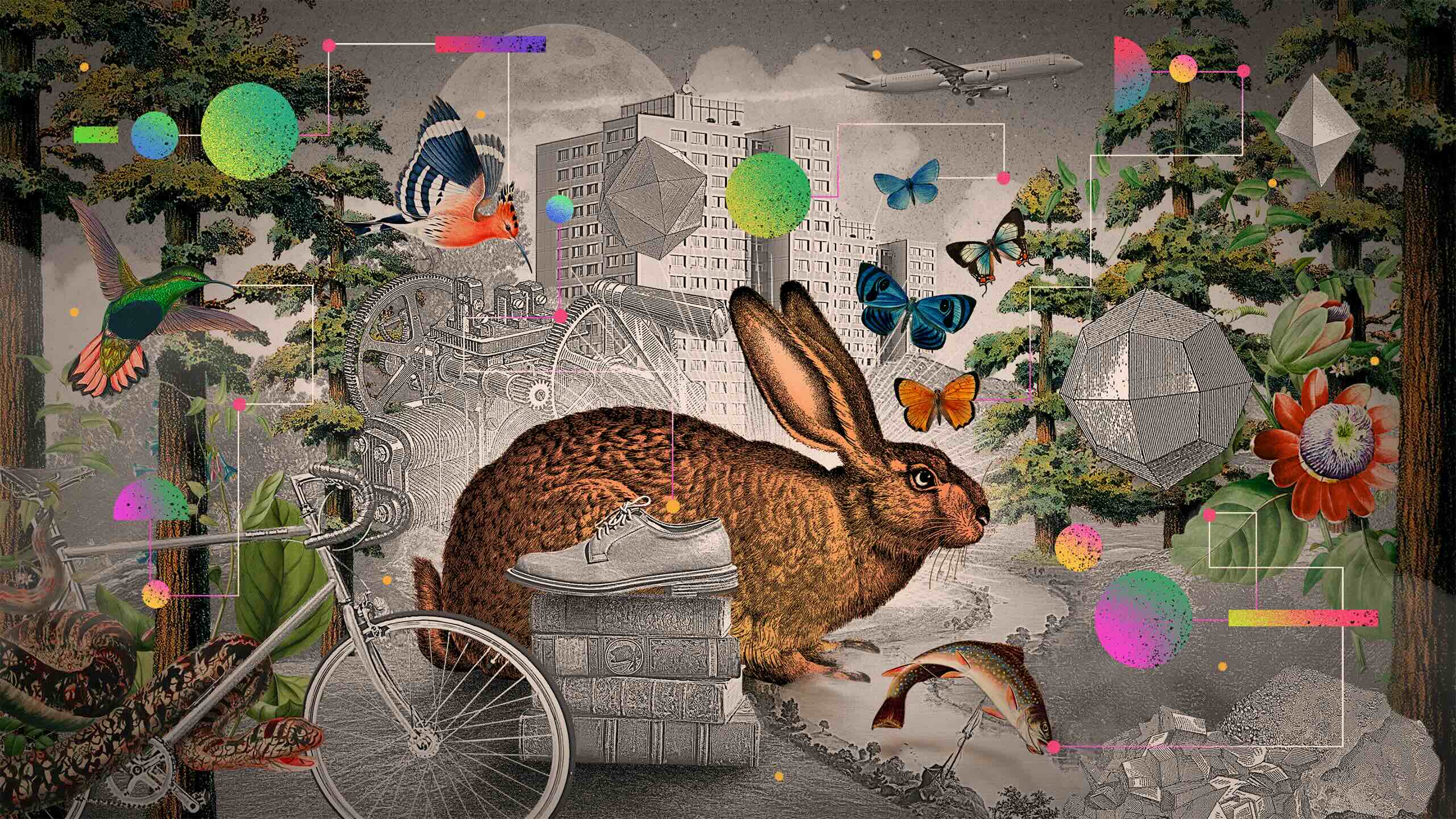
The idea of ‘biological agency’ — that life devises its own goals and behaves accordingly — complicates our understanding of what it means to be alive. But, Philip Ball asks, does it serve a scientific purpose?…
In 1993, a team led by the planetary scientist Carl Sagan tentatively concluded that there is life on Earth. Not much of a deduction, you might think — except that the researchers confined their evidence to observations made by the Galileo spacecraft, which had flown past our planet three years earlier on a looping journey to Jupiter. So great is the transformative power of life that its presence can be detected just from the light and radio waves our planet emits or reflects into space. Today we scan the cosmos for some of these telltale signatures light-years away.
Life leaves a mark, yet even now there’s no scientific consensus about what makes living things so different from inorganic substances like the rocks, gases, and oceans that are the sole components of dead worlds. Many scientists cite properties such as replication or metabolism. Others speak in more abstract terms about the way life is out of thermodynamic equilibrium with its surroundings. But some give another kind of answer. Living organisms are different because they do stuff for reasons.
It’s not enough to say that life is a nonequilibrium organized state through which there’s a constant flux of matter and energy. That description applies to hurricanes, too. But hurricanes just are. Only living entities have goals: to find food, to reproduce, to survive, sometimes simply to experience good things. (Dog owners will recognize that this is not just a human attribute.)
One way to express this idea is to say that living organisms have “agency.” It’s a hotly contested term. Some biologists reject it outright, at least for any organisms except humans, because we decide on our actions with conscious deliberation. (Whether we’re truly the only species to do so is another issue.) Others think that agency is a fundamental attribute of all life. Since there’s no agreed-upon definition of the term, to some extent it can mean whatever you want it to mean. But the debate about biological agency touches on fundamental issues in our understanding of what it means to be alive, because agency evokes a notion that biologists and philosophers have always wrestled with: teleology, the apparent purposiveness of life. If we admit agency into biology, do we open the floodgates to ideas about design, vitalism, or cosmic meaning? Or is it just a recognition of what makes life such a special state of matter?
To me, the notion of agency indeed speaks to our intuitive sense of what makes living things so special: not mere machines pushed around by environment and circumstance. I suspect that aversion to agency betrays a queasiness about confronting life as something more than some kind of genetic program. But there’s danger in the idea, too: It could so easily derail the work of studying the mechanistic explanations of how life works. I’m not looking to either bury or praise agency, but to explore whether it can be a scientifically productive idea…
[Ball unpacks the idea of agency, then reviews both scientific observations and the theories that they have provoked. He concludes…]
… I’m cautiously optimistic about the prospects of uniting such theoretical ideas with biological mechanisms. It seems unlikely to be coincidental, for example, that organisms that seem to show more agency also have molecular pathways that permit more openness to the influence of context and external information.
If we can get a clearer idea of what makes an agent, this could help us to understand how collective goals arise — as they did when multicellular organisms first arose long ago — and how they can break down, as in cancer. What’s more, a proper theory of agency might give us a clearer idea of what’s needed to make genuine artificial agents, not just computers and machines programmed with our own goals, but ones that can formulate their own. We might then also get a clearer idea of the potential benefits and dangers such truly agential machines might bring. But perhaps the most compelling argument for recognizing agency is that it might help us understand what makes life so different — not just humans, but life — that it is able to shape an entire planet in a manner visible from outer space.
Purpose? Goals? On the idea of “biological agency”: “Is Life Just Different?” from @philipcball.bsky.social in @quantamagazine.bsky.social.
* Erwin Schrödinger in What Is Life? (in which he wrestled, in his way, with Ball’s question, contending that life feeds on negative entropy) Full text here.
###
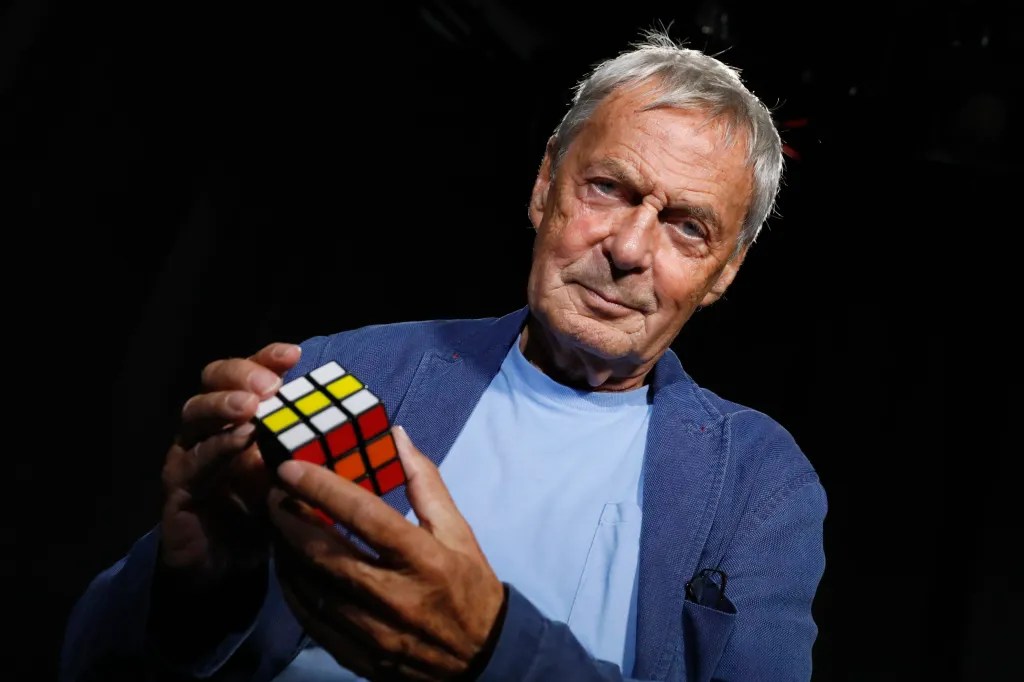
As we wonder why, we might send frustrated birthday greetings to Ernő Rubik; he was born on this date in 1944. An architect and inventor, he created the Rubik’s Cube (in 1974), which has become the world’s best-selling puzzle game, with over half a billion sold.
A Rubik’s Cube consists of 26 small cubes that rotate on a central axis; nine colored cube faces, in three rows of three each, form each side of the cube. After the cube arrangement is randomized (the highest level of entropy), the player must restore order (that’s to say, practice “negative entropy”), returning it to the original condition of faces with matching colors on each side — which is one among 43 quintillion possible configurations.
“Anyone not shocked by quantum mechanics has not yet understood it”*…

In the summer of 1925, a young Werner Heisenberg retreated to Helgoland in the North Sea and reemerged with the first full-fledged version of quantum mechanics. A century later, the theory’s meaning remains unsettled. Charlie Wood joined a group of physicists in Helgoland to take stock of the theory on its centennial…
Happy 100th birthday, quantum mechanics!” a physicist bellowed into a microphone one evening in June, and the cavernous banquet hall of Hamburg’s Hotel Atlantic erupted into cheers and applause. Some 300 quantum physicists had traveled from around the world to attend the opening reception of a six-day conference marking the centennial of the most successful theory in physics. The crowd included well-known pioneers of quantum computing and quantum cryptography, and four Nobel Prize winners.
“I feel like I’m at Woodstock,” Daniel Burgarth of the University of Erlangen-Nuremberg in Germany told me. “It’s my only chance to see them all in one place.”
One hundred years to the month had passed since a 23-year-old postdoc named Werner Heisenberg was driven by a case of hay fever to Helgoland, a barren, windswept island in the North Sea. There, Heisenberg completed a calculation that would become the heart of quantum mechanics, a radical new theory of the atomic and subatomic world.
The theory remains radical.
Before quantum mechanics hit the scene, “classical” physics theories dealt directly with the stuff of the world and its properties: the orbits of planets, say, and the speeds of pendulums. Quantum mechanics deals in something more abstract: possibilities. It predicts the chances that we’ll observe an atom doing this or that, or being here or there. It gives the impression that particles can engage in multiple possible behaviors at once, that they have no fixed reality. So physicists have spent the last century grappling with questions like: What is real? And where does our reality come from?…
Wood recounts the genesis and development of the theory and considers some of the vexing questions that remain: e.g., the many-world interpretation, the place (?) of gravity in the theory, et al. He concludes with a quote from Robert Spekkens, a physicist at the Perimeter Institute (whose work illustrates Lawrence Krause‘s observation that “At the heart of quantum mechanics is a rule that sometimes governs politicians or CEOs – as long as no one is watching, anything goes”): “We’re privileged to live at a time when the great prize of making sense of quantum theory is still there for the taking.”
Eminently worth reading in full: “‘It’s a Mess’: A Brain-Bending Trip to Quantum Theory’s 100th Birthday Party” from @walkingthedot.bsky.social in @quantamagazine.bsky.social.
See also: “Physicists Can’t Agree on What Quantum Mechanics Says about Reality“
* Niels Bohr
###
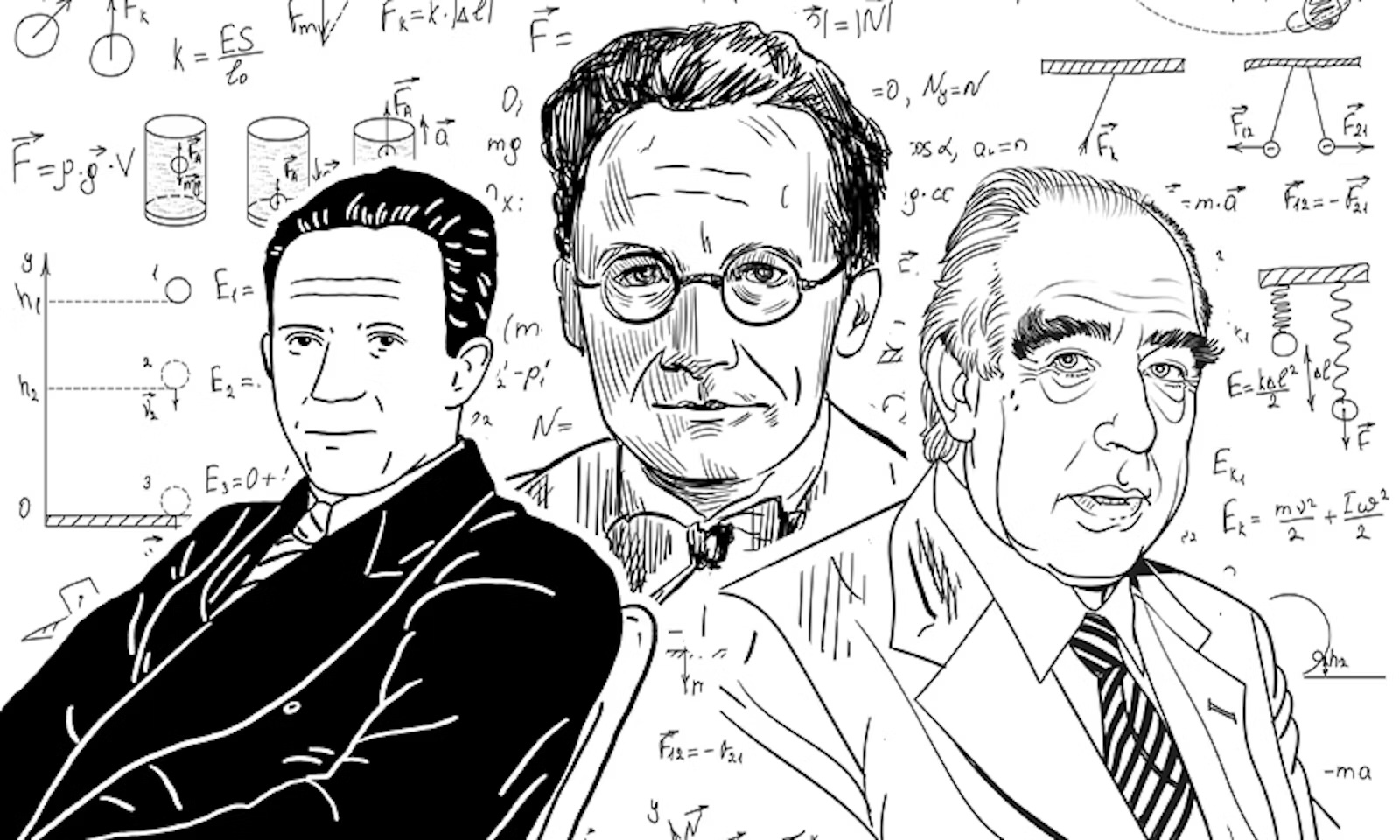
As we wrestle with reality, we might send relativistic birthday greetings to one of quantum theory’s pioneers, Erwin Schrödinger; he was born on this date in 1887. A physicist, Schrödinger took Louis de Broglie‘s concept of atomic particles as having wave-like properties, and modified the earlier Bohr model of the atom to accommodate the wave nature of the electrons, which he instantiated in the Schrödinger equation, which provides a way to calculate the wave function of a system and how it changes dynamically in time. It was the basis of the work that earned him the Nobel Prize in 1933. And he coined the term “quantum entanglement” in 1935.
But surely Schrödinger is most widely known for creating the thought experiment we all know as “Schrödinger’s Cat” (and here).

“Those who are not shocked when they first come across quantum theory cannot possibly have understood it”*…
A scheduling note: your correspondent is headed onto the road for a couple of weeks, so (Roughly) Daily will be a lot more roughly than daily until September 20th or so.
100 years ago, a circle of physicists shook the foundation of science. As Philip Ball explains, it’s still trembling…
In 1926, tensions were running high at the Institute for Theoretical Physics in Copenhagen. The institute was established 10 years earlier by the Danish physicist Niels Bohr, who had shaped it into a hothouse for young collaborators to thrash out a new theory of atoms. In 1925, one of Bohr’s protégés, the brilliant and ambitious German physicist Werner Heisenberg, had produced such a theory. But now everyone was arguing with each other about what it implied for the nature of physical reality itself.
To the Copenhagen group, it appeared reality had come undone…
[Ball tells the story of Niels Bohr’s building on Max Planck, of Werner Heisenberg’s wrangling of Bohr’s thought into theory, of Einstein’s objections and Erwin Schrödinger’s competing theory; then he homes in on the ontological issue at stake…]
Quantum mechanics, they said, demanded we throw away the old reality and replace it with something fuzzier, indistinct, and disturbingly subjective. No longer could scientists suppose that they were objectively probing a pre-existing world. Instead, it seemed that the experimenter’s choices determined what was seen—what, in fact, could be considered real at all.
In other words, the world is not simply sitting there, waiting for us to discover all the facts about it. Heisenberg’s uncertainty principle implied that those facts are determined only once we measure them. If we choose to measure an electron’s speed (more strictly, its momentum) precisely, then this becomes a fact about the world—but at the expense of accepting that there are simply no facts about its position. Or vice versa…
…A century later, scientists are still arguing about this issue of what quantum mechanics means for the nature of reality…
[Ball recounts subsequent attempts to reconcile quantum theory to “reality,” including Schrödinger’s wave mechanics…]
… Schrödinger’s wave mechanics didn’t restore the kind of reality he and Einstein wanted. His theory represented all that could be said about a quantum object in the form of a mathematical expression called the wave function, from which one can predict the outcomes of making measurements on the object. The wave function looks much like a regular wave, like sound waves in air or water waves on the sea. But a wave of what?
At first, Schrödinger supposed that the amplitude of the wave—think of it like the height of a water wave—at a given point in space was a measure of the density of the smeared-out quantum particle there. But Born argued that in fact this amplitude (more precisely, the square of the amplitude) is a measure of the probability that we will find the particle there, if we make a measurement of its position.
This so-called Born rule goes to the heart of what makes quantum mechanics so odd. Classical Newtonian mechanics allows us to calculate the trajectory of an object like a baseball or the moon, so that we can say where it will be at some given time. But Schrödinger’s quantum mechanics doesn’t give us anything equivalent to a trajectory for a quantum particle. Rather, it tells us the chance of getting a particular measurement outcome. It seems to point in the opposite direction of other scientific theories: not toward the entity it describes, but toward our observation of it. What if we don’t make a measurement of the particle at all? Does the wave function still tell us the probability of its being at a given point at a given time? No, it says nothing about that—or more properly, it permits us to say nothing about it. It speaks only to the probabilities of measurement outcomes.
Crucially, this means that what we see depends on what and how we measure. There are situations for which quantum mechanics predicts that we will see one outcome if we measure one way, and a different outcome if we measure the same system in a different way. And this is not, as is sometimes implied (this was the cause of Heisenberg’s row with Bohr), because making a measurement disturbs the object in some physical manner, much as we might very slightly disturb the temperature of a solution in a test-tube by sticking a thermometer into it. Rather, it seems to be a fundamental property of nature that the very fact of acquiring information about it induces a change.
If, then, by reality we mean what we can observe of the world (for how can we meaningfully call something real if it can’t be seen, detected, or even inferred in any way?), it is hard to avoid the conclusion that we play an active role in determining what is real—a situation the American physicist John Archibald Wheeler called the “participatory universe.”..
… Heisenberg’s “uncertainty” captured that sense of the ground shifting. It was not the ideal word—Heisenberg himself originally used the German Ungenauigkeit, meaning something closer to “inexactness,” as well as Unbestimmtheit, which might be translated as “undeterminedness.” It was not that one was uncertain about the situation of a quantum object, but that there was nothing to be certain about.
There was an even more disconcerting implication behind the uncertainty principle. The vagueness of quantum phenomena, when an electron in an atom might seem to jump from one energy state to another at a time of its own choosing, seemed to indicate the demise of causality itself. Things happened in the quantum world, but one could not necessarily adduce a reason why. In his 1927 paper on the uncertainty principle, Heisenberg challenged the idea that causes in nature lead to predictable effects. That seemed to undermine the very foundation of science, and it made the world seem like a lawless, somewhat arbitrary place….
… One of Bohr’s most provocative views was that there is a fundamental distinction between the fuzzy, probabilistic quantum world and the classical world of real objects in real places, where measurements of, say, an electron with a macroscopic instrument tell us that it is here and not there.
What Bohr meant is shocking. Reality, he implied, doesn’t consist of objects located in time and space. It consists of “quantum events,” which are obliged to be self-consistent (in the sense that quantum mechanics can describe them accurately) but not classically consistent with one another. One implication of this, as far as we can currently tell, is that two observers can see different and conflicting outcomes from an event—yet both can be right.
But this rigid distinction between the quantum and classical worlds can’t be sustained today. Scientists can now conduct experiments that probe size scales in between those where quantum and classical rules are thought to apply—neither microscopic (the atomic scale) nor macroscopic (the human scale), but mesoscopic (an intermediate size). We can look, for example, at the behavior of nanoparticles that can be seen and manipulated yet are small enough to be governed by quantum rules. Such experiments confirm the view that there is no abrupt boundary of quantum and classical. Quantum effects can still be observed at these intermediate scales if our devices are sensitive enough, but those effects can be harder to discern as the number of particles in the system increases.
To understand such experiments, it’s not necessary to adopt any particular interpretation of quantum mechanics, but merely to apply the standard theory—encompassed within Schrödinger’s wave mechanics, say—more expansively than Bohr and colleagues did, using it to explore what happens to a quantum object as it interacts with its surrounding environment. In this way, physicists are starting to understand how information gets out of a quantum system and into its environment, and how, as it does so, the fuzziness of quantum probabilities morphs into the sharpness of classical measurement. Thanks to such work, it is beginning to seem that our familiar world is just what quantum mechanics looks like when you are 6 feet tall.
But even if we manage to complete that project of uniting the quantum with the classical, we might end up none the wiser about what manner of stuff—what kind of reality—it all arises from. Perhaps one day another deeper theory will tell us. Or maybe the Copenhagen group was right a hundred years ago that we just have to accept a contingent, provisional reality: a world only half-formed until we decide how it will be…
Eminently worth reading in full: “When Reality Came Undone,” from @philipcball in @NautilusMag.
See also: When We Cease to Understand the World, by Benjamin Labatut.
* Niels Bohr
###
As we wrestle with reality, we might spare a thought for Ludwig Boltzmann; he died on this date in 1906. A physicist and philosopher, he is best remembered for the development of statistical mechanics, and the statistical explanation of the second law of thermodynamics (which connected entropy and probability).
Boltzmann helped paved the way for quantum theory both with his development of statistical mechanics (which is a pillar of modern physics) and with his 1877 suggestion that the energy levels of a physical system could be discrete.

“The threat of a pandemic is different from that of a nerve agent, in that a disease can spread uncontrollably, long after the first carrier has succumbed”*…

We were, of course, warned. As we do our best to digest the news of emergent new strains of the COVID-19 virus, a look back at Annie Sparrow‘s 2016 New York Review of Books essay on pandemics…
Pandemics—the uncontrolled spread of highly contagious diseases across countries and continents—are a modern phenomenon. The word itself, a neologism from Greek words for “all” and “people,” has been used only since the mid-nineteenth century. Epidemics—localized outbreaks of diseases—have always been part of human history, but pandemics require a minimum density of population and an effective means of transport. Since “Spanish” flu burst from the trenches of World War I in 1918, infecting 20 percent of the world’s population and killing upward of 50 million people, fears of a similar pandemic have preoccupied public health practitioners, politicians, and philanthropists. World War II, in which the German army deliberately caused malaria epidemics and the Japanese experimented with anthrax and plague as biological weapons, created new fears…
According to the doctor, writer, and philanthropist Larry Brilliant, “outbreaks are inevitable, pandemics are optional.”
…
Much of human history can be seen as a struggle for survival between humans and microbes. Pandemics are microbe offensives; public health measures are human defenses. Water purification, sanitation, and vaccination are crucial to our living longer, better, even taller lives. But these measures of mass salvation are not sexy. While we know prevention is better and considerably cheaper than cure, there is little financial reward or glory in it. Philanthropists prefer to build hospitals rather than pay community health workers. Pharmaceutical companies prefer the Western market to the distant and poor Global South where people cannot afford to buy treatments. Education is a powerful social vaccine against the ignorance that enables pathogens to flourish, but insufficient to overcome the corruption of public goods by private interests. The current enthusiasm for detecting the next panic-inducing pathogen should not divert resources and research from the perennial threats that we already have. We must resist the tendency of familiarity and past failures to encourage contempt and indifference…
An important (and in its time, sadly, prescient) read: “The Awful Diseases on the Way,” from @annie_sparrow in @nybooks.
See also “6 of the Worst Pandemics in History” (source of the image above) and “A history of pandemics.”
[TotH to MK]
###
As we prioritize preparation, we might recall that it was on this date in 1935 that physicist Erwin Schrödinger published his famous thought experiment– now known as “Schrödinger’s cat“– a paradox that illustrates the problem of the Copenhagen interpretation of quantum mechanics.

“You’re mad, bonkers, completely off your head. But I’ll tell you a secret. All the best people are.”*…

Edward Brooke-Hitching grew up in a rare book shop, with a rare book dealer for a father. As the author of histories of maps The Phantom Atlas, The Golden Atlas and The Sky Atlas, he has always been “really fascinated by books that are down the back alleys of history.” Ten years ago, he embarked on a project to come up with the “ultimate library.” No first editions of Jane Austen here, though: Brooke-Hitching’s The Madman’s Library collects the most eccentric and extraordinary books from around the world.
“I was asking, if you could put together the ultimate library, ignoring the value or the academic significance of the books, what would be on that shelf if you had a time machine and unlimited budget?” he says.
Following up anecdotes, talking to booksellers and librarians and trawling through auction catalogues, he came across stories like that of the 605-page Qur’an written in the blood of Saddam Hussein. “If that was on a shelf, what could possibly sit next to it?” he asks. “I mentioned it to a bookseller and they told me about a diary that they’d had, from the 19th century, written by a shipwrecked captain who only had old newspaper and penguins to hand. So Fate of the Blenden Hall was written entirely in penguin blood.”
There’s the American civil war soldier who inscribed his journal of the conflict on to the violin he carried. There’s the memoir of a Massachussetts highwayman, James Allen, which he “requested be bound in his own skin after his death, and presented to his one victim who had fought back as a token of his admiration.” Or the diary of the Norwegian resistance fighter Petter Moen, pricked with a pin into squares of toilet paper and left in a ventilation shaft; although Moen was killed in 1944, one of his fellow prisoners returned to Oslo after it was liberated from the Nazis and found the diary. Or the entirely fabricated book An Historical and Geographical Description of Formosa: its author George Psalmanazar, a blond-haired, blue-eyed, pale-skinned man with a thick French accent, arrived in London in about 1702 and declared himself to be the first Formosan, or Taiwanese, person to set foot on the European continent. (“Obviously no one had been there and nobody knew what Taiwanese people looked like, and he became the toast of high society,” says Brooke-Hitching.)
The joy for the author in his discoveries – and make no mistake, The Madman’s Library is an utterly joyous journey into the deepest eccentricities of the human mind – was that they “make you realise that, above everything, people have always been funny, been weird, been unquenchably curious in every possible arena”…
The Madman’s Library, the ultimate collection of bizarre books down the ages: “From cut-out confessions to cheese pages: browse the world’s strangest books.”
[TotH to buddy MK]
* Lewis Carroll, Alice’s Adventures in Wonderland
###
As we get weird, we might recall that it was on this date in 1935 that physicist Erwin Schrödinger published his famous thought experiment– now known as “Schrödinger’s cat“– a paradox that illustrates the problem of the Copenhagen interpretation of quantum mechanics.

You must be logged in to post a comment.