Posts Tagged ‘engineering’
“Science explains how things work, it doesn’t always answer why they exist”*…

Still, it’s cool to know how things work. In a continuing series of “tear-downs,” Bryan Macomber obliges in the most elegant of ways…
Are you curious why a clicky Pen… clicks? How a Zippo Lighter flips open? Or what lives inside a Pez Dispenser?
I’ve illustrated tear-downs and break-downs of everyday products that you may have taken for granted. Let’s take a look inside and understand how they work. Click around, have fun and maybe learn something new!…
An illustrated celebration of the engineering around us: “Mechanical Pencil.”
* (Paraphrase of) Isaac Newton
###
As we muse on the mechanical, we might recall that it was on this date (according to most sources, though a few cite the 12th or the 19th of June) in 1902 that Philadelphia restauranteurs Frank Hardart and Joe Horn opened the first Automat in the U.S. A cavernous, waiterless establishment that was a combination of fast (but fresh) food, vending, and a cafeteria. Customers put nickels into slots beside small glass-doored compartments in the Automats and turned a knob. In the compartment next to the slot, food revolved into place for the customer to receive through the glass door.
Horn & Hardart Automats expanded into a chain reaching Manhattan in 1912. With their uniform recipes and centralized commissary system of supplying their restaurants, the Automats were America’s first major fast-food chain.
For more on how they worked, see “Meet Me at the Automat” and the charming documentary “The Automat.”


“Scuse me while I kiss the sky”*…
In 1967, Jimi Hendrix’s manager, Chas Chandler arranged for Jimi to meet Cream…
There was a particular night when Cream allowed Jimi to join them for a jam at the Regent Street Polytechnic in central London. Meeting Clapton had been among the enticements Chandler had used to lure Hendrix to Britain: “Hendrix blew into a version of [Howlin’ Wolf’s] ‘Killing Floor’,” recalls [Tony] Garland, “and plays it at breakneck tempo, just like that – it stopped you in your tracks.” [Keith] Altham recalls Chandler going backstage after Clapton left in the middle of the song “which he had yet to master himself”; Clapton was furiously puffing on a cigarette and telling Chas: “You never told me he was that fucking good.” – source
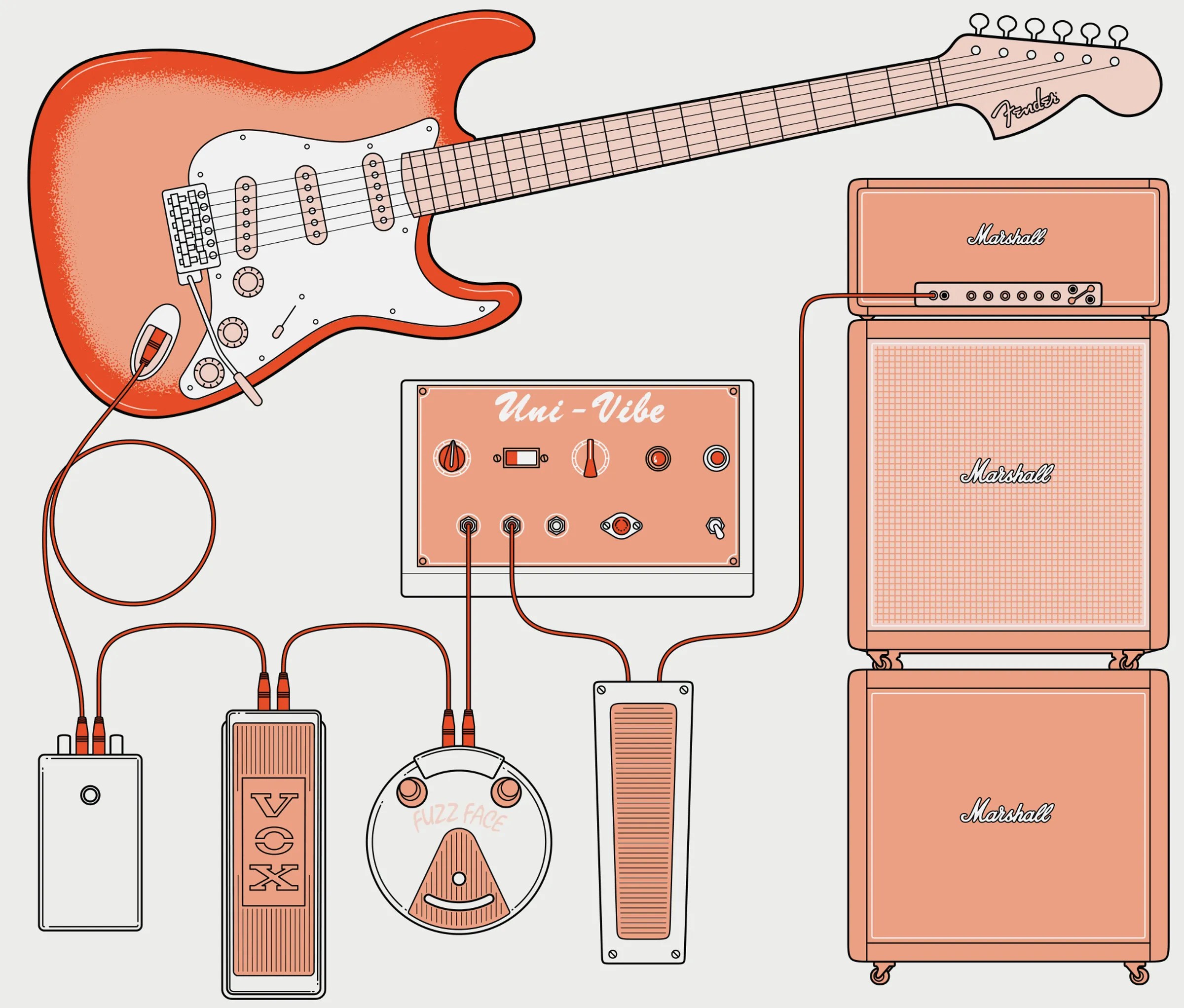
Hendrix’s extraodinary virtuosity has, altogether justly, gotten a great deal of attention; less well noted, his incredible mastery of the technology of music making, recording, and performance. Rohan Puranik explains…
3 February 1967 is a day that belongs in the annals of music history. It’s the day that Jimi Hendrix entered London’s Olympic Studios to record a song using a new component. The song was “Purple Haze,” and the component was the Octavia guitar pedal, created for Hendrix by sound engineer Roger Mayer. The pedal was a key element of a complex chain of analog elements responsible for the final sound, including the acoustics of the studio room itself. When they sent the tapes for remastering in the United States, the sounds on it were so novel that they included an accompanying note explaining that the distortion at the end was not malfunction but intention. A few months later, Hendrix would deliver his legendary electric guitar performance at the Monterey International Pop Festival.
“Purple Haze” firmly established that an electric guitar can be used not just as a stringed instrument with built-in pickups for convenient sound amplification, but also as a full-blown wave synthesizer whose output can be manipulated at will. Modern guitarists can reproduce Hendrix’s chain using separate plug-ins in digital audio workstation software, but the magic often disappears when everything is buffered and quantized. I wanted to find out if a more systematic approach could do a better job and provide insights into how Hendrix created his groundbreaking sound.
My fascination with Hendrix’s Olympic Studios’ performance arose because there is a “Hendrix was an alien” narrative surrounding his musical innovation—that his music appeared more or less out of nowhere. I wanted to replace that narrative with an engineering-driven account that’s inspectable and reproducible—plots, models, and a signal chain from the guitar through the pedals that you can probe stage by stage…
[And probe it Puranik does– fascinatingly, stage by stage…]
… Hendrix didn’t speak in decibels and ohm values, but he collaborated with engineers who did—Mayer and Kramer—and iterated fast as a systems engineer. Reframing Hendrix as an engineer doesn’t diminish the art. It explains how one person, in under four years as a bandleader, could pull the electric guitar toward its full potential by systematically augmenting the instrument’s shortcomings for maximum expression.
“Jimi Hendrix Was a Systems Engineer,” from @spectrum.ieee.org.
See also: “The Technology of Jimi Hendrix.”
* Jimi Hendrix, “Purple Haze”
###
As we plug in, we might send well-connected birthday greetings to another wizard with wires, Geoff Tootill; he was born on this date in 1922. An electronic engineer and computer scientist, he worked (with Freddie Williams and Tom Kilburn) to design a computer memory. To that end they built the first electronic stored-program computer— the Manchester Baby— at the University of Manchester in 1948.
The Baby was not intended to be a practical computing engine, but was instead designed as a testbed for the Williams tube, the first truly random-access memory. Nonethless, Baby worked: Alan Turing moved to Manchester to use it, and the following year, it inspired the Ferranti Mark 1, the world’s first commercially available electronic general-purpose stored-program digital computer.

“Curiosity is, in great and generous minds, the first passion and the last”*…

From the arcane through the mysterious to the perplexing, a glorious collecton of obscure– but fascinating– knowledge…
Freakpages is a community-curated directory of esoteric articles across the internet, primarily from Wikipedia. Here, we encourage you to learn about interesting topics you have never heard of…
… divided into categories (Society, History, Technology, Psychology, Physics, Biology, Chemistry, Finance, Philosphy), with continuously refreshed selections from both the curators and the community.
A few examples: Egregore, Operation Northwoods, Matrioshka Brain, Zeigarnik Effect, Retrocausality, Horizontal Gene Transfer, Strange Matter Seeding, Keynesian Beauty Contest, Chinese Room…
So many more at: Freakpages
[Image above: source]
###
As we explore, we might spare a thought for a man driven by an endles spirit of inquiry, William Thomson, 1st Baron Kelvin; he died on this date in 1907. A mathematician, mathematical physicist, and engineer considered by many “the Newton of his era,” Lord Kelvin was instrumental in the formulation of the first and second laws of thermodynamics, and contributed significantly to unifying physics, which was then in its infancy of development as an emerging academic discipline. He received the Royal Society’s Copley Medal in 1883 and served as its president from 1890 to 1895. In 1892 he became the first scientist to be elevated to the House of Lords. Absolute temperatures are stated in units of kelvin in his honor.

“The difference between screwing around and science is writing it down”*…

It’s that time of year again: the 2025 IgNobel Awards have been awarded. Jennifer Ouellette reports…
Does alcohol enhance one’s foreign language fluency? Do West African lizards have a preferred pizza topping? And can painting cows with zebra stripes help repel biting flies? These and other unusual research questions were honored tonight in a virtual ceremony to announce the 2025 recipients of the annual Ig Nobel Prizes… when the serious and the silly converge—for science.
Established in 1991, the Ig Nobels are a good-natured parody of the Nobel Prizes; they honor “achievements that first make people laugh and then make them think.” The unapologetically campy awards ceremony features miniature operas, scientific demos, and the 24/7 lectures whereby experts must explain their work twice: once in 24 seconds and the second in just seven words.
Acceptance speeches are limited to 60 seconds. And as the motto implies, the research being honored might seem ridiculous at first glance, but that doesn’t mean it’s devoid of scientific merit. In the weeks following the ceremony, the winners will also give free public talks, which will be posted on the Improbable Research website…
Read on for accounts (each both amusing and fascinating) of this year’s winners: “Meet the 2025 Ig Nobel Prize winners,” @jenlucpiquant.bsky.social in @arstechnica.com.
More at the web site of Improbable Research— “research that makes people LAUGH, then THINK”– the organization behind the IgNobels.
* Adam Savage (@asavage.bsky.social)
###
As we have some serious fun, we might we might spare a thought for a man who embodied the marriage of science and glee: Ron Toomer; he died on this date in 2011. Toomer began his career as an aeronautical engineer who contributed to the heat shields on NASA’s Apollo spacecraft. But in 1965, he joined Arrow Development, an amusement park ride design company, where he became a legendary creator of steel roller coasters. His first assignment was “The Run-Away Mine Train” (at Six Flags Over Texas), the first “mine train” ride, and the second steel roller coaster (after Arrow’s Matterhorn Ride at Disneyland). Toomer went on to design 93 coasters worldwide, and was especially known for his creation of the first “inversion” coasters (he built the first coasters with 1, 2, 3, 4, 5, 6, and 7, loops). In 2000, he was inducted in the International Association of Amusement Parks and Attractions (IAAPA) Hall of Fame as a “Living Legend.”


“I tell you, sir, the only safeguard of order and discipline in the modern world is a standardized worker with interchangeable parts.”*…

… a sentiment that grates on the indivisualists among us. Still, there’s no denying the enormous impact that standardization has had. In an excerpt from his book, Exactly: How Precision Engineers Created The Modern World, Simon Winchester on the revolution that came from interchangeable parts…
Lewis Mumford, the historian and philosopher of technology, was one of the earliest to recognize the major role played by the military in the advancement of technology, in the dissemination of precision-based standardization, in the making of innumerable copies of the same and usually deadly thing, all iterations of which must be identical to the tiniest measure, in nanometers or better. The stories that follow, in which standardization and precision-based manufacturing are shown to become crucial ambitions of armies on both sides of the Atlantic, serve both to confirm Mumford’s prescience and to underline the role that the military plays in the evolution of precision. The examples from the early days of the science are of course far from secret; those from today, and that might otherwise be described in full to illustrate today’s very much more precise and precision-obsessed world, are among the most secure and confidential topics of research on the planet — kept in permanent shadow, as the dark side necessarily has to be.
It was in the French capital in 1785 that the idea of producing interchangeable parts for guns was first properly realized, and the precision manufacturing processes that allowed for it were ordered to be first put into operation. Still, it is reasonable to ask why, if the process was dreamed up in 1785, was it not being applied to the American musketry in official use in 1814, twenty-nine years later? Men were running, battles were being lost, great cities were being burned — and in part because the army’s guns were not being made as they should have been made. There is an answer, and it is not a pretty one.
Two little-remembered Frenchmen got the honor of first introducing the system that, had it been implemented in time and implemented properly, would have given America the guns it should have had. The first, the less familiar of the pair, despite the evidently superior nature of his name, was Jean-Baptiste Vaquette de Gribeauval, a wellborn and amply connected figure who specialized in designing cannons for the French artillery. He supposedly came up with a scheme, in 1776, for boring out cannons using almost exactly the same technique that John Wilkinson had invented in England, that of moving a rotating drill into a solid cannon-size and cannon-shaped slug of iron. Wilkinson had patented his precisely similar system two years earlier, in 1774, but nonetheless, the French system, the système Gribeauval, as it came to be known for the next three decades, long dominated French artillery making. It gave the French armies access to a range of highly efficient and lightweight, but manifestly not entirely originally conceived, field pieces. (Gribeauval did employ what were called go and no-go gauges as a means of ensuring that cannonballs fitted properly inside his cannons, but this was hardly revolutionary engineering, and it had been around in principle for five centuries.)
The second figure, the man who did the most to bring the system of interchangeable parts to the making of guns, and whose technique was, unlike Gribeauval’s, unchallengeable, was Honoré Blanc. He was not a soldier but a gunsmith, and during his apprenticeship he became well aware of the Gribeauval system. He decided early in his career that he could bring a similar standardization to the flintlock musket, for the benefit of the man on the battlefield.
Yet there was a difference. A cannon was big and heavy and crude — a gunner simply touched his linstock, with its attached lighted match, to the vent, and the cannon fired — and so such parts as there were proved easily amenable to standardization. With the flintlock, however, the lock (that part of a musket that delivered the spark that exploded the priming powder that ignited the main charge and drove the ball down the barrel) was a fairly delicate and complex piece of engineering, made of many oddly shaped parts and liable to all kinds of failure. To the uninitiated, the names of the bits and pieces of a flintlock alone are bewildering: a lock has parts that are variously known as the bridle, the sear, the frizzen, the pan, and any number of springs and screws and bolts and plates as well as, of course, the spark-producing (when struck by the aforementioned metal frizzen) piece of flint. To render the lock into a standard piece of military equipment, with all its parts made exactly the same for each lock, was going to be a tall order.
Cost, rather than the well-being of the infantryman or the conduct of the battle, was the prime motive. The French government declared in the mid-1780s that the country’s gunsmiths were charging too much for their craftsmanship, and demanded they improve their manufacturing process or lower their prices. The smiths not unnaturally balked at the impertinence of the suggestion, and promptly tried selling their products to the new armories and gun makers across the Atlantic in America, a move that alarmed the French government, as it imagined it might well run out of weaponry as a result.
It was at this point that Honore Blanc entered the picture, taking a civilian job as the army’s quality-control inspector. His brother gunsmiths expressed their dismay over the fact that one of their number was going over to the other side, was a poacher turning gamekeeper. Blanc dismissed the criticism and got on with his job, his own motivation being the welfare of the soldier out in the field rather than allowing the government to cut costs. He was greatly influenced by M. de Gribeauval, and decided he could ape his system of standardization, ensuring that all the component parts of a flintlock he made as exact and faithful copies of one perfectly made master.
This master he made himself, carefully and with great precision, and with all the specifications laid down as precisely as possible (using the arcane system of the Ancien Régime, which still employed dimensional measures such as the pointe, the ligne, and the pouce) to tolerances of about what today we would recognize as 0.02 millimeters. He then made a series of jigs and gauges to ensure that all the locks made subsequently were faithful to this first perfect master, by the judicious use of files and such lathes as were available. The gunsmiths hired by Blanc to perform this task — by hand, still — made each lock exactly as the original. Providing that they did so, exactly, all the pieces would then fit perfectly together, and the whole assembled lock would fit equally perfectly into each completed weapon.
Yet only a small number of gunsmiths were willing to work under these stringent new conditions. Most balked. Making guns simply by copying parts reduced the value of the gunsmith’s craftsmanship to near insignificance, they argued. Unskilled drones could do their work instead. By arguing this, the French smiths were voicing much the same complaints as the Luddites had grumbled over in England: that precision was stripping their skills of worth. This argument would be heard many times in the future as the steady march of precision engineering advanced across Europe, the Americas, the world. The kind of mutinous sentiments heard in the English Midlands half a century before were now being muttered in northern France, as precision started to become an international phenomenon, its consequences rippling into the beyond.
Such was the hostility in France to Honoré Blanc, in fact, that the government had to offer him protection, and so sequestered him and his small but faithful crew of precision gun makers in the basement dungeons of the great Château de Vincennes, east of Paris. At the time, the great structure (much of it still standing, and much visited) was in use as a prison: Diderot had been incarcerated there, and the Marquis de Sade. In the relative peace of what would, within thirty years, become one of postrevolutionary France’s greatest arsenals, Blanc and his team worked away producing his locks, all of them supposedly identical. Blanc made all the necessary tools and jigs to help in his efforts — according to one source, hardening the metal pieces by burying them for weeks in the copious leavings of manure from the castle stables.
By July of 1785, Blanc was ready to offer a demonstration. He sent out invitations to the capital’s nabobs and military flag officers and to his still-hostile colleague gunsmiths, to show them what he had achieved. Many officials came, but few of the smiths, who were still seething. Yet one person of great future significance did present himself at the donjon’s fortified gates: the minister to France of the United States of America, Thomas Jefferson…
On the making of the modern world: interchangeable parts, from @simonwwriter, via the invaluable @delanceyplace.
###
As we mix and match, we might spare a thought for another contibutor to our modern age, Jethro Tull; he died on this date in 1741. An agronomist who promoted planting seeds in rows (as opposed to “broadcast,” simply casting the seeds around), he perfected a horse-drawn seed drill in 1701 that economically sowed the seeds in three neat rows; because of its internal moving parts (including a rotary mechanism that became part of all sowing devices that followed), it has been called the first agricultural machinery. He later developed a horse-drawn hoe, a four-coultered plow that made vertical cuts in the soil before the plowshare.
Tull’s methods– horse-hoeing and row seeding, effectively a rejection of traditional Virgilian husbandry– were initailly controversial, but were steadily adopted by many landowners and helped to provide the basis for modern agriculture.

You must be logged in to post a comment.