Posts Tagged ‘computer memory’
“Scuse me while I kiss the sky”*…
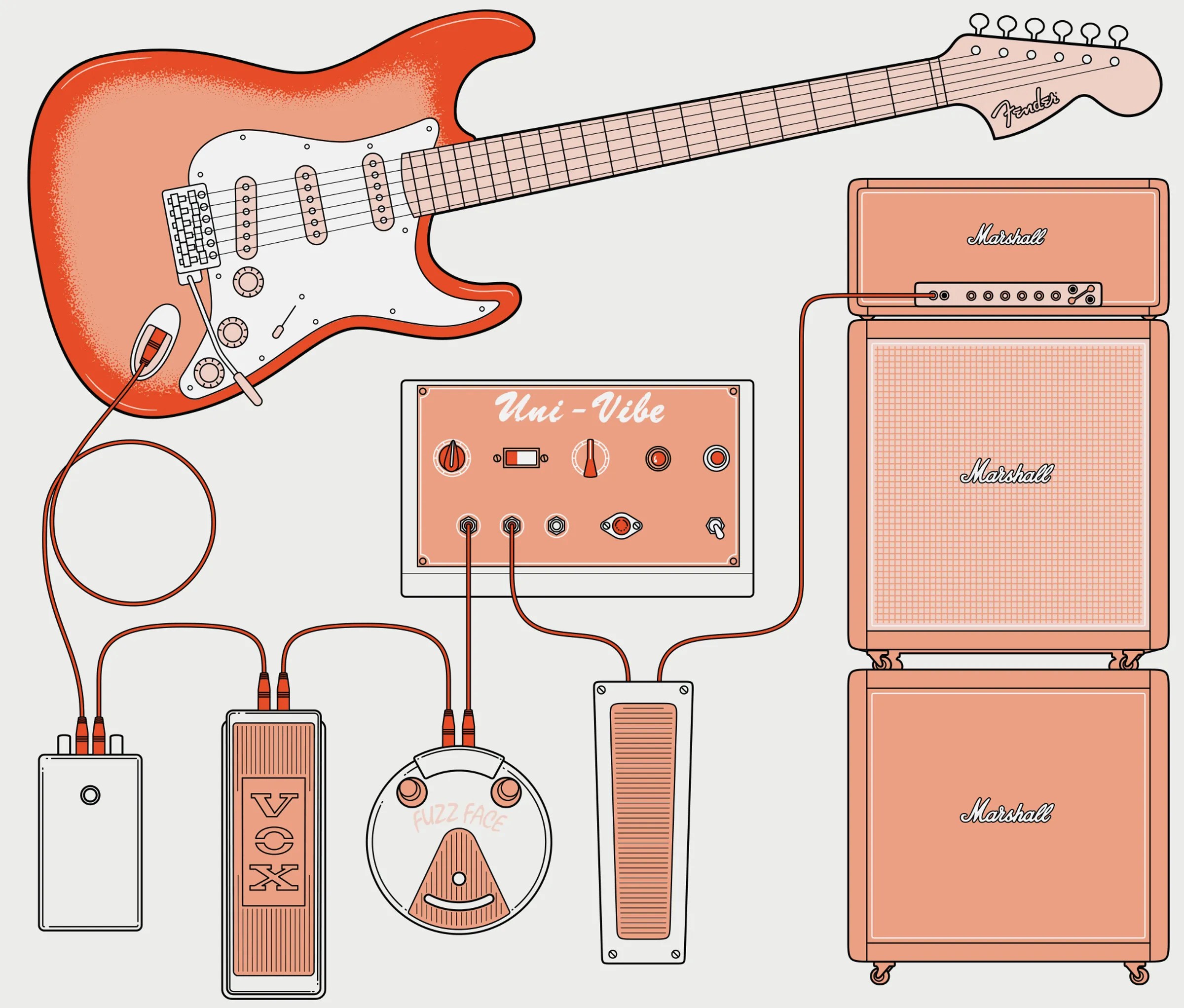
In 1967, Jimi Hendrix’s manager, Chas Chandler arranged for Jimi to meet Cream…
There was a particular night when Cream allowed Jimi to join them for a jam at the Regent Street Polytechnic in central London. Meeting Clapton had been among the enticements Chandler had used to lure Hendrix to Britain: “Hendrix blew into a version of [Howlin’ Wolf’s] ‘Killing Floor’,” recalls [Tony] Garland, “and plays it at breakneck tempo, just like that – it stopped you in your tracks.” [Keith] Altham recalls Chandler going backstage after Clapton left in the middle of the song “which he had yet to master himself”; Clapton was furiously puffing on a cigarette and telling Chas: “You never told me he was that fucking good.” – source
Hendrix’s extraodinary virtuosity has, altogether justly, gotten a great deal of attention; less well noted, his incredible mastery of the technology of music making, recording, and performance. Rohan Puranik explains…
3 February 1967 is a day that belongs in the annals of music history. It’s the day that Jimi Hendrix entered London’s Olympic Studios to record a song using a new component. The song was “Purple Haze,” and the component was the Octavia guitar pedal, created for Hendrix by sound engineer Roger Mayer. The pedal was a key element of a complex chain of analog elements responsible for the final sound, including the acoustics of the studio room itself. When they sent the tapes for remastering in the United States, the sounds on it were so novel that they included an accompanying note explaining that the distortion at the end was not malfunction but intention. A few months later, Hendrix would deliver his legendary electric guitar performance at the Monterey International Pop Festival.
“Purple Haze” firmly established that an electric guitar can be used not just as a stringed instrument with built-in pickups for convenient sound amplification, but also as a full-blown wave synthesizer whose output can be manipulated at will. Modern guitarists can reproduce Hendrix’s chain using separate plug-ins in digital audio workstation software, but the magic often disappears when everything is buffered and quantized. I wanted to find out if a more systematic approach could do a better job and provide insights into how Hendrix created his groundbreaking sound.
My fascination with Hendrix’s Olympic Studios’ performance arose because there is a “Hendrix was an alien” narrative surrounding his musical innovation—that his music appeared more or less out of nowhere. I wanted to replace that narrative with an engineering-driven account that’s inspectable and reproducible—plots, models, and a signal chain from the guitar through the pedals that you can probe stage by stage…
[And probe it Puranik does– fascinatingly, stage by stage…]
… Hendrix didn’t speak in decibels and ohm values, but he collaborated with engineers who did—Mayer and Kramer—and iterated fast as a systems engineer. Reframing Hendrix as an engineer doesn’t diminish the art. It explains how one person, in under four years as a bandleader, could pull the electric guitar toward its full potential by systematically augmenting the instrument’s shortcomings for maximum expression.
“Jimi Hendrix Was a Systems Engineer,” from @spectrum.ieee.org.
See also: “The Technology of Jimi Hendrix.”
* Jimi Hendrix, “Purple Haze”
###
As we plug in, we might send well-connected birthday greetings to another wizard with wires, Geoff Tootill; he was born on this date in 1922. An electronic engineer and computer scientist, he worked (with Freddie Williams and Tom Kilburn) to design a computer memory. To that end they built the first electronic stored-program computer— the Manchester Baby— at the University of Manchester in 1948.
The Baby was not intended to be a practical computing engine, but was instead designed as a testbed for the Williams tube, the first truly random-access memory. Nonethless, Baby worked: Alan Turing moved to Manchester to use it, and the following year, it inspired the Ferranti Mark 1, the world’s first commercially available electronic general-purpose stored-program digital computer.

“Last time I checked, the digital universe was expanding at the rate of five trillion bits per second in storage”*…

… and rising. Happily, technologists are keeping up:
The intricate arrangement of base pairs in our DNA encodes just about everything about us. Now, DNA contains the entirety of “The Wonderful Wizard of Oz” as well.
A team of University of Texas Austin scientists just vastly improved the storage capacity of DNA and managed to encode the entire novel — translated into the geek-friendly language of Esperanto — in a double strand of DNA far more efficiently than has been done before. DNA storage isn’t new, but this work could help finally make it practical…
The full story at “Scientists Stored “The Wizard of Oz” on a Strand of DNA.” The UT release, here.
* George Dyson
###
As we reconsider Kondo, we might send carefully-stowed birthday greetings to Jay Wright Forrester; he was born on this date in 1914. A pioneering computer engineer and systems scientist, he was one of the inventors of magnetic core memory, the predominant form of random-access computer memory during the most explosive years of digital computer development (between 1955 and 1975). It was part of a family of related technologies which bridged the gap between vacuum tubes and semiconductors by exploiting the magnetic properties of materials to perform switching and amplification.
And close to your correspondent’s heart, Forrester is also believed to have created the first animation in the history of computer graphics, a “jumping ball” on an oscilloscope.

You must be logged in to post a comment.