Posts Tagged ‘Improbable Research’
“The difference between screwing around and science is writing it down”*…

It’s that time of year again: the 2025 IgNobel Awards have been awarded. Jennifer Ouellette reports…
Does alcohol enhance one’s foreign language fluency? Do West African lizards have a preferred pizza topping? And can painting cows with zebra stripes help repel biting flies? These and other unusual research questions were honored tonight in a virtual ceremony to announce the 2025 recipients of the annual Ig Nobel Prizes… when the serious and the silly converge—for science.
Established in 1991, the Ig Nobels are a good-natured parody of the Nobel Prizes; they honor “achievements that first make people laugh and then make them think.” The unapologetically campy awards ceremony features miniature operas, scientific demos, and the 24/7 lectures whereby experts must explain their work twice: once in 24 seconds and the second in just seven words.
Acceptance speeches are limited to 60 seconds. And as the motto implies, the research being honored might seem ridiculous at first glance, but that doesn’t mean it’s devoid of scientific merit. In the weeks following the ceremony, the winners will also give free public talks, which will be posted on the Improbable Research website…
Read on for accounts (each both amusing and fascinating) of this year’s winners: “Meet the 2025 Ig Nobel Prize winners,” @jenlucpiquant.bsky.social in @arstechnica.com.
More at the web site of Improbable Research— “research that makes people LAUGH, then THINK”– the organization behind the IgNobels.
* Adam Savage (@asavage.bsky.social)
###
As we have some serious fun, we might we might spare a thought for a man who embodied the marriage of science and glee: Ron Toomer; he died on this date in 2011. Toomer began his career as an aeronautical engineer who contributed to the heat shields on NASA’s Apollo spacecraft. But in 1965, he joined Arrow Development, an amusement park ride design company, where he became a legendary creator of steel roller coasters. His first assignment was “The Run-Away Mine Train” (at Six Flags Over Texas), the first “mine train” ride, and the second steel roller coaster (after Arrow’s Matterhorn Ride at Disneyland). Toomer went on to design 93 coasters worldwide, and was especially known for his creation of the first “inversion” coasters (he built the first coasters with 1, 2, 3, 4, 5, 6, and 7, loops). In 2000, he was inducted in the International Association of Amusement Parks and Attractions (IAAPA) Hall of Fame as a “Living Legend.”


Whether ’tis ignobler…
“The most exciting phrase to hear in science, the one that heralds new discoveries, is not ‘Eureka!’ but, ‘That’s funny…” —Isaac Asimov
“Once you eliminate the impossible, whatever remains, no matter how improbable, must be the truth.” —Sherlock Holmes
The good folks at Improbable Research have once again awarded the Ig Nobel Prizes. In keeping with IR’s goal…
to make people laugh, then make them think. We also hope to spur people’s curiosity, and to raise the question: How do you decide what’s important and what’s not, and what’s real and what’s not — in science and everywhere else?
… The Ig Nobel’s “honor” research that is, at the least, amusing… for instance, among this year’s winners:
VETERINARY MEDICINE PRIZE: Catherine Douglas and Peter Rowlinson of Newcastle University, Newcastle-Upon-Tyne, UK, for showing that cows who have names give more milk than cows that are nameless.
PEACE PRIZE: Stephan Bolliger, Steffen Ross, Lars Oesterhelweg, Michael Thali and Beat Kneubuehl of the University of Bern, Switzerland, for determining — by experiment — whether it is better to be smashed over the head with a full bottle of beer or with an empty bottle.
MEDICINE PRIZE: Donald L. Unger, of Thousand Oaks, California, USA, for investigating a possible cause of arthritis of the fingers, by diligently cracking the knuckles of his left hand — but never cracking the knuckles of his right hand — every day for more than sixty (60) years.
For the scholarly citations attaching to these accomplishments– and a full list of other winners– click here.
 At the 2009 ceremony, Public Health ig Nobel Prize winner Dr. Elena Bodnar demonstrates her invention — a brassiere that, in an emergency, can be quickly converted into a pair of protective face masks, one for the brassiere wearer and one to be given to some needy bystander. She is assisted by (real) Nobel laureates Wolfgang Ketterle (left), Orhan Pamuk, and Paul Krugman (right). PHOTO: Alexey Eliseev.
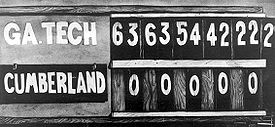
As our minds drift back toward campus, we might recall that, on this date in 1916, The Georgia Tech Yellow Jackets (playing under coach John Heisman, after whom The Trophy is named) set a still-unbroken football record, beating the Bulldogs of Cumberland College 222-0… of course, the game was in Atlanta, so the Jackets had home field advantage… Astoundingly, Tech wasn’t named National Champion for the first time until the following season.
 Everett Strupper, who scored eight TDs in the game
![Reblog this post [with Zemanta]](https://i0.wp.com/img.zemanta.com/reblog_e.png?w=700)
You must be logged in to post a comment.