Posts Tagged ‘attention’
“Tell me to what you pay attention and I will tell you who you are”*…

Before the attention economy consumed our lives, “pursuit tests” devised by the US military coupled man to machine with the aim of assessing focus under pressure. D. Graham Burnett explores these devices for evaluating aviators, finding a pre-history of the laboratory research that has relentlessly worked to slice and dice the attentional powers of human beings…
We worry about our attention these days — nearly all of us. There is something. . . wrong. We cannot manage to do what we want to do with our eyes and minds — not for long, anyway. We keep coming back to the machines, to the screens, to the notifications, to the blinking cursor and the frictionless swipe that renews the feed.
An ethnographer from Mars, moving among us (would we even notice?), might have trouble understanding our complaint: “Trouble with their attention? They stare at small slabs of versicolor glass all day! Their attentive powers are. . . sublime!”
And that misunderstanding rather sharpens the point: we don’t have any problem at all with the forms of attention that involve remaining engaged with, and responsive to, machines. We are amazing at the click and tap of durational vigilance to this or that stimulus, presented at the business end of a complex device. Our uncanny and immersive cybernetic attention is a defining characteristic of the age. Our human attention — our ability to be with ourselves and with others, our ability to receive the world with our minds and senses, our ability to daydream, read a book uninterrupted, or watch a sunset — well, many of us are finding it increasingly difficult to remember what that might even mean.
This isn’t really an accident. Over the last century or so, a series of elaborate programs of laboratory research have worked to slice and dice the attentional powers of human beings. Their aim? To understand the operational capacities of those who would be asked to shoot down airplanes, monitor radar screens, and otherwise sit at the controls of large and expensive machines. Seated in front of countless instruments, experimental subjects were asked to listen and look, to track and trigger. Psychologists stood by with stopwatches, quantifying our cybernetic capacities, and seeking ways to extend them. For those of us who have come of age in the fluorescence of the “attention economy”, it is interesting to look back and try to catch glimpses of the way that the movement of human eyeballs came under precise scrutiny, the way that machine vigilance became a field of study. We know now that the mechanomorphic attention dissected in those laboratories is the machine attention that is relentlessly priced in our online lives — to deleterious effects.
You could say that this process began with the fascinating and now mostly forgotten tool known as the “pursuit test”. Part steampunk videogame, part laboratory snuff-flick, the pursuit test staged and restaged the integration of man and machine across the first decades of the twentieth century…
Fascinating– and timely: “Cybernetic Attention– All Watched over by Machines We Learned to Watch,” from @publicdomainrev.bsky.social. Eminently worth reading in full.
* Jose Ortega y Gasset
###
As we untangle engagement, we might send thoughtful birthday greetings to a man whose work influenced the endeavors described in the piece featured above, Hermann Ebbinghaus; he was born on this date in 1850. A psychologist, he pioneered the experimental study of memory and discovered the learning curve, the forgetting curve, and the spacing effect.

“Stercus accidit”*…
As we try to understand the rifts afflicting our nation and world, many turn to Marx and his framework of class. But in a provocative essay, Catherine Nichols suggests that it was David Hume (in an 1752 essay that identified the unfettering of wealth from land) who identified the origin of our political divisions…
Describing the political map in terms of Left and Right is an accepted convention all over the world, almost to the point of cliché. Yet it is surprisingly complicated to explain whose interests lie on each side of this spectrum. For example, if the Left supports the interests of workers over the interests of employers, why are Left-leaning regions of the United States and elsewhere in the world among the richest? When Japan and South Korea sought to become economic powerhouses in the later 20th century, they adopted Leftist policies such as strong public education, universal healthcare and increased gender equality – if countries seeking to compete in capitalist arenas adopt broadly Leftist policies, then how do we explain why Leftists are always talking about overthrowing capitalism? And if the Left is somehow both the party of workers’ rights and the party of material wealth, then whose interests are supported by the Right? Given such contradictions, how did these terms become so central to modern politics?
The terms ‘left’ and ‘right’ come from the seating arrangements in the National Assembly during the French Revolution, where the combatants used the medieval estate groupings to define their battle lines. According to their writings, land-owning aristocrats (the Second Estate) were the party of the Right, while the interests of nearly everyone else (the Third Estate) belonged to the Left. This Third Estate included peasants working for the landowners but also every other kind of business owner and worker. Decades later, Karl Marx offered a different analysis of capitalism: he put owners of both land and businesses together on one side (the bourgeoisie), while grouping workers from fields and factories on the other side (the proletariat) in a single, world-wide class struggle. The trouble with both these ways of parsing Left and Right is that voting patterns never seem to line up with class. Both historic analyses leave us with questions about the contemporary world – and not just the paradox of why so many Left-leaning places are so rich. Why, for example, do working-class conservatives appear to vote against their material interests, year in and year out, across generations?
The 18th-century philosopher and political theorist David Hume had answers to these questions, though he was writing decades before the French Revolution. While his essay ‘Of Public Credit’ (1752) was a warning about the dangers of Britain’s increasing reliance on debt financing, his apocalyptic vision of the future turned out to describe some features of our current political map surprisingly well. Hume was writing because he believed that debt financing had the power to upend Europe’s traditional power structure and culture by creating a new source of money divorced from tradition or responsibility: stocks and bonds. Unlike land, anyone with some cash could buy war bonds and get an immediate passive income in the form of interest. This was the thin end of the wedge caused by the debt financing that Hume believed was destroying every part of society. The governments of antiquity, Hume argued, saved money to use in battle and then waged wars in self-defence, or else to expand their territory. But the British had invented a new form of warfare that Hume saw no precedent for, even in the merchant states of Nicollò Machiavelli’s Italy: war for trade, funded with money borrowed from private stockholders…
[Nichols unpacks Hume’s observations (centrally, that three groups with stakes in the status quo, heretability, and the sanctity of “family and family hierarchy”tradition”– landowners, aging parents, and want to preserve old power structures, including the family– and traces their relevance, from Hume’s time to ours…]
… There are many reasons for people aligning Right or Left, which is why analyses of class and material interests fall short of describing the realities of people’s politics. Hume foresaw that these specific groups would resent the economic sea-change of the 18th century – and he was correct. Many people would rather have land and power than money and liberty.
Still, the power of the Right hasn’t doomed the Left – no more than the Spanish Inquisition doomed the rise of the Left in 18th-century England and France. As long as governments want to keep the value of their currencies from falling, someone in their ranks will be using the methods of the Left and inventiveness that brought us everything from our banking system to gay marriage. We don’t need to resurrect communism or focus narrowly on class, following Marx. The experiments are far from over, and we should remember that the Left is generally where money comes from in modern times. We give away too much power when we forget it…
Rethinking Right and Left: “Landholder vs stockholder,” from @catherinenichols.bsky.social in @aeon.co.
As for how it’s going at the moment (and further to Hume and the quote in this post’s title), see: “MAGA’s Betrayal of Small Business,” from @pkrugman.bsky.social.
* “shit happens”– often attributed to David Hume, reflecting his skeptical view that human understanding, particularly of cause-and-effect, is limited to habitual belief from experience, implying that unforeseen, messy outcomes (“shit”) inevitably occur in life despite our reasoning.
###
As we sort the Whigs from the Tories, we might recall that it was on this date 1656 that Blaise Pascal (writing under the pseudonym Louis de Montalte) published the first of his Provential Letters (Lettres provinciales), a series of eighteen polemical letters using humor to attack Jesuits for their use of casuistry and their moral laxity. Though the Letters were a popular success, they had little immediate effect on politics or the clergy. But they influenced later French writers like Voltaire and Jean-Jacques Rousseau and ultimately persuaded Pope Alexander to condemn “laxity” in the church and order a revision of casuistic texts.

“Attention is the rarest and purest form of generosity”*…

… But that most valuable of gifts is being hijacked, subverted/converted into a commodity, and used to mold not just consumer behavior, but society-as-a-whole. We live in an attention economy, and its media/tech ownership landscape is becoming ever more consoldiated.
Kyla Scanlon unpacks the way in which concentrated ownership of media and tech and their automated manipulation reshape democracy…
It’s nearly impossible not to get lost in the news right now. I was at a wedding last week, and every conversation eventually drifted back to the same subject: the World We Are in and All That is Happening. The ground feels like it’s moving faster than anyone can feasibly keep up with.
Some people think the shift is progress. Others see collapse. Either way, the line between digital and physical life is increasingly blurry. What happens online is real life. What we consume is what we become.
Plenty of thinkers have circled this before – Postman, Debord, Huxley, Orwell on media; Machiavelli, Tocqueville, Thucydides, Gibbon on human corruptibility during times of uncertainty. The convergence of endless information and a ragebait economy creates the perfect environment for splintering how we understand the world and how we understand each other.
The deeper problem is this: we no longer trust institutions to provide truth, fairness, or mobility. Once, they were scaffolding that helped us climb from raw data to wisdom. And when that scaffolding gives out, people adapt: some over-perform in the status race (because you have to) and others defect from obligations altogether (why would I work for institutions if they don’t work for me).
There are a few ways to picture our distorted information ecosystem.
- The DIKW Pyramid (Data → Information → Knowledge → Wisdom): raw posts and clicks at the bottom, trending content in the middle, shared truths above that, and finally wisdom, the rare ability to see causes instead of just symptoms.
- Or the Ladder of Inference: we start with data, add meaning, make assumptions – and our beliefs tend to affect what data we select. Bots and algorithms hijack that ladder, nudging us toward polarized beliefs before we realize what’s happening.
Taken together, we can combine them into what we might call a hierarchy of information:
- Raw data: the endless stream of posts, likes, bot spam
- Information: headlines, hashtags, trending things
- Knowledge: the narratives we share and fight over.
- Understanding: recognizing what might not be real (or is hyperreal)
- Wisdom: systemic analysis, the ability to see causes instead of just symptoms.
Right now, we’re stuck sloshing around in the middle layers of the hierarchy: drowning in outrage, fighting over partisan hot takes, rarely reaching understanding, almost never wisdom.
Chaos always has an architect. And if we want to make sense of American democracy today, we need to understand who those architects are, and how they profit from confusion.
This polarization rests on media concentration.The Telecommunications Act of 1996 was sold as a way to increase competition in media and telecommunications, but in reality, it did quite the opposite. Within five years, four firms controlled ~85% of US telephone infrastructure. That deregulated spine carried today’s consolidation of the entire media environment – not just telephones. Newspapers. Social media. TV stations.
We have the increasing concentration of media ownership, the financialization of attention, and the transformation of information from a public good into a private commodity to be bought, sold, and manipulated…
[Scanlon characterizes and explains the concentration, examines its impacts, and unpacks the roles of bots…]
When manufacturing consensus is both cheap to produce and valuable to those who benefit from confusion, you get industrial-scale manipulation.
Truth becomes whatever can capture the most attention in the shortest amount of time. Traditional journalism, with its slow fact-checking and institutional processes, can’t compete with bot-amplified outrage. Democratic deliberation, which requires shared facts and good faith dialogue, becomes nearly impossible when the information environment is designed to maximize conflict.
We’re living in a speculation economy where perception drives value more than fundamentals. Look at the stock market: Nvidia gained $150 billion in value based the back of a $100 billion OpenAI investment (which OpenAI will use to buy more Nvidia chips). Ten companies pass hundreds of billions back and forth, and the S&P jumps like it’s measuring something real.
It’s all memes wearing suits. Meme stocks and Dogecoin at least looked like jokes; now the same speculative energy runs through the corporate core. Attention, perception, and narrative drive valuation more than production or profit.
We’ve built a world where the hierarchy of information has flipped upside down.
At the bottom, bots flood us with raw noise. In the middle, outrage and team narratives harden into “knowledge.” At the top, the ladders to wisdom like journalism, schools, civic discourse, shared institutions are weakened. The scaffolding that once helped us climb no longer holds.
The traditional solutions – fact-checking, media literacy, content moderation – assume we’re dealing with a content problem when we’re actually facing an infrastructure problem. You can’t fact-check your way out of a system designed to reward misinformation. You can’t educate your way around algorithms optimized for polarization. You can’t moderate your way past economic incentives that make confusion profitable.
Recognizing this as a market structure problem rather than an information problem changes everything. Instead of focusing on individual bad actors or specific false claims, you start thinking about the underlying systems that make manipulation both profitable and scalable.
The information wars are economic policy, determining how we allocate attention, structure incentives, and organize the flow of information that shapes every other market and political decision we make. I don’t think it’s useful to get on a Substack soapbox about this – but we need to take (1) the power of media seriously and (2) those trying to influence it extremely seriously. There is a way to get to the top of the information hierarchy! We don’t have to be stuck in these middle layers…
Follow the money: “Who’s Getting Rich Off Your Attention?” from @kyla.bsky.social
For more on how the Telecommunications Act of 1996 helped set all of this in motion, see: “On Jimmy Kimmel: It’s Time to Destroy the Censorship Machine and Repeal the Telecommunications Act of 1996” from @matthewstoller.bsky.social.
For more on thoughts on why companies are behaving in the ways they are: “Why Corporate America Is Caving to Trump” and “Media consolidation is shaping who folds under political pressure — and who could be next.”
And lest we think that this came out of nowhere: “David Foster Wallace Tried to Warn Us About these Eight Things.”
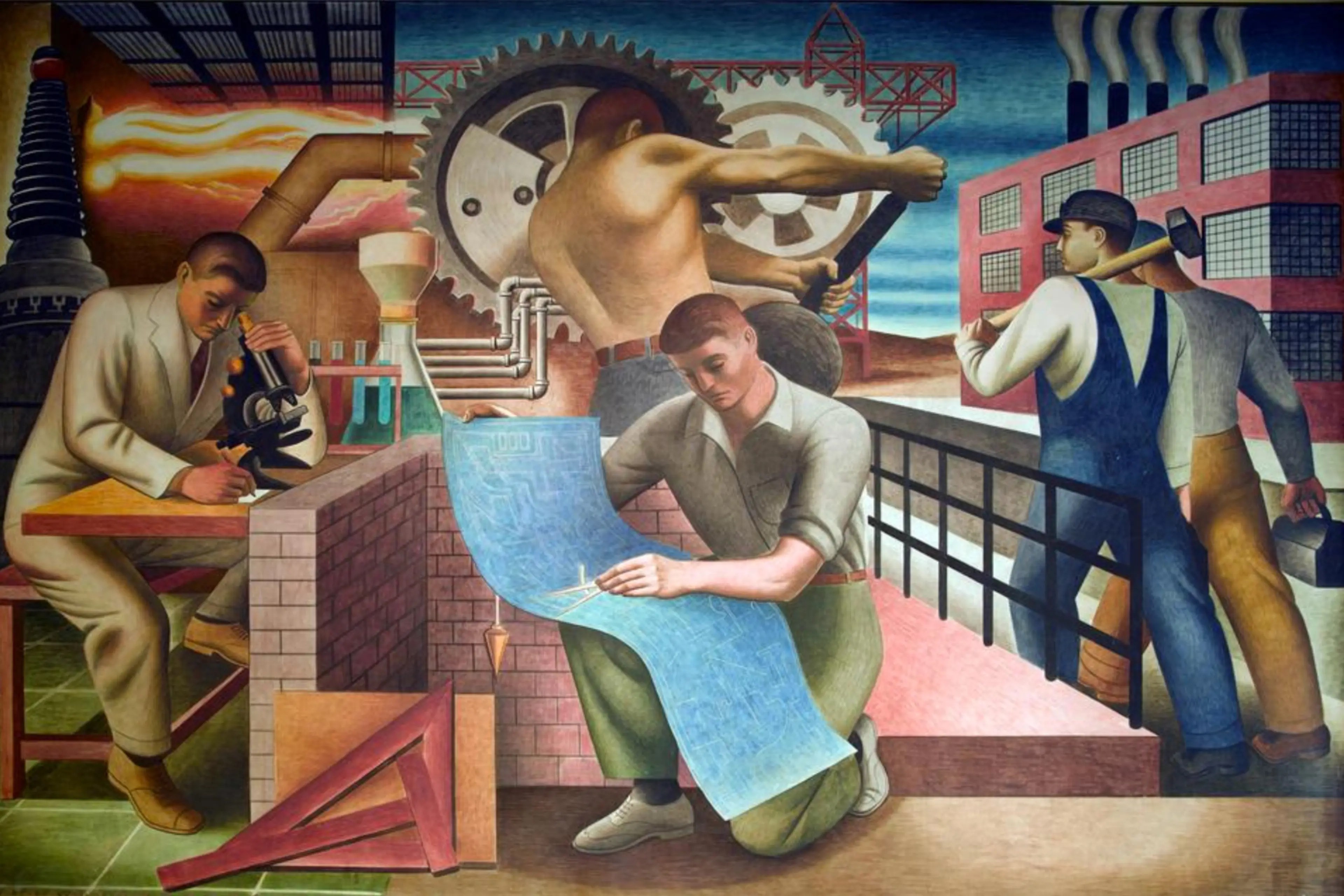
[Image above: source]
###
As we reclaim recognition, we might recall that on this date in 1452 an earlier information revolution began: Johannes Gutenberg started work on his Bible (which was completed and published in 1455). An inventor and craftsman, Gutenberg created the movable-type printing press, enabling a much faster (and cheaper) printing process. (Movable type was already in use in East Asia, but was slower and used for smaller jobs.) His Bible was his first major work, and his most impactful.
The printing press later spread across the world, leading to an information revolution– the unprecedented mass-spread of literature throughout Europe. It had a profound impact on the development of the Renaissance, Reformation, and Humanist movements.

“Tell me to what you pay attention and I will tell you who you are”*…

… and then I’ll sell you something.
D. Graham Burnett on how an alliance between psychologists and advertisers at the turn of the 20th century taught us how to measure (and monetize) human attention…
Our eyes are worth money. We know that, now. It has become a commonplace that our “attention economy” is functionally an eyeball economy. But how did eyeballs come to look like dollar signs? Let’s dig into what we might think of as the original Faustian Bargain by which the sciences of human perception (with their sophisticated technologies of precision monitoring and measurement) cut a deal with those who move the money around…
An illuminating account of the history of a powerful– and profitable– alliance: “Fracking Eyeballs,” from @asterisk_mag_.
* Jose Ortega y Gasset
###
As we analyze attentiveness, we might recall that it was on this date in 1994 that Laurence Cantor unleashed the “Green Card” spam (advertising the law firm that he operated with his wife, Martha Siegel, and its immigration law services) on the Usenet. While it wasn’t the very first instance of spam, it was the first commercial Usenet spam; and its unapologetic authors are seen as having pioneered the modern global practice of spamming.

“The control of large numbers is possible, and like unto that of small numbers, if we subdivide them”*…

It’s always been intuitively obvious that we handle small numbers more easily than large ones. But the discovery that the brain has different systems for representing small and large numbers provokes new questions about memory, attention, and mathematics…
More than 150 years ago, the economist and philosopher William Stanley Jevons discovered something curious about the number 4. While musing about how the mind conceives of numbers, he tossed a handful of black beans into a cardboard box. Then, after a fleeting glance, he guessed how many there were, before counting them to record the true value. After more than 1,000 trials, he saw a clear pattern. When there were four or fewer beans in the box, he always guessed the right number. But for five beans or more, his quick estimations were often incorrect.
Jevons’ description of his self-experiment, published in Nature in 1871, set the “foundation of how we think about numbers,” said Steven Piantadosi, a professor of psychology and neuroscience at the University of California, Berkeley. It sparked a long-lasting and ongoing debate about why there seems to be a limit on the number of items we can accurately judge to be present in a set.
Now, a new study in Nature Human Behaviour has edged closer to an answer by taking an unprecedented look at how human brain cells fire when presented with certain quantities. Its findings suggest that the brain uses a combination of two mechanisms to judge how many objects it sees. One estimates quantities. The second sharpens the accuracy of those estimates — but only for small numbers…
Although the new study does not end the debate, the findings start to untangle the biological basis for how the brain judges quantities, which could inform bigger questions about memory, attention and even mathematics…
One, two, three, four… and more: “Why the Human Brain Perceives Small Numbers Better,” from @QuantaMagazine.
* Sun Tzu
###
As we stew over scale, we might spare a thought for a man untroubled by larger (and more complicated) numbers, Émile Picard; he died on this date in 1941. A mathematician whose theories did much to advance research into analysis, algebraic geometry, and mechanics, he made his most important contributions in the field of analysis and analytic geometry. He used methods of successive approximation to show the existence of solutions of ordinary differential equations. Picard also applied analysis to the study of elasticity, heat, and electricity. He and Henri Poincaré have been described as the most distinguished French mathematicians in their time.
Indeed, Picard was elected the fifteenth member to occupy seat 1 of the Académie française in 1924.


You must be logged in to post a comment.