Posts Tagged ‘attention’
“The best way to preserve a child’s vision is to let them see things their way rather than yours”*…

Kira Cook contemplates a series of photos taken by kids of their (unaware or surprised) parents…
… somehow, these malevolent images are borne from the tiny fingers and eyes and perspectives of the ones who love us… most?!
Children, of course, know little to nothing about “crafting” a good portrait. They know naught of symmetry, or contrast, or depth of field. They do, however, know the specific power of finally having control over the rectangular device normally glued to their parents’ hands. They pound that round red button at will, capturing images from their abbreviated heights, their lilliputian thumbs obscuring the lens, often blurring the image with their relentless movement.
These pictures remind us that while we study our children, they study us back. Before we speak, we see. For months before spoken language ever enters the relationship, a child gazes upon its mother for hours, every day. The gaze of the child is the least judgmental, the most accepting. When a child takes a portrait of their parent, there is an absence of so many of the elements that inherently exist in the portraits an adult makes. There is no moralizing, for one. No manipulation. They don’t bother to hide or deny the aspects we normally do in photos. In fact, unlike in every other photographic example, there is a total absence of forethought or editorializing…

More (and more on the) unflattering portraits that do what kids do best, wholeheartedly engage with the present moment: “The Humbling Tyranny of the Photos Our Kids Take of Us,” from @kirahesser in @romper.
* Jacob Liberman
###
As we say cheese, we might recall that it was on this date in 1839 that Samuel Morse, a professor of art and painting at the University of the City of New York (now New York University) in Paris to promote his invention of the telegraph, met with Louis Daguerre.
Morse was fascinated by Daguerre’s daguerreotype—the first practical means of photography. Morse wrote a letter to the New York Observer describing the invention, which was published widely in the American press and stoked broad interest in the new technology. On his return to New York, he taught classes in the technique to his colleagues at NYU and others– including Mathew Brady, one of the earliest photographers in American history, famous for his depictions of the Civil War.

“I will buckle down to work as soon as I finish reading the Internet”*…

Worried that technology is “breaking your brain:? As Joe Stadolnik explains, fears about attention spans and focus are as old as writing itself…
If you suspect that 21st-century technology has broken your brain, it will be reassuring to know that attention spans have never been what they used to be. Even the ancient Roman philosopher Seneca the Younger was worried about new technologies degrading his ability to focus. Sometime during the 1st century CE, he complained that ‘The multitude of books is a distraction’. This concern reappeared again and again over the next millennia. By the 12th century, the Chinese philosopher Zhu Xi saw himself living in a new age of distraction thanks to the technology of print: ‘The reason people today read sloppily is that there are a great many printed texts.’ And in 14th-century Italy, the scholar and poet Petrarch made even stronger claims about the effects of accumulating books:
Believe me, this is not nourishing the mind with literature, but killing and burying it with the weight of things or, perhaps, tormenting it until, frenzied by so many matters, this mind can no longer taste anything, but stares longingly at everything, like Tantalus thirsting in the midst of water.
Technological advances would make things only worse. A torrent of printed texts inspired the Renaissance scholar Erasmus to complain of feeling mobbed by ‘swarms of new books’, while the French theologian Jean Calvin wrote of readers wandering into a ‘confused forest’ of print. That easy and constant redirection from one book to another was feared to be fundamentally changing how the mind worked. Apparently, the modern mind – whether metaphorically undernourished, harassed or disoriented – has been in no position to do any serious thinking for a long time.
In the 21st century, digital technologies are inflaming the same old anxieties… and inspiring some new metaphors…
Same as it ever was– a history of the anxieties about attention and memory that new communications technologies have occasioned through history: “We’ve always been distracted,” from @joestadolnik in @aeonmag.
* Stewart Brand @stewartbrand
###
As we learn our way into new media, we might recall that it was it was on this date in 1946 that the first first Washington, D.C. – New York City telecast was accomplished, using AT&T corporation’s coaxial cable; General Dwight Eisenhower was seen to place a wreath at the base of the statue in the Lincoln Memorial and others made brief speeches. The event was judged a success by engineers, although Time magazine called it “as blurred as an early Chaplin movie.”

“The things right in front of us are often the hardest to see”*…

Fake news, like conjuring, plays on our weaknesses — but, as Tim Harford explains, with a little attention, we can fight back…
Why do people — and by “people” I mean “you and I” — accept and spread misinformation? The two obvious explanations are both disheartening. The first is that we are incapable of telling the difference between truth and lies. In this view, politicians and other opinion-formers are such skilled deceivers that we are helpless, or the issues are so complex that they defy understanding, or we lack basic numeracy and critical-thinking skills. The second explanation is that we know the difference and we don’t care. In order to stick close to our political tribe, we reach the conclusions we want to reach.
There is truth in both these explanations. But is there a third account of how we think about the claims we see in the news and on social media — an account that, ironically, has received far too little attention? That account centres on attention itself: it suggests that we fail to distinguish truth from lies not because we can’t and not because we won’t, but because — as with Robbins’s waistcoat — we are simply not giving the matter our focus.
What makes the problem worse is our intuitive overconfidence that we will notice what matters, even if we don’t focus closely. If so, the most insidious and underrated problem in our information ecosystem is that we do not give the right kind of attention to the right things at the right time. We are not paying enough attention to what holds our attention.
The art of stage magic allows us to approach this idea from an unusual angle: Gustav Kuhn’s recent book, Experiencing the Impossible, discusses the psychology of magic tricks.
“All magic can be explained through misdirection alone,” writes Kuhn, a psychologist who runs the Magic Lab at Goldsmiths, University of London. Such a strong claim is debatable, but what is beyond debate is that the control and manipulation of attention are central to stage magic. They are also central to understanding misinformation. The Venn diagram of misinformation, misdirection and magic has overlaps with which to conjure.
[There follows a fascinating unpacking of the relevance of misdirection to to misinformation…]
We retweet misinformation because we don’t think for long enough to see that it is misinformation. We obsess over bold lies, not realising that their entire purpose is to obsess us. We see one thing and assume it is another, even though we are only deceiving ourselves. We will argue in favour of policies that we opposed seconds ago, as long as we can be distracted long enough to flip our political identities in a mirror.
And behind all this is the grand meta-error: we have no intuitive sense that our minds work like this. We fondly imagine ourselves to be sharper, more attentive and more consistent than we truly are. Our own brains conspire in the illusion, filling the vast blind spots with plausible images.
But if you decide to think carefully about the headlines, or the data visualisations that adorn news websites, or the eye-catching statistics that circulate on social media, you may be surprised: statistics aren’t actually stage magic. Many of them are telling us important truths about the world, and those that are lies are usually lies that we can spot without too much trouble.
Pay attention; get some context; ask questions; stop and think. Misinformation doesn’t thrive because we can’t spot the tricks. It thrives because, all too often, we don’t try. We don’t try, because we are confident that we already did…
Simple, but profoundly important, wisdom: “What magic teaches us about misinformation,” from @TimHarford. eminently worth reading in full. (Originally appeared in the Financial Times Magazine, from whence the illustration above.)
Related: the Barnum (or Forer) Effect
* Apollo Robbins, world-famous pickpocket and illusionist
###
As we dissect disinformation, we might spare a thought for Oscar Hammerstein; he died on this date in 1919. As a newly-arrived immigrant to the U.S., Hammerstein worked in a cigar factory, where he discovered ways to automate the rolling process. He patented his innovation and made a fortune– which he promptly reinvested in his true passions, music and the arts. Possessed of a sharp sense of design and an equally good acoustical sense, he built and ran theaters and concert halls, becoming one of Americas first great impressarios… a fact worth honoring, as history tends to overlook “Oscar the First” in favor of his grandson, Oscar Hammerstein II, the gifted librettist/lyricist and partner of Richard Rodgers.

“How we spend our days is, of course, how we spend our lives”*…

On the history and impact of a seemingly simple service…
If I was to ask you what was the most important invention of the 20th century, you might mention the car, the television, the computer, or the internet. But there’s another invention that had such a huge impact on culture and society that people would organize their lives around it, and it drove the growth of multi-billion dollar industries. Despite this, most of us wouldn’t think of it as an invention at all, as it seems to have always just been there. So here’s a brief history of one of the most important overlooked inventions of modern times: the TV schedule…
The TV schedule organized the attention of millions of people at the same time, sharing the same experience, whether it was Richard Nixon sweating in a presidential debate, Neil Armstrong stepping foot onto the moon, or finding out who shot JR. These live, synchronous events created a kind of public sphere at a scale that had never been seen before, and we’re unlikely to see again. Sports are the only TV events that get close—on the list of most-watched US TV programs of all time, the only entries from the 2000s are Superbowls.
For nearly a century, a simple list, based around the hours of the day, structured the daily habits of millions of people, shaped the careers of politicians and celebrities, and powered a multi-billion dollar advertising industry. As we spend less time watching live TV, and more time on digital platforms, that power is now passing from the TV schedule to another way of organising our attention—algorithmic streams…
Entertainment, technology, and shared experiences: “The TV Schedule Edition,” from Why Is This Interesting? (@WhyInteresting), by Matt Locke (@matlock).
(Image above: source)
* Annie Dillard
###
As we tune in, we might recall that it was on this date in 1980 that Magnum, P. I. premiered on CBS; consistently highly-rated and the recipient of numerous Emmy and Golden Globe nominations and awards, it ran until 1988, and made a star of its lead, Tom Selleck.

“The element of mystery to which you want to draw attention should be surrounded and veiled by a quite obvious, readily recognisable commonness”*…
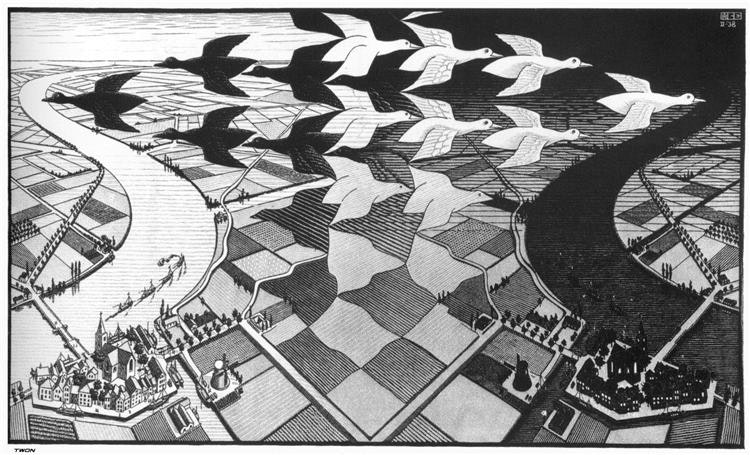
An appreciation of the marvelous M.C. Escher…
Despite being a fan of Rennaisance Art and the work of the Impressionists, he feels increasingly pulled in a different direction…
When you look at this picture, you’re flipping between world views. Either you’re seeing the white birds, and the bright, presumably sunlit day scene with its cheerful flotilla of steam ships puffing their way upriver – or you’re seeing the black birds, and your eye is drawn to the night-shrouded landscape where the houses have their lights on and the sky’s already eaten the horizon & is creeping nearer…
Except, that’s not quite right. The black birds are in the daylight side, and the white ones are flying into the night. These aren’t just mirror images: they’re like the Ancient Chinese yin-yang symbol, each side containing part of its opposite…
Escher’s love of the fantastical is primarily inspired by what he sees around him, not what he can dream up out of next to nothing… By looking closely at the real world, and trying to understand how it works, Escher will invite his initially small but intensely loyal fanbase to explore some very strange mysteries indeed.
…

It’s the 1960s now, and nonconformity is all the rage. Hair is getting longer, psychedelics-powered artistry is flourishing, and anything that seems to scream to hell with the rules is increasingly in vogue… Because of the fantastical elements of his work, Escher is acquiring a reputation as a surrealist. As a self-identifying “reality enthusiast,” it’s the very last thing he wants. Take Ascending & Descending, where he’s clearly turning his imagination to the futility of so much in the human-centred world. In a letter to a friend, he says:
“Yes, yes, we climb up and up, we imagine we are ascending; one step is about 10 inches high, terribly tiring – and where does it get us? Nowhere.”
But until the end of his career, his work will continue to speak to something deeper – a rebellion against human incuriosity, or a constant rallying-cry for the act of paying attention…
Read it in full: “Fooling With Certainty: The Impossibly Real Worlds Of MC Escher,” from Mike Sowden (@Mikeachim)
* M. C. Escher
###
As we look closely, we might recall that it was on this date in 1859 that our perspective was shifted in a different kind of way: Charles Darwin published The Origin of the Species. Actually, on that day he published On the Origin of Species by Means of Natural Selection, or the Preservation of Favoured Races in the Struggle for Life; the title was shortened to the one we know with the sixth edition in 1872.

(Roughly) Daily will be on a brief Thanksgiving hiatus, returning when the the tryptophan haze has passed…
You must be logged in to post a comment.