Posts Tagged ‘advertising’
“To a real child anything will serve as a toy”*…

The story of a toy that both confirms and contradicts that sentiment, Mr. Potato Head…
Mr. Potato Head is an American toy brand consisting of a plastic model of a potato “head” to which a variety of plastic parts can attach — typically ears, eyes, shoes, hat, nose, pants and mouth.
Mr. Potato Head was invented and manufactured by George Lerner in 1949, but was first distributed by Hasbro in 1952… In its original form, Mr. Potato Head was offered as separate plastic parts with pushpins to be affixed to a real potato or other vegetable. Due to complaints regarding rotting vegetables and new government safety regulations, Hasbro began including a plastic potato body with the toy set in 1964.
…
In the early 1940s, Brooklyn-born toy inventor George Lerner came up with the idea of inserting small, pronged body and face parts into fruits and vegetables to create a “funny face man”. Some speculate he got the idea from his wife’s nephew Aaron Bradley, who was seen placing sticks inside of potatoes in the family garden. Lerner would often take potatoes from his mother’s garden and, using various other fruits and vegetables as facial features, he would make dolls with which his younger sisters could play. The grape-eyed, carrot-nosed, potato-headed dolls became the principal idea behind the plastic toy which would later be manufactured.
Mr, Potato Head turned out to be a trailblazer– the pioneer of a new form of marketing that supercharged the toy category and paved the way for the toy-character-centered entertainment environment in which we live…
On April 30, 1952, Mr. Potato Head became the first toy advertised on television. The campaign was also the first to be aimed directly at children; before this, commercials were only targeted at adults, including toy advertisements. The commercial revolutionized marketing, and caused an industrial boom. Over one million kits were sold in the first year…
“Mr. Potato Head” from @Wikipedia.
Image above: from the collection of the Victoria and Albert Museum
* John Cowper Powys
###
As we play, we might send tasty birthday greetings to the literary genius behind green eggs and ham, Theodor Seuss Geisel, AKA “Dr. Seuss”; he was born on this date in 1904. After a fascinating series of early-career explorations, Geisel settled on a style that created what turned out to be the perfect “gateway drug” to book addiction– and a love of words– for generations of young readers.
The more that you read,
The more things you will know.
The more that you learn,
The more places you’ll go.
– I Can Read With My Eyes Shut! (1978)

“Nothing is so painful to the human mind as a great and sudden change”*…
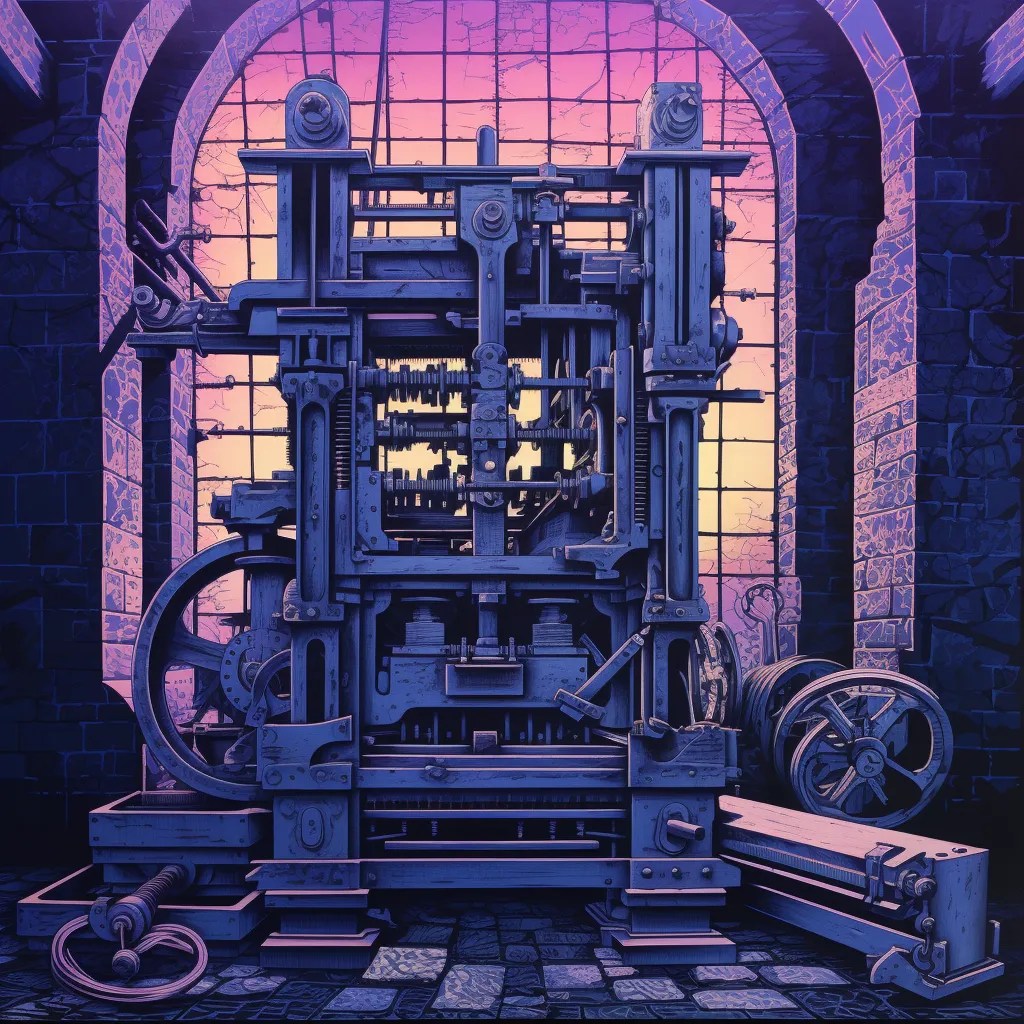
If an AI-infused web is the future, what can we learn from the past? Jeff Jarvis has some provocative thoughts…
The Gutenberg Parenthesis—the theory that inspired my book of the same name—holds that the era of print was a grand exception in the course of history. I ask what lessons we may learn from society’s development of print culture as we leave it for what follows the connected age of networks, data, and intelligent machines—and as we negotiate the fate of such institutions as copyright, the author, and mass media as they are challenged by developments such as generative AI.
Let’s start from the beginning…
In examining the half-millennium of print’s history, three moments in time struck me:
- After Johannes Gutenberg’s development of movable type in the 1450s in Europe (separate from its prior invention in China and Korea), it took a half-century for the book as we now know it to evolve out of its scribal roots—with titles, title pages, and page numbers. It took another century, until this side and that of 1600, before there arose tremendous innovation with print: the invention of the modern novel with Cervantes, the essay with Montaigne, a market for printed plays with Shakespeare, and the newspaper.
- It took another century before a business model for print at last emerged with copyright, which was enacted in Britain in 1710, not to protect authors but instead to transform literary works into tradable assets, primarily for the benefit of the still-developing industry of publishing.
- And it was one more century—after 1800—before major changes came to the technology of print: the steel press, stereotyping (to mold complete pages rather than resetting type with every edition), steam-powered presses, paper made from abundant wood pulp instead of scarce rags, and eventually the marvelous Linotype, eliminating the job of the typesetter. Before the mechanization and industrialization of print, the average circulation of a daily newspaper in America was 4,000 (the size of a healthy Substack newsletter these days). Afterwards, mass media, the mass market, and the idea of the mass were born alongside the advertising to support them.
One lesson in this timeline is that the change we experience today, which we think is moving fast, is likely only the beginning. We are only a quarter century past the introduction of the commercial web browser, which puts us at about 1480 in Gutenberg years. There could be much disruption and invention still ahead. Another lesson is that many of the institutions we assume are immutable—copyright, the concept of creativity as property, mass media and its scale, advertising and the attention economy—are not forever. That is to say that we can reconsider, reinvent, reject, or replace them as need and opportunity present…
Read on for his suggestion for a reinvention of copyright: “Gutenberg’s lessons in the era of AI,” from @jeffjarvis via @azeem in his valuable newsletter @ExponentialView.
* Mary Wollstonecraft Shelley, Frankenstein
###
As we contemplate change, we might spare a thought for Jan Hus. A Czech theologian and philosopher who became a Church reformer, he was burned at the stake as a heretic (for condemning indulgences and the Crusades) on this date in 1415. His teachings (which largely echoed those of Wycliffe) had a strong influence, over a century later, on Martin Luther, helping inspire the Reformation… which was fueled by Gutenberg’s technology, which had been developed and begun to spread in the meantime.

“The past is a foreign country: they do things differently there”*…

The inimitable Tim Urban on the children who populate print ads from the first (the “pre-TV”) half of the 20th century…
Girls who are a weird level of hungry…

Kids with old faces…

Infants drinking soda…

Children at risk…

… and so much more: “Creepy Kids in Creepy Vintage Ads,” from @waitbutwhy.
* L.P. Hartley, The Go-Between
###
As we contemplate change, we might recall that it was on this date in 1941, before a Brooklyn Dodgers–Philadelphia Phillies game at Ebbets Field, that NBC-owned station WNBT in New York aired the first (legal) television commercial– The “Bulova Time Check.” Bulova paid $4 in air fees plus $5 in station fees; there were about 4,000 TV sets in the New York Area at the time. The average cost of a 30-second spot in the broadcast of the last Super Bowl was $7,000,000.
“Make it simple. Make it memorable. Make it inviting to look at. Make it fun to read.”*…

From the annals of advertising…
Planted in 1938, the Studebaker sign in Bendix Woods was once recognized by Guinness World Records as the world’s largest living advertisement. In its prime, it contained 8,000 red and white pine trees. After 75 years with no maintenance, it has thinned out to just 2,000 but is still visible from the air.
Back in 1926, the Studebaker Corporation built what it claimed to be the first closed testing facility for an American car company. The automobile manufacturer, founded in 1852, spent more than one million dollars on the test facility, which included a three-mile circuit with a variety of special test sections including hill climbs, skid pads, snaking curves, and bumpy roads.
Naturally, if you’re going to spend a million dollars on a test circuit, you might as well invest a little more on a giant living sign made out of pine trees that’s only visible from the air, so that’s what Studebaker did…
Initially, the letters were nicely ordered, well defined and maybe even a little skinny. They were easy to read from the air, which is exactly what Studebaker intended. The sign was a salute to the growing aviation industry and a handy publicity stunt that could be seen by overflying aircraft passengers.
Over the years, of course, the pine trees grew and so did the letters. Studebaker, on the other hand, started to wither away. After years of financial problems, the company closed its last remaining production facility in 1966. Studebaker sold the land on which the trees stood to the Bendix Corporation, which donated some of the property for the creation of a county park (hence its current name: Bendix Woods County Park)…
Despite the demise of its namesake company, the Studebaker sign remained. In 1985, it was included in the National Register of Historic Places. Two years later, it first appeared in the Guinness Book of World Records as the world’s “largest living advertisement sign” (a record that no longer seems to exist)…
One of the world’s largest living advertisements is made out of pine trees: the “Studebaker Tree Sign,” from @atlasobscura.
* Advertising pioneer Leo Burnett
###
As we think big, we might recall that today is a momentous one in the histories of two other monumental messages:
On this date in 1631 Mumtaz Mahal, the beloved wife of the fifth Mughal emperor, Shah Jahan, died. He spent the next 17 years building her mausoleum, the Taj Mahal.

And on this date in 1885 the Statue of Liberty— a message of affection and respect from the people of France– arrived in New York Harbor.

“Toys are intriguing… they represent one way that society socializes its young”*…

And, as Greg Daugherty explains, that process was accelerated in the second half of the last century…
World War II gave rise to countless innovations that would change American life for decades to come—from the rugged Jeep, to mass-produced penicillin, to the terrifying atomic bomb. But, ironically enough, few U.S. industries were more profoundly affected by the war than the toy business.
Not only were toy and game designers and makers able to take advantage of the latest scientific advances, such as colorful and inexpensive plastics; they also benefited from two other post-war trends. The baby boom—more than 76 million kids born between 1946 and 1964—offered them record numbers of potential customers. And television, little more than a novelty before the war, soon made it possible to demonstrate the latest playthings to millions of kids at a time. Little wonder that toy sales grew from $84 million in 1940 to $900 million by 1953 and into the billions of dollars in by the early 1960s…
The ascendance of plastics and television forever changed an industry– and our culture: “How Toys Changed After World War II,” from @GregDaugherty1 in @HISTORY.
Mr. McGuire : I just want to say one word to you. Just one word.
Benjamin : Yes, sir.
Mr. McGuire : Are you listening?
Benjamin : Yes, I am.
Mr. McGuire : Plastics.
Benjamin : Exactly how do you mean?
Mr. McGuire : There’s a great future in plastics. Think about it. Will you think about it?
From The Graduate, written by Calder Willingham and Buck Henry (from the novel by Charles Webb); directed by Mike Nichols
* David Levinthal (a photographer whose work centers toys)
###
As we play, we might note that today is the celebration of the 2022 inductees into the Toy Hall of Fame at the Strong National Museum of Play… two of the three honorees are plastic toys heavily advertised on television in the 60s, 70s, and 80s.

You must be logged in to post a comment.