Posts Tagged ‘television’
“We sort of read two or three big newspapers but we don’t get the flavor of the local events, the local news as much”*…

Your correspondent is off again– back on March 13… and then (for all your sins) around for a while…
The Media Power Collaborative (a project of Free Press) compares local news to public goods like safe roads and public education and argues that it needs– and deserves– public funding. But those funds need to support authentic local journalism, not the zombiefied private equity-mined operations currently passing for “local news.” Sarah Scire reports…
What would a local media system that prioritizes working and middle classes over corporate profits and the interests of billionaires look like? A new public policy agenda released this week has some ideas.
The Media Power Collaborative, which released its policy framework on Tuesday, describes itself as an organizing space for media workers and their allies in research, activism, and education. The collaborative grew out of a peer networking group — now known as the News Futures collective — and is part of the media reform group Free Press. If you remember the much-discussed Roadmap for Local News that argued that the future of local news is “civic information,” this is the same crowd.
The local news industry, as Nieman Lab readers well know, has been devastated by ad revenue losses, layoffs, and profit-driven corporate ownership over the past couple of decades. Over that time, local newspapers have shrunk faster than a new crop of local news sites and nonprofit newsrooms have been able to grow. Through the policy agenda, policy tracker, and a new network of regional coalitions, the Media Power Collaborative wants to push the public policy conversation toward support for some of the more community-minded local media that’s emerged to fill that gap…
… The Media Power Collaborative agenda highlights local news and information as a public good that deserves “robust public funding” whether it comes from a legacy newsroom or not. From the report:
Just like safe roads and strong public-education systems, public-service journalism and civic information are public goods that benefit entire communities. Unfortunately, the market is critically underproducing these public goods: Estimates of what it would cost annually to bridge current community-information gaps range from $1 billion to $10 billion or more. Even with promising new philanthropic investments in local news and civic media, public funding is essential to addressing a deficit of this magnitude and building toward a community-centered local-news system.
The agenda also reflects a widespread frustration with public policy proposals that would benefit legacy newspaper chain owners such as Alden Global Capital. This has been a consistent theme for civic information advocates though by no means limited to them.
“Corporate media and hedge funds and broadcasters — these are folks who have the ears of lawmakers. They have resources to lobby. And so every starting place in the conversations about media policy is something that protects their interests,” Rispoli said. “A bit of it is saying this [civic media] part of the field deserves a seat at the table. But a bit of it is saying we should be the ones setting the table.”…
… The agenda attempts to address some of the biggest questions in local news policy, including how to protect editorial independence; which local news orgs should qualify for assistance; and, given finite public funding, which communities should be prioritized. Limiting public funds to legacy news organizations does not address their history of underserving communities of color as well as rural and low-income groups. It seems more likely to reinforce existing news deserts and information gaps. Candice Fortman, a John S. Knight Fellow at Stanford and former executive director of Outlier Media, was one of the 10 members that met over the course of 2024 to craft the public policy agenda.
“Many minds are working to build the agenda for the future of local news and how we will protect and fund reporting,” Fortman said. “This initiative, however, is about more than just saving local news; it’s about rebuilding it in a way that is equitable, sustainable, and deeply rooted in community needs.”…
[Scire recounts the elements of the Media Power Collaborative’s agenda (which is resonant with the thinking that led to the Public Broadcasting Act of 1967)…
… No one is saying any of this will be easy. Those estimates for closing the local news gap are enormous and it’s unlikely public funding alone is the answer. There are also important and fair questions about editorial independence and giving anyone — never mind the government — the power to decide which journalists and news organizations will receive taxpayer dollars.
Perhaps more pressingly, though, is that although majorities of both Democrats and Republicans approve of local media, the political polarization and harsh rhetoric at the national level has trickled down to state and local policy conversations. Funding for public media — already lower in the U.S. than in many other democracies — is under threat. Even paid news subscriptions for government workers have been criticized and exploited for political purposes in recent weeks. Federal legislation seems off the table for now, and we’ll have to see how many states and cities will see proposals to support local news become law.
I noted one other ominous sign. The Media Power Collaborative’s policy agenda mentions that research tells us low-income communities, communities of color, immigrant communities, and rural communities are the most underserved by our current local media system. The report includes a link to research published by the FCC. The report, which was live in late December, now shows a “page not found” error message…
On a possiblle future for local journalism: “A new public policy agenda has a vision for ‘local news for the people’,” from @sarahscire.com and @niemanlab.org.
See also: “America Needs a Working-Class Media” from @columjournreview.bsky.social (source of the image above)
* Jane Smiley
###
As we pay attention, we might recall that it was on this date in 1954 Edward R. Murrow and his CBS news program, See It Now, examined Senator Joseph McCarthy’s record and anti-communist methods, now widely understood to have been a witch-hunt.
The program is often remembered for these words:
“We will not walk in fear, one of another. We will not be driven by fear into an age of unreason, if we dig deep in our history and our doctrine, and remember that we are not descended from fearful men — not from men who feared to write, to speak, to associate and to defend causes that were, for the moment, unpopular.
This is no time for men who oppose Senator McCarthy’s methods to keep silent, or for those who approve. We can deny our heritage and our history, but we cannot escape responsibility for the result. There is no way for a citizen of a republic to abdicate his responsibilities. As a nation we have come into our full inheritance at a tender age. We proclaim ourselves, as indeed we are, the defenders of freedom, wherever it continues to exist in the world, but we cannot defend freedom abroad by deserting it at home.
The actions of the junior Senator from Wisconsin have caused alarm and dismay amongst our allies abroad, and given considerable comfort to our enemies. And whose fault is that? Not really his. He didn’t create this situation of fear; he merely exploited it — and rather successfully. Cassius was right. ‘The fault, dear Brutus, is not in our stars, but in ourselves.’
Good night, and good luck.”
It is often referred to as “television’s finest hour.”
(One notes that McCarthy’s right-hand man, Roy Cohn, went on to become a Mafia lawyer (before being disbarred), a political fixer, and Donald Trump’s mentor.)
“Nature doesn’t feel compelled to stick to a mathematically precise algorithm; in fact, nature probably can’t stick to an algorithm.”*…

Just over 30 years ago, my GBN partner Stewart Brand and I were discussing the then-new web affordance Pointcast, an active screensaver that displayed news and other information tailored to a user’s expressed interests and delivered live over the Internet. It was big news at the time; and while it failed, it prefigured the emergence of the algorithms that today feed “preferences” that we don’t even need (nor for that matter have the opportunity) to articlulate.
The problem, we mused, is that a system like that becomes a trap, one that (by simply satisfying expressed desires) impicitly works against discovery of the altogether new, of the thing we didn’t yet know might interest (or benefit) us. A system like that pulls us more deeply into holes instead of helping us explore broader horizons– it is biased against discovery, against learning (in its broadest sense). Our most important discoveries are often the books somewhere on the library shelp near the one we were seeking, the article in the (old print) newpaper next to the one to which we were intially drawn.
The answer, we imagined, wasn’t to skip such systems altogether; they can play a useful role; rather, it was to introduce a complementary “dial-up randomness”– to create ways to feed ourselves a stream of surprises.
Benj Edwards reports on just such an affordance…
[Recently] a New York-based app developer named Isaac Gemal [here] debuted a new site called WikiTok, where users can vertically swipe through an endless stream of Wikipedia article stubs in a manner similar to the interface for video-sharing app TikTok.
It’s a neat way to stumble upon interesting information randomly, learn new things, and spend spare moments of boredom without reaching for an algorithmically addictive social media app. Although to be fair, WikiTok is addictive in its own way, but without an invasive algorithm tracking you and pushing you toward the lowest-common-denominator content. It’s also thrilling because you never know what’s going to pop up next.
WikiTok, which works through mobile and desktop browsers, feeds visitors a random list of Wikipedia articles—culled from the Wikipedia API—into a vertically scrolling interface. Despite the name that hearkens to TikTok, there are currently no videos involved. Each entry is accompanied by an image pulled from the corresponding article. If you see something you like, you can tap “Read More,” and the full Wikipedia page on the topic will open in your browser.
For now, the feed is truly random, and Gemal is currently resisting calls to automatically tailor the stream of articles to the user’s interests based on what they express interest in.
“I have had plenty of people message me and even make issues on my GitHub asking for some insane crazy WikiTok algorithm,” Gemal told Ars. “And I had to put my foot down and say something along the lines that we’re already ruled by ruthless, opaque algorithms in our everyday life; why can’t we just have one little corner in the world without them?”
The breadth of topics you’ll encounter on WikiTok is staggering, owing to the wide range of knowledge that Wikipedia covers…
… Gemal posted the code for WikiTok on GitHub, so anyone can modify or contribute to the project. Right now, the web app supports 14 languages, article previews, and article sharing on both desktop and mobile browsers. New features may arrive as contributors add them. It’s based on a tech stack that includes React 18, TypeScript, Tailwind CSS, and Vite.
And so far, he is sticking to his vision of a free way to enjoy Wikipedia without being tracked and targeted. “I have no grand plans for some sort of insane monetized hyper-calculating TikTok algorithm,” Gemal told us. “It is anti-algorithmic, if anything.”
WikiTok cures boredom in spare moments with wholesome swipe-ups: “Developer creates endless Wikipedia feed to fight algorithm addiction,” @benjedwards.com in @arstechnica.com.
###
As we supersize serendipity, we might recall that it was on this date in 1967 that a remarkably warm and open new neighbor moved into the neighborhood: Misteroger’s Neighborhood premeired nationally on public television stations.
Fred McFeely Rogers was born in Latrobe, Pennsylvania on March 20, 1928. After earning his bachelor’s degree in music from Rollins College in 1951, he began working for NBC for a short time in New York. In 1953, he began working at the new public television station WQED for the show, The Children’s Corner where he learned that wearing sneakers were a lot quieter on the set than his dress shoes.
In 1961, Rogers moved to Toronto, Ontario to work on a new 15-minute show called Misterogers for CBC Television. In 1966, Rogers went back to WQED to create Misteroger’s Neighborhood.
In 1970, the show was renamed Mister Rogers’ Neighborhood. The series ended again in 1976 but was picked up three years later when Rogers felt as if his work speaking to children wasn’t done. The show continued from 1979 through 2001. Mr. Rogers passed away on February 27, 2003.
In 2011, PBS created an animated “spinoff” of the show called Daniel Tiger’s Neighborhood featuring the characters Rogers had created in his “land of make-believe”; and in 2019, Tom Hanks portrayed Rogers in the film, A Beautiful Day in the Neighborhood,” a role that earned him an Oscar nomination.

“Badger hates Society, and invitations, and dinner, and all that sort of thing”*…

Americans are now spending more time alone– mostly at home– than ever. It’s changing our personalities, our politics, and even our relationship to reality. While the pandemic certainly enforced some of that isolation; the post-COVID world remains extraordinarily atomized.
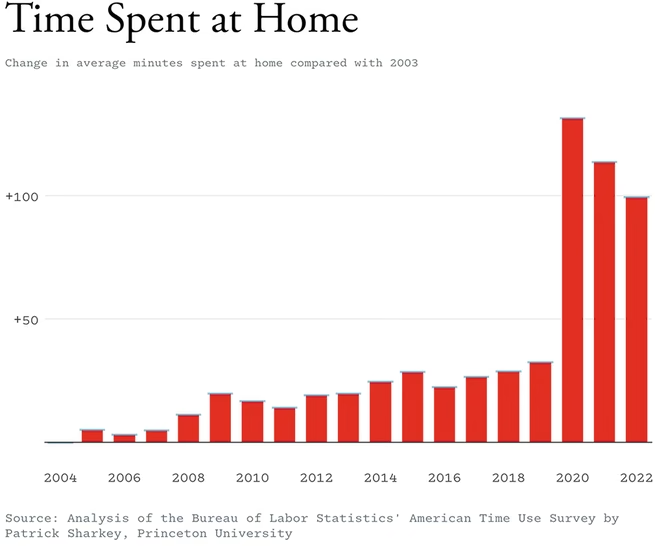

In a bracing essay, Derek Thompson, explores the emergence of this wide-spread isolation, unpacking its drivers, enumerating its considerable (personal and civic) costs, musing on the possible impact of AI, and pondering what might lead to a return to sociability…
… “I have a view that is uncommon among social scientists, which is that moral revolutions are real and they change our culture,” Robert Putnam [author of Bowling Alone] told me. In the early 20th century, a group of liberal Christians, including the pastor Walter Rauschenbusch, urged other Christians to expand their faith from a narrow concern for personal salvation to a public concern for justice. Their movement, which became known as the Social Gospel, was instrumental in passing major political reforms, such as the abolition of child labor. It also encouraged a more communitarian approach to American life, which manifested in an array of entirely secular congregations that met in union halls and community centers and dining rooms. All of this came out of a particular alchemy of writing and thinking and organizing. No one can say precisely how to change a nation’s moral-emotional atmosphere, but what’s certain is that atmospheres do change. Our smallest actions create norms. Our norms create values. Our values drive behavior. And our behaviors cascade.
The anti-social century is the result of one such cascade, of chosen solitude, accelerated by digital-world progress and physical-world regress. But if one cascade brought us into an anti-social century, another can bring about a social century. New norms are possible; they’re being created all the time. Independent bookstores are booming—the American Booksellers Association has reported more than 50 percent growth since 2009—and in cities such as New York City and Washington, D.C., many of them have become miniature theaters, with regular standing-room-only crowds gathered for author readings. More districts and states are banning smartphones in schools, a national experiment that could, optimistically, improve children’s focus and their physical-world relationships. In the past few years, board-game cafés have flowered across the country, and their business is expected to nearly double by 2030. These cafés buck an 80-year trend. Instead of turning a previously social form of entertainment into a private one, they turn a living-room pastime into a destination activity. As sweeping as the social revolution I’ve described might seem, it’s built from the ground up by institutions and decisions that are profoundly within our control: as humble as a café, as small as a new phone locker at school…
On how we spend our time and what that yields: “The Anti-Social Century,” from @dkthomp.bsky.social in @theatlantic.com (gift article).
See also: “You’re Being Alienated From Your Own Attention,” from @chrislhayes.bsky.social (also in @theatlantic.com, also a gift article)
* Kenneth Grahame, The Wind in the Willows
###
As we call a friend, we might recall that it was on this date in 1915 that Alexander Graham Bell placed the first transcontinental phone call, from New York to San Francisco, where the Panama–Pacific International Exposition celebrations were underway and his assistant, his assistant Thomas Augustus Watson stood by. Bell repeated his famous first telephonic words, “Mr. Watson, come here. I want you,” to which Watson this time replied “It will take me five days to get there now!” Bell’s call officially initiated AT&T’s transcontinental service.

And, on ths date 45 years later, in 1959, The first non-stop transcontinental commercial jet trip was made by an American Airlines Boeing 707, from Los Angeles to New York. The sleek silver plane made the flight in airline official time of 4 hours and 3 minutes, half the usual scheduled time for the prop-driven DC- 7Cs then in regular use on that route.

“The sentiment of justice is so natural, and so universally acquired by all mankind, that it seems to be independent of all law, all party, all religion”*…

Yunsuh Nike Wee, Daniel Sznycer, and Jaimie Arona Krems on an example of human values that seems due more to shared intuitions than local customs or social practices…
The Bible’s lex talionis – “Eye for eye, tooth for tooth, hand for hand, foot for foot” (Exodus 21:24-27) – has captured the human imagination for millennia. This idea of fairness has been a model for ensuring justice when bodily harm is inflicted.
Thanks to the work of linguists, historians, archaeologists, and anthropologists, researchers know a lot about how different body parts are appraised in societies both small and large, from ancient times to the present day.
But where did such laws originate?
According to one school of thought, laws are cultural constructions – meaning they vary across cultures and historical periods, adapting to local customs and social practices. By this logic, laws about bodily damage would differ substantially between cultures.
Our new study explored a different possibility – that laws about bodily damage are rooted in something universal about human nature: shared intuitions about the value of body parts.
Do people across cultures and throughout history agree on which body parts are more or less valuable? Until now, no one had systematically tested whether body parts are valued similarly across space, time and levels of legal expertise – that is, among laypeople versus lawmakers.
We are psychologists who study evaluative processes and social interactions. In previous research, we have identified regularities in how people evaluate different wrongful actions, personal characteristics, friends, and foods. The body is perhaps a person’s most valuable asset, and in this study we analyzed how people value its different parts. We investigated links between intuitions about the value of body parts and laws about bodily damage…
… If people have intuitive knowledge of the values of different body parts, might this knowledge underpin laws about bodily damage across cultures and historical eras?
To test this hypothesis, we conducted a study involving 614 people from the United States and India. The participants read descriptions of various body parts, such as “one arm,” “one foot,” “the nose,” “one eye” and “one molar tooth.” We chose these body parts because they were featured in legal codes from five different cultures and historical periods that we studied: the Law of Æthelberht from Kent, England, in 600 C.E., the Guta lag from Gotland, Sweden, in 1220 C.E., and modern workers’ compensation laws from the United States, South Korea, and the United Arab Emirates…
… Our findings were striking. The values placed on body parts by both laypeople and lawmakers were largely consistent. The more highly American laypeople tended to value a given body part, the more valuable this body part seemed also to Indian laypeople, to American, Korean and Emirati lawmakers, to King Æthelberht and to the authors of the Guta lag. For example, laypeople and lawmakers across cultures and over centuries generally agree that the index finger is more valuable than the ring finger, and that one eye is more valuable than one ear.
But do people value body parts accurately, in a way that corresponds with their actual functionality? There are some hints that, yes, they do. For example, laypeople and lawmakers regard the loss of a single part as less severe than the loss of multiples of that part. In addition, laypeople and lawmakers regard the loss of a part as less severe than the loss of the whole; the loss of a thumb is less severe than the loss of a hand, and the loss of a hand is less severe than the loss of an arm…
… Much of what counts as moral or immoral, legal or illegal, varies from place to place. Drinking alcohol, eating meat and cousin marriage, for example, have been variously condemned or favored in different times and places.
But recent research has also shown that, in some domains, there is much more moral and legal consensus about what is wrong, across cultures and even throughout the millennia. Wrongdoing – arson, theft, fraud, trespassing and disorderly conduct – appears to engender a morality and related laws that are similar across times and places. Laws about bodily damage also seem to fit into this category of moral or legal universals…
“An eye for an eye: People agree about the values of body parts across cultures and eras,” from @us.theconversation.com.
* Voltaire
###
As we contemplate corporeal consensus, we might recall that on this date in 1974 (after the 1973 airing of a series of made-for-TV movies that established the character), The Six Million Dollar Man debuted as a weekly hour-long series.
Unlike superhero movies today, The Six Million Dollar Man TV series was not based on a comic book title. Instead, the science fiction, fantasy, adventure series was based Martin Caidin’s 1972 novel Cyborg and its three sequels. The series starred Lee Majors as an astronaut whose life is forever changed after a NASA test flight accident. Colonel Steve Austin awoke after the accident to find that his body had been rebuilt with bionic parts including two legs, one arm and one eye. The cost of the operation ran roughly $6 million. Now a super-human, Austin could run over 60 mph and had incredible strength. He found work as a secret agent for the Office of Scientific Intelligence. Before the show debuted on this day in 1974, three movie pilots had already been shown on ABC the year before. In 1975, a two-part episode featured Jaime Sommers (Lindsay Wagner), a professional tennis player who experienced a parachuting accident and was given bionic parts as well. However, her body rejected these parts and died. Then again, he character was so popular, Sommers’ character came back to life to star in her own series, The Bionic Woman. Both series were hugely popular and ran through 1978. Then, three new made-for-TV movies starring the couple aired in 1987, 1989 and 1994 and all three also starred Lee Majors’ son (Lee Majors II) as OSI agent Jim Castillian… – source

“It turns out that we’re actually capable of something other than neoliberalism and actually we’re really capable of enjoying ourselves more than we do under neoliberalism”*…

… but the path from here to there, the estimable Brad DeLong warns, could be overcast. In notes for his lectures to his Econ 135 class at Berkeley (“The History of Economic Growth,” shared in his terrific newsletter, Grasping Reality) he begins with an explanation of neoliberalism [also explained here– source of the image above], then considers what might be next…
So what is coming after neoliberalism?
First, one thing that is coming, at least here in America, is renewed or perhaps novel attention to places. Places have never been important in American identity. American identity has, instead, long been defined by a focus on mobility and opportunity. Americans are people who have moved to new places—undertaken errands unto the Wilderness—precisely because of the mistakes being made in and the limitations circumscribing their choices where they were. Americans are people who have abandoned some Old World because of its mistakes, and have moved to a New World to remake themselves and make a new society that will at least make different mistakes. The promise of more abundant resources and the chance to build a better life has driven this pattern of migration and reinvention. Thus the advice given to those who find their birth-region constraining or insufficiently prosperous has always been “go west!”: move to opportunity.
My Richardson ancestors were farmers in the hilly, rocky terrain of New England in the 1840s. Farming the land was difficult. To say that New England soil is “stony” is to greatly understate the case, as you can see even today from the ubiquitous stone walls found throughout New England all built from rocks that had to be removed from the fields before farming could even begin.
The Richardson family decided to leave New Hampshire and traveled down the Ohio River to St. Louis, where they established a pharmaceutical company: the Richardson Drug Company. The family story is that they specialized in cocaine—legal at the time, and their cocaine products were very low concentration, nothing like lines or crack. But, still, my ancestors became the very first cocaine pushers west of the Mississippi in St. Louis. The company was quite successful for two generations. Then, one New Year’s Day, a catastrophic fire destroyed their chemical plant. The fire department was, the story goes, slow to respond, as they were recovering from New Year’s Eve. And how does a catastrophic fire start when the plant is entirely shut down for the holiday. I am suspicious of my ancestors.
Rather than rebuild the plant, the Richardsons opted to take the large insurance settlement and shift their focus to banking. The course of the Richardsons is thus a very American story: change who you are and what you are doing and where you are doing several times over the course of even a few generations.
The Neoliberal Order was about capitalism but it was also about freedom. And one aspect of this freedom was freedom to successfully organize to resist being dominated by the behemoths of the New Deal Order: Big Government, Big Business, Big Labor, and also Big Cultural Expectations. The assumption that your husband should get a job with a large corporation and commute by car as you moved to suburbia and that you alone should raise the children was an essential part of the New Deal Order. And it called forth a middle-class feminist rebellion. The assumption that Blacks should largely stay in their place and be happy with slow advances toward equal rights and a small share of the benefits from social-insurance programs was an essential part of the bargains in the 1930s that formed the New Deal Order. The Black Civil Rights movement was not in itself neoliberal, but was an expression of the underlying anti-system anti-bureaucracy current. And with respect to land-use planning—Big Government bureaucrats should not be able to assist Big Finance money and Big Business bulldozers to order you around and bulldoze and “renew” your community. It was individual unbureaucratic enterpreneurship that was supposed to be beautiful. Hence NIMBYism (Not In My Backyard-ism) as we know it today is an important piece of the Neoliberal Order, as it actually was on the ground.
Consider San Francisco’s Embarcadero Freeway, an 8-story, 90-foot high structure that blocked views of the ocean and bay. Residents preferred to maintain the open views rather than prioritize faster commutes for drivers from Marin County. This was seen as a victory for rational, people-centered development at the time. And the post-1989 earthquake removal of the initial parts of the Embarcadero Freeway was a huge win—it resulted in a much more pleasant and open waterfront area for residents and visitors to enjoy.
But in the long run NIMBYism has been a disaster. Berkeley houses no more people now than it did fifty years ago. So housing prices have skyrocketed, and the guy who runs the Little Farm Children’s Center in Tilden Park has to commute from beyond the Altamont Pass.
NIMBYism killed America’s tradition of moving to opportunity stone dead. This has been a very powerful if indirect cause of rage against The Neoliberal Order Machine. Thus the growing call for place-based policies to make opportunity move to where people are, instead of assuming people will move to opportunity. The Polanyian right to the land—to keep Schumpeterian creative-destruction from destroying your community as a side-effect of its pursuit of profit—is and will take a more prominent role in whatever comes after the Neoliberal Order.
Second, the “after” will include explicit industrial policies. The Neoliberal Order was about hyperglobalization. Under the Neoliberal Order it was assumed that free trade and laissez-faire policies were beneficial for all. They were beneficial for the Global North as they heightened the concentration of high-value and high-externality activities like science, engineering, and worthwhile manufacturing within itself. And they were beneficial for the Global South because only the threat that economic activity and talented people would leave could curb the predatory instincts of Global South governments. The concerns of economists like W. Arthur Lewis that trade in a globalized market on terms increasingly tilted against primary products actually developed the fact of underdevelopment were pushed to one side.
But now the assumption that free trade works to concentrate high-value and high-externality activities like science, engineering, and worthwhile manufacturing in the United States is very much in doubt. The CHIPS Act of the Biden administration signals the end of the belief that the global market was working in America’s favor. The CHIPS Act represents a shift away from the implicit acceptance of the global market’s inequities now that they no longer seem to be working so strongly in America’s favor. Instead, there is now a demand for more explicit industrial policies as an alternative..
Third, the “after” will include a strong demand for champions of the people. There is growing recognition that neoliberalism has led to an unfair domestic plutocracy. The 2008 Republican presidential and vice-presidential ticket was almost composed of individuals who collectively owned 20 houses—John McCain owned 12 houses, and Mitt Romney owned 8. Political advisors felt that that foreclosed choosing Romney as likely to make the ticket look ridiculous, and so they prevailed on McCain to choose the very odd Alaska Governor Sarah Palin insted.
What to do about plutocracy, where there is a growing belief that the system is working not for the people but for the super-rich and for their rootless cosmopolite allies and clients? Power requires countervailing power. Hence what is needed is someone powerful to vindicate the interests of the common people, rather than of some privileged élite: a strongman to disrupt the status quo and the inertia of “business as usual”.
It has never been the case that the “strongman” has to come from the people. Indeed, often in history a plutocrat, oligarch, or aristocrat has been preferred—a “class traitor” as other members of Harvard’s Porcellian Society whispered about their fellow member, New Deal President Franklin Delano Roosevelt. The idea is that only someone who has thoroughly benefitted from being in the system and knows it inside and out will know enough about its vulnerability to be able to disrupt it.
Analogously, consider Andrew Jackson. He positioned himself as a defender of the common people against the system—land speculators, Philadelphia financiers, and corrupt politicians who together made sure that the people could not prosper as America grew.vJackson presented himself as an outsider who would protect the interests of the “Kentucky frontiersmen” against the domestic élite, even though he himself was no true frontiersman.
Indeed, the earliest examples of strongman politicians overthrowing existing oligarchic systems to vindicate at least the short-run interests of a broader “people” come from the early days of Classical Hellenic civilization. Peisistratos, Tyrant of Athens in the -500s, is the prime historical example. The Tyrants abolished debt slavery, canceled the debts of the overindebted, and redistributed land more equitably—paving the way for the establishment of Hellenic democracy, which was a very attractive civilization as far as the societies of domination of those days went.
Unfortunately for us, the champions of the people being chosen today appear more fascist than populist—more interested in telling people what to do to make them followers to burnish the glory of the leader than in lifting the burdens from the people by cancelling the debts and redistributing the land—and more kleptocrat than plutocrat, with the leader’s skills more in running a con game than in understanding the workings of the system.
Fourth, what is coming after the Neoliberal Order appears to be a politics of fear: fear of the diverse, fear of the woke, fear of the other—whatever the other is, people who seem strange and weird—and fear of the rootless cosmopolite.
In the last analysis, the Neoliberal Order fell because it did not deliver the goods. Free markets and largely ineffectual gestures at freeing-up individual autonomy from bureaucracy were not enough to create a society where people felt at home, even if there was a great expansion of individual freedom to choose elsewise than commanded by formerly-dominant social norms. But the failure of the past Order did not in itself bring a new one into existence. In this sense we are in a similar period of uncertainty to that of the late 1920s and early 1930s. Back then, before he died in Mussolini’s jail, the Marxist thinker Antonio Gramsci observed: “The Old Order is dying, and the New Order appears perhaps to be stillborn: now is a time of monsters”…
Oh, to be able to go back to school… Eminently worth reading in full: “Neoliberalism & After,” from @delong.bsky.social. See also the notes from a proximate lecture: “Post-2010 “Polycrisis”: Culture, Communications, Politics, & War.”
* “It turns out that we’re actually capable of something other than neoliberalism and actually we’re really capable of enjoying ourselves more than we do under neoliberalism. It feels that if neoliberalism is first about privatizing desire and imagination before the economy, then we’re in this process of publicizing it again.” – Rebecca Solnit
###
As we fumble with the future, we might recall that it was on this date in 1968 that 60 Minutes, which had premiered two months earlier, introduced its trademark “ticking stopwatch” opening logo/transition. 60 Minutes is, of course, the most-watched television news show in history.

Since near the show’s inception in 1968, the opening of 60 Minutes features a stopwatch. The Aristo (Heuer) design first appeared in 1978. On October 29, 2006, the background changed to red, the title text color changed to white, and the stopwatch was shifted to the upright position. This version was used from 1992 to 2006 (the Square 721 type was changed in 1998). Source
You must be logged in to post a comment.