Posts Tagged ‘Technology’
“As the servants of the Machines are becoming a privileged class, the Machines are going to be enormously more powerful”*…

Technological sovereignty is a nation’s ability to create, control, and own (or reliably source from reliable alllies) the technologies, infrastructure, and data essential to national security and economic growth.
Concerns with technological sovereignty date back to at least the 17th century (when, for instance, European mercantilist states banned the export of textile machinery to protect domestic monopolies and maintain a favorable balance of trade). They characterized much of the 20th century (as nations built up indigenous defense industries to ensure military independence).
In our 21st century, the one-two punch of the Trump tariffs and his attack on Iran (and the effective closure of the Straights of Hormuz), with the supply chain disruptions attendant on them, have raised the issue of technological sovereignty anew– and with a vengence. In our interconnected, interdependent– thus vulernable to disruption– world, China and the U.S. are in the lead; but experts project slow advance in national tech sovereignty over the next several years.
But this time around, Francesco Crespi and his co-authors argue, the Big Tech corporate monopolies/oligopolies in both China and the U.S. have emerged as even more important players (than their historical analogues have been). Their increasing dominance of private R&D, the increasing centrality of privately-controlled digital technology, their resultant control over knowledge, infrastructures, and key technologies such as telecoms, cloud computing, and AI. have made them central to nation’s futures, even as the Big Tech players (as corporations) have different imperatives.
Crespi, et al. unpack this state of play and propose a typology of technological sovereignty that takes into account the degree of technological dependence on Big Tech, the nature of the relationship between states and digital companies, and, consequently, a nation’s capacity to align the activities of these companies with its own strategic objectives. They summarize:
This paper has examined TS at a historical moment in which the control of critical technologies, infrastructures and knowledge is increasingly concentrated in a limited number of digital corporations. Its starting point was a conceptual tension in the existing debate. TS is commonly defined as the capacity of a state, or a federation of states, to access and provide critical technologies without incurring one-sided structural dependence (Edleret al., 2023). Yet this definition implicitly assumes that sovereignty is ultimately held and exercised by public authorities. The argument developed in the present paper is that this assumption has become increasingly problematic. In core domains such as cloud computing, AI, data infrastructures, satellite systems and digital services for defence, the effective control of technological capabilities is often exercised by private corporations whose interests, strategies and governance mechanisms only partly overlap with public objectives.
The empirical evidence discussed in the paper points to three connected transformations. First, the long-term retreat of public research and the expansion of intellectual property regimes have shifted the centre of gravity of innovation systems towards large private actors. The rise of ICT and platform-based business models has reinforced this tendency by allowing a small group of firms to accumulate data, proprietary knowledge, network advantages and infrastructural assets on a global scale. Second, the hierarchy of corporate R&D has changed substantially since the early 2000s. Digital firms, especially from the United States and China, now occupy the leading positions among global R&D spenders and dominate strategic technological areas such as AI, cloud and software ecosystems. Third, this concentration is infrastructural as much as technological. The control of data centres, cloud availability zones, platforms, operating systems and search engines gives Big Tech firms a systemic role in the functioning of economies, public administrations and security apparatuses (Coveri et al., 2025).
As a result, this concentration of techno-economic power modifies the relationship between the state and private capital. Public authorities no longer simply procure technologies from firms operating in competitive markets. In many cases, they depend on proprietary ecosystems that set standards, store data, provide computing capacity, update software and mediate access to essential digital functions. This produces a form of structural lock-in that is particularly severe in dual-use and security domains. The state can retain formal authority while losing part of the operational capacity required to exercise it. Under these conditions, TS cannot be evaluated only by measuring the presence of advanced technologies within a territory; it must also be assessed by asking who owns, controls and governs the infrastructures and knowledge through which those technologies are produced and deployed.
The analysis of the military-digital complex further strengthens this conclusion (Guarascio and Pianta, 2025). The digitalisation of warfare has made the capabilities of Big Tech increasingly indispensable for military and intelligence activities. Cloud infrastructures, AI systems, cyber-defence tools, satellite connectivity and battlefield data services have become essential components of contemporary security systems. At the same time, public procurement, defence contracts and battlefield experimentation reinforce the technological and market position of these firms. Hence, the resulting relationship is one of mutual dependence, but it is not necessarily symmetrical. Governments need access to digital infrastructures and capabilities that they often do not control internally, while Big Tech firms use military and security demand to consolidate their technological advantages, expand proprietary ecosystems and increase their bargaining power vis-a-vis public authorities. This gives concrete substance to the notion of privatised TS (Abels, 2026).
Building on this analytical and empirical framework, the paper proposes a typology for interpreting the notion of TS according to these structural transformations. In particular, it distinguishes between strong and weak technological sovereignty and between private-driven, public-driven and public-private-driven governance arrangements. This distinction matters because the same technological capability may have different economic and political implications depending on the distribution of control across states, domestic firms, foreign firms and hybrid institutional arrangements.
They conclude:
Taken together, these findings suggest that TS should not be assessed only by asking whether a country possesses advanced technologies. It should also be assessed by examining how control is distributed and governed across the state, domestic firms, foreign firms and hybrid governance arrangements. The broader implication is that private-driven TS is not neutral from a welfare standpoint. It may increase innovation speed and geopolitical capacity, but it can also redirect technological change towards rent extraction, militarisation and proprietary lock-in. On the opposite, public-driven technological sovereignty can better preserve public-good objectives, but public institutions should possess adequate technical, financial and organisational capabilities, while public-private technological sovereignty can work when public conditionality is strong; otherwise, it may degenerate into the socialisation of risk and the privatisation of control. A welfare-oriented strategy for TS should therefore prioritise public and collective control over essential technological infrastructures, strengthen public R&D and procurement capabilities, impose interoperability and open- standard requirements, and ensure that critical data, patents and infrastructures generated with public support remain accessible for public purposes.
The central policy question, therefore, is not simply how to become technologically sovereign, but how to prevent the pursuit of sovereignty from becoming a vehicle for the privatisation of the very capabilities on which welfare, democracy and long-term development depend. Technological sovereignty can strengthen resilience, strategic autonomy and collective welfare only if it is embedded in institutions capable of governing technological change in the public interest. Without such institutions, the language of sovereignty may legitimise new forms of dependency: dependence on domestic monopolies in some countries, dependence on foreign platforms in others, or dependence on public-private arrangements in which public authorities finance
strategic projects while private actors retain control over their future trajectories. A research and policy agenda on TS should therefore place ownership, governance and accountability at the centre of the analysis, alongside capabilities and geopolitical positioning.
Eminently worth reading in full: “Technological Sovereignty, Big Tech, and the Military-Digital Complex” via @ssrn.bsky.social. (Full PDF here.)
See also: “Technology sovereignty as an emerging frame for innovation policy. Defining rationales, ends and means” and “Reconciling open science with technological sovereignty“
And for a look at one of the moving parts of the puzzle, one that underlines the importance of Crespi’s closing suggestions: “Elon Musk and SpaceX’s Futurist Coup.”
(Image above: source)
* J.R.R. Tolkien, The Letters of J.R.R. Tolkien
###
As we develop deftly, we might might send connected birthday greetings to a man who was instrumental in the development the promise/threat of Big Tech as today we know it: Mark Weiser; he was born on this date in 1952. A comouter scientist and CTO of Xerox PARC, he is is widely considered to be the father of ubiquitous computing, a term he coined in 1988, when he described a future in which personal computers would be replaced with tiny computers embedded in everyday “smart” devices and their connection via a network.

“I believe that we can forecast the ‘changing landscape of context,’ and thus get insight into when we are entering the danger zone”*…

Derek Thompson shares his interview with philosopher Agnes Callard…
Here are some questions that I consider self-evidently compelling about the modern world:
- Why is the news media so interested in telling you how much the world sucks all the time?
- Why are so many of us obsessed with distraction and managing our attention?
- Why is it so hard to stop comparing ourselves to others?
- And why does everything in art and design seem the same these days?
A week ago, I didn’t think these questions were related. I’m not sure I would have told you I had a good answer to most of them. And I certainly wouldn’t have made the audacious and borderline bonkers claim that one single theory could begin to explain all of them, at once.
But then I had the pleasure of speaking to Agnes Callard, the University of Chicago professor, about her new theory called “the uni-context.” It’s easily one of them most interesting conversations I’ve had all year. And once you’ve heard or read it, I think you might find it hard to think about anything else.
One way to prepare your mind for Callard’s theory of the uni-context is to think about the better-known concept of “context collapse.” If you post something to social media, it will be simultaneously visible to your boss, your parents, your ex, and total strangers. So, while your offline life might be distinct with each of these groups—you might be differential to your boss, childish with your parents, and bawdy with your friends—all of those distinctions are flattened on the internet. That’s context collapse, and you can think of it as the answer to a question: How do informational norms change when we’re all living in the same universal room?
Callard takes the idea significantly further. She asks: How do all other norms—our morals, our ethics, our sense of what is good for us and for others—change when we continually imagine ourselves to be living in a universal room with everybody else? The connections that Callard makes are consistently surprising, often quite funny, and ultimately mind-exploding…
A small sample…
… Thompson: Tell me if this is a fair recapitulation of our conversation so far.
For most of human history, people judged norms based on local context. A home had its own rules, a cathedral its own rules, and a classroom or bar or funeral parlor had its own rules. But now it is almost like we are constantly living in universal rooms, and the universal room we occupy is assumed to have universal values and universal norms. That has specific implications. First, rather than talk about what is good, which is context-dependent, we tend to focus about universal truths, and it’s easier to talk about universal bads than goods, so people focus on negativity. Two, character is context-dependent, so we talk less about character and more about its universalist equivalent, which is identity.
There’s a third implication that we should discuss. If everyone is on the same comparable plane, the same evaluative field, then comparison itself becomes a more inextricable part of life.
Callard: Exactly.
Thompson: Tell me how the uni-context leads to a world of more comparison and competition.
Callard: Imagine two school districts with two high schools that do things slightly differently. If you’re in district A, you go to school A, and if you’re in district B, you go to school B. There might be a lot of information about what they do, but people treat it as: I’m in this district, so I go to this school. Then they change the rule: You can go to either school no matter where you live. Suddenly there is motivation to compare. You had the information before, but no motivation to compare, because the schools were not in the same space of choice, the same evaluative field.
Now they are, so you find ways to compare them: graduation rates, what colleges people get into, how many AP classes they teach. And that affects the schools. Suppose one gets less popular because it doesn’t teach many AP classes. They were offering an individualized curriculum, but now everyone’s going to the other school, so they say, “We’ve got to teach AP classes too.” The process homogenizes the two schools, so they can compete. That’s not the only possible result. They could specialize, with one becoming the school for freshman and sophomore years, the other becoming the school for junior and senior years. But if they don’t recreate a normative barrier, you get homogenization from comparison.
As more things enter the same evaluative field, you make comparisons you never used to be able to make.
Thompson: There are three pieces I’m trying to keep straight.
One, the upstream phenomenon of the uni-context. Two, the downstream phenomenon of more fields of comparison. Three, the further downstream phenomenon of homogenization.
This is where the theory really starts to sing for me, because I think about sports. As the analytics revolution came for baseball, you had all these teams in possession of the same statistics by which they could compare players. Previously, you had 30 teams using their own private scouts, so their analysis was more context-dependent. But when an easily calculable statistic like on-base percentage or WAR becomes the conventional way to evaluate whether a player is good, all the players become part of the same comparative set. You can rank them one-to-250 easily on a spreadsheet.
But analytics didn’t just lead to more math, or more comparison. It led to more homogenization of strategy. One of the great critiques of baseball has been that every team essentially does the exact same thing: it’s the same strategies for pitchers; the same strategies for hitters; the three true outcomes; all the batters swinging for the fences. So you have the uni-context creating a comparative field, in this case analytics, which leads to homogenization.
Callard: What you said reminded me that I have a theory of the inflection point for the uni-context. I don’t think it started five or ten years ago. The moment it really showed up was around 1910.
One century ago, there were a bunch of people looking around at the world, thinking: What the hell is happening? Did culture break? A lot of those people were novelists, and they wrote a new kind of novel called the modernist novel, which is a novel about how to live in a world in which the uni-context is just coming into existence. Theorists of the time—such as Georg Simmel, Max Weber, and Martin Heidegger—they noticed something weird was going on. They tended to describe it in terms that sound almost like the opposite of the uni-context. They described it as the fragmentation of everything. All of a sudden, they said, everything is breaking apart. That was my first clue.
The reason I thought of this is that you said everything is becoming homogenous, and I thought, “in a way, yes, but that’s a later effect.” The first thing that happens when a bunch of stuff is unified in a single evaluative field is that you feel overwhelmed by your choices. It feels like stuff is fragmented, because you don’t know how to compare these things, because you haven’t yet developed technologies of comparing them.
So, the early feeling of the uni-context was a feeling of the world being fragmented. If you were a medieval peasant doing art, you were in art’s normative world. If you were in the church, you were in the church’s normative world. But in the 20th century, around World War I, you start to think: How do we reconcile the schoolteacher turned murderer, the soldier? How do we think about the relationship between art and religion? We’re suddenly trying to compare all these different values inside a single context, and the world feels dis-unified. Eventually we get technologies of commensurability. What fragmentation really means—and that part was invisible to these writers—is that suddenly everything is part of the same evaluative field. That’s why you experience a multiplicity where you used to experience one thing at a time…
There’s much more, all of it provocative. Here, the conclusion…
Thompson: I want to know what we should do about this.
A simple answer might be: When you’re having dinner with your family, you can be present with your family, or you can be on your phone, which is a universal room that makes you everywhere at once. So put away the phone. But that feels like a cheap and predictable answer. Do you have something prescriptive that isn’t just “put away the phone at family dinner?”
Callard: The question of whether the uni-context is good or bad is loaded, because the uni-context struggles to see good things. It’s better at seeing bad things. Pretty much everyone who hears me talk about the uni-context immediately responds that it’s bad. I’ve never had anyone say, “The uni-context sounds great!”But the thing is that this supposedly bad thing is a thing we’re creating. We’re choosing it over and over again. Even me talking to you from far away about an abstract thing [is the uni-context.]
The uni-context is a space of unruliness. It’s a space in which a certain thing about humanity gets expressed, namely our deep aversion to “world closure.” For almost all of human history, we have lived in closed little worlds, and those worlds presented themselves as the only world. A series of contexts presented the person with direction—here’s what you should do. What we are moving toward is a “world openness” that we hunger after, where I’m not just going to do things a certain way because that’s how we do things or where I was born.
Antonio Gramsci famously said, “the old world is dying, and the new world struggles to be born: now is the time of monsters.” So, how do we use openness, as Callard describes it, as space in which to create a world in which we want to live? How do we recover the wisdom imbedded in context– the accreted shell of our shared history– without context’s reactionary trappings? How do we build anew a better world?
In any case, once you learn what the “uni-context” is, you won’t stop seeing it everywhere: “A Philosopher’s One-Word Theory to Explain Why the World Feels So Weird,” from @dkthomp.bsky.social and @agcallard.bsky.social.
###
As we muse on milieu, we might recall that it was on this date in 1963 that The Essex (a singing group composed of four active-duty Marines) reached #1 on Billboard R&B chart with their first release “Easier Said Than Done” (which had been intended as the B-Side of the record); it went on to top Billboard‘s Hot 100, and was the biggest hit of their career.
“A mouse never entrusts his life to only one hole”*…

… Well, our earth is riddled with them. And as our old friend Randall Munroe at xkcd reminds us, some of them are very deep…
“Holes”
Via Jason Kottke, who reminds us that “Explain xkcd has more info on each of the various holes, including the truly bonkers Cave of Crystals in Mexico” (and explanatory background on other xkcd posts as well…)
* Plautus
###
As we spelunk, we might recall that it was on this date in 1962 that the U.S. military detonated Little Feller I, a tactical nuclear weapon at the Nevada Test Site as part of Operation Sunbeam. It was the last near-ground atmospheric nuclear detonation conducted by the United States. The high-altitude Fishbowl tests concluded in November of1962 with a detonation at around 69,000 feet altitude. Thereafter, in accordance with the 1963 Partial Test Ban Treaty, tests were conducted underground… more holes.
“Invention, my dear friends, is 93% perspiration, 6% electricity, 4% evaporation, and 2% butterscotch ripple”*…
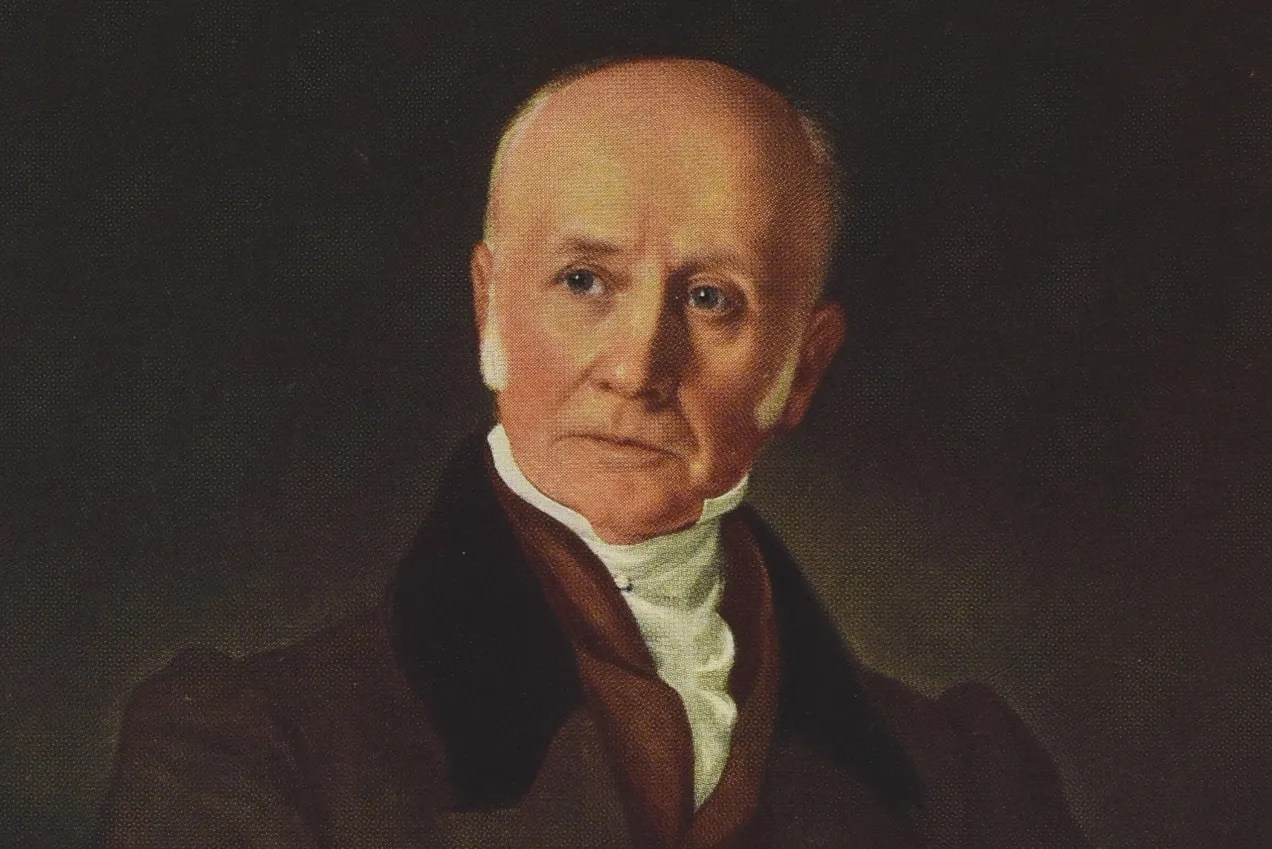
Jason Toon on a man whose applied creativity birthed not one, but two major industries…
Global canned food sales are now more than $210 billion annually. The average American eats about 200 pounds of canned food every year. Meanwhile the worldwide paper industry has seen steep falls in the production of newsprint, printing paper, and writing paper since 2010, but the rise in paper and cardboard packaging has more than made up for it. The paper industry is bigger than ever, with revenue of $485 billion in 2025.
For better or worse, our world would simply not look the same today without these two industries. And one person was the key figure in starting both of them. Bryan Donkin can legitimately claim to be the “father” of the canned-food industry and the paper industry as we know them. So who was he, besides one of the very few guys named Bryan in the 18th century?
Born in northeastern England in 1768, Bryan Donkin went into the same business as his father: real estate. But it didn’t speak to him. So in 1792, at the rather ripe age of 24, he became an apprentice to John Hall at Dartford Iron Works to pursue his true calling as an engineer.
At the time, all paper was made by hand, more or less the same way it had been done since the Middle Ages. Cotton and linen rags were soaked in water and beaten into a pulp. A shallow, rectangular mold with a screen bottom would be dipped into the liquid slurry and shaken. A thin layer of the macerated fibers would settle on the screen; when dry, you’d have yourself a single sheet of paper.
Donkin started his post-apprenticeship career making these molds. But around 1801, he got connected to the Fourdrinier brothers, who produced stationery in London. They’d made a deal with a French inventor, Louis-Nicolas Robert, to bring a new paper-making machine to Britain. At the time, between the post-revolutionary turmoil in France and England’s more advanced industrial base, the latter seemed to hold more lucrative prospects for the new invention.
Unlike the laborious single-sheet, mold-based method, this new “Fourdrinier machine” used a cylinder to continuously produce rolls of paper. A mechanism called the “shake” agitated the conveyor belt at a high speed, to spread the wet pulp fibers in an even layer. Unfortunately, this rapid movement put a lot of strain on the mostly wooden machine. One of Donkin’s improvements was to use metal parts instead, for improved stability and precision.
Another refinement of his was adjusting the rollers that squeezed the water out of the paper, to maximize contact between them and the paper, to dry the paper more quickly and thoroughly. This and other improvements turned the Fourdrinier machine from an interesting prototype to a viable technical advancement.
It quickly became the industry standard, and remains so over 200 years later. The publishing boom of the late 19th and early 20th century wouldn’t have been possible without it. Those big machines you see today producing rolls of paper are most likely Fourdrinier machines. Donkin also made some key advancements in printing technology, so the Pulitzers and Murdochs of the world owe him double gratitude.
His fortune secured, now the head of a company bearing his name that still exists (these days they make gas valves), Donkin’s restless mind turned to another puzzle: the preservation of food. Like too many technological quests, this one was spurred by military needs. Best frenemies England and France were both spreading their empires around the planet, frequently clashing, and looking for ways to keep their troops fed. In such wide-ranging conflicts as the Seven Years’ War (1756-1763), far more sailors died of malnutrition than in combat.
It seems yet another French inventor had visions of pounds sterling dancing in his eyes. Philippe de Girard had come up with a method of preserving food by putting in inside a sealed tin container, then boiling the container in water to sterilize it. Or maybe he swiped the method from another French inventor, Nicolas Appert [see here]. Or maybe they were in cahoots. What we do know is that in 1810, de Girard went to London and engaged a merchant named Peter Durand to be his frontman for getting a British patent, which de Girard would not have been eligible for since Britain and France were at war.
Durand was duly awarded the patent in his name. Ever since, he’s been often called the inventor of the tin can, despite having nothing to do with inventing it, and doing nothing with it except selling the patent for £1,000 in 1812. The buyer? Bryan Donkin’s old apprenticeship master, John Hall.
Now on equal terms as budding titans of industry, Hall put up the money and Donkin provided the brains along with a third partner, John Gamble, to bring tin canning to an industrial scale. Again, it took a couple of years, but Donkin and Gamble steadily refined the process. One of their major innovations was to use iron coated in a thin layer of tin, combining the strength of the former with the non-reactive properties of the latter for an imperturbable can that could survive the longest, roughest ocean voyages.
For the second time, a French invention plus Donkin’s enhancements equaled le jackpot. After getting the likes of Queen Charlotte and the Duke of Wellington hooked with some free samples of canned beef, the firm of Donkin, Hall and Gamble received an order for 156 pounds of canned food from the Admiralty in 1813. That grew to 2,939 pounds the following year, increasing annually to 9,000 pounds by 1821.
Having bested the canning challenge, Donkin again wandered off in search of other worlds to conquer: helping Charles Babbage with the “difference engine” that would eventually become the computer, consulting on bridge and canal projects, inventing the first metal pen and a screw-cutting machine, being a founding member of both the Institution of Civil Engineers and the Royal Astronomical Society.
He died in 1855, an esteemed eminence in Victorian scientific and engineering circles. Today Bryan Donkin’s impact is out of all proportion to his memory. On a visit to his grave in London, the BBC found, [there was] no mention of his achievements. Cemetery staff didn’t know who he was.
I can sense the question from some quarters of the audience: are Bryan Donkin’s achievements worth celebrating? Not only did canned food help enable imperial conquest and war, it also led eventually to the mass industrialization of food production, with its attendant crises of public health and monocultural farming, and our psychological distance from our food supply. And one look at any municipal dump will show you how much paper and cardboard waste still goes into landfill, even in a supposedly “paperless world”.
Those points are well taken. But it’s easier to dismiss these advancements when you live in a world that’s always known them. Over the last century or two, large-scale paper production enabled the rise of mass literacy, from only 10% of the world’s population being literate in 1820 to 90% today.
And it’s not just British seamen who eat better because of canned food. A 2011-2013 National Institutes of Health study found that people who eat six or more canned items a week “consume more nutrient-dense food groups such as fruits, vegetables, dairy products, and protein-rich foods, and also have higher intakes of 17 essential nutrients” including potassium, calcium, and fiber. Canned food has helped overcome the tyrannies of distance and time to get more nutrition to more people.
From the perspective of people in 1810, both food canning and mass paper production were immense steps forward. We can’t lay our subsequent inability to maintain some equilibrium at their feet. It’s true that Bryan Donkin didn’t invent the machines he perfected. Both industries probably would have happened, in some form, eventually, without him. But in being the first to perfect them for large-scale use, and granting all the downsides they’ve brought along with them, he hastened the coming of a less hungry, more educated world. Not bad for a guy named Bryan…
How one genius fathered both the canning and paper industries: “The Lives of Bryan,” from @jasontoon.bsky.social.
* Willy Wonka (in Roald Dahl’s Charlie and the Chocolate Factory)
###
As we devise, we might send carefully-calculated birthday greetings to Dan Bricklin; he was born on this date in 1951. An engineer, he was the co-creator, with Bob Frankston, of VisiCalc, the first spreadsheet program. Known as “the father of the Spreadsheet,” he was awarded the Grace Murray Hopper Award in 1981 for VisiCalc and was one of six people spotlighted when “the Computer” was named “Machine of the Year” by Time magazine in 1982.
Neither Bricklin nor Frankston reaped huge financial profits from their spreadsheet program, though it sold over a half-million copies by 1983. At the time, copyright protection was not generally sought for software; their company was subsequently acquired by Lotus 1-2-3, which became the new spreadsheet standard (until, of course, Excel).

“Technology doesn’t force us… it merely opens the door”*…

The estimable Tim O’Reilly reminds us to think deeply about how AI could and should turn out. He suggests that Jeff Ding‘s diffusion theory of the role of technology in great-power competition also applies to AI adoption– and that it suggests that companies obsessed with the frontier might be optimizing for the wrong thing…
In the 1980s, Japan led the world in semiconductors, consumer electronics, and computer hardware, the industries everyone assumed would decide the next phase of economic power. Japan won them and still did not overtake the United States in the information revolution that followed. Jeff Ding, a political scientist at George Washington University, opens his book Technology and the Rise of Great Powers with the history of the first and second industrial revolutions and the third, the information revolution. The explanation he gives for who wins and who loses applies to companies as well as it does to nations, and very much to the current trajectory of AI.
Ding contrasts two theories of how technological revolutions reshape economic power. The conventional one he calls the leading sector model, or LS theory. It goes like this: New technologies create fast-growing new industries like steel and railroads and automobiles and semiconductors, and the country that dominates invention in those sectors captures the monopoly profits and the upstream and downstream economic linkages that come with them. As the story goes, if you win the leading sector, you win the era. Britain won in the first industrial revolution through its mastery of steam power, and then was surpassed by the US in the second through its leadership in electrification, the internal combustion engine, and mass manufacturing. The US kept its lead over Japan in the information systems revolution not by competing in the “leading sector” of electronic hardware but by diffusing “up the stack” via software that took the power of computing into every sector of the economy. (OK, that last bit is my explanation of what happened rather than Ding’s, but it’s consistent with his theory.)
Leading Sector theory is pretty clearly the working hypothesis of today’s AI industry and the national strategy that is forming around that industry. The company and the country with the biggest and best models wins. Everyone else is an also-ran.
Ding offers another explanation, which he calls diffusion theory. He points out that general-purpose technologies, foundational ones like the steam engine, electricity, and the computer, don’t just create massive profits and productivity gains in a single industry but instead spread across the whole economy. National economic leadership comes not from inventing the new sector but from diffusing the general-purpose technology more quickly and more broadly than your rivals. This happens over decades. The win goes to whoever most successfully embeds the technology into a wide range of ordinary productive work. This is how the US kept its lead over Japan rather than being surpassed by it.
This is obviously aligned with the thinking of Arvind Narayanan and Sayash Kapoor in “AI as Normal Technology,” which Ding cites in his book.
A big part of what enables diffusion is what Ding calls skill infrastructure, the education and training systems that widen the pool of people who can actually work with the technology. When the priority is widespread adoption rather than invention, he argues, the institutions that matter are the ones that build engineering skill at scale, standardize good practice, and tie research to industry. He writes:
GPT diffusion theory highlights the importance of GPT [General Purpose Technology] skill infrastructure. Education and training systems that widen the pool of engineering skills and knowledge linked to a GPT. When widespread adoption of GPTs is the priority, it is ordinary engineers, not heroic inventors, who matter.
Music to my ears, as it should be to yours: “It is ordinary engineers, not heroic inventors, who matter.”
That is not how the current AI narrative goes. Everyone is fixated on the labs, the frontier models, and the most famous researchers. And that fixation shapes enterprise strategy. Inside many companies AI strategy is a procurement decision: Which model and which vendor and which flagship tool should we choose? Or it’s a moonshot to stand up a lab and build an impressive demo and hire your own famous developer. Both approaches treat AI as a sector to be won. Ding’s argument is that the breakthrough sector itself is not where the long-term value for national power lives. And I believe that the same applies to corporate success. The value is in how widely and how well the technology gets embedded into the work of the people you already employ. The company that puts AI to work in finance and support and legal and sales and operations, across every unglamorous process, as well as in product and engineering, outperforms its competitors and drives its industry forward.
The reason diffusion takes a long time is that it is an organizational problem and not a technical one…
[Tim elaborates, and specifies the requirements for successful management of what is an “enterprise transformation problem”; he then unpacks the geopolitics of AI. He concludes…]
… Sovereign AI is not just a matter of national power. It is a predictable consequence of diffusion. A technology that diffuses widely will be adapted by different societies, firms, and institutions to suit their own needs, values, and constraints. Sovereign AI is AI designed for diffusion, not just raw increases in capability.
This is one reason the arms-race framing is unhelpful. It encourages us to treat AI as if it were a weapons system or a scarce strategic asset. But if AI is closer to electrification, computing, or the written word, the important thing is how the technology is embedded into the ordinary life of economies and institutions, and whether that embedding happens in ways that increase agency broadly rather than concentrating it in a few hyperpowerful companies.
There are a few additional lessons we can take from the history of electrification. While motors became decentralized, factories stopped generating their own power and bought it from a centralized grid. The unit-drive revolution decentralized application, not generation. This limitation, which we are now working to overcome to some extent with decentralized solar generation, is perhaps ironically showing up most strongly in the strain that AI data centers are placing on the grid. Let’s learn from that misstep. You can diffuse AI into every workflow via API calls to a big centralized model, or it can be diffused by a network of smaller models that turbocharge every part of the economy.
We should design for a future of multiple AIs, not a single universal system. Different countries will want systems shaped by different legal regimes, languages, histories, and cultural assumptions. So will companies. So will professions and communities of practice. The instinct of some frontier labs is to imagine that the right answer is to homogenize the technology, purge it of bias, and offer a single sanitized intelligence layer for the world. But AI is a social and cultural technology. The differences are not a defect to be smoothed away.
We do need to think about standards and interoperability. The historical analogy that comes to mind is railroad gauge. When real world systems are built to incompatible standards, the result is not healthy diversity but decades of friction, kludges, and retrofitting. The same may prove true for AI. If we force the future into a choice between one universal model and a patchwork of disconnected sovereign systems, we will get the worst of both worlds. We need a layer between uniformity and fragmentation, which can come from standardized protocols that allow different models, tools, and institutions to interoperate without requiring them to become identical.
This is also why open source matters, but only if it is properly understood. Open source is not just about licenses. My earliest introduction to the shared development of software that now goes by that name came from the research community that grew up around Bell Labs’ Unix operating system despite AT&T’s proprietary (albeit permissive) licensing. Because of that experience, I became convinced that it was the modular, protocol-centric architecture of Unix that was a key driver of collaborative, internet-enabled software development.
Open source AI depends on far more than open models. It depends on the architecture of participation built into the systems above and around them: the protocols, servers, interfaces, and shared technical conventions that let many different actors build on common foundations. The Open Source AI Gap Map shows just how rich that open source AI ecosystem is becoming. But open source can also coexist with proprietary, de facto standards like the OpenAI and Anthropic APIs. Like the electric grid we are now beginning to rebuild, the AI future will be a mix of centralized and decentralized systems. Cooperation and competition can coexist. Different actors can build different systems, for different purposes, under different forms of governance, while still participating in a shared technical and economic order.
This is how the future can belong not just to the inventors of AI but to the people who make it usable, adaptable, interoperable, and worth adopting.
Eminently worth reading in full. AI for all of us: “Ordinary Engineers, Not Heroic Inventors,” from @timoreilly.bsky.social
Apposite: “How to talk about “AI” without adding to the anthropomorphization“
###
As we amplify access, we might we might spare a thought for someone who launched more than one central technology into braod diffusion: the Serbian-American electrical engineer and inventor Nikola Tesla; he died on this date in 1943. Tesla is probably best remembered for his rivalry with Thomas Edison: Tesla invented and patented the first AC motor and generator (c.f.: Niagara Falls); Edison promoted DC power… and went to great lengths to discredit Tesla and his approach. In the end, of course, Tesla was right.
Tesla patented over 300 inventions worldwide, though he kept many of his creations out of the patent system to protect their confidentiality. His work ranged widely, from technology critical to the development of radio to the first remote control. At the turn of the century, Tesla designed and began planning a “worldwide wireless communications system” that was backed by J.P. Morgan… until Morgan lost confidence and pulled out. “Cyberspace,” as described by the likes of William Gibson and Neal Stephenson, is largely prefigured in Tesla’s plan. On Tesla’s 75th birthday in 1931, Time put him on its cover, captioned “All the world’s his power house.” He received congratulatory letters from Albert Einstein and more than 70 other pioneers in science and engineering. But Tesla’s talent ran far, far ahead of his luck. He died penniless in Room 3327 of the New Yorker Hotel.

You must be logged in to post a comment.