Posts Tagged ‘Technology’
“It’s difficult to make predictions, especially about the future”*…

It’s that time of year: predictions and forecasts and outlooks for 2026 on just about everything are everywhere. Scott Belsky‘s list is eminently worth a read…
From talent arbitrage and “proof of craft” to hardware moats, ambient listening, homegrown software, and the end of waste – what should we expect to see in the coming year? What are the implications?…
“12 Outlooks for the Future: 2026+”
For a bracing list of “black swan” possibliities in the new year, see “15 Scenarios That Could Stun the World in 2026.”
But in the interest of starting this year on as positive a note as possible: “1,084 Reasons the World Isn’t Falling Apart.”
* an axiom attributed to Niels Bohr and Yogi Berra, among others
###
As we contemplate what’s coming, we might recall that it was on this date in 1902 that Andrew Carnegie filed the incorporation papers for what he called the Carnegie Institution of Washington– which we now know as Carnegie Science. The first of 20 not-for-profit institutions he founded (in addition to his other philanthropy, e.g., funding over 3,000 public libraries), Carnegie Science conducts fundamental research both directly and in collaboration with other organizations (mostly research universities). In its 120+ year history, it has contributed scores of foundational discoveries– e.g., the expanding universe, the existence of dark matter, transposons (“jumping genes”)– across multiple scientific disciplines. Its principals have won multiple Nobel Prizes (and myriad other awards) and have contributed to scientific and technical policy (e.g., Carnegie President Vannevar Bush) and to scientific education.

“Everybody experiences far more than he understands. Yet it is experience, rather than understanding, that influences behavior, especially in collective matters of media and technology, where the individual is almost inevitably unaware of their effects upon him.”*…

In the early 1970’s Marshall McLuhan and his son set out to discover if there might be general principles of technology, attributes, and effects common to all products of human innovation, to all of these artificial extensions of ourselves. Eric’s son, Andrew McLuhan shares their findings…
… Toward the end of his life, a life which ended before his 70th birthday, Avant Garde magazine asked Marshall McLuhan what he considered his greatest achievement. His reply?
“I consider my greatest achievement is the discovery that all human artifacts, all the extensions of man, are patterned structurally in the mode of the word. Whether it is a medium like radio, a bull dozer, or a safety pin; whether it is the word or a law of science, all these utterings and outerings of man have a four-part structure which is that of metaphor itself. I will illustrate this discovery from the character of money, which:
(a) enhances the speed of exchange
(b) obsolesces barter
(c) retrieves potlatch (conspicuous waste) and
(d) when pushed to its limits, flips or reverses its character into credit.
A book of these things is due to appear, title ‘The Laws of the Media’.”
But no one was interested in publishing it. It wasn’t published until 1988 when Eric McLuhan finally got someone – University of Toronto Press – to put it out as ‘Laws of Media: The New Science.’ The subtitle was a deliberate nod to Francis Bacon (Novum Organon) and Giambattista Vico (Scienza Nuova) of which tradition the McLuhans felt their work was part.
I have noticed more people using the laws of media, or the ‘tetrad’ (group of four) as it’s called, lately.
The laws of media can’t tell you everything about any technology, but they give you four reliable places from which to begin to explore what any technology is and what it does – another way of saying ‘the medium is the message.’ Particularly, it’s a way of examining the form of a thing and not just its content. The content of a medium, what we do with it, pay attention to, is always both the smaller part of the situation, and the less affective area. In Understanding Media McLuhan brilliantly paraphrases T S Eliot when he describes content as the juicy piece of meat carried by the burglar to distract the watchdog of the mind. The content keeps us busy, hold our attention, while the media do their work rearranging us, our lives, our world. To enlist Mary Poppins, content is the spoonful of sugar that helps the medicine go down.
The four things the McLuhans discovered are that:
Any given technology enhances or amplifies some aspect of us. We create tools to do something we already do faster, more easily or efficiently. Gloves to save our hands. Computers, to calculate. Telephone, that our voice carries across the world.
“It is a persistent theme of this book that all technologies are extensions of our physical and nervous systems to increase power and speed.” (‘Understanding Media: The Extensions of Man’ 1964)
It obsolesces, it upsets or displaces, disrupts something already in a dominant position. The Linotype machine put 90% of typesetters out of work. Twitter broke the news that television and radio networks used to.
“Now today, we speak of the book as obsolete. This means the book is acquiring ever new uses in the age of Xerox and the age of paperbacks.” (Marshall and Eric McLuhan in conversation, 1971)
It retrieves, or brings back something from the past, however near or far, in a new form. Text messaging put a telegraph in your pocket. The man in the car, the knight in shining armour.
“What recurrence or retrieval of earlier actions and services is brought into play simultaneously by the new form? What older, previously obsolesced ground is brought back and inheres in the new form?” ‘Laws of Media: The New Science’ 1988
When pushed past a point, it tends to flip or reverses its utility or characteristics. A glass of wine or two can make for a good time, relieve stress, grease the social wheels. A few bottles… quite the opposite. Information assists informed, timely decisions, too much information leads to overload, paralysis.
“When pushed to the limits of its potential the new form will tend to reverse what had been its original characteristics. What is the reversal potential of the new form?” (Laws of Media: The New Science 1988)
For example, here’s a tetrad from Laws of Media:
Xerox:
enhances: the speed of the printing press
obsolesces: the assembly-line book
reverses into: everybody becomes a publisher
retrieves: the oral tradition
Laws of Media: The New Science (Marshall and Eric McLuhan, 1988)
While media can be complex in nature and do many things, Marshall and Eric found that all media, without exception, do these four things. As remarkable as this discovery is – so remarkable that Marshall McLuhan considered it his most impressive achievement – almost equally remarkable is that so few people know about it.
They found four things which applied in all cases, but never stopped looking for a fifth. I know my father Eric was still keeping an eye or ear out for a fifth common dimension, something that would apply without exception to all media. A few people have ventured one thing or another but they did not satisfy my father’s criteria…
… The ‘laws of media’ can’t tell you everything about any medium, but it does give us something remarkable: predictability. We know that anything we can come up with will do these four things. It will amplify some part of us. It will make something obsolete. It will bring something back from the past in a new form. It will, when pushed, flip. This is an incredible advantage when it comes to new media. It gives us a real head start on being able to anticipate the effects of new forms on us and our world…
… [Per the title quote above] The point of the tetrad, the point of media studies at all, is to make media visible. To force us to pay attention to what’s happening all around us, sometimes only slightly beneath our awareness, sometimes buried deeply underneath. The true user experience is what we don’t notice but which shapes us all the same…
More (including how to “make” tetrads yourself): “Laws of (New) Media.”
* Marshall McLuhan, Understanding Media: The Extensions of Man, 1964
###
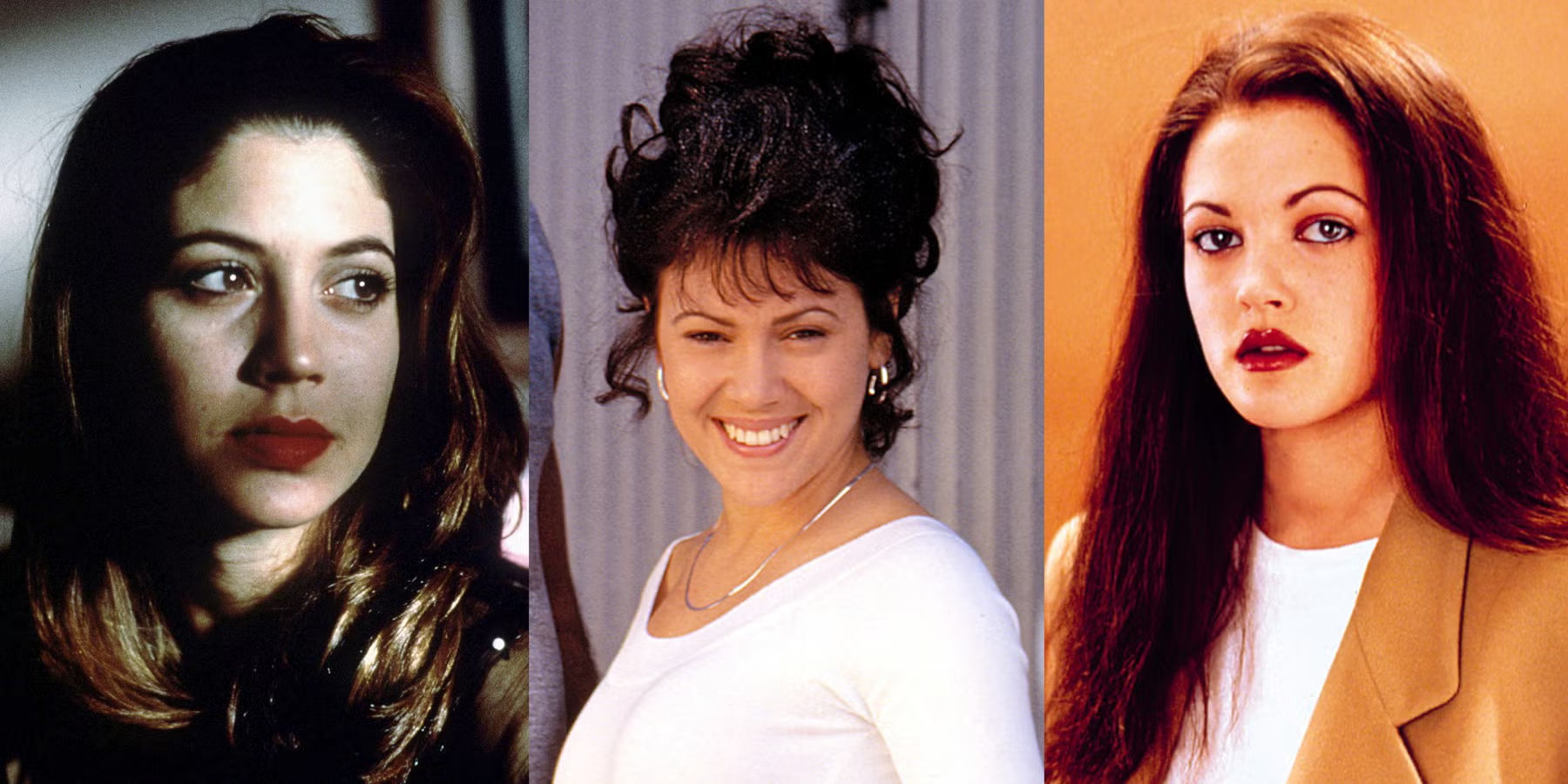
As we engage with the emergent, we might recall that it was on this date in 1993 that ABC and CBS simultaneously broadcast their own movies based on the Amy Fisher story with ABC’s starring Drew Barrymore and CBS’s starring Alyssa Milano. NBC had already scooped the other networks, airing their own version (starring Noelle Parker) about six days prior.
“Language is the road map of a culture. It tells you where its people come from and where they are going”*…

From Colin Gorrie, how our world also shapes our language– and in the example he uses, also our sense of duty…
Debt is old. It’s older than writing. The first writing system, Sumerian cuneiform, evolved out of marks used for accounting. From the beginning, writing was used to track who had what, and, crucially, who owed what to whom.
The influence of debt also extends to language more generally. In many languages, including English, the experiences of owing and being owed provided the blueprint for more abstract notions of duty, necessity, and obligation.
Words meaning ‘to owe’ developed into abstract expressions of obligation so often that it’s useful to have a name for the phenomenon. I call it the owe-to-ought pipeline, named after one of the clearest cases of this development. The word ought is, in fact, nothing but the old past tense form of owe.
This pipeline shows us something about how language changes and develops over time. First, it shows how easily words can slide from one meaning to another, although that’ll be no surprise to anyone who has watched the development of slang over a few decades.
The more important lesson owe-to-ought teaches us has to do with where grammar comes from. Wait, don’t run away! This isn’t a grammar lesson. What I want to show you is how languages create grammar — a collection of abstract meanings such as plurality and verb tense — out of the concrete realities of our shared human experience.
And what human experience is more common than debt?
This is the story of three families of words: owe, should, and the word debt itself. Understand these three families, and you’ll understand how the English language built its way of expressing duty, necessity, and obligation — not to mention guilt and sin — out of the raw materials of accounting…
A case study in how our vocabulary (and our sense of obligation) evolved: “How debt shaped the way we speak,” from @colingorrie.bsky.social.
* Rita Mae Brown
###
As we acknowledge our antecedents, we might recall that it was on this date in 1950 that Rose Marie Reid was granted one of her several patents, US2535018A. A swimwear designer and manufacturer, Reid has already been the first swimsuit designer to use inner brassieres, tummy-tuck panels, stay-down legs, elastic banding, brief skirts, and foundation garments in swimwear, and the first designer to introduce dress sizes in swimwear, designing swimwear for multiple sizes and types of bodies, rather than just producing one standard size. This patent was, in its way, even more revolutionary– it was for a one-piece bathing suit made of elastic fabric “embodying a novel construction for causing it to snugly fit the body of a wearer in a flattering manner [that would] shape and support portions of the body of the wearer in areas of the bust and abdomen in a flattering manner without discomfort or impedance to free movements of the body.” The elastic fabric and elastic securing bands were designed to enable the garment to be put on without having buttoned openings which would “detract from the appearance of the garment.”
Reid assigned her patent to her company and enjoyed huge sales success, in part due to her impact in Hollywood and the motion picture industry. Famous screen actresses (e,g, Rita Hayworth, Marilyn Monroe, Jane Russell, and Rhonda Fleming) wore her swimsuits. And her suits also appeared in several California beach party films from the late 1950s and the early 1960s, including Gidget, Muscle Beach Party, and Where the Boys Are.

“Curiosity is, in great and generous minds, the first passion and the last”*…

From the arcane through the mysterious to the perplexing, a glorious collecton of obscure– but fascinating– knowledge…
Freakpages is a community-curated directory of esoteric articles across the internet, primarily from Wikipedia. Here, we encourage you to learn about interesting topics you have never heard of…
… divided into categories (Society, History, Technology, Psychology, Physics, Biology, Chemistry, Finance, Philosphy), with continuously refreshed selections from both the curators and the community.
A few examples: Egregore, Operation Northwoods, Matrioshka Brain, Zeigarnik Effect, Retrocausality, Horizontal Gene Transfer, Strange Matter Seeding, Keynesian Beauty Contest, Chinese Room…
So many more at: Freakpages
[Image above: source]
###
As we explore, we might spare a thought for a man driven by an endles spirit of inquiry, William Thomson, 1st Baron Kelvin; he died on this date in 1907. A mathematician, mathematical physicist, and engineer considered by many “the Newton of his era,” Lord Kelvin was instrumental in the formulation of the first and second laws of thermodynamics, and contributed significantly to unifying physics, which was then in its infancy of development as an emerging academic discipline. He received the Royal Society’s Copley Medal in 1883 and served as its president from 1890 to 1895. In 1892 he became the first scientist to be elevated to the House of Lords. Absolute temperatures are stated in units of kelvin in his honor.

“Yesterday’s weirdness is tomorrow’s reason why”*…

Ash Sanders visits Bombay Beach, a half-ruined former vacation town on the edge of the Salton Sea where absurdist philosophers, artists, and everyday townsfolk have undertaken a postapocalyptic experiment in radical living…
It is easy to miss California’s biggest environmental disaster. Driving north on Highway 111, you wouldn’t expect to find an inland sea. If it’s summer, the thermometer in your car could read 115 degrees. But amid the shimmering heat, there are signs of water. All around you, rows of broccoli, lettuce, and alfalfa stretch in every direction. In the fields, farmworkers bend and straighten. The air is sharp with cow dung. A pall of dust hangs over everything.
You are sixty miles north of the Mexican border at Calexico. If you keep going, the landscape will transition from fields to palm trees. You’re driving out of poverty and into money, away from one of the poorest counties in California and toward towns with golf courses and named for oases. Palm Springs. Rancho Mirage.
The left turn is easy to miss, the brown sign a seeming anachronism. BOMBAY BEACH. Surely there is no town here, you think, let alone a beach. But if you continue, you’ll see hints of life. There are saplings on the side of the road—not much to look at yet but there all the same. In the distance, a squat building hangs on under the punishing sun. THE SKI INN, it says on the ’70s-era marquee. LOWEST BAR IN THE WESTERN HEMISPHERE. Indeed, you are 223 feet below sea level here, in a depression known as the Salton Sink.
For now, drive past the bar and look up. In front of you is a giant black-and-white billboard. Four white women in vintage swimsuits smile as they water-ski side by side. Behind them, a sea stretches into vastness. LAST STOP FOR THE BOMBAY BEACH RESORT, the sign says. The vibe is nostalgic, carefree. But where is the water? You turn around and around. On every side of you, dust. Above you, the flat, hard sky. That’s when you see the other billboard. This one’s more minimalist. Just a few palm trees and some lettering. BOMBAY BEACH, it reads. THE LAST RESORT! You aren’t sure if it’s a welcome or a warning.
You feel as if you’ve stepped back in time, into a place people have forgotten. The town isn’t large—a little over a half-mile square, its dirt roads named with numbers and letters. But it’s big enough to be a lot of things at once. On some streets, you could be forgiven for thinking no one lived here. Old trailer homes sigh on their blocks, their screen doors rusted and hanging. A sign announcing BOMBAY BEACH ESTATES sits next to a huddle of concrete buildings, their doors and windows gone, their abundant graffiti tending toward alien iconography. The scene reads like a developer’s erstwhile dream, and a homeowners association’s worst nightmare.
But the sense of ruin is not uniform. Here and there, the feeling of absence is replaced by a strange sort of presence. On one street, someone has lined up a series of junked vintage cars to face a movie screen. The cars are empty. The vibe: rapture at the drive-in. Down the road, old TVs have been stacked side by side, their screens painted with abstract shapes. On the roof of a nearby house, there sits, inexplicably, a giant sculpted egg. The scene puts you in mind of Whitman. Does it contradict itself? Very well, then: It contradicts itself. The town contains multitudes…
Sanders elaborates, via the tale of her visit to the Bombay Beach Biennale and her accounts of the remarkable people she met and things she saw there, concluding…
… We saw the tollbooth on our way out of town. It was wooden, and the boom gate was the skeleton of a fish—the unofficial mascot of Bombay. There was a sign hanging in the window. STOP, it said. PAY TOLL FOR RE-ENTRY TO THE REAL WORLD. Someone had crossed out REAL and written NIGHTMARE. We stopped and gave a donation to a bored-looking teen, who handed us our reentry pass. “This ticket buys your return to everything you were running from” was printed on it.
As we drove past the Ski Inn, I saw the billboard again. BOMBAY BEACH. THE LAST RESORT! As in: our last chance. As in: our final effort.
Perhaps it was because of all the talking with Tao and Wanda and Mark, but I found myself in a philosophical frame of mind. I thought of Sean Guerrero’s driftwood ship, the Tetanus Tatanka, made of various pieces of the past. That got me thinking of the ship of Theseus. In Greek mythology, it’s said that the people of Athens honored the memory of one of their greatest heroes by preserving his ship for many years. When one board rotted, they replaced it; when the mast listed, they replaced that. The ship hangs on in our collective memory less as an object and more as a philosophical conundrum. If the ship is always changing—always being changed—is it still the same ship?
Suddenly I felt a chill amid the heat. The landscape swerved, became surreal, uncanny. I closed my eyes, and the sea came up to my ankles. I opened them and the sea retreated again. All at once I entered a perpetual present. It is 2025, and there are cormorant nests made of bird bones out on Mullet Island; it is 1965 and the Beach Boys water-ski on a glimmering sea. It is five million years ago and the Colorado River has just gotten going; it is two million years later, and it is pushing over its berm, flooding the Salton Sink. It is hundreds of years ago and the fires of the Cahuilla people dot the edge of a giant lake; it is the turn of the nineteenth century and the first white farmer is planting his stick on the riverbank, saying, “Mine; this water is mine.” There are buffalo back east somewhere, their bodies massed and vital on the plains. Then the settlers kill the buffalo and there are none left. The world, as Irondad suggested, is always ending and always beginning, and we are always trapped and always about to break free.
I knew at once that this dream was not supposed to let anyone off the hook—it was not saying that things would be fine, or that we were not responsible for what we’d done or must do. It was more of a desert vision, a mirage induced by heat that made regular objects appear different. The ship of Theseus has long posed a question of persistent identity, of how and when a thing stops being what it once was. But leaving Bombay, I wondered if it could also be a story about how long it takes something to become something else—a new species or a new kind of society. After how many revisions and mistakes, how many repetitions or re-creations of the past? Convivium is a gathering, but it is also a process. Slowly, and in isolation, a group of desert people fumbles its way into a new body, and a new body politic.
“The Last Resort” (or, if impeded, here) from @thebeliever.net.
For those unable (or just unlikely) to make it to the Salton Sea: “Make the Internet Weird Again,” from Zach Frechette.
* Hunter S. Thompson (who also– and more famously– observed that “when the going gets weird, the weird turn pro”)
###
As we dance with destiny, we might spare a thought for Eugène Dubois; he died on this date in 1940. A paleoanthropologist and geologist, he was the first person ever deliberately to search for fossils of human ancestors. He is best remembered for his discovery of Pithecanthropus erectus (later redesignated Homo erectus), or “Java Man.” Estimated to be between 700,000 and 1,490,000 years old, it was, at the time of its discovery, the oldest hominid fossil ever found, and it remains the type specimen for Homo erectus… an extinct species of archaic human from the Pleistocene.

You must be logged in to post a comment.