Posts Tagged ‘Marshall McLuhan’
“Technologies are not mere exterior aids but also interior transformations of consciousness and never more than when they affect the word”*…

It feels clear that we’re in the midst of a meaningful cultural/social transition… but what kind of transition? When did it begin? And what might it portend?
Increasingly, folks are turning to the works and thoughts of mid-twentieth century thinkers like Eric Havelock, Walter Ong (who drew on heavily on Havelock’s work), Marshall McLuhan, Joshua Meyrowitz, and others to suggest that we are in the midst of a shift from a literate culture (back) to an oral culture.
We’ve looked before at one (pessimistic) version this argument, and at one approach to understanding the mechanism of the shift. We return to the question today, with a fascinating conversation between Derek Thompson and Joe Weisenthal. Thomson sets the scene…
The world is full of theories of everything. The smartphone theory of everything argues that our personal devices are responsible for the rise of political polarization, anxiety, depression, and conspiracy theories—not to mention the decline of attention spans, intelligence, happiness, and general comity. The housing theory of everything pins inequality, climate change, obesity, and declining fertility on the West’s inability to build enough homes. If you treat TOEs as literal theories of everything, you will be disappointed to find that they all have holes. I prefer to think of them as exercises in thinking through the ways that single phenomena can have vast and unpredictable second-order effects.
Today’s article and interview are about my new favorite theory of everything. Let’s call it “the orality theory of everything.” This theory emerges from the work of mid-20th-century media theorists, especially Walter Ong and Marshall McLuhan. They argued that the invention of the alphabet and the rise of literacy were perhaps the most important events in human history. These developments shifted communications from an age of orality—in which all information was spoken and all learning was social—to an age of literacy, when writing could fix words in place, allowing people to write alone, read alone, and build abstract thoughts that would have been impossible to memorize. The age of orality was an age of social storytelling and flexible cultural memory. The age of literacy made possible a set of abstract systems of thought—calculus, physics, advanced biology, quantum mechanics—that are the basis of all modern technology. But that’s not all, Ong and his ilk said. Literacy literally restructured our consciousness, and the demise of literate culture—the decline of reading and the rise of social media—is again transforming what it feels like to be a thinking, living person.
The most enthusiastic modern proponent that I know of the orality theory of everything is Bloomberg’s Joe Wiesenthal, the co-host of the Odd Lots podcast… we discussed orality, literacy, and the implications for politics, storytelling, expertise, social relations, and much more…
Some highlights:
Derek Thompson: The return of orality: Why do you think it explains everything?
Joe Weisenthal: I don’t think it explains everything. I think it only explains 99% of everything.
I believe that human communication is becoming more oral. And by that I don’t just mean that people are talking more with their mouths, although I do think that is the case. It’s more that communication in general, whether in the spoken form or in the digital form, has the characteristics of conversation. And it truly harkens back to a time before really the written word or, certainly, mass literacy…
… Thompson: Thinking used to be something that had to be done socially. It was impossible to learn the Odyssey on your own. It was transmitted to you from a person. You would rehearse it with someone else. So the mode of information transfer was necessarily social. Books are written alone and books are typically read alone. And so this age of literacy gave rise to this privilege of solitude and interiority that I think is really, really important.
Walter Ong, our mutual hero, has a great quote that I want to throw to you and then get your reaction to, because it goes right to this point. He said:
Human beings in primary oral cultures do not study. They learn by apprenticeship, hunting with experienced hunters, for example, by discipleship, which is a kind of apprenticeship by listening, by repeating what they hear, by mastering proverbs and ways of combining and recombining them, but not study in the strict sense.
I’m very interested in a phenomenon that I call the antisocial century, the idea that for a variety of reasons, we are spending much more time alone. And that is having a bunch of second and third order effects. And it really is interesting to me as I was going deeper into this project, to think that it’s the age of literacy that in many ways allowed us to be alone as we learned and prize a certain kind of interiority.
Wiesenthal: Marshall McLuhan had this observation: The alphabet is the most detribalizing technology that’s ever existed. It speaks to this idea that prior to the written word, all knowledge was per se communal. It had to be in a group. If you have multiple texts in front of you, then you trust the one that feels most logical. But you don’t have that luxury when all knowledge is communal. Being part of the crowd has to be part of learning.
The ear and the eye are very different organs. You can close your eyes, which you can’t do with your ears. You can get perspective from your eye and establish perspective in a way you can’t do with your ears. So it’s like you go into a room and you can stand back at the corner so you can make sure that you can see everything going on in the room. The ear is very different. We’re at the center of everything constantly. You can’t close it. The ear continues to work while we’re sleeping. There’s an evolutionary purpose for the fact that we can still hear when we’re sleeping, because if there’s an intruder or a wild animal or something, it wakes us up and we can run.
So the ear, McLuhan said, is inherently a source of terror. It feels very digital. Even though we do look at the internet, there is this sense in which we can never remove ourselves from it. Even if we’re reading the internet, it almost feels more like we’re hearing it. There’s an immersiveness in contemporary digital discourse that I think is much more like hearing than it is about seeing. So I think there’s all kinds of different ways that we are sort of returning to this realm….
… Thompson: I want to apply your theories to some domains of modern life, starting with politics. You mentioned Donald Trump, and I went to look up Donald Trump’s nicknames, because I know that you’re very interested in his propensity for epithets, for nicknames. It’s nearly Homeric. And so fortunately for our purposes, Wikipedia keeps track of all of Donald Trump’s nicknames, so I didn’t have to remember them—speaking of outsourced memory. Here’s some of them. Steve Bannon was Sloppy Steve, Joe Biden was Sleepy Joe, Mike Bloomberg was Mini Mike, Jeb Bush, of course, Low Energy Jeb, Crooked Hillary, Lyin’ James Comey, Ron DeSanctimonious, DeSantis. I think that one might’ve gotten away from him.
Weisenthal: That was late Trump, he didn’t have his fastball anymore.
Thompson: This plays into this classic tradition of orality. Right? The wine-dark seas, swift-footed Achilles. And Walter Ong has a great passage where he writes about this, that I would love to get your reaction to:
”The cliches in political denunciations in many low-technology developing cultures, enemy of the people, capitalist warmongers, that strike high literates as mindless are residual formulary essentials of oral thought processes.”
Basically, it’s so interesting to think that Ong is saying that it is low-technology developing countries where these nicknames are prevalent. But you wake up today and thee richest country in the world is presided over by a now two-time president whose facility for nicknames is very famous. I wonder what significance do you put on this? Why is it important that a figure like Trump plays into these old-fashioned oral traditions?
Wiesenthal: It’s interesting when you say things like, “Oh, Trump has a sort of Homeric quality the way he speaks,” that repels a lot of people. Like, “What are you talking about? This is nothing like Homer.” But my theory, which I can’t prove. The original bards who composed Homer were probably Trump-like characters. So rather than seeing Trump as a Homeric character, what’s probably, what I’m almost certain is the case, is that the people who gathered around and told these ancient stories were probably Trump-like characters of their time. Colorful, very big characters, people who were loud, who could really get attention, who would captivate people when they talked. One of Ong’s observations in Orality and Literacy is about heavy and light characters in oral societies. Heavy characters, it’s like the Cerberus, like the three-headed dog, the Medusa, the Zeus. These just larger-than-life, frequently grotesque, visually grotesque characters.
I think if you look at the modern world, the modern world has elevated a lot of what I think Ong would call heavy characters. I certainly think Trump is a heavy character, with his makeup, and his hair, and his whole visual presentation. I think Elon is a heavy character. I think if you look at the visual way that a lot of sort of YouTube stars look with their ridiculous open-mouthed soy faces when on their YouTube screenshot. I think they sort of present themselves, not in a way that we would think of as conventionally good-looking. Right? Not in a way that’s conventionally attractive, but this sort of grotesque visual that just sticks in your head. And that that is clearly what works. We are in the time of the heavy character…
… Meyrowitz in 1985 was talking about electronic media before anyone really conceived of that idea. One of his observations is that everybody has a front stage and a backstage. We talk on this podcast in a certain way. But that is different than how we would talk at home with our family. Or you and I might talk differently when we hang up this podcast and we’re saying goodbye or something. This is a very normal thing, which is that you just talk differently in different environments and so forth.
What Meyrowitz anticipated in No Sense of Place is this idea that electronic media would cause us to come to be suspect of people who talk differently in one environment vs. another. If someone code-switched, if someone talked differently on the campaign trail than they did in their private life, that we would come to think, ”Oh, this person’s a phony.” He predicted that by allowing everyone to see all the facets of these characters, we would view them differently.
Thinking about a politician, something about Trump is that there’s very few examples of him ever talking differently than any other environment. People could be totally repelled by things that he said in public or private. But he’s not a hypocrite in the way that a lot of people use that word. He is the same in almost every environment. This is precisely what Meyrowitz would’ve anticipated, that we would gravitate toward people who when we saw their front stage and their backstage, where the concept of place was completely disintegrated from the idea of character, that we would come to view that consistency of character as a value.
Thompson: The name of Meyrowitz’s book is No Sense of Place. And I want to just slow down on that title, because it’s a pun. It’s not a very intuitive pun, but it’s a really, really smart pun. By No Sense of Place, Meyrowitz is saying that electronic media extends our consciousness outward, so we don’t really know where we are. I could be reading Twitter in Arlington, Virginia, but feel myself becoming emotional about Gaza or Ukraine, or Minneapolis, in a way that was impossible in the age before television or radio. This new age of communications media takes us out of where we are and puts us right in front of the faces of people that are thousands of miles away.
But he also means no sense of place in a hierarchical sense. He means that people will be able, with electronic media, to operate outside of their slot in the hierarchy: the poor will be able to scream at the billionaires; the disenfranchised will be able to scream at those who disenfranchise them. And this he said is going to create more social unrest. It’s going to create more, I think what he would agree now is something like populism. And this really interesting idea that electronic media not only unmoors us from where we are geographically, but that it also demolishes hierarchies, I think it was incredibly insightful, considering it was written 41 years ago.
But he goes one step further in a way that’s really surprising… He says this about our future relationship to expertise. And God only knows how many people have talked about what’s happened to expertise in the last few decades. Meyrowitz:
Our increasingly complex technological and social world has made us rely more and more heavily on expert information, but the general exposure of experts as fallible human beings has lessened our faith in them as people. The change in our image of leaders and experts leaves us with,” and this is exactly your point, “a distrust of power, but also with a seemingly powerless dependence on those in whom we have little trust…
And so much more (including their thoughts on AI): “The Obscure Media Theory That Explains ‘99% of Everything’,” from @dkthomp.bsky.social and @weisenthal.bsky.social. Or (if you’re more orally inclined) listen on Thompson’s Plain English podcast.
Via Patrick Tanguay in his always-illuminating newsletter.
* Walter J. Ong
###
As we contemplate culture, we might note that it was on this date in 2012 that Encyclopædia Britannica’s president, Jorge Cauz, announced that it would not produce any new print editions and that 2010’s 15th edition would be the last. The first (printed) edition of the Encyclopedia Britannica was published between 1768 and 1771 in Edinburgh as the “Encyclopedia Britannica, or, A Dictionary of Arts and Sciences compiled upon a New Plan.” Since 2012, the company has focused only on an online edition and other educational tools. It goes by simply “Britannica” now.

“Everybody experiences far more than he understands. Yet it is experience, rather than understanding, that influences behavior, especially in collective matters of media and technology, where the individual is almost inevitably unaware of their effects upon him.”*…

In the early 1970’s Marshall McLuhan and his son set out to discover if there might be general principles of technology, attributes, and effects common to all products of human innovation, to all of these artificial extensions of ourselves. Eric’s son, Andrew McLuhan shares their findings…
… Toward the end of his life, a life which ended before his 70th birthday, Avant Garde magazine asked Marshall McLuhan what he considered his greatest achievement. His reply?
“I consider my greatest achievement is the discovery that all human artifacts, all the extensions of man, are patterned structurally in the mode of the word. Whether it is a medium like radio, a bull dozer, or a safety pin; whether it is the word or a law of science, all these utterings and outerings of man have a four-part structure which is that of metaphor itself. I will illustrate this discovery from the character of money, which:
(a) enhances the speed of exchange
(b) obsolesces barter
(c) retrieves potlatch (conspicuous waste) and
(d) when pushed to its limits, flips or reverses its character into credit.
A book of these things is due to appear, title ‘The Laws of the Media’.”
But no one was interested in publishing it. It wasn’t published until 1988 when Eric McLuhan finally got someone – University of Toronto Press – to put it out as ‘Laws of Media: The New Science.’ The subtitle was a deliberate nod to Francis Bacon (Novum Organon) and Giambattista Vico (Scienza Nuova) of which tradition the McLuhans felt their work was part.
I have noticed more people using the laws of media, or the ‘tetrad’ (group of four) as it’s called, lately.
The laws of media can’t tell you everything about any technology, but they give you four reliable places from which to begin to explore what any technology is and what it does – another way of saying ‘the medium is the message.’ Particularly, it’s a way of examining the form of a thing and not just its content. The content of a medium, what we do with it, pay attention to, is always both the smaller part of the situation, and the less affective area. In Understanding Media McLuhan brilliantly paraphrases T S Eliot when he describes content as the juicy piece of meat carried by the burglar to distract the watchdog of the mind. The content keeps us busy, hold our attention, while the media do their work rearranging us, our lives, our world. To enlist Mary Poppins, content is the spoonful of sugar that helps the medicine go down.
The four things the McLuhans discovered are that:
Any given technology enhances or amplifies some aspect of us. We create tools to do something we already do faster, more easily or efficiently. Gloves to save our hands. Computers, to calculate. Telephone, that our voice carries across the world.
“It is a persistent theme of this book that all technologies are extensions of our physical and nervous systems to increase power and speed.” (‘Understanding Media: The Extensions of Man’ 1964)
It obsolesces, it upsets or displaces, disrupts something already in a dominant position. The Linotype machine put 90% of typesetters out of work. Twitter broke the news that television and radio networks used to.
“Now today, we speak of the book as obsolete. This means the book is acquiring ever new uses in the age of Xerox and the age of paperbacks.” (Marshall and Eric McLuhan in conversation, 1971)
It retrieves, or brings back something from the past, however near or far, in a new form. Text messaging put a telegraph in your pocket. The man in the car, the knight in shining armour.
“What recurrence or retrieval of earlier actions and services is brought into play simultaneously by the new form? What older, previously obsolesced ground is brought back and inheres in the new form?” ‘Laws of Media: The New Science’ 1988
When pushed past a point, it tends to flip or reverses its utility or characteristics. A glass of wine or two can make for a good time, relieve stress, grease the social wheels. A few bottles… quite the opposite. Information assists informed, timely decisions, too much information leads to overload, paralysis.
“When pushed to the limits of its potential the new form will tend to reverse what had been its original characteristics. What is the reversal potential of the new form?” (Laws of Media: The New Science 1988)
For example, here’s a tetrad from Laws of Media:
Xerox:
enhances: the speed of the printing press
obsolesces: the assembly-line book
reverses into: everybody becomes a publisher
retrieves: the oral tradition
Laws of Media: The New Science (Marshall and Eric McLuhan, 1988)
While media can be complex in nature and do many things, Marshall and Eric found that all media, without exception, do these four things. As remarkable as this discovery is – so remarkable that Marshall McLuhan considered it his most impressive achievement – almost equally remarkable is that so few people know about it.
They found four things which applied in all cases, but never stopped looking for a fifth. I know my father Eric was still keeping an eye or ear out for a fifth common dimension, something that would apply without exception to all media. A few people have ventured one thing or another but they did not satisfy my father’s criteria…
… The ‘laws of media’ can’t tell you everything about any medium, but it does give us something remarkable: predictability. We know that anything we can come up with will do these four things. It will amplify some part of us. It will make something obsolete. It will bring something back from the past in a new form. It will, when pushed, flip. This is an incredible advantage when it comes to new media. It gives us a real head start on being able to anticipate the effects of new forms on us and our world…
… [Per the title quote above] The point of the tetrad, the point of media studies at all, is to make media visible. To force us to pay attention to what’s happening all around us, sometimes only slightly beneath our awareness, sometimes buried deeply underneath. The true user experience is what we don’t notice but which shapes us all the same…
More (including how to “make” tetrads yourself): “Laws of (New) Media.”
* Marshall McLuhan, Understanding Media: The Extensions of Man, 1964
###
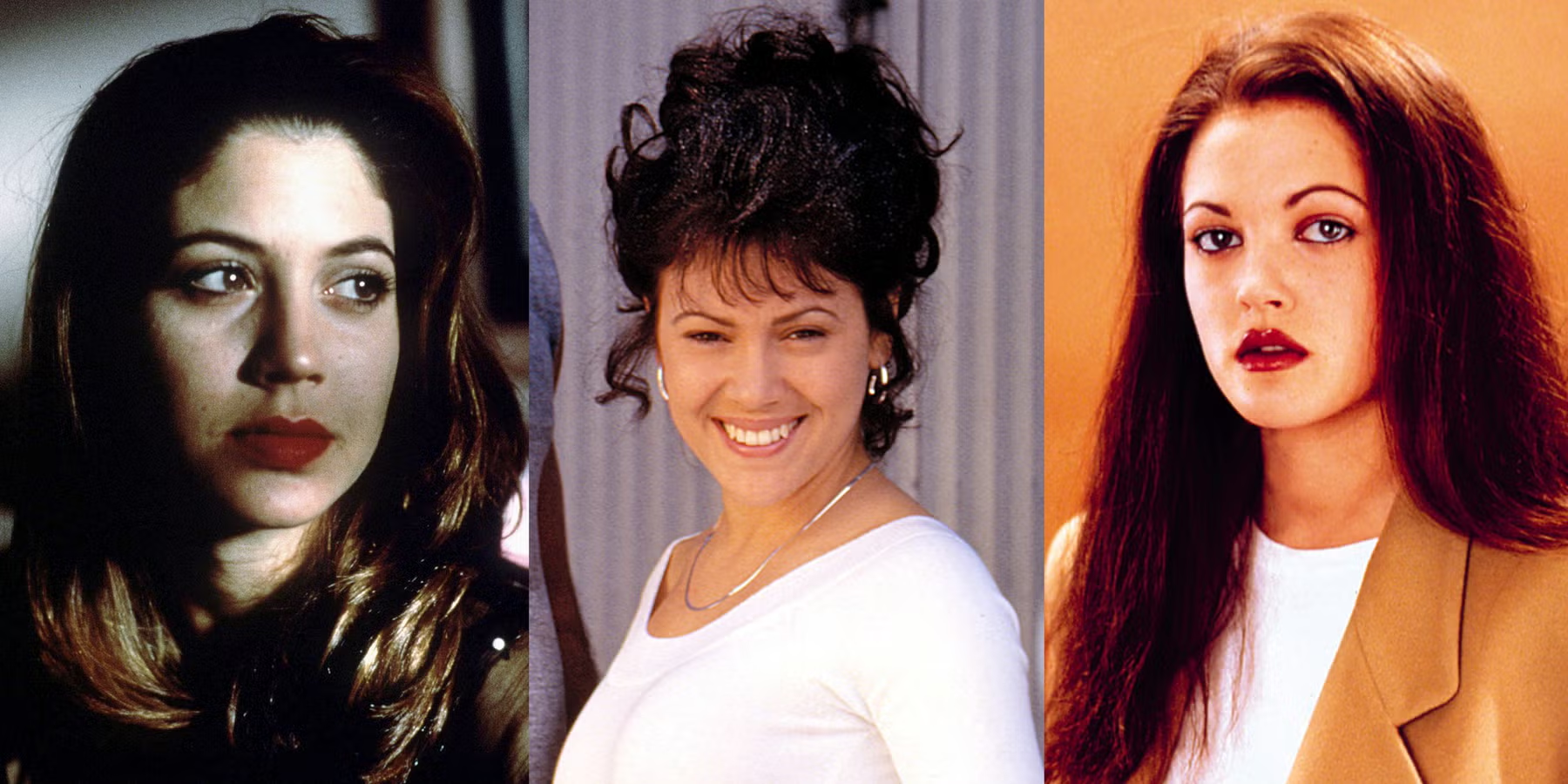
As we engage with the emergent, we might recall that it was on this date in 1993 that ABC and CBS simultaneously broadcast their own movies based on the Amy Fisher story with ABC’s starring Drew Barrymore and CBS’s starring Alyssa Milano. NBC had already scooped the other networks, airing their own version (starring Noelle Parker) about six days prior.
“You have to remember one thing about the will of the people: it wasn’t that long ago that we were swept away by the Macarena”*…

At the higher elevations of informed American opinion these days, the voices of reason stand united in their fear and loathing of Donald J. Trump, real estate mogul, reality-TV star, forty-fifth president of the United States. Their viewing with alarm is bipartisan and heartfelt, but the dumbfounded question, “How can such things be?” is well behind the times. Trump is undoubtedly a menace, but he isn’t a surprise. His smug and self-satisfied face is the face of the way things are and have been in Washington and Wall Street for the last quarter of a century.
Trump staked his claim to the White House on the proposition that he was “really rich,” embodiment of the divine right of money and therefore free to say and do whatever it took to make America great again. A deus ex machina descending an escalator into the atrium of his eponymous tower on Manhattan’s Fifth Avenue in June 2015, Trump was there to say, and say it plainly, that money is power, and power, ladies and gentlemen, is not self-sacrificing or democratic…
Trump is a product of the junk entertainment industry but also product of what Marshall McLuhan recognized nearly half a century ago as an “acoustic world” in which there is “no continuity, no homogeneity, no connections, no stasis…an information environment of which humanity has never had any experience whatever.” McLuhan’s Understanding Media appeared in 1964 with the proposition that new means of communication give rise to new structures of feeling and thought. “We shape our tools and thereafter our tools shape us.” We become what we behold, and “the medium is the message.” Shift the means of communication from printed page to enchanted screen, and they establish new rules for what counts as knowledge. The visual order of print sustains a sequence of cause and effect, tells a story with a beginning, middle, and end. The speed of light spreads stories that run around in circles, eliminate the dimensions of space and time, construct a world in which nothing follows from anything else. Sequence becomes additive instead of causative, “Graphic Man” replaces “Typographic Man,” and images of government become a government of images signifying nothing other than their own transient magnificence. Like the moon acting upon the movement of the tides, the idols of divine celebrity (Ronald Reagan and Madonna, Lady Gaga and Donald Trump) call forth collective surges of emotion that rise and fall with as little inherent meaning as the surf breaking on the beach at Malibu.
The sound bites come and go on a reassuringly familiar loop, the same footage, the same spokespeople, the same commentaries. What was said last week certain to be said this week, next week, and then again six weeks from now. The ritual returns as surely as the sun, demanding of the constant viewer little else except devout observance. Pattern recognition becomes applied knowledge; the making of as many as 12,000 connections in the course of a day’s googling and shopping (Miller beer is wet, Nike is a sneaker or a cap, Rolex is not a golf ball), adds to the sum of all ye know or need to know on the yellow brick road to truth and beauty…
Advertising is the voice of money talking to money, a dialect characterized by Toni Morrison in her 1993 Nobel Prize speech as “language that drinks blood…dumb, predatory, and sentimental,” prioritized to “sanction ignorance and preserve privilege.” Which is the language in which we do our shopping and our politics. Typographic Man wrote the Constitution and the Gettysburg Address; Graphic Man elects the president of the United States. The media on the campaign trail with Donald Trump weren’t following a train of thought. Like flies to death and honey, they were drawn to the splendour and flash of money, to the romance of crime and the sweet decaying smell of overripe celebrity…
The consequence is the destruction of a credible political discourse without which democracy cannot exist…
From an essay (adapted from a talk) by Lewis Lapham, arguing that this “destruction of credible political discourse” started long before President Trump– eminently worth reading in its entirety: “The Myth of American Democracy.”
[The source of the image above, “American Democracy Is Broken. Here’s How to Fix It” makes a series of smart suggestions for adjustments to the mechanism of our democracy… but stops short of addressing the zeitgeist that Lapham dissects.]
* John Stewart
###
As we return from our patriotically-justified holidays, we might send annexing birthday greetings to Frederick William Seward; he was born on this date in 1830. Seward served twice as Assistant Secretary of State, from 1861 to 1869 under both Abraham Lincoln and Andrew Johnson and then from 1877 to 1879 in the administration of Rutherford B. Hayes. In his first stint, he served under his father, Secretary of State William H. Seward, and helped him engineer “Seward’s Folly,” the U.S. purchase of Alaska in 1867 from Russia.

And we might recall that it was on this date in 1898 that Jefferson Randolph “Soapy” Smith uttered his last words: “My God, don’t shoot!” Smith, a confidence man who was “following the gold,” had moved to Skagway, Alaska, after successful criminal careers in Denver and Creede, Colorado. He’d assembled a gang and taken control of the docks– an important distribution point in the Klondike Gold Rush. A committee of vigilantes formed to rid the town of Smith and his gang. When federal authorities failed to act, they decided to confront Soapy themselves. Smith met them carrying a Winchester rifle. In the event, only one of the citizen’s committee– Frank Reid, who’d been a bartender in on of Smith’s saloons– was armed. The two men struggled and wounded each other, after which another member of the committee, Jesse Murphy (a recently-arrived employee of the railroad) wrestled the rifle from Smith and killed him with it. Reid also died from his wounds; though his own reputation was far from untarnished, his funeral was the largest in Skagway’s history, and his gravestone was inscribed with the words “He gave his life for the honor of Skagway.”

Soapy Smith
“Technological progress has merely provided us with more efficient means for going backwards”*…
45 years ago, four eminences took the stage at the University of Toronto: Irish actor Jack MacGowran, best known for his interpretations of Samuel Beckett; English poet and dramatist W.H. Auden; American architect and theorist of humanity’s way of life Buckminster Fuller; and Canadian literary scholar turned media technology oracle Marshall McLuhan. Now only did all four men come from different countries, they came from very different points on the intellectual and cultural map. The CBC recorded them for broadcast on its long-running series Ideas, prefacing it with an announcement that “the ostensible subject of their discussion is theatre and the visual arts.”
Key word: ostensible. “That topic is soon forgotten as two modes of perception clash,” says the announcer, “that of Professor McLuhan, who is one of the most famous interpreters of contemporary 20th-century cultural trends, and that of W.H. Auden, who cheerfully admits to being ‘a 19th-century man’ and sees no reason to change.” And so, though Fuller and MacGowan do occasionally provide their perspective, the panel turns into a rollicking debate between McLuhan and Auden, more or less from the point where the former — making one of his characteristically compelling proclamations — declares that modern media brings us to a world in which “there is no audience. There are only actors.” But the latter objects: “I profoundly disapprove of audience participation.”…
The conversation is above; for more of the backstory: “Marshall McLuhan, W.H. Auden & Buckminster Fuller Debate the Virtues of Modern Technology & Media (1971).
* Aldous Huxley, Ends and Means
###
As we mind the message that is the medium, we might send tasty birthday wishes to John Montagu, Fourth Earl of Sandwich; he was born on this date in 1718. Lore suggests that the Earl, an enthusiastic gambler, instructed his servants to skip the distraction of a served meal, asking instead for “meat between two pieces of bread” to be consumed as he remained at the gaming table. While there’s no real historical support for the tale, the comestible is nonetheless still known as a “sandwich.”
Montagu also had a nautical edge, serving as First Lord of the Admiralty from 1771-1782. He was sufficiently regarded that Captain Cook named the Sandwich Islands in his honor. On the other hand, he was widely blamed for the sorry state of readiness displayed by the British Navy during the “Unpleasantness with the Colonies.” (Indeed, it may in gratitude for Montagu’s help– however inadvertent– that American’s have adopted the sandwich as our national dish…)

The eyes of the beholders…
Readers will know Etsy, the successful online “market for handmade things,” where the mission is “to enable people to make a living making things, and to reconnect makers with buyers.”
Now, thanks to reader PL, readers can discover Regretsy— a site that focuses on a sub-set of the postings on Etsy; as Regretsy’s motto explains: “Handmade? It looks like you made it with your feet.”
For example:

or…

Regretsy is quick to be clear about where it stands:
Don’t get us wrong. We like crafts.
We just don’t like these crafts.
Yes, we know these people put their hearts into it. We know it took hours and hours. We know how mean it is to laugh at their creations. And we regret being the only web site on the internet that makes fun of things.
But what can we do? We’re immature.
Besides, art is totally subjective. Who cares what we think? I barely care and I’m writing this.
Listen, if you like something you see here, don’t argue with us, go and buy it. Seriously. Click on any photo and you’ll be taken to the seller’s store (if a photo is not linked, the store is closed, or we are unable to find the seller). We’re only too glad to have made the introduction.
Otherwise, we’re just going to sit here and look at the amputee kitten paintings and vulva earrings and laugh so hard that we pee in our reusable Pokemon pads.
Etsy, for its part, has been very gracious: “If it brings in more traffic to the shop and helps make sales, then all the better.” And in fact, many of the items featured on Regretsy have found new owners.
For our parts, lest we rush too quickly to any judgments, we might recall the thoughts of several close observers of beauty and the arts:
Good taste is the first refuge of the non-creative. It is the last ditch stand of the artist.
– Marshall McLuhanIt is good taste, and good taste alone, that possesses the power to sterilize and is always the first handicap to any creative functioning.
– Salvador DaliTaste is the enemy of creativity.
– Pablo Picasso
As we reach for those knitting needles, we might ponder bobbing our hair in commemoration of the incomparable Louise Brooks, fabled actress (Pandora’s Box and other Pabst greats) and author of Lulu in Hollywood; she was born this day in 1906.


You must be logged in to post a comment.