Posts Tagged ‘society’
“I believe that we can forecast the ‘changing landscape of context,’ and thus get insight into when we are entering the danger zone”*…

Derek Thompson shares his interview with philosopher Agnes Callard…
Here are some questions that I consider self-evidently compelling about the modern world:
- Why is the news media so interested in telling you how much the world sucks all the time?
- Why are so many of us obsessed with distraction and managing our attention?
- Why is it so hard to stop comparing ourselves to others?
- And why does everything in art and design seem the same these days?
A week ago, I didn’t think these questions were related. I’m not sure I would have told you I had a good answer to most of them. And I certainly wouldn’t have made the audacious and borderline bonkers claim that one single theory could begin to explain all of them, at once.
But then I had the pleasure of speaking to Agnes Callard, the University of Chicago professor, about her new theory called “the uni-context.” It’s easily one of them most interesting conversations I’ve had all year. And once you’ve heard or read it, I think you might find it hard to think about anything else.
One way to prepare your mind for Callard’s theory of the uni-context is to think about the better-known concept of “context collapse.” If you post something to social media, it will be simultaneously visible to your boss, your parents, your ex, and total strangers. So, while your offline life might be distinct with each of these groups—you might be differential to your boss, childish with your parents, and bawdy with your friends—all of those distinctions are flattened on the internet. That’s context collapse, and you can think of it as the answer to a question: How do informational norms change when we’re all living in the same universal room?
Callard takes the idea significantly further. She asks: How do all other norms—our morals, our ethics, our sense of what is good for us and for others—change when we continually imagine ourselves to be living in a universal room with everybody else? The connections that Callard makes are consistently surprising, often quite funny, and ultimately mind-exploding…
A small sample…
… Thompson: Tell me if this is a fair recapitulation of our conversation so far.
For most of human history, people judged norms based on local context. A home had its own rules, a cathedral its own rules, and a classroom or bar or funeral parlor had its own rules. But now it is almost like we are constantly living in universal rooms, and the universal room we occupy is assumed to have universal values and universal norms. That has specific implications. First, rather than talk about what is good, which is context-dependent, we tend to focus about universal truths, and it’s easier to talk about universal bads than goods, so people focus on negativity. Two, character is context-dependent, so we talk less about character and more about its universalist equivalent, which is identity.
There’s a third implication that we should discuss. If everyone is on the same comparable plane, the same evaluative field, then comparison itself becomes a more inextricable part of life.
Callard: Exactly.
Thompson: Tell me how the uni-context leads to a world of more comparison and competition.
Callard: Imagine two school districts with two high schools that do things slightly differently. If you’re in district A, you go to school A, and if you’re in district B, you go to school B. There might be a lot of information about what they do, but people treat it as: I’m in this district, so I go to this school. Then they change the rule: You can go to either school no matter where you live. Suddenly there is motivation to compare. You had the information before, but no motivation to compare, because the schools were not in the same space of choice, the same evaluative field.
Now they are, so you find ways to compare them: graduation rates, what colleges people get into, how many AP classes they teach. And that affects the schools. Suppose one gets less popular because it doesn’t teach many AP classes. They were offering an individualized curriculum, but now everyone’s going to the other school, so they say, “We’ve got to teach AP classes too.” The process homogenizes the two schools, so they can compete. That’s not the only possible result. They could specialize, with one becoming the school for freshman and sophomore years, the other becoming the school for junior and senior years. But if they don’t recreate a normative barrier, you get homogenization from comparison.
As more things enter the same evaluative field, you make comparisons you never used to be able to make.
Thompson: There are three pieces I’m trying to keep straight.
One, the upstream phenomenon of the uni-context. Two, the downstream phenomenon of more fields of comparison. Three, the further downstream phenomenon of homogenization.
This is where the theory really starts to sing for me, because I think about sports. As the analytics revolution came for baseball, you had all these teams in possession of the same statistics by which they could compare players. Previously, you had 30 teams using their own private scouts, so their analysis was more context-dependent. But when an easily calculable statistic like on-base percentage or WAR becomes the conventional way to evaluate whether a player is good, all the players become part of the same comparative set. You can rank them one-to-250 easily on a spreadsheet.
But analytics didn’t just lead to more math, or more comparison. It led to more homogenization of strategy. One of the great critiques of baseball has been that every team essentially does the exact same thing: it’s the same strategies for pitchers; the same strategies for hitters; the three true outcomes; all the batters swinging for the fences. So you have the uni-context creating a comparative field, in this case analytics, which leads to homogenization.
Callard: What you said reminded me that I have a theory of the inflection point for the uni-context. I don’t think it started five or ten years ago. The moment it really showed up was around 1910.
One century ago, there were a bunch of people looking around at the world, thinking: What the hell is happening? Did culture break? A lot of those people were novelists, and they wrote a new kind of novel called the modernist novel, which is a novel about how to live in a world in which the uni-context is just coming into existence. Theorists of the time—such as Georg Simmel, Max Weber, and Martin Heidegger—they noticed something weird was going on. They tended to describe it in terms that sound almost like the opposite of the uni-context. They described it as the fragmentation of everything. All of a sudden, they said, everything is breaking apart. That was my first clue.
The reason I thought of this is that you said everything is becoming homogenous, and I thought, “in a way, yes, but that’s a later effect.” The first thing that happens when a bunch of stuff is unified in a single evaluative field is that you feel overwhelmed by your choices. It feels like stuff is fragmented, because you don’t know how to compare these things, because you haven’t yet developed technologies of comparing them.
So, the early feeling of the uni-context was a feeling of the world being fragmented. If you were a medieval peasant doing art, you were in art’s normative world. If you were in the church, you were in the church’s normative world. But in the 20th century, around World War I, you start to think: How do we reconcile the schoolteacher turned murderer, the soldier? How do we think about the relationship between art and religion? We’re suddenly trying to compare all these different values inside a single context, and the world feels dis-unified. Eventually we get technologies of commensurability. What fragmentation really means—and that part was invisible to these writers—is that suddenly everything is part of the same evaluative field. That’s why you experience a multiplicity where you used to experience one thing at a time…
There’s much more, all of it provocative. Here, the conclusion…
Thompson: I want to know what we should do about this.
A simple answer might be: When you’re having dinner with your family, you can be present with your family, or you can be on your phone, which is a universal room that makes you everywhere at once. So put away the phone. But that feels like a cheap and predictable answer. Do you have something prescriptive that isn’t just “put away the phone at family dinner?”
Callard: The question of whether the uni-context is good or bad is loaded, because the uni-context struggles to see good things. It’s better at seeing bad things. Pretty much everyone who hears me talk about the uni-context immediately responds that it’s bad. I’ve never had anyone say, “The uni-context sounds great!”But the thing is that this supposedly bad thing is a thing we’re creating. We’re choosing it over and over again. Even me talking to you from far away about an abstract thing [is the uni-context.]
The uni-context is a space of unruliness. It’s a space in which a certain thing about humanity gets expressed, namely our deep aversion to “world closure.” For almost all of human history, we have lived in closed little worlds, and those worlds presented themselves as the only world. A series of contexts presented the person with direction—here’s what you should do. What we are moving toward is a “world openness” that we hunger after, where I’m not just going to do things a certain way because that’s how we do things or where I was born.
Antonio Gramsci famously said, “the old world is dying, and the new world struggles to be born: now is the time of monsters.” So, how do we use openness, as Callard describes it, as space in which to create a world in which we want to live? How do we recover the wisdom imbedded in context– the accreted shell of our shared history– without context’s reactionary trappings? How do we build anew a better world?
In any case, once you learn what the “uni-context” is, you won’t stop seeing it everywhere: “A Philosopher’s One-Word Theory to Explain Why the World Feels So Weird,” from @dkthomp.bsky.social and @agcallard.bsky.social.
###
As we muse on milieu, we might recall that it was on this date in 1963 that The Essex (a singing group composed of four active-duty Marines) reached #1 on Billboard R&B chart with their first release “Easier Said Than Done” (which had been intended as the B-Side of the record); it went on to top Billboard‘s Hot 100, and was the biggest hit of their career.
“Food, culture, people, and landscape are all absolutely inseparable”*…

Further, in a fashion, to yesterday’s post: Stephen Lurie and our friends at The Pudding with an elegant and insightful looks at what America’s earliest restaurants can teach us about America…
The New York Public Library’s Buttolph Collection of menus, dated 1880-1920, captures the emergence of modern restaurant dining…
… A menu describes what a reataurant serves– but a menu also describes who is being served. [Collectively] they refect the class, gender, political, technological, and environmental shifts of history.
The thousands of menus in this collection document a period of fundamental transformation– and the birth of the society and the restaurant we know today.
I’ve searched through the archive to tell you that story in ten dishes. Your table is ready– right this way…
Restaurant dining in America was once an Imitation: wannabe aristocrats attempting French feasting. But as the 19th became the 20th century, the American middle class and the true American resaturant emerged: diverse, accessible, opinionated… and at times, chaotic.
From Bisque d’Ecrevisses and Celery in a Crystal Celery Vase through “cosmopolitan” and “ethnic” food to Potatoes O’Brien Au Gratin and Baked Alaska, the tasty (and illuminating) tale of dining out in America: “A History of Menus is a Menu of History,” from @luriethereal.bsky.social and @pudding.cool.
* Anthony Bourdain
###
As we dig in, we might send tasty birthday greetings to a man who has built a culinary domain that epitomizes (in its scale, at least one huge quadrant of) the current state of the restaurant business: Wolfgang Puck; he was born on this date in 1949. He made his name with Spago restaurant in Los Angeles in 1982. He now has more than 20 fine dining restaurants and dozens of pizza bars, bistros, cafes, airport restaurants, express outlets, catering services, cultural center cafes; he sells gourmet foods, cookware, and appliances; and he runs a catering empire (that has catered he official Academy Awards Governors Ball every year since 1994).

“The present is the past rolled up for action, and the past is the present unrolled for understanding”*…
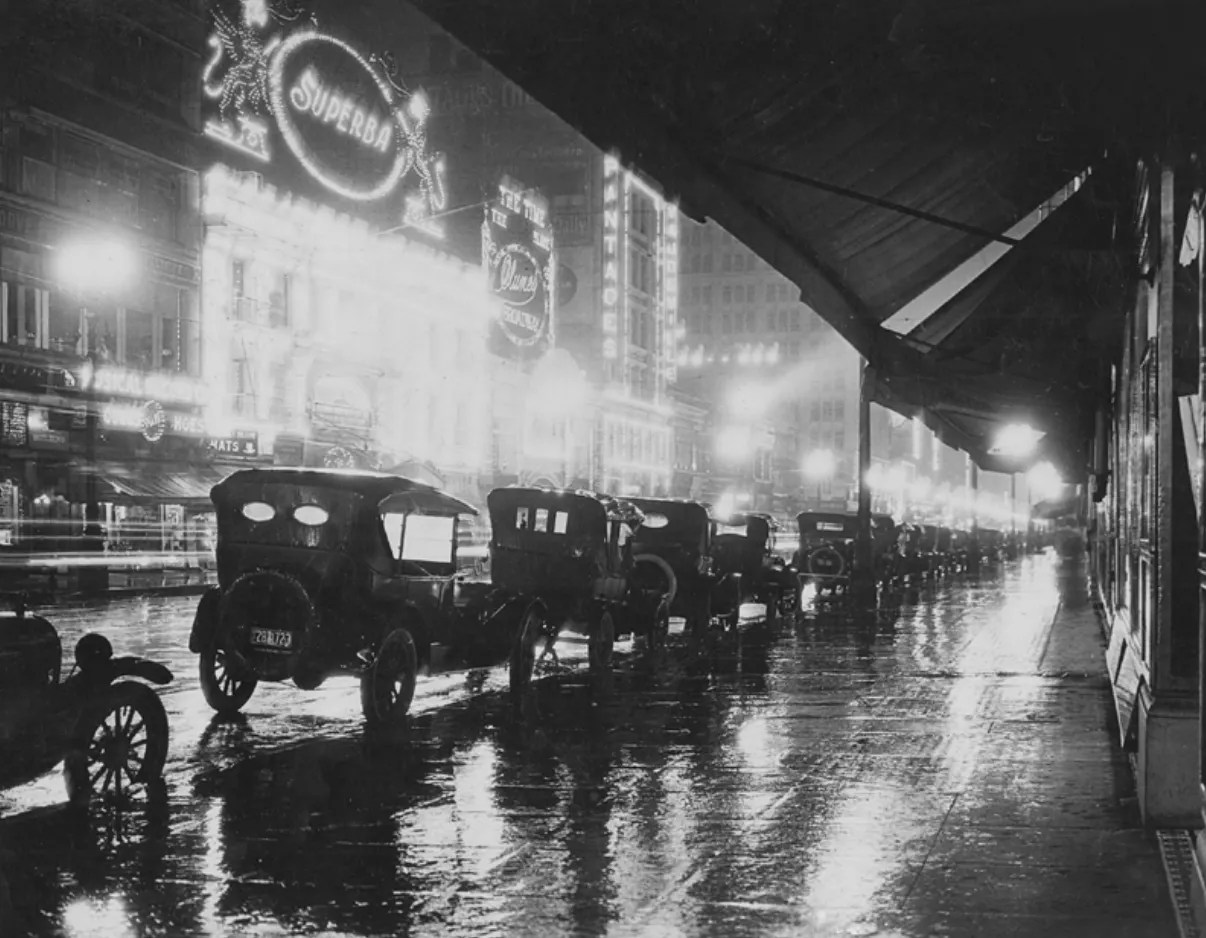
As Jean-Baptiste Alphonse Karr put it, “plus ça change, plus c’est la même chose” (“the more things change, the more they stay the same”). Case in point: Derek Thompson reminds us that about 100 years ago, America was obsessed with technology, immigration, women, work, and money. Sound familiar?
[Just over] one hundred years ago, on September 26, 1929, President Herbert Hoover gathered a group of social scientists at the White House. He asked them to begin research on the most detailed report ever produced on the state of the nation. Four years later, running more than 1,500 pages long, Recent Social Trends was published, offering an unusually granular look at life in the mid-1920s.
The document is almost entirely forgotten. But today, for America’s 250th birthday, I’m blowing the cobwebs off this sucker and taking readers inside its yellowed pages for a look back at what life was like in the U.S. exactly 100 years ago, when the U.S. was celebrating its sesquicentennial anniversary…
And what a look it is…
… Imagine that you are the typical American in 1926. You are a white 26-year-old. (In 2026, the median age is 40.) Since most immigrants have been male, we’ll say you’re a guy. Your name is John. Born in the first term of William McKinley’s presidency, you are raised on a farm without flush toilets or electric lighting. Too young to fight in World War I, you come of age alongside a generation that sees war in Europe as a “useless colossal blunder,” in the words of historian David M. Kennedy. Your life—indeed, your entire generation—is shaped by several notable developments: education, urbanization, automation, and women’s rights. You are the first person in your family to finish high school.
At 19, you move from the countryside to an urban apartment, as one small drop in the migratory flood from farm to city. Jobs in manufacturing and retail are easy to find. They’re also easy to lose. Temporary unemployment is the norm. You earn $100 a month and put some away for a rainy day, confident that the bustling city will provide another job in a few months. (Unemployment insurance does not exist; neither does Social Security.) In the evenings, you “radio”; yes, it’s a verb, too. Every weekend, you visit a cineplex, where the movies are black-and-white and silent. Sometimes, you down a few prohibited cocktails and go dancing with flappers. Several times a week, you drive around in a black Model T.
The year 1926 has been good to you. City life is a blur of high-velocity machines—cars, assembly lines, and radio broadcasts—and you sometimes miss the ancient rhythms of your farmland home. One year from now, Charles Lindbergh will shock the world by flying across the Atlantic. In two years, at 28, you’ll be married. In three years, you’ll have a baby. And in four years, in 1930, just months after the biggest stock market crash in American history, the world as you know it will be over…
Thompson goes on to unpack the details of the economy and employment, the migration from farm to city, the extraordinary centrality of the automobile, changing mores and gender roles, the primacy of literature and the rise of radio, and so much more. He concludes…
The authors of Recent Social Trends were astonishingly prescient about the direction of technology. In one paragraph, they somehow anticipated the rise of audiobooks, YouTube, Netflix, smartphone cameras, musical software, ubiquitous air conditioning, and the electric battery revolution:
It may be that the world will find much use for talking books; school and college students may listen to lectures by long-running phonographs or talking pictures; moving pictures may be transmitted by wireless into houses; seeing with that new electric eye, the photo-electric cell, and recording what is seen, appear to have almost unlimited applications; new musical instruments different from any now in use may be given to us by electricity; the production of artificial climate may become widespread; an efficient storage battery of light weight and low cost might produce changes rivaling those of the internal combustion engine. And these are only a few of the myriad possibilities from new inventions in the future!
In an equally oracular section, the authors predicted the emergence of remote work and declining geographic mobility, anticipating that “the transmission of goods, of the voice and possibly of vision may act as a retarding influence on human mobility in the future and may cause a development of more remote and impersonal direction and controls.”
But the social scientists did not see these trends as altogether good. They worried that modern life, defined in equal parts by urbanization and technology, obliterated people’s values and their sense of self. Even as they gawked at the increase in patents—which grew more than 20-fold between the 1850s and the 1920s—they worried that a growing number of discoveries would bring “problems of morals, of education, of law, of leisure time, of unemployment, of speed, of uniformity and of differentiation.”
Social scientists of the 1920s saw machines pushing workers off of farms and competing with workers in manufacturing plants. How long, they wondered, until they would replace human workers in all tasks? “A larger proportion of work by machines, and a smaller proportion of human labor, is to be expected in the future,” they wrote. “There are indeed a few cases of wholly automatic factories and automatic stores and many automatic salesmen.” It is extraordinary to read these fears and not reflect on the AI jobs panic of the present, while also marveling at the thousands of occupations that are possible today precisely because machines made old jobs obsolete.
The dawn of the age of the machine drove us mad. Physicians of the day warned that the frail human mind was no match for the car, predicting at the time that “diseases of the wheel” would afflict the youth who rode bicycles and cars without restraint. It was not entirely obvious that they were wrong. In Germany, the number of patients registered in mental hospitals grew from 40,375 in 1870 to 220,881 in 1910. Over the same period, the share of patients admitted to general hospitals for illnesses of the nervous system rose from 44 to 60 percent.
Most perceptively, social critics of the age recognized that the urban-technological revolution of the early 20th century—what we might even call “modernity”—transformed not only our minds but also our values. Machines and systems that pulled Americans off the farm, away from the family home, and into churning markets of people and products threatened to replace the Judeo-Christian values that had bound the country for centuries with a new system of values dictated by markets. In 1903, the sociologist Georg Simmel anticipated the anxieties of the Twenties—ours and theirs—when he observed that in cities “money takes the place of all the manifoldness of things” and becomes “a common denominator of all values.” Money “hollows out the core of things, their peculiarities, their specific values, and their uniqueness and incomparability in a way which is beyond repair.”
One hundred and twenty years after the publication of that essay, the Wall Street Journal asked thousands of Americans what values were still important to them. While a declining share of Americans endorsed the worthiness of patriotism, religion, community, and children, the share who said “money” was “very important to them” went up. It sometimes seems as if markets and money are the last value standing, the final common denominator beneath all human endeavor.

On its 250th birthday, the U.S. similarly defines itself through markets. Those famous words of Calvin Coolidge, America’s president in 1926, could just as well serve this American president and this American moment: “The chief business of the American people is business.”…
Eminently worth reading in full: “America, 1926: What a Forgotten 100-Year-Old Report Says About Who We Are,” from @dkthomp.bsky.social.
You can find the full text of Recent Social Trends in the United States- Report of the President’s Research Committee on Social Trends, from the collection of the remarkable Prelinger Library, at the invaluable Internet Archive: Volume 1 and Volume 2.
* Will and Ariel Durent, The Lessons of History (in which, also: “Progress is an improvement in the means that we use for achieving the same old ends. I sometimes wonder if the progress is only of means without any progress in ends.”)
###
As we hear the echo, we might recall that today marks the anniversary of a signature advance during the period covered by Recent Social Trends in the United States: on this date in 1928, sliced bread was sold for the first time, by the Chillicothe Baking Company of Chillicothe, Missouri.
For more on this seminal development, see “What was the best thing before sliced bread?“

“The clearest way to see through a culture is to attend to its tools for conversation”*…
Matt Pearce revisits Neil Postman‘s 1992 Technopoly: The Surrender of Culture to Technology…
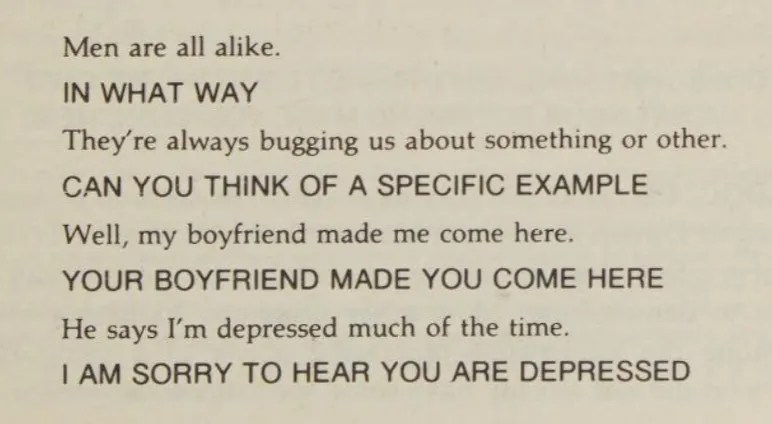
In the 1960s, a German-American computer scientist named Joseph Weizenbaum coded an early version of today’s AI chatbots. Weizenbaum called his program ELIZA, after the “My Fair Lady” character Eliza Doolittle who takes speech lessons (and gets better).
How people reacted to Weizenbaum’s crude creation tells us almost everything we need to know about AI hype more than half a century later.
ELIZA could hold basic “conversations,” including playing the role of a psychotherapist with real human users. [In the example above, ELIZA’s responses to one woman are shown in capital letters.]
Anybody with a cursory awareness of recent headlines about AI romances and AI psychosis already knows where this is going. ELIZA’s human interlocuters in the 1960s, despite talking to a clunky machine they knew had been programmed by Weizenbaum, refused to believe that they were talking to a mere machine. His secretary, having watched him build the contraption over several months, after just a few exchanges with ELIZA, asked Weizenbaum to leave the room so she could have some privacy.
Weizenbaum, exhibiting a bit of Freudian sangfroid about all this, was not surprised to see people form emotional attachments with inanimate objects. He’d already seen people get attached to their cars or guitars or computers. But “what I had not realized is that extremely short exposures to a relatively simple computer program could induce powerful delusional thinking in quite normal people,” Weizenbaum wrote in his 1976 book “Computer Power and Human Reason: From Judgment to Calculation.”…
… I learned about Weizenbaum’s ELIZA experiment from Neil Postman’s 1992 book “Technopoly: The Surrender of Culture to Technology,” a work of technoconservatism that, like Weizenbaum’s writings, was imbued with foresight about our struggles with today’s vastly more powerful technologies.
Consider this passage from Postman’s “Technopoly”:
In a technocracy, tools play a central role in the thought-world of the culture. Everything must give way, in some degree, to their development. The social and symbolic worlds become increasingly subject to the requirements of that development. Tools are not integrated into the culture; they attack the culture. They bid to become the culture. As a consequence, tradition, social mores, myth, politics, ritual, and religion have to fight for their lives.
Technology, attacking and taking over the culture? Bending society to its own imperative for advancement? In my United States of America? Postman (most famous for writing “Amusing Ourselves to Death”) thought the U.S. was the world’s first “Technopoly,” a society marked by “the submission of all forms of cultural life to the sovereignty of technique and technology,” where information itself has become a form of pollution.
To Postman, “the milieu in which Technopoly flourishes is one in which the tie between information and human purpose has been severed, i.e., information appears indiscriminately, directed at no one in particular, in enormous volume and at high speeds, and disconnected from theory, meaning or purpose.”
Neil Postman wrote “Technopoly” before the introduction of ChatGPT and Sora; TikTok and YouTube; Twitter and Facebook; Google Search and the Netscape browser. Postman wrote the book before Windows 95 existed. A philosophy of technology that mostly holds up through successive eras of technical revolution has already passed time’s first test, which is for the philosophy to outlive the philosopher. And Postman’s philosophy is ultimately conservative, motivated by the desire to preserve the traditions of humanism, social cohesion and a shareable sense of collective history.
Technoconservatism was old before it was new. Postman quotes Plato’s “Phaedrus,” where Thamus warns that whoever learns writing (one of our first dangerous technologies) “will cease to exercise their memory and become forgetful” and “will receive a quantity of information without proper instruction, and in consequence be thought very knowledgeable when they are for the most part quite ignorant.” And Postman, to his credit, is like — well, yeah! Writing really did that. A new technology is neither good nor bad, but ecological: it “does not add or subtract something. It changes everything. In the year 1500, fifty years after the printing press was invented, we did not have old Europe plus the printing press. We had a different Europe.”
In previous generations, societies dealt with information revolutions (which always produced information gluts) by creating institutions that prioritize “good” information and deprioritize the bad; think about schools with their organized curricula, courts with their standards of evidence, newspapers with their party lines or codes of journalistic ethics. But Postman notes that we got lucky after the Gutenberg revolution, when information technology’s development slowed down long enough for societies to catch up and be excellent:
From the early seventeenth century, when Western culture undertook to reorganize itself to accommodate the printing press, until the mid-nineteenth century [with the invention of the telegraph], no significant technologies were introduced that altered the form, volume, or speed of information. As a consequence, Western culture had more than two hundred years to accustom itself to the new information conditions created by the press. It developed new institutions, such as the school and representative government. It developed new conceptions of knowledge and intelligence, and a heightened respect for reason and privacy. It developed new forms of economic activity, such as mechanized production and corporate capitalism, and even gave articulate expression to the possibilities of a humane socialism. New forms of public discourse came into being through newspapers, pamphlets, broadsides, and books. It is no wonder that the eighteenth century gave us in the work of Goethe, Voltaire, Diderot, Kant, Hume, Adam Smith, Edmund Burke, Vico, Edward Gibbon, and, of course, Jefferson, Madison, Franklin, Adams, Hamilton, and Thomas Paine. I weight the list with America’s “Founding Fathers” because technocratic-typographic America was the first nation ever to be argued into existence in print.
Contrast the luxuriously slow social pace of the Gutenberg era with today’s information development timelines. Over the course of three decades, we’ve seen the rise and now-decline of the open web; the rise and now-decline of social media; the rise of short-form video and the rise of chatbots and synthetic information. All created enormous economic and philosophical disruptions whose fundamental impacts you can’t get a group of people in a room together to describe accurately. Among the disruptions: These increasingly efficient forms of sharing information keep encountering falling test scores; universities are trying to implement AI as their own students use it for cheating or boo the tech at their graduations; people are falling in love with their chatbots, which sometimes tell their users to kill themselves. A society that wants to understand itself probably wouldn’t act like this…
Read on for how we might — dare one suggest, should— act: “A society that wants to understand itself probably wouldn’t act like this,” from @mattdpearce.com.
Compare to/contrast with with Yuval Avnar‘s riff on Pascal’s musing on the implications of his invention, the “arithmetic machine” (an early, if not the first, modern mechanical calculator): “The Inventor of the Thinking Machine Didn’t Worry. Neither Should You.“
* Neil Postman, Amusing Ourselves to Death: Public Discourse in the Age of Show Business
###
As we introspect, we might send pointed birthday greetings to Ambrose Bierce; he was born on this date in 1842. His satirical lexicon The Devil’s Dictionary was named as one of “The 100 Greatest Masterpieces of American Literature” by the American Revolution Bicentennial Administration. His story “An Occurrence at Owl Creek Bridge” has been described as “one of the most famous and frequently anthologized stories in American literature”; and his book Tales of Soldiers and Civilians (also published as In the Midst of Life) was named by the Grolier Club as one of the 100 most influential American books printed before 1900.
A prolific and versatile writer, Bierce was regarded as one of the most influential journalists in the United States, and as a pioneering writer of realist fiction. For his horror writing, Michael Dirda ranked him alongside Edgar Allan Poe and H. P. Lovecraft. S. T. Joshi argues that he may well be the greatest satirist America has ever produced, and can take his place with such figures as Juvenal, Swift, and Voltaire. His war stories influenced Stephen Crane, Ernest Hemingway, and others; and he was an influential and feared literary critic. In recent decades Bierce has gained even wider regard as a fabulist and for his poetry.
In 1913, Bierce told reporters that he was travelling to Mexico to gain first-hand experience of the Mexican Revolution. He disappeared over the border and was never seen again.
Apropos the piece featured above:
TELEPHONE, n. An invention of the devil which abrogates some of the advantages of making a disagreeable person keep his distance.
– The Devil’s Dictionary

“The world as we have created it is a process of our thinking. It cannot be changed without changing our thinking.”*…

The transition from small hunter-gatherer societies into complex civilizations gave rise to the first Axial Age [see also]. Does our polycrisis moment herald another big shift?
Nathan Gardels, editor-in-chief of Noema, introduces two provocative articles from the current issue that suggest that it might…
Is our present moment comparable to the first Axial Age some 2,500 years ago? This was a time when major religions, philosophical frameworks and ethical systems — from Hinduism and Buddhism to the Hebrew prophets and the Greek philosophes — emerged around the world in relative simultaneity.
In a Noema essay, Otto Scharmer thinks this is likely so. If history moves by cycles of challenge and response, he argues that today’s “planetary polycrisis” — widespread anomie, social distrust and disorientation in the face of war, climate change and the upheavals of AI — “demands not just better policies or technologies but a shift in our structure of consciousness” at the level of collective awareness. He continues, “For the first time in human history, the challenges we face require a planetary response.”
In the first Axial Age, the attainment of written language capacitated an inner life of reflection on the basis of abiding texts that created a platform for shared meanings. That critical self-distancing capacity for reflection, or “interiority,” enabled people to transcend their immediate circumstances, tribes and local narratives to become self-aware as individuals in the larger universe. The sociologist Charles Taylor called this process “dis-embedding.”
In this context, written language — the first cloud technology of stored information — fostered philosophical exchange, the codification of ethical systems and shared metaphysical notions of salvation from the earthly storm. The sense of ontological security these narratives promised amid perpetual turmoil spread the appeal among constituencies far and wide.
In our era, Scharmer sees a new axial shift toward “collective interiority,” in which a new consciousness of the relationality of all being as an indivisible unity conjoins the subjective inner world with the outer world. In a word, he sees the “re-embedding” of the individual back into the interdependence of community and nature, this time not out of narrow ignorance as in the ascribed past, but through an enlightened ecology of mind.
Scharmer’s prime anxiety is what he calls “an emerging epistemic monoculture.” He writes: “Just as industrial agriculture replaced the diversity of the living soil with chemical fertilizers and crop monocultures — productive in the short term, devastating over time — the current AI moment is producing an epistemic monoculture. It manifests in a single computational form of knowing that views the world as a set of objects.”
In this, he follows the philosopher Martin Heidegger, who feared in the 1960s that the integral nature of Being would be extinguished by the advent of cybernetic technologies, in which encompassing feedback loops self-reinforce calculating reason to the exclusion of any spiritual dimension or philosophical frame to elevate or govern it. He worried that what he called the “technicity” of instrumental means with no substantive end would inexorably prevail over the diminished soul.
The key question going forward is whether this is necessarily so. Is AI the path to an epistemic monoculture that depletes the rich soil of experiential existence? Or, through the capacity for planetary-scale computation, can it cultivate the very collective interiority that comes from a fuller understanding of how multiple intelligences comprise the Earth system as one self-regulating organism? Won’t augmenting the human field of experience with AI, and vice versa, generate the very awareness of relationality that bridges the divide between individual and collective interiority?
In a related Noema conversation, theoretical biologist and complex systems scientist Stuart Kauffman discusses how this new consciousness would manifest as a transcendent presence awakened within individuals’ inner lives.
Frontier scientific advances have made us humans realize we are embedded and entangled within Earth’s habitat. We are not above and apart from our biosphere, Kauffman says, but “co-creators” in its evolution. Like the poet Goethe, he sees a dynamic, creative universe as a continuous “divine” activity rather than a static set of laws for all time — creatio continua —in which humans are participants.
“What are the implications for the self-understanding and responsibility of human civilization in this undetermined unfolding?” I asked Kauffman.
He explained: “The spiritual consequence, I would argue, is a new sacredness of participation. If the world is not fully given in advance, then Creation is not only ‘back then’ but ongoing. The sacred is not merely a completed order; it is the act of becoming itself … [it is] reverence for the creative unfolding, not worship of a finished blueprint.
“A ‘Next Axial Age’ could be framed as a spirituality of co-creation rather than dominion. And crucially, this spirituality would not be anti-science — it would be a new science understood as careful participation in a living, creative world.”
The observant reader will surely note how far all of this is from the dominant zeitgeist of bitter polarization in both culture and politics, the backtracking on climate commitments, the waging of hard-power wars and the acceleration toward superintelligence with few guardrails in place. Yet it is precisely these extreme conditions that are fueling the search for a new way of seeing and organizing the world. It is in the nature of an axial shift that it arises in opposition to the present order…
Awareness of the relationality of all being is a response to the planet in crisis: “What Might The Next Axial Age Look Like?” from @noemamag.com.
Both of the cited pieces– “We May Be Entering A Second Axial Age” and “Emergence Is Not Engineering“– are eminently worth reading in full.
Apposite: “On metanarratives – or, how we transform our cultural mythology” by Sharon Blackie, complemented by Nicholas Carr‘s “Restoration of the Demon” and Alan Jacobs‘ “Something Happened By Us: A Demonology” together, a caution against mistaking re-enchantment for re-connection.
* Albert Einstein
###
As we speculate on sea change, we might send compassionate birthday greetings to a man who tacked against the tide that may now be turning, Gustavo Gutiérrez; he was born on this date in 1928. A philosopher, theologian, and Dominican priest, he was one of the founders of Latin American liberation theology, and his 1971 book A Theology of Liberation is considered pivotal to the formation of liberation theology at large.
Gutiérrez’s theological focus connected salvation and liberation through the preferential option for the poor, with an emphasis on improving the material conditions of the impoverished. Gutiérrez argued that revelation and eschatology have been excessively idealized at the expense of efforts to bring about the Kingdom of God on Earth. His methodology was often critical of the social and economic injustice he believed to be responsible for poverty in Latin America, and of the Catholic clergy itself. The central pastoral question of his work was: “How do we convey to the poor that God loves them?”

You must be logged in to post a comment.