Posts Tagged ‘poetry’
“If I am to be remembered, I hope it will not be primarily for my specialized scientific work, but as a generalist; one to whom, enlarging Terence’s words, nothing human and nothing in external nature was alien.”*…
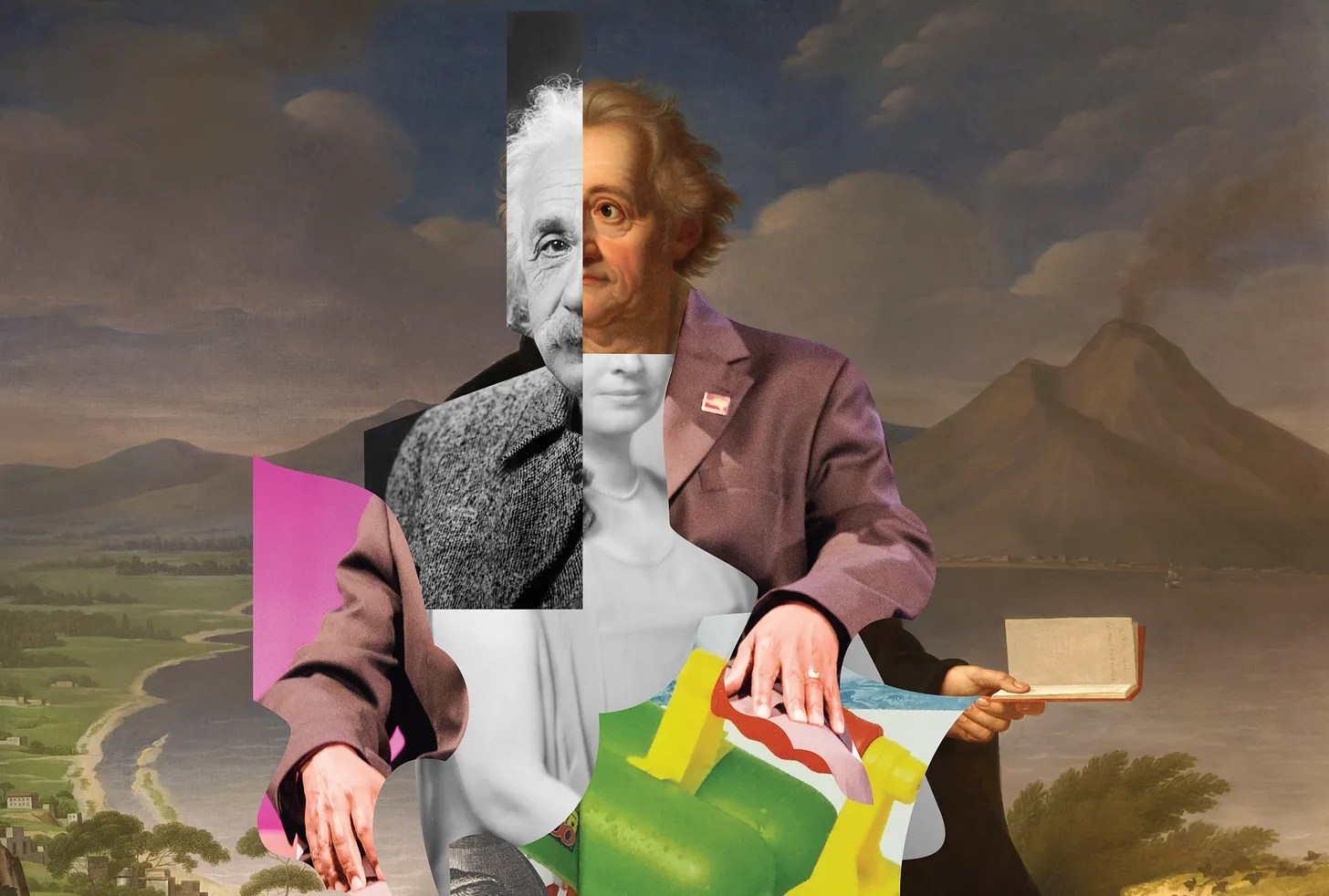
Interdisciplinary artist, writer, and musician Ross Simonini with 47 thoughts on the glory of looking– and living– beyond a specialty…
1. I was raised to believe that I was made to do one thing. Find that one pursuit that fills my life with meaning and empty all my energy into it. This is the realization of human potential: to excel with rigorous focus on a refined lifelong mission. This and only this will bring us to our greatest success and fulfillment.
For me, this was not something I even had to be told—though I was, many times, by many people—because I implicitly understood that this kind of teleology was woven into the fibers of my world. I also knew that rejecting a singular pursuit would be an insult to my very existence. Without this unifying reason for being alive, I would wander aimlessly into the barren void of nihilism. I’d heard about great artists who refused to create, who stepped away from their work to fritter away their time on leisure, and I knew this was a life of tragedy.
Likewise, I understood that sliding your attention across interests is a way to waste your gift. The more hours you put into a skill, the more skilled you become—right? To treat your gift with the proper deference, you must exhaust yourself into it.
Within this paradigm, the most unfortunate people are those who do not have a single, clear vocation. These types float from job to job without a trajectory; they are vagabonds who have given up on greatness.
This may sound a little dramatic, but somewhere inside me, these beliefs are there—and as a lifelong generalist, I spend every day rubbing up against them.
…
16. Let’s talk about mastery. Everyone wants to be a master, even if they are disgusted by the monstrous implications of the word. Mastery suggests dominance over something, but every true master knows that they are merely a supplicant at the mercy of their field, which existed long before them and will exist long after them. Anyone who believes in their own mastery likely suffers from hubris. Work hard enough at something and you watch your dominance slip ever further away.
Mastery is an illusion, a notion of a fictional purity that cannot be understood or measured in terms of time. Just look at those young savants who excel wildly after only a few years spent on their craft. For them, mastery cannot be the result of time plus work, as we all assume it is. In fact, maybe the newness of their skills is precisely what gives their work its value.
But these little wonders are exceptions, right? The rest of us have to dedicate our lives to something to achieve greatness, and anyone who doesn’t do this will likely be middling in their work. Most writers I know are immediately suspicious when an actor publishes a novel. We delight in calling the person a moonlighter. Literature is our territory, and the only way to live here is to put in the time and labor.
…
24. Isaiah Berlin, the political theorist, ethicist, philosopher, and historian, wrote a book called The Hedgehog and the Fox, in which he divides people into two types: hedgehogs, who see the entire world through one big thing, and foxes, who see the world as many things that cannot be reduced. According to Berlin, hedgehogs include Plato, Dostoyevsky, and Proust, while foxes include Aristotle, Shakespeare, and James Joyce.
“Everything I learned in my life, I learned because I decided to try something new,” said David Lynch (musician, filmmaker, painter, lamp maker, sculptor, writer, actor, and lecturer, mostly on meditation).
…
29. Sometimes history hides generalism to preserve a specialized agenda. Isaac Newton, a figure whom we consider the father of modern math, physics, and reasoned thinking, was also a dedicated alchemist. Alchemy, a generalist practice in itself, was a precursor to modern chemistry. It involves spirituality, myth, belief, and metallurgy, but its inclusion of belief stands in direct conflict with the scientific rationalism Newton now represents. Subsequent generations of historians and scientists buried Newton’s dedication to the occult, willfully ignoring the blow it deals to their obsessive, single-minded materialism. But Newton’s own records tell a different story. He wrote over a million words on alchemy in his lifetime, and his study of the subject helped inspire some of his most paradigm-shifting discoveries.
…
31. A filmmaker must understand aspects of sound design, photography, storytelling, music, acting, props, environment, finance, writing, and dialogue. In this way, some jobs are naturally suited to the generalist. A skilled homemaker, for example, understands everything from cooking to cleaning to healing to sociology. Acting, too, is a fairly generalist vocation. The practice of writing, what I am doing right now, is extremely broad, without consistent subject matter, form, or even mediums.
Generalism can be an approach of the neophyte or of the seasoned worker. Some entry-level positions (assistant, secretary, intern) are, in fact, compilations of micro-jobs, and some high-level positions—
managers, CEOs, directors, business owners, presidents—are positions of vast, nonspecific oversight. Sometimes the highest perch has the widest perspective.…
39. A generalist must engage with both sides of any argument: skepticism and belief, optimism and pessimism. So, for this essay, it would only be right to take a look at the dark side of generalism and the side effects of adopting it as a whole-life philosophy.
The glaring danger of general thinking in its extreme form is relativism, a sort of mushy non-position in which there are no universal standards: nothing can ever be condemnable or universally wrong. At the most dramatic levels, relativism might dismiss murder and genocide. It’s a slippery slope of open-mindedness.
Likewise, a generalist must contend with political centrism. In our bifurcated world, the center is one of the most reviled of all political positions, and a generalist will come to understand whether their own centrism is an evasion of choice or a refusal of unpalatable options.
Few things are more torturous than making decisions, and a mind will do anything to avoid such a relentlessly complex activity. Adherence to these vague philosophies, as I see them, can certainly be used as an excuse for escaping commitment. As a generalist, I must stay vigilant against this kind of laziness of mind and instead allow many fierce, contrary ideas to exist at once.
…
42. Generalism is not a thing. It’s definitely not an ism or some kind of doctrine. The general approach defies the nature of ideologies, which are characterized by the limits they place on understanding the world. There is no system of generalism. The general philosophy is to love variety.
For this reason, generalists don’t exist—not in the way that, say, Marxists do—because they can’t identify as generalists. I can call myself intra-, cross-, multi-, inter-, and trans-disciplinary—which, for some, are all legitimate and distinct prefixes—but that does more to distinguish and alienate me from others than to connect me with a community. There is no lineage of generalists, as there is for microbiologists or flutists, because every generalist works with their own complex bouquet of interests.
Probably this whole essay is my attempt to give a sense of unity to my life. Maybe I have to write a manifesto on “the art of doing many things”because I fear that if our culture doesn’t have a catchy keyword for my role, I’ll just fade away. So here I am, reducing generalism to a single, branded snap, just like a specialist.
After all, generalists are, in moments, great specialists. Likewise, a deep specialist can approach their niche from an ever-growing number of perspectives. A man with a repetitive job can endlessly engage with his work from fresh angles. And, of course, it’s all relative. A single task looked at from another angle is a plentiful cornucopia of individuated micro-tasks.
Some long-term generalists focus exclusively on a single activity for a number of years before moving on to the next. Rather than doing many things simultaneously, they do them sequentially.
Pure generalism and pure specialism are just intellectual games. Our minds drift between unified oneness and individuality without ever settling into either. Binary thinking is for computers.
These two states of being are not roles we need to inhabit but rather nodes to be considered. One situation requires diligent focus, but another benefits from a more diffuse form of attention. Certain qualities of engagement can occur only when you do multiple things at once. This is the value of the glance.
…
47. Generalism is not the opposite of specialism. It includes specialism. Everyone gets to experience both. Or maybe both approaches lead to the same place. Maybe the study of quantum physics brings a mind to the same conclusions as basketry. Maybe it’s like meditation: You can sit in open awareness and experience everything until you reach an unprejudiced understanding of life. Or you can unflinchingly focus on a single mantra for decades, repeating it with each breath, and as you plunge deeper toward a single infinite point, you discover that everything is already right there.
Eminently worth reading in full: “In praise of generalism” from @thebeliever.net.
###
As we widen our irises, we might send carefully-calculated birthday greetings to Pierre de Fermat; he was born on this date in 1601. While he is remembered as one of the two great mathematicians of the early 17th century (with Descartes), Fermat was (like Descartes) driven by wider interests. Fermat was a trained lawyer, who served as a councilor at the Parlement de Toulouse, one of the High Courts of Judicature in France. He was fluent in six languages and praised for his written verse in several of them; his advice was eagerly sought regarding the emendation of Greek texts… which is to say that mathematics was but one of his interests, and more a hobby than a profession at that. Still, Fermat made foundational contributions to analytical geometry, probability, number theory and calculus.

“I have said before that metaphors are dangerous”*…

… still, metaphor animates much of our thought and of the received wisdom that it can become. Quinn Slobodian unpacks the ways in which metaphors of the natural sciences loom large in the neoliberalism conception, then walks us through its myriad permutations, concluding with metaphor’s corrosion at the hands of Silicon Valley’s reactionary accumulation regime…
Polyps confounded political theorists in the 18th century. The creatures that collectively make up coral reefs acted in ways that defied both expectations of divine design and the established hierarchy of the animal kingdom. How could these lowest of organisms create such enormous structures—especially ones that appeared to be the product of one mind? How could microscopic creatures obstruct the ships of the most powerful forces on Earth, rupturing their hulls and forcing them to chart their way around polyp metropoli risen into islands? It’s no wonder that the anarchist anthropologist James C. Scott later drew an analogy between polyps and peasants. “Just as millions of anthozoan polyps create, willy-nilly, a coral reef,” he wrote, “so do thousands upon thousands of individual acts of subordination and evasion create a political or economic barrier reef of their own.”
The historian of science Whitney Barlow Robles quotes Scott in her wonderful book, Curious Species, where she explains how coral unsettled certainties. Fed by sunlight like grass, plants with their tentacles laid down layers of limestone. The power of polyps turned ideas of agency on their head, a molecular sightless mass acting as architect. Robles imagines it would be like “suddenly learning that butterflies, not people, planted all the trees in Central Park.”
It was a similar wonder at the endless events of the natural world that led classical liberals to draw connections between the order of nature and the order created by human exchange in the profane world of political economy. Philip Mirowski reminds us that natural metaphors serve double duty: they are “reassuring and graphically concrete images of order, situating humanity squarely at home in ‘its’ universe” while they also tame the disorder of nature, making “an unintelligible alien world comprehensible.”
Nature offered what Deirdre McCloskey calls the ”metaphors economists live by.” Because so much of our politics relies on an explicit and implicit understanding of economics, this means we live by those metaphors too. The intellectual movement of neoliberalism arrived at its ideas of the good society by thinking with and through nature. As the post-Cold War consensus around neoliberal globalization crumbles and the boundaries of individual freedom narrow, new metaphors might help us understand the successor ideology…
[Slobodian outlines the intellectual history of neoliberalism, from Friedrich Hayek, its intwined connection with he sciences, and the centrality of the “garden” metaphor in economics. He describes the displacement of the graden with the “swarm” and argues that it is now being wrestled into a mechanistic, surveillance-centric vision of control– a factory…]
… In Curious Species, Whitney Robles reminds us that the polyp agglomerations—those coral structures built by tiny, collective labor—were dubbed “colonies” in the language of the European merchant empires and the Romans before them. The metaphor was no accident. Colonial science mapped political fantasies onto biological forms.
Robles insists that the polyps were never docile subjects. Yet, however resilient, the polyps are not immortal. When the waters around them acidify and warm, these vast reef-structures bleach and break apart. The microorganisms that once formed a community detach from the whole and float away—winking, fluttering, nearly invisible. A nothing. A dispersal. Polyp politics does not just teach us about creation. It teaches us about endings, too.
The neoliberal imagination, when it looked to nature, saw spontaneous order, unplanned complexity, and the beautiful unpredictability of emergent systems. But it often underestimated the possibility of collapse—not as failure of planning, but as a systemic consequence of the very freedom it prized.
What happens when the waters change? When the reef dissolves?
In our current moment, we are no longer just asking how order emerges, but how it vanishes. We are watching the garden trodden underfoot, the swarm militarized, the factory reinstalled as a total system of command. And in this long shift—from polyps to protocols, from butterflies to drones—there is a profound political lesson.
Freedom, when real, is fragile. So is spontaneity. So is improvisation. The forces of order may begin in a coral reef or a Central Park meadow, but they can end in a codebase, a drone cloud, or a boardroom with no windows.
The question is no longer whether we can find metaphors from the natural world to describe human society. It is whether we can preserve the kinds of life that those metaphors once made thinkable…
As Robert Frost once said, “unless you are educated in metaphor, you are not safe to be let loose in the world”: “Garden, Swarm, Factory,” from The Ideas Letter and @open-society.bsky.social.
Apposite: “Artificial intelligence” as we’re being encouraged to understand and accept it is a lie that depends on a worldview the richest people on the planet need you to believe in, namely that intelligence is “measurable and hierarchical” “Toolmen.”
And further: “A Reality Check for Tech Oligarchs.”
* Milan Kundera
###
As we analyze our analogies, we might send lyrical birthday greetings to a master of metaphor, Walt Whitman; he was born on this date in 1819. A poet, essayist, and journalist; he also wrote two novels. Whitman is considered one of the most influential poets in American and world literature. He incorporated both transcendentalism and realism in his writings and is often called the father of free verse. His work was controversial in his time, particularly his 1855 poetry collection Leaves of Grass, which was described by some at the time (and again, more recently) as obscene for its overt sensuality.
Whitman grew up in Brooklyn, where over time he moved from printing to teaching to journalism, becoming the editor of the Brooklyn Daily Eagle in 1846. He began experimenting with a new form of poetry, revolutionary at the time, free of a regular rhythm or rhyme scheme, that has come to be known as “free verse.” In 1855, Whitman published, anonymously and at his own expense, the first edition of Leaves of Grass— which was revolutionary too in its content, celebrating the human body and the common man. Whitman spent the rest of his life revising and enlarging Leaves of Grass; the ninth edition appeared in 1892, the year of his death.

Whitman and the Butterfly, from the 1889 edition of Leaves of Grass (source: Library of Congress)
“Man towers above the rest of creation so long as he realizes his own nature, and when he forgets it, he sinks lower than the beasts”*…

The estimable Jill Lepore on her strategy for coping during the “First 100 Days”…
On the twentieth of January, the year of our Lord 2025, Donald Trump’s one hundred days began.
Thank you. Thank you very much, everybody. (Applause.) Wow. Thank you very, very much.
I read his second Inaugural Address early the next morning in bed, curled, bent to the glow of an iPhone in dark mode, a morning ritual that always feels like sin.
From this day forward, our country will flourish and be respected again all over the world.
Then, dutifully, I scrolled through the Day One executive orders:
A full, complete and unconditional pardon . . . offenses related to events that occurred at or near the United States Capitol on January 6, 2021 . . .
. . . the privilege of United States citizenship does not automatically extend to persons born in the United States . . .
. . . establishes the Department of Government Efficiency . . .
. . . eliminate the “electric vehicle (EV) mandate” . . .
. . . directing that it officially be renamed the Gulf of America.
The Day One executive orders included—and depended on—the President’s formal, executive declarations of not one, not two, but three national emergencies: an immigration emergency, an energy emergency, and a terrorism emergency. There was also the Donald-Trump-is-President-again emergency.
I buried my phone under my pillow and closed my eyes. Blindly, I reached over to my nightstand and groped for a book. I pulled off the stack the first of the Penguin Little Black Classics, a collection of slender paperbacks that I’d been meaning to read, each as thin and sleek as my phone, bound in black, with white type on a plain cover. Dark mode.
No. 1, Giovanni Boccaccio, “Mrs Rosie and the Priest,” is described on the back cover as “bawdy tales of pimps, cuckolds, lovers and clever women from the fourteenth-century Florentine masterpiece The Decameron.” The book opened like a flower, like a hinge, like a butterfly, like a pair of hands in blessing. I turned to the first page:
I was told some time ago about a young man from Perugia called Andreuccio, the son of a certain Pietro and a horse-dealer by trade.
My heart leapt. I had found my doomscrolling methadone. With five hundred gold florins in his bag, Andreuccio set off for Naples. And I made a vow to read one volume of the Penguin Little Black Classics each morning in bed, matins, for a hundred days. Two and a half times Lent. In case of emergency, break open a book…
And read she did– each morning, before the day’s decrees, she turned to a slim book, hoping for sense, or solace… and happily for us, she kept a journal: “A Hundred Classics to Get Me Through a Hundred Days of Trump,” from @newyorker.com. (In the event of a paywall: an archived version.)
* “Indeed, the condition of human nature is just this; man towers above the rest of creation so long as he realizes his own nature, and when he forgets it, he sinks lower than the beasts. For other living things to be ignorant of themselves, is natural; but for man it is a defect.” – Boethius, The Consolation of Philosophy
###
As we pursue perspective, we might recall that it was on this date in 1968 that Aretha Franklin impatrted some timeless advice: she released “Think” (which she had co-written with Ted White), the first single from her upcoming album Aretha Now. It reached No. 7 on the Billboard Hot 100, Franklin’s seventh top 10 hit in the United States and hit number 1 on the magazine’s Hot Rhythm & Blues Singles, her sixth single to top that chart.

“By improving health, empowering women, population growth comes down”*…

… And increasingly across the globe, starting in the developed world, we’ve been doing a better job of that. Indeed, some are beginning to worry about a kind of problem that the modern world has never faced– depopulation.
History Today offers a fascinating snapshot…
During the 1930s and early 1940s, many Americans held off on starting families because of the economic insecurity of the Great Depression and uncertainty of World War II. But the prosperous postwar era led to an increase of births between 1946 and 1964 that gave the baby boomer generation its nickname. Over this 19-year period, the booming birth rate helped the U.S. population grow by more than 50%. The country’s demographic makeup shifted so rapidly that by 1960, there were 64.2 million Americans under age 18, out of 180 million overall — a whopping 36% of the population. For context, in 2022, an estimated 22.4% of the U.S. population was under 18.
General fertility rates in the baby boom era peaked in 1957 at 122.9 live births for every 1,000 women aged 15 to 44 — that’s 4.3 million babies that year alone. The general fertility rate took a nosedive throughout the 1960s as the birth control pill became more widely available and women entered the workforce at much higher rates. By 1970, the general fertility rate was 87.9, and the much smaller Generation X was well underway.
The baby boomer generation didn’t reproduce at the same rapid clip as their parents, but because there were so many of them, they still produced a lot of offspring. Indeed, 1990 — the year all those 1957 babies turned 33 — was another banner year for births, with 4.2 million millennials entering the world, despite a general fertility rate of just 70.9…
Consider these population pyramids from the U.S. Census Bureau:


This picture is of course in aggregate: some locales (e.g., Utah) continue to grow and are “younger”; others, like Alexander County, Illinois are much “older.” And globally, the picture is even more mixed:
The global population reached nearly 8.2 billion by mid-2024 and is expected to grow by another two billion over the next 60 years, peaking at around 10.3 billion in the mid-2080s. It will then fall to around 10.2 billion, which is 700 million lower than expected a decade ago. However, changes in global population are uneven and the demographic landscape is evolving, with rapid population growth in some places and rapid ageing in others…
… The world’s overall fertility rates are dropping, with women having one child fewer on average than they did around 1990.
In more than half of all countries and areas, the average number of live births per woman is below 2.1 – the level required for a population to maintain a constant size.
Meanwhile, nearly a fifth of all countries and areas, including China, Italy, the Republic of Korea and Spain, now have “ultra-low fertility,” with fewer than 1.4 live births per woman over a lifetime. As of 2024, population size has peaked in 63 countries and areas, including China, Germany, Japan and the Russian Federation, and the total population of this group is projected to decline by 14 per cent over the next thirty years…
While the slow growth or decline of populations is occurring mainly in high-income countries, rapid population growth will occur in low-income and lower-middle-income countries.
Specifically, Angola, the Central African Republic, the Democratic Republic of Congo, Niger, and Somalia, very rapid growth is projected, with their total population doubling between 2024 and 2054.
This population growth will increase demand for resources, especially in sub-Saharan Africa and South Asia and, combined with poorly managed urbanisation and rising living standards, it will worsen environmental impacts.
Climate change, a major challenge, affects these countries the most, where many rely on agriculture – and food insecurity is prevalent.
In countries including India, Indonesia, Nigeria, Pakistan and the United States [our inherent decline offset to some extent by immigration… at least until now], population is also expected to increase through 2054 and could potentially peak in the second half of the century or later…
Implicit assumptions of a growing population underlie many– if not most– of the decisions we’ve made about everything from social policies (e.g., social security) to business plans (e.g., growing markets).
Populations grow for some combination of three reasons: fertility is above replacement level, people live longer, and/or immigration swells the ranks. For quite a while, the U.S. was hitting on all three cylinders; more lately, on the latter two. But recently, life expectancy has stalled.
Immigration is currently strong (and, as noted above, keeping U.S. population growth positive), but it’s looking increasingly uncertain: political energy to restrict (indeed, to undo) immigration is high, even as the pressures of climate change and political upheaval are increasing numbers of people from around the world hoping to find a home in the U.S.
If, as Comte is said to have suggested, demography is destiny, then what is ours? “In 1960, more than a third of the U.S. population was under 18.”
Apposite: “Why people over the age of 55 are the new problem generation,” gift article from The Economist
* Bill Gates
###
As we dig into demographics, we might send thoughtful birthday greetings to Robinson Jeffers; he was born on this date in 1887. A poet renowned both for his longer (narrative and epic) verse and his shorter work, he was an icon of the environmental movement. His philosophy of “inhumanism” argued that transcending conflict required human concerns to be de-emphasized in favor of the boundless whole.

“The path to paradise begins in hell”*…

It’s been over 700 years since Dante Aligheri found himself, midway along the journey of his life, within a dark forest. His terza rima epic, The Divine Comedy, rivets us still…. and as Hunter Dukes recounts, raises questions…
Ever since the publication of Dante’s Divine Comedy, scholars and artists have tried to map the Inferno’s architecture, survey Purgatory, and measure their way across the spheres of Paradise. The first cosmographer of Dante’s universe was the Florentine polymath Antonio Manetti, whose unpublished research — which mathematically concluded that hell was 3246 miles wide and 408 miles deep — inspired the woodcuts used for a landmark 1506 edition of the poem. In 1588, a young Galileo weighed in, deriving Lucifer’s height and armlength (1200 and 340 meters respectively) and suggesting that the Inferno’s vaulted ceiling was supported by the same physical principles as Brunellesci’s dome. The scholarly tradition continued for centuries, culminating with the works of Michelangelo Caetani, who designed a series of maps and charts. These were published as The Divine Comedy of Dante Alighieri Described in Six Plates and appeared in two editions, an 1855 edition featuring hand-colored lithographs and an 1872 edition printed using an early form of chromolithography, deployed by an order of monks at Monte Cassino near Rome…
Learn more about Caetani and his approach, and see more of his work: “Diagramming Dante: Michelangelo Caetani’s Maps of the Divina Commedia,” from @hunterdukes in @PublicDomainRev.
* Dante Alighieri
###
As we chart cosmology, we might recall that it was on this date in 1971 that Michael Hart launched the source of the link to The Divine Comedy embedded above, Project Gutenberg, and effectively invented ebooks. It debuted on ARPANET.
An online library of free ebooks, it currently has over 70,000 items available (in plain text as well as other formats, such as HTML, PDF, EPUB, MOBI, and Plucker wherever possible).

You must be logged in to post a comment.