Today’s post– commemorating the 124th birthday of a man who knew exactly where to stand– reverses (Roughly) Daily‘s usual format, opening with the almanac entry…
We might send thoughtfully-composed birthday greetings to Ansel Adams; he was born on this date in 1902. A photographer who specialized in landscapes, especially in black-and-white photos of the American West, he was hugely influential both in photography and in environmentalism.
Adams helped found Group f/64, an association of photographers advocating “pure” photography which favored sharp focus and the use of the full tonal range of a photograph; was a key advisor in establishing the photography department at the Museum of Modern Art in New York, and a founder of the photography journal Aperture.
His love of photography was born when, at age 12, he visited Yosemite and took his first shots. He became a life-long advocate for environmental conservation, a commitment deeply intertwined with his photographic practice. At one point, he contracted with the United States Department of the Interior to make photographs of national parks. For his work and his persistent advocacy, which helped expand the National Park system, he was awarded the Presidential Medal of Freedom in 1980.
Visit the Ansel Adams Gallery to see more of Adams’ signature lanscape and natural wonder work.
On the occasion of Adams’ birthday, we might note that, working photographer that he was, he took commercial assignments from time to time– assignments focused on subjects not usually associated with Adams. Two of them are especially interesting…
A collection of photos taken for Fortune Magazine in Los Angeles in the run-up to World War II documented the lives of workers in Los Angeles’ booming aviation industry…
Lockheed Plant In Burbank
Sunnyside Cemetary (next to an oil field) in Long Beach
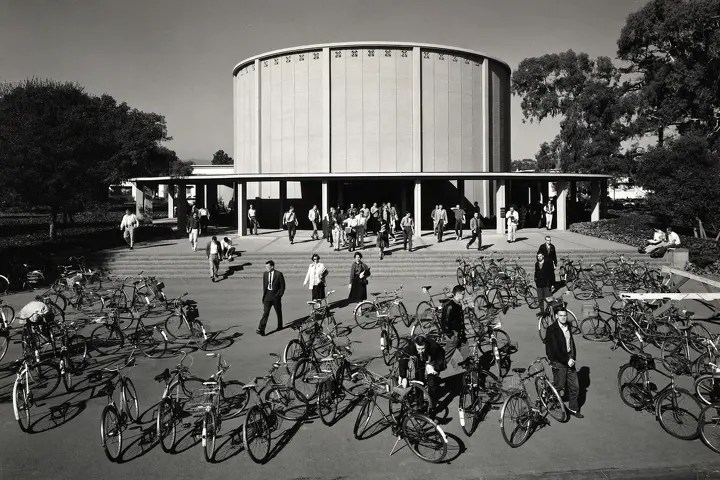
And then, from the early 1960s, photos taken by Adams for Stanford’s PACE Program…
“Once it was a rich, sleepy school with rich, sleepy students; now it aims to be the ‘Harvard of the West’.” That was how Time magazine described Stanford University in the fall of 1962. The publication had been reporting on Stanford’s PACE program, a massive fundraising effort that the school launched to strive toward the kind of prominence that its founders Leland and Jane Stanford had originally envisioned. The core drive behind PACE, an acronym for Plan of Action for a Challenging Era, was for Stanford to transcend its “sleepy” backwater reputation (the “rich” part would remain) and emerge as a potential Western rival to the Ivy League universities on the East Coast.
When it came to PACE’s promotional materials for wooing donors, Stanford’s planning department hired Ansel Adams to produce the visuals. Adams was already well known and highly accomplished at the time, having shot the majority of his masterpiece landscapes depicting the natural grandeur of the American West. But in the early 1960s, he was also still a for-hire photographer trying to make a living in the Bay Area. According to archival letters, Adams and his team of photographers were contracted for $3,000 to produce a series of images from around the Stanford campus over a period of two months in early 1961.
The PACE program ultimately proved to be a resounding success, to the tune of $114 million in fundraising (nearly $1.1 billion today), which became foundational to Stanford’s present-day status as an ultra-elite university. In parallel fashion, Adams would eventually be considered the great American photographer of his era, an exceedingly rare household name in the world of photography, and a visual artist still highly celebrated in museums and pricey galleries around the world. However, his series of Stanford photographs was never recorded in his otherwise meticulous photo log and fell into deep obscurity, becoming all but never-before-seen images by the general public and unknown to even his biographers and archivists…
Students departing the Physics Lecture Hall (aka the Physics Tank) on the Stanford Campus in 1961
A class gathered on the lawn outside Wallenberg Hall, on the Stanford University campus, in 1961
The interior of a 1717 Stradivarius Violin (source: Charles Brooks)
Jennifer Sandlin is (perfectly understandably) blown away by cellist-turned-photographer Charles Brooks’ images of the interiors of rare musical instruments…
… Each instrument appears as if it’s straight out of a dream — some look like futuristic structures, some like fantasy castles, and others like secret lairs of fantastical creatures. It’s hard to believe they’re real, and I’m just in awe of Brooks’ photography talent.
The photographs are part of Brooks’ “Architecture in Music” series, where, he explains, he “explore[s] the hidden spaces inside fine instruments” which have included a Steinway Grand Piano, the St. Mark’s Pipe Organ, and the Lockey Hill Cello (c. 1780, England), among many others…
The Exquisite Architecture of Steinway, Part 7 (source: Charles Brooks)
* Ivry Gitlis (speaking of his 1713 Stradivarius violin)
###
As we cherish craftsmanship, those among us with a preference for reeds might note that today is Saxophone Day– a commemoration of the birth (on this date in 1814) of Adolphe Sax, a musician and inventor who created several new musical instruments (e.g., a redesigned bass clarinet still in use today), most notably the one that bears his name– the saxophone…
… while the brassier might celebrate the birthday (in 1854) of John Philip Sousa. A composer and conductor known primarily for American military marches (e.g., “The Stars and Stripes Forever,” National March of the United States of America. and “Semper Fidelis,” official march of the United States Marine Corps) he is widely acknowledged in the U.S. as “The March King.”
Your correspondent was in New York last week and ducked into Grand Central Station (or more formally, Grand Central Terminal)… to find it transformed. Sarah Cascone has the backstory…
For the first time possibly ever, there is not a single ad to be seen in Grand Central Terminal. “Humans of New York,” Brandon Stanton‘s popular social media art series of photographs of people he’s interviewed on the city’s streets, has taken over each and every one of the 150 video billboards in the grand concourse, as well as the subway ads below in Grand Central Station for “Dear New York.”
“This beautiful art installation transforms the terminal into a photographic display of New Yorkers telling their stories from all walks of life—serving as a powerful reminder of our shared humanity,” MTA director of commercial ventures Mary John said in a statement. “It is the first time an artist has unified digital displays in both the terminal and subway station below, and the MTA coordinated across many corners of our organization to make this happen.”
“If it provides even the slightest amount of joy, solace, beauty, or connection to the 750,000 people who pass through Grand Central every day—we have achieved our goal,” he wrote on Facebook.
The original plan was to use the proceeds from his new book, Dear New York, but Stanton ended up having to dip into his life savings to cover the total cost, which included space rental and covering the station’s lost ad revenue. The artist and journalist, who wrote the best-selling book Humans of New York, declined to provide an exact figure, but told the New York Times that “I no longer have any stocks.”
Stanton has shot portraits of 10,000 people across the five boroughs and beyond since beginning “Humans of New York” in 2010, creating a kind of photographic census of the city. (He has since expanded the project’s scope internationally, to 40 countries and counting.)…
“Humans of New York” founder Brandon Stanton in Grand Central Terminal with his new book, “Dear New York,” at his photography exhibition of the same name
As we see, we might spare a thought for a photographer with a different– but also crucially-important– focus, Edwin Way Teale; he died on this date in 1980. A naturalist, photographer, and writer, his works serve as primary source material documenting environmental conditions across North America from 1930–1980. He is perhaps best known for his series The American Seasons, four books documenting over 75,000 miles of automobile travel across North America following the changing seasons.
Teale’s Hampton, CT home, “Trail Wood” (chronicled in his A Naturalist Buys an Old Farm and further described in A Walk through the Year) is now managed as a nature preserve by the Connecticut Audubon Society. His papers, housed in the University of Connecticut Archives & Special Collections, take up 238 feet of shelf space and include field notes and drafts for each of his books, early childhood writings, professional writings for magazines, newspapers and book reviews, correspondence- both personal and professional, personal and family documents, scrapbooks, and memorabilia, as well as his photographs (prints, negatives, and transparencies) and his personal library. But he bequeathed to the Concord (MA) Free Public Library his collection of Henry David Thoreau books, letters, correspondence, mementos and any other material dealing with Thoreau and Ralph Waldo Emerson and other material relating to Concord, Massachusetts– 12 containers and 108 printed books and pamphlets.
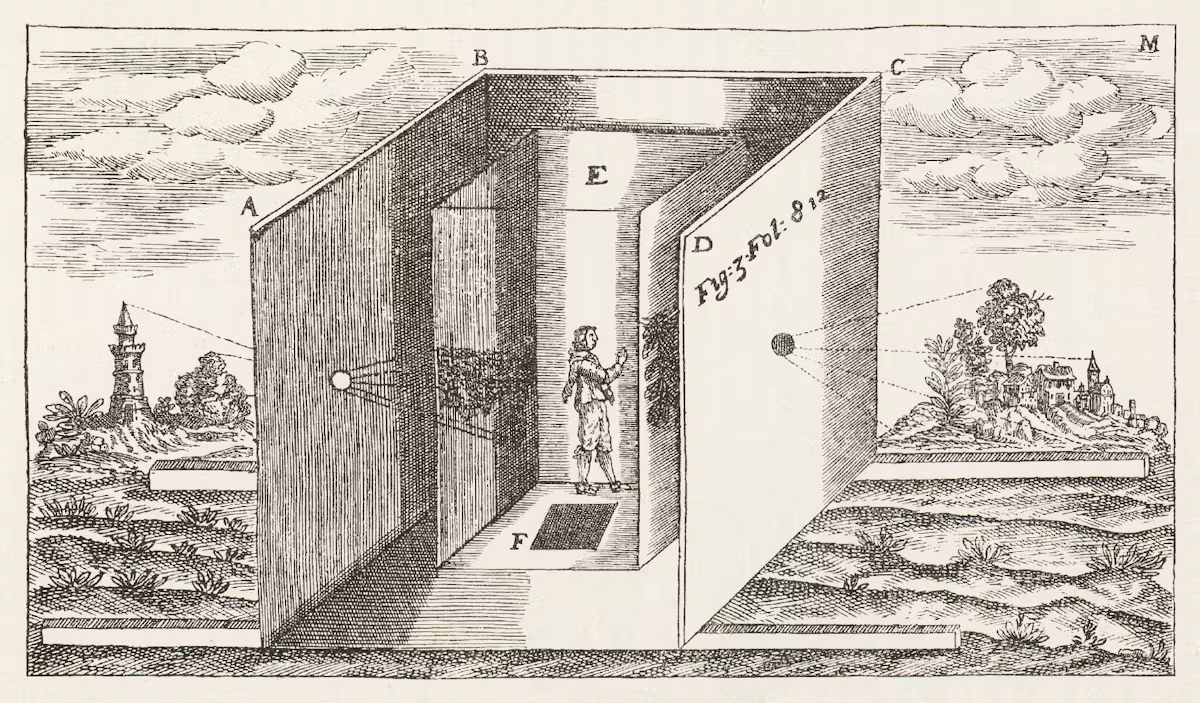
“Athanasius Kircher’s camera obscura,” illustration from Kirscher’s Ars magna lucis et umbrae (1671) reproduced in Josef Maria Eder’s Ausführliches Handbuch der Photographie (Detailed handbook of photography, 1905 — Source.
Centuries before photography froze the world into neat frames, scientists, poets, and artists streamed transient images into dark interior spaces with the help of a camera obscura. Julie Park explores the early modern fascination with this quasi-spiritual technology and the magic, melancholy, and dream-like experiences it produced…
The camera obscura, a device known as the photographic camera’s predecessor, was originally the size of a room. As an artist’s aid for rendering perspective, a scientific model for understanding optics, and a source of popular entertainment, it furnished observers with all kinds of information during the early modern period. In the context of pursuing knowledge about the natural world — whether in studying the sun, the light it emits, or the very organ for seeing, the eye — alchemists, astronomers, and mathematicians turned rooms in their homes into camera obscuras for revealing what was previously invisible.
In the most rudimentary terms, the camera obscura (whose Latin name means “dark chamber”) is a dark and enclosed environment with a hole on one side. This aperture allows light to stream into the interior space, casting moving images onto the opposite wall. Because its images of external reality appear reversed, both laterally and vertically — in colors deeper than their original, with movements intact but seemingly exaggerated — the camera obscura’s projections of the world re-envision it as a dream.
One of the very first mentions of the phenomenon behind the camera obscura is tied to the viewing of a solar eclipse. Aristotle, while observing a partial solar eclipse in the fourth century BCE, glimpsed its reflection in the play of light that seeped through the dense canopy of a tree. Here, the “dark chamber” is not a box or a room, but the critical space between solid things. Transposing this phenomenon onto the walls of domestic architecture, early modern natural philosophers made it possible to experience the domain of one’s personal space as a realm of marvelous reversal and illusion.
For Giambattista della Porta, polymath author of Natural Magic (1558), a book of natural philosophy and alchemy filled with magic tricks and scientific experiments, the camera obscura was a space for “see[ing] all things in the dark, that are outwardly done in the Sun, with the colours of them”. This evocative phrasing suggests the metaphysical happenings that the experience of being and peering inside a camera obscura offers. Della Porta’s instructions for engineering this “very pleasant and admirable” experience — among the “great secrets of Nature” — involve managing sources of light and creating the conditions by which it can be strategically channeled: “you must shut all the Chamber windows, and it will do well to shut up all holes besides”, except for one that is as wide and long as your hand. By covering the walls with paper or white cloth to create a viewing screen, the outside world will appear indoors, both familiar and estranged: “so shall you see all that is done without in the Sun, and those that walk in the streets, like to Antipodes, and what is right will be the left, and all things changed.”
A spiritual dimension inheres in this experience: the notion of illumination via obscuration that surrounds the early modern camera obscura carries remnants of the medieval period’s approach to darkness as the medium for perceiving the glorious light of God. Elina Gertsman explains how nowhere was this more evident than in windows through which light, both colored and clear, flooded into the darkness of cathedrals. Without the dimly lit cathedral space, this transmission of light as an expression of God’s splendor would not be so keenly felt. Both cathedrals and camera obscuras share the principle that dark places form the critical environment through which transformative light and its effects can be channeled. Yet in the case of camera obscuras, it was not just light alone, but ever more wondrous projections of the world that illuminated enclosed spaces…
[Park describes the camera obscuras of Johannes Kepler, Alexander Pope, Joshia Reynolds, and others…]
… While one might draw parallels with photographic technologies (both still and motion) — regarding how images are conjured by controlling an aperture — a key difference lies in the ephemerality of the viewing experience offered by the camera obscura. It captures life and its happenings as they take place, rather than preserving their images for the future. In other words, the moving images of the world it brings into its dark room are as transient as the dream state it appears to summon. And like dreams, the camera obscura could offer a new perspective on the world, to reveal things that might otherwise remain invisible. In 1764, the author of a dictionary entry on the camera obscura reflected on the ways in which the device underscores the motion of “the object itself”, such as a man walking, so that he appears to “have an undulating motion, or to rise up and down every step he takes”, in a way that could never be “observed in the man himself, as viewed by the naked eye”.
Despite their delight, the beguiled eighteenth-century viewers and inhabitants of the camera obscura’s worlds ineluctably expressed a sense of melancholy over the ephemerality of its projected scenes. Such sentiments are apparent in the numerous poems that appeared in the period conveying regret over the eventual disappearance of its pleasing phantoms. Yet, for a brief time, the camera obscura, especially when experienced as a room, gave individuals a sense of owning their own moving images of the world, in ways that might have felt far more vivid and evocative of one’s dream life than our own experiences with cinema are felt today. The moving images it mediates come from the viewer’s immediate environment, not from a world created by a scriptwriter and producer. This aspect of the camera obscura encouraged viewers to see reality in an unreal guise, both as an inner reality and a dream world, an elsewhere that is in fact quite nearby.
Paying attention to the historical role that the camera obscura played — allowing humans a safe and enclosed environment for accessing their imaginations, the sun, and many things in between — might transform the ways we look at our own spaces of solitude. Its visual effects can make us see that our emotional and mental landscapes are inseparable from the spaces in which we live and organize our lives. The very walls that provide us with shelter can also transform the world into scenes from a passing dream. By showing the world “with all things changed”, the camera obscura reveals just how clearly we can see in dark places…
As we marvel, we might send birthday greetings to a modern photgrapher who has resurrected the technique, Abelardo Morell; he was born on this date in 1948. While his work is wide-ranging, he is perhaps best known for turning rooms into camera obscuras and then capturing the marriage of interior and exterior in large format photographs, for example:
The once ubiquitous mechanical calculator were engineering marvels… and as Kevin Twomey‘s photos also demonstrate, things of beauty…
More stunning photos of calculators (and typewriters and more) on Twomey’s site.
* Gottfried Wilhelm Leibniz, describing, in 1685, the value to astronomers of the hand-cranked calculating machine he had invented in 1673
###
As we sum it up, we might send snappy birthday greetings to Nicéphore Niépce; he was born on this date in 1765. An inventor, he was a pioneer of photography…
The very first photograph was taken in 1826 by Joseph Nicéphore Niépce, who aimed a camera obscura, which held a polished pewter plate coated with bitumen of Judea (an asphalt derivative of petroleum), out the window of the upper-story workroom at his Saint-Loup-de-Varennes country house, Le Gras. After a day-long exposure, the plate was removed and the latent image of the view from the window was rendered visible by washing it with a mixture of oil of lavender and white petroleum, which dissolved away the parts of the bitumen which had not been hardened by light. The result was this permanent direct positive picture– a one-of-a-kind photograph on pewter:
(For more on Niépce and the story of his pioneering accomplishment [and a larger version of this inagural image], visit the source of this photo, the site of the Harry Ransom Center at the University of Texas.)






You must be logged in to post a comment.