Posts Tagged ‘music’
“Valentine’s Day is a gentle reminder that Christmas decorations must come down”*…

Today is, of course, Valentine’s Day– a celebration overseen by Cupid. Jacqueline Mansky explains how that rascally cherub has been part of Valentine’s Day lore since Chaucer’s time…
Despite a long list of Valentines and Valentinas that included emperors, martyrs-turned-saints, and a pope, there is no evidence that Saint Valentine’s Day as a holiday about love existed before Chaucer’s time. But as soon as it was, Cupid was part of it.
As the late University of Kansas English professor Jack B. Oruch wrote in “St. Valentine, Chaucer, and Spring in February,” it was the English literary giant and a circle of contemporaries, including John Gower, Oton de Grandson, and John Lydgate, who, building on the courtly love tradition, were the original “mythmaker[s]”of Valentine’s Day as a holiday focused on love and fertility. Cupid’s association with the day was present from the start, says Oruch. “At the time of Chaucer’s death in 1400, the transformation of Valentine into an auxiliary or parallel to Cupid as sponsor of lovers was well under way.”
But Cupid’s image did not stay the same in Valentine’s lore. By the mid-1800s, Cupid was looking less literary and more marketable.
As Leigh Eric Schmidt, a professor of religion and politics at Washington University in St. Louis, writes in “The Fashioning of a Modern Holiday: St. Valentine’s Day, 1840-1870,” Americans in the mid 1800s repurposed the holiday, and Cupid’s image shifted. Valentine’s Day had such a hold over the public, Schmidt writes, that it amounted to a “mania, craze, rage, or epidemic—a ‘social disease’ that seemed to recrudesce annually with ever heightening interest and anticipation.”
Naturally, Schmidt writes, merchants were eager to capitalize on this phenomenon even more by bringing children into the fold, so they created “lines of ‘juvenile valentines’.” Cupid came to have a new visual. Middle-class Americans of the nineteenth century had a “sentimental devotion to the child,” Schmidt writes, so the “piety of the angelic youngster” was reflected in a wide range of Valentine’s Day cards. The repackaging, Schmidt contends, was “very much a new image for the holiday”:
A refashioned image of Cupid as an innocent cherub indicated a redirection toward children and familial devotion. Merchants helped create a darling infant Cupid who bore only a faint resemblance to the often capricious Roman Cupid, who was said, among other things, to have sharpened his arrows on a grindstone whetted with blood.
Cupid’s image continues to be repurposed to this day in the pursuit of profit. Take the 2001 slasher flick Valentine. As film theorist and historian Richard Nowell writes in his essay “‘There’s More Than One Way to Lose Your Heart’: The American Film Industry, Early Teen Slasher Films, and Female Youth Author(s),” Cupid was reimagined as a “cherub-masked killer” to target teenage girls and young women, America’s “second-largest theatergoing demographic.” Clearly no longer playing for the children in the room, the trailer asks: “Why is it that the one day of the year that everyone’s afraid to be alone is Valentine’s Day?” The answer, Nowell writes, is the film’s tagline: “Love Hurts.”
It’s certainly a stretch from where Chaucer started with springtime and lovers, but considering that planned Valentine’s Day sales in the U.S. are expected to rake in approximately $27.4 billion this year—an increase of $6.7 billion since 2019—unless we collectively agree to quit celebrating Valentine’s Day, it’s a sure bet there’s more of this waiting in the, well, wings…
“Why Cupid Rules Valentine’s Day,” from @jstordaily.bsky.social.
* anonymous
###
As we celebrate, we might recall that it was on this date in 1977 that The B-52s performed their first live show at a Valentine’s Day party in their hometown of Athens, Georgia.
“Music is liquid architecture and architecture is frozen music”*…
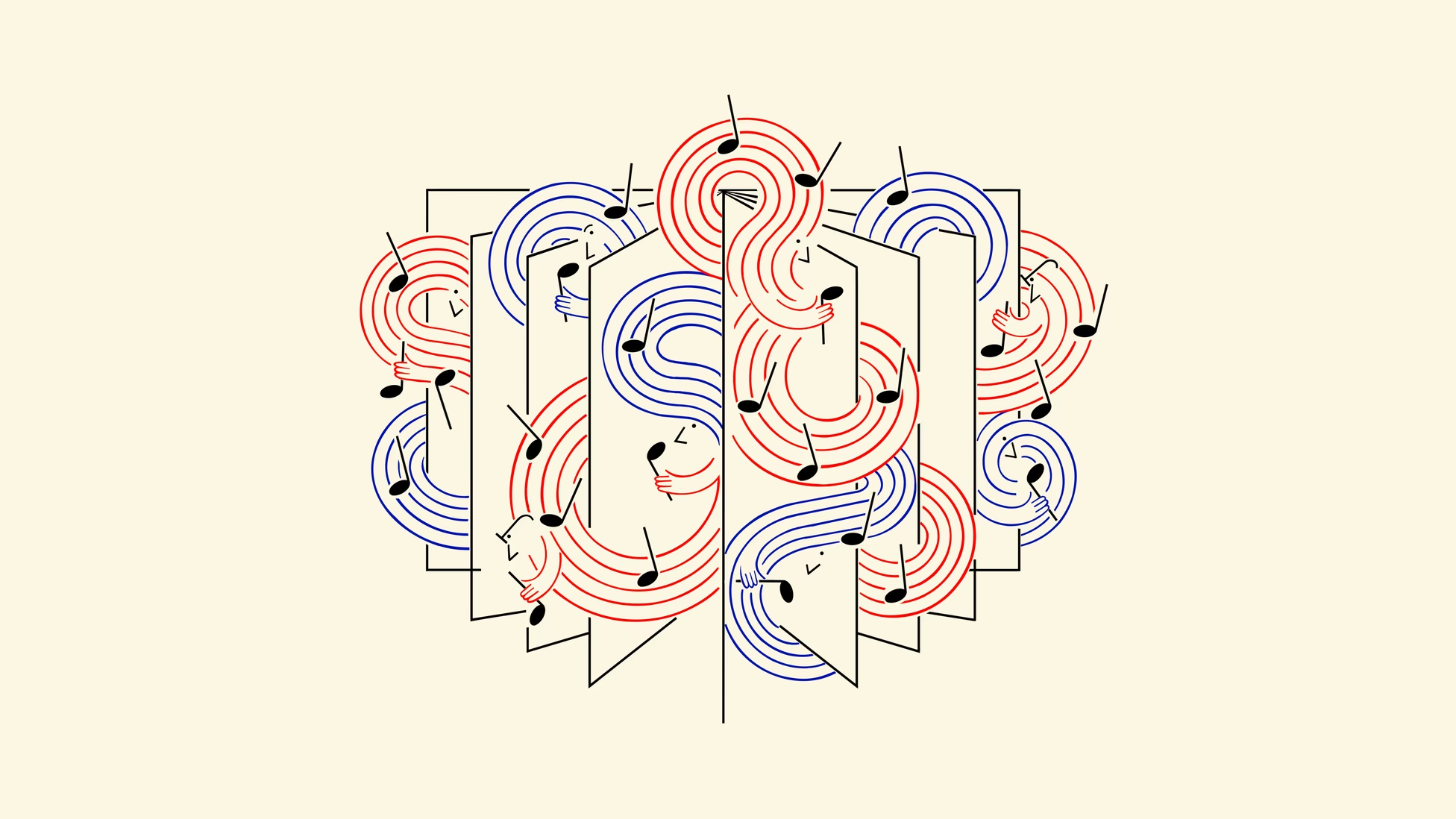
“Classical music” is a label applied to radically different compositions across more than 1,000 years of history. Composer, conductor, writer, pianist, and 2018 MacArthur Fellow Matthew Aucoin that we need a better definition…
… What is classical music, whom is it for, and what about it is worth defending?
Our answers to these questions will depend on what exactly we love about this music, and what we care about preserving, enriching, and expanding. Claiming that classical music deserves a prominent place in American culture merely because we want to safeguard a particular sound, style, or cultural or ethnic lineage—“music that sounds like Brahms,” or “music from one of three Central European countries”—would be a losing cause.
But a better answer is out there. Rather than defend the “classical” in classical music, I want to champion a particular creative process. What links Hildegard von Bingen and Kaija Saariaho, Johann Sebastian Bach and George Benjamin, is not a specific sound or aesthetic but a shared technology of transmission. At its core, classical music isn’t “classical.” It is written music.
By “written music,” I mean music that comes into being through the act of composition. Music from practically any tradition can, of course, be written down. If you’re a Beatles fan, you can buy a collection of Beatles sheet music, and if you want to plunk out your favorite jazz standard, you can order a copy of The Real Book, which contains the essential harmonic and melodic information for hundreds of well-traversed tunes. (Both a Real Book and a 1,136-page tome called The Beatles: Complete Scores are sitting on my piano as I write this.)
Though all music can be documented and experienced in multiple ways—scores, recordings, live performances—one approach to distinguishing musical traditions is to ask which form a given tradition treats as authoritative. It would be odd, for instance, to claim that a collection of printed scores constitutes a definitive document of the Beatles canon, because the unquestioned reference point is the band’s studio albums. My Beatles compendium proudly declares its own contingency: Printed on the front cover is an all-caps proclamation that its pages contain FULL TRANSCRIPTIONS FROM THE ORIGINAL RECORDINGS.
In other words: albums first, scores later. Taylor Swift’s 2019 decision to rerecord her earlier albums was a potent gesture, even a radical one, precisely because in pop music, the studio album typically possesses an authority upon which all subsequent iterations—whether live performances or written transcriptions—are based. Only by returning to the studio could Swift achieve control over her master recordings and literally set the record(s) straight.
Jazz musicians and aficionados tend to have a different perspective. Even though certain albums (Kind of Blue, A Love Supreme ) have attained the status of holy relics in the minds of many listeners, I think most jazz lovers would agree that the genre is not defined by the worship of specific studio recordings. Fans are more likely to value the evanescent moment of live performance, with its potential for spontaneous expression, for the very reason that a familiar tune can sound different every time it’s performed. A major artist such as Miles Davis might have performed and recorded a certain song—“My Funny Valentine,” for example—many times throughout his career, and there’s no reason to automatically treat a particular performance as the authoritative version. In spite of The Real Book’s name, jazz musicians rarely consider the printed score to be “the real thing” either. No self-respecting jazz musician would play a Real Book score exactly as written.
Western classical music is an unusual case. The reference point for a given piece of music is the score, rather than a studio recording or a live performance. Beethoven’s symphonies have been recorded hundreds—if not thousands—of times, and they’ve been performed many more times than that, but every one of those performances and recordings refers to the same score. For a composer, the score is the foundational site of creativity, and the act of score-making links together artists who could hardly sound more different from one another—say, an Italian composer of the late Renaissance and early Baroque period like Claudio Monteverdi and a 20th-century American avant-gardist like John Cage. Even an extreme case, such as Cage’s famous 4’33”—a work in which performers refrain from playing their instrument for four minutes and 33 seconds—depends on its score, a simple and playful set of written instructions. (In fact, to a greater degree than most notated music, 4’33” is inconceivable as a work of art without those directions.)
If we let ourselves be guided by this basic question—which musical artists regard the score as a creative starting point?—we arrive at the broadest and most welcoming definition of “classical” music. All kinds of unexpected affiliations and affinities emerge beyond music that’s typically thought of as belonging to the tradition. Many of the big-band masterpieces of Duke Ellington and Billy Strayhorn, for instance, strike me as indistinguishable, in their creative genesis, from orchestral works by Igor Stravinsky and Aaron Copland that were being written around the same time: They are notated in exquisite detail, usually for large ensembles, and Strayhorn’s gorgeously balanced wind and brass voicings remind me in particular of Stravinsky’s. To my ear, Strayhorn is a symphonist at heart. His work—in its fundamental writtenness—has more to do with that of many so-called classical composers than it does with, for example, that of an artist like Ornette Coleman, a free-jazz master who ostensibly hails from a tradition that is continuous with Strayhorn’s, but whose method could hardly be more different.
Written music matters for the same reason written langauge does: To write is to free oneself from the constraints of memory. It’s possible, in a novel or an essay or a nonfiction narrative or a book of poems, to devise an aesthetic structure full of details, depths, and digressions that would be far harder to construct in a purely oral storytelling tradition, one in which verbal transmission works through either memorization or improvisation. When you write, you don’t simply set down your thoughts; in the process of writing, your thoughts are transformed, and allowed to assume a newly complex shape—the miraculous scaffolding that emerges from the accumulation of thoughts on the page.
Our world is awash in written language, but not written music. The musical genres that dominate mainstream American culture are all more or less oral traditions….
… Musical literacy is a highly specialized skill; to become a fluent reader of music, a student needs to be given the kind of focused instruction that not all public schools have the funding to provide. Exposure to music education, beyond the rudiments, all too often becomes a question of whose family can afford expensive private lessons. We can react to this fact by feeling guilty about it, and letting notated music be tainted by its association with elitism, or we can push for an expansion of musical education. We all understand that to teach a child to read and write is to endow them with potent means of expression and self-discovery. Why should musical literacy be any different? Even a basic grounding in musical notation can transform a child’s sense of what can be communicated to another human being, especially—and this is crucial—if notation is treated as a tool of creativity rather than simply an unpleasant test of the ability to play all the right notes or else.
If we understand that writing, in music as in language, has the potential to be a force for liberation, and that it can transcend localized questions of style and aesthetic, we might come to a fuller sense of what music can be in our lives—the many forms it can take, the many truths it can tell. And if I could prescribe one thing for our world at this moment, it would be to deepen and expand our understanding of what it is to listen…
Eminently worth reading in full: “Do You Actually Know What Classical Music Is? Does Anyone?” (gift article) from @theatlantic.com.
* Johann Wolfgang von Goethe (though we might recall that Martin Mull observed that “writing about music is like dancing about architecture”)
###
As we read and write, we might recall that this date– National Opera Day— is the anniversary of the premiere in 1874 of Modest Mussorgsky‘s (and here) Boris Godunov at the Mavrinsky Theater in St. Petersburg. (Some sources give the date as January 27 of that year.) Mussorgsky’s only completed opera, it is considered his masterpiece.
Mussorgsky composed the work, based on Pushkin‘s 1825 play Boris Godunov (and here), between 1868 and 1873. By the 1980s In the 1980s, Boris Godunov had moved closer to the status of a repertory piece than any other Russian opera, even Tchaikovsky‘s Eugene Onegin, and is the most recorded Russian opera.

“They are alone together”*…

Andrew Trousdale and Erik J. Langer bridge the years between Robert Putnam‘s Bowling Alone and Jonathan Haidt‘s The Anxious Generation with a brief history of the trade-off between convenience and connection in America. From Zach Rauch’s introduction…
The Anxious Generation is best understood as a three-act tragedy. Act I begins in the mid-20th century, when new social and entertainment technologies (e.g., air conditioning and television) set in motion a long, gradual collapse of local community. Act II begins in the 1980s, as the loss of local community weakened social trust and helped erode the play-based childhood. Act III begins in the early 2010s, with the arrival of the phone-based childhood that filled the vacuum left behind.
This post, written by Andrew Trousdale and Erik Larson, goes deep into Act I. Andrew is a psychology researcher and human-computer interaction designer who is co-running a project on the psychological tradeoffs of progress. Erik is the author of The Myth of Artificial Intelligence, writes the Substack Colligo, and is completing the MIT Press book Augmented Human Intelligence: Being Human in an Age of AI, due in 2026. Together, they show how the isolation we experience today did not begin with smartphones but began decades earlier, as Americans, often for good and understandable reasons, traded connection for convenience, and place-based relationships for privacy and control.
Tracing these trade-offs across the twentieth century, Andrew and Erik help explain the problem of loneliness we face today, and offer some guidance for how we can turn it around and reconnect with our neighbors. Robert Putnam, who read a recent draft, described it as “easily the best, most comprehensive, and most persuasive piece on the contemporary social capital conundrum I’ve yet read.”…
Trousdale and Langer trace the social, cultural, economic, political, and technological forces that have played out from the the late 1940s to today. It is, at once, familiar and shocking. They conclude…
When we asked Robert Putnam what gives him hope, he pointed to history. In The Upswing, he reminds us that Americans faced a similar crisis before. The Gilded Age brought economic inequality, industrialization, and the rise of anonymous urban life. Small-town bonds gave way to tenements and factory floors. Trust collapsed. By the 1890s, social capital had reached historic lows — roughly where it stands today.
The Progressive reformers found this new world unacceptable, but they didn’t try to turn back the clock. Cities and factories were here to stay. Instead, they adapted, creating new forms of connection suited to their changed reality, from settlement houses for anonymous neighborhoods to women’s clubs that built networks of mutual aid. They didn’t reject modernity; they metabolized it, showing up day after day to create new institutions and communities suited to the industrialized world.
Decades ago Neil Postman observed in Amusing Ourselves to Death that we haven’t been conquered by technology — we’ve surrendered to it because we like the stimulation and cheap amusement. More recently, Nicholas Carr concludes in Superbloom that we’re complicit in our loneliness because we embrace these superficial, mediated forms of connection. Like Postman and Carr, the Progressive Era reformers understood where they had agency when technology upended their world. It isn’t in demanding that others fix systems we willingly participate in, nor is it in outright rejecting technologies that deliver real benefits — it’s in changing how we ourselves live with and make use of the tools that surround us.
There are already signs that people are willing to do this. In a small, three-day survey, Talker Research found that 63% of Gen Z now intentionally unplug — the highest rate of any generation — and that half of Americans are spending less time on screens for their well-being, and their top alternative activity is time with friends and family. And they found that two-thirds of Americans are embracing “slow living,” with 84% adopting analog lifestyle choices like wristwatches and paper notebooks that help them unplug. Meanwhile in Eventbrite’s “Reset to Real” survey, 74% of young adults say in-person experiences matter more than digital ones. New devices like the Light Phone, Brick, Meadow, and Daylight Computer signal a growing demand for utility without distraction.
Unplugging isn’t enough on its own. The time and energy we reclaim has to go toward building social connections: hosting the dinner party despite the hassle, staying for coffee after church when you’d rather go home, sitting through the awkward silence, offering or asking for help.
Ultimately, we can’t expect deep social connection in a culture that prioritizes individual ease and convenience. Nor is community something technology can deliver for us. What’s required is a change of culture, grounded in a basic fact of human nature: that authentic connection requires action and effort, and that this action and effort is part of what makes connection fulfilling in the first place.
We can form new rituals and institutions that allow us to adapt to technology, ultimately changing it to our liking. But it starts with the tools we use and the choices we make each day. If we all prioritize the individual comforts and conveniences we’ve grown accustomed to, no one else will restore the community we say we miss. No one else can. If we want deeper relationships and better communities than we have, we’re going to have to put more of our time, effort, and attention into the people around us.
History shows that we can adapt, building communities suited to changing times. The question is: Will we stay in and scroll? Or will we go out and choose one another?…
Eminently worth reading in full: “Scrolling Alone.”
In the spirit of the call for forward-looking determination, pair with “The Displacement of Purpose” from Peter Adam Boeckel (“If AI automates production, then humanity must automate compassion. Only then will progress remember what it was for.”)
[Image above: source]
* Robert Putnam, Bowling Alone (in which he also observed: “People divorced from community, occupation, and association are first and foremost among the supporters of extremism.”)
###
As we get together, we might spare a thought for Aldus Manutius; he died on this date in 1515. A printer and humanist, he founded the Aldine Press. In the books he published, he introduced a standardized system of punctuation and use of the semicolon. He designed many fonts, and created italic type (which he named for Italy).

And apropos the piece featured above, we might note that on this date in 1965 “You’ve Lost That Lovin’ Feeling,” the first major hit for the Righteous Brothers, simultaneously reached #1 on both the Billboard and Cash Box charts in the US as well as the UK singles chart. The song was produced by Phil Spector (who had discovered the duo at a San Francisco show) for his own label, Philles Records. All the songs previously produced by Spector for Philles featured African-American singers; the Righteous Brothers were his first white vocal act– they had a vocal style, blue-eyed soul, that suited Spector.
“You get what you measure”*…

Matt Stoller takes the occasion of Trump’s selection of Kevin Warsh to head the Fed (“an orthodox Wall Street GOP pick, though he is married to the billionaire heiress of the Estee Lauder fortune and was named in the Epstein files. He’s perceived not as a Trump loyalist but as an avatar of capital”) to ponder why public satisfaction with the economy is so low (“if you judge solely by consumer sentiment, Trump’s first term was the third best economy Americans experienced since 1960. Trump’s second term is not only worse than his first, it is the worst economic management ever recorded by this indicator”).
Stoller argues that we’re mesuring the wrong things (or, in some cases, the right things in the wrong ways)…
… the models underpinning how policymakers think about the economy just don’t reflect the realities of modern commerce. The fundamental dynamic is that those models were constructed in an era where America was one discrete economy, with Wall Street and the public tied together by the housing finance system. But today, Americans increasingly live in tiered bubbles that have less and less to do with one another. Warsh will essentially be looking at the wrong indicators, pushing buttons that are mislabeled.
While corporate America is experiencing good times, much of the country is experiencing recessionary conditions. Let’s contrast consumer sentiment indicators with statistics showing an economic boom. Last week, the government came out with stats on real gross domestic product increasing at a scorching 4.4% in the third quarter of last year. There’s higher consumer spending, corporate investment, government spending, and a better trade balance. Inflation, according to the Consumer Price Index, is low at 2.6.% over the past year. And while official numbers aren’t out for the final three months of the year, the Atlanta Fed’s GDPNow forecast shows that it estimates growth at 4.2%. And there are other indicators showing prosperity, from low unemployment to high business formation, which was up about 8% last year, as well as record corporate profits…
… Behavioral economists and psychologists have all sorts of reasons to explain that people don’t really understand the economy particularly well. But in general, when the stats and the public mood conflict, I believe the public is usually correct. Often, there are some weird anomalies with the data used by policymakers. In 2023, I noticed that the consumer price index, the typical measure of inflation, didn’t account for borrowing costs, so the Fed hike cycle, which caused increases in credit card, mortgage, auto loan, payday loans, et al, just wasn’t incorporated. The public wasn’t mad at phantom inflation, they were mad at real inflation that the “experts” didn’t see.
I don’t think that’s the only miscalculation…
[Stoller goes on to explain the ways in which “consumer spending” doesn’t tell us much about consumers anymore, about the painful reality of “spending inequality,” and about the obscure(d) problem of monopoly-driven inflation. He concludes…]
… Finally, there’s a more philosophical point, which I don’t think explains the short-term frustrations people feel, but is directionally correct. Do people actually want what the economy is producing? For most of the 20th century, the answer was yes. When Simon Kuznets invented these measurement statistics in 1934, financial value and the value that Americans placed on products and services were similar. A bigger economy meant things like toilets and electricity spreading across rural America, and cars and food and washing machines.
Today? Well, that’s less clear. According to the Bureau of Labor Statistics, the second fastest growing sector of the economy in terms of GDP growth from 2019-2024 was gambling. Philip Pilkington wrote a good essay last summer on the moral assumptions behind our growth statistics. There is no agreed upon notion of what makes up an economically valuable object or activity, so our stats are inherently subtle moral judgments. Classic moral philosophers like Adam Smith believed in the “use value” of an item, meaning how it could be used, whereas neoclassical economists believed in the “exchange value” of an item, making no judgments about use and are just counting up its market price.
Normal people subscribe on a moral level to use value. Most of us see someone spending money on a gambling addiction as doing something worse than providing Christmas presents for kids, but not because of price. However, our GDP models use the market value basis. Kuznets, presumably, was not amoral, he just thought that our laws would ban immoral activities like gambling, and so use value and market value wouldn’t diverge. But they have.
It’s not just things like gambling or pornography or speculation. A lot of previously unmeasured activity has been turned into data and monetized, which isn’t actually increasing real growth but measuring what already existed. Take the change from meeting someone at a party to using a dating app. One is part of GDP, the other isn’t. Both are real, but only one would show a bigger economy.
Beyond that much of our economy is now based on intangibles – the fastest growing sector was software publishing. Is Microsoft moving to a subscription fee model for Office truly some sort of groundbreaking new product? It’s hard to say, while corporate assets used to be hard things like factories, today much of it is intangibles like intellectual property.
A boomcession, where the rich and corporate America experience a boom while working people feel a recession, is a very unhealthy dynamic. It’s certainly possible to create metrics to measure it, and to help policymakers understand real income growth among different subgroups. You could start looking at real income after non-discretionary consumer spending, or find ways of adjusting for price discrimination.
But I think a better approach is to try to knit us into one society again. The kinds of policymakers who could try to create metrics to understand the different experiences of classes, and ameliorate them, don’t have power. Instead, the people in charge still use models which presume one economy and one relatively uniform set of prices, where “consumer spending” means stuff consumers want.
I once noted a speech in 2016 by then-Fed Chair Janet Yellen in which she expressed surprise that powerful rich firms and small weak ones had different borrowing rates, which affected the “monetary transmission channel” the Fed relied on. Sure it was obvious in the real world, but she preferred theory.
Or they don’t use models at all; Kevin Warsh is not an economist, he’s a lawyer and political operative, and is uninterested in academic theory. He cares about corporate profits and capital formation. That probably won’t work out well either.
At any rate, we have to start measuring what matters again. If we don’t, then we’ll continue to be baffled that normal people hate the economy that looks fine on our charts…
The models used by policymakers to understand wages, economic growth, and consumer spending are misleading. That’s why corporate America is having a party, and everyone else is mad. Eminently worth reading in full: “The Boomcession: Why Americans Hate What Looks Like an Economic Boom,” from @matthewstoller.bsky.social (or @mattstoller.skystack.xyz).
* Richard Hamming (and also to the article above, see “Goodhart’s law“)
###
As we ponder the pecuniary, we might recall that it was on this date in 1958 that Benelux Economic Union was founded, creating the seed from the European Economic Community, then the European Union grew.
On that same day, Philadelphia doo wop group The Silhouettes started five weeks at the top of the Billboard R&B chart with their first single, “Get A Job.”
“I Want My MTV!”*…

You’ve probably seen a variation of this news on social media over the past few days: MTV officially shut down on New Year’s Eve, ending their final broadcast the same way the network started: With the clip “Video Killed the Radio Star” by The Buggles.
But those posts are misinformed. It’s New Year’s Day 2026, and MTV is still around. Granted, today the channel is playing a marathon of “The Big Bang Theory” sitcom repeats, so your interpretation of “MTV is still around” may vary…
– Variety, January 1, 2026
Indeed, the reality shows and network re-runs are still flowing. But the new owners of MTV’s parent, Paramount Global, did end its dedicated, 24/7 music channels (like MTV Music, MTV 80s, MTV 90s) at the close of 2025 across most international markets, effectively ceding the video music turf to YouTube.
So it’s a propitious moment to pause and reflect on the legacy, the impact of MTV…
… MTV, the Music Television that launched a thousand careers and redefined a generation, is finally shutting down [as a music channel]. It’s bittersweet to see it go, but it’s also a perfect moment to reflect on just how profoundly this channel, born in a blaze of sound and vision, altered the landscape of music, media, and even society itself.
It’s hard to imagine now, but before August 1, 1981, music was primarily an auditory experience. You listened to it on the radio, on records, or at concerts. The idea of a 24-hour channel dedicated solely to music videos was revolutionary, a gamble by Warner-Amex Satellite Entertainment. They saw the burgeoning popularity of music videos, then mostly promotional tools for artists, and envisioned a dedicated platform. The very first video ever played, fittingly, was “Video Killed the Radio Star” by The Buggles – a prophetic title if there ever was one.
MTV’s early days were a chaotic, vibrant mix of rock, pop, and new wave, with VJs (video jockeys) becoming household names. It was raw, experimental, and deeply intertwined with the youth culture of the 80s. But what started as a niche cable channel quickly exploded into a global phenomenon, forever altering how we consumed and understood music. So, as we bid adieu, let’s explore ten ways MTV truly changed everything…
Remember them at: “MTV: A Farewell to the Channel That Changed Our World,” from Eric Alper (@thatericalper.com)
* The tag line of MTV’s initial ad campaign (aimed at getting cable viewers to press their cable suppliers to carry MTV)
###
As we recollect rock, we might recall that it was on this date in 1972 that David Bowie released “Changes,” from his 1971 album Hunky Dory. Co-produced by Bowie and Ken Scott, it featured Rick Wakeman on piano and the musicians who would later become known as the Spiders from Mars—Mick Ronson, Trevor Bolder and Mick Woodmansey.

You must be logged in to post a comment.