Posts Tagged ‘music history’
“The wind has its reasons”*…
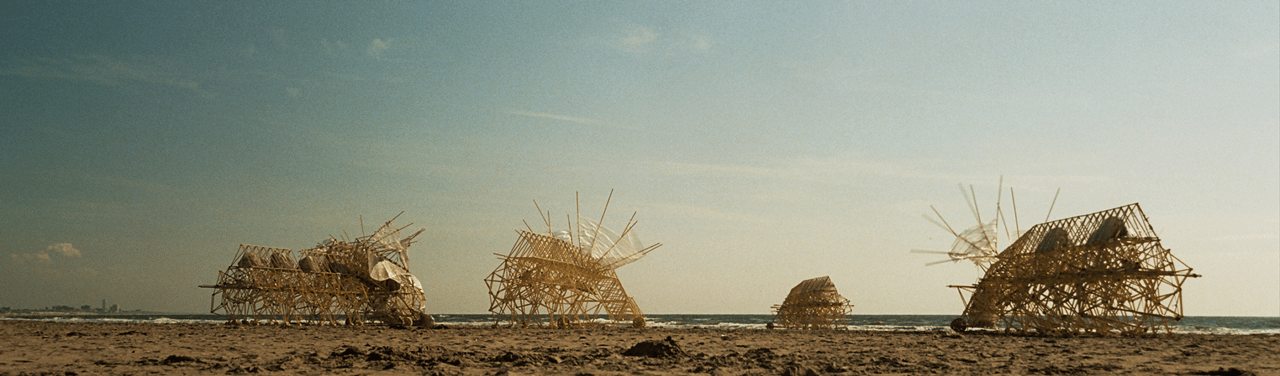
For Theo Jansen, it’s all about the wind…
Many of us hit the beach to enjoy some sunshine or catch a wave. But for Dutch artist Theo Jansen it’s all about the wind. Jansen’s been working with this limitless natural resource for 30 years to create a fabulous array of giant beach creatures—brought to life by the wind. With every gust, his wondrous seaside sculptures become more lifelike, ambling along the coast like creatures in their own right…
Jansen started designing them in the 1990s after reading about rising sea levels threatening the low-lying Netherlands—a country famous for the fact that one third of it is below sea level. He had a dream of creating a herd of wind-powered coastal sentinels, perpetually piling sand high onto the dunes to keep the water at bay.
What he ended up building took a different turn, with Jansen developing the idea to explore evolution as the primary creative force behind all life on Earth, capturing people’s imaginations in the process…
An artist’s moving tribute to nature’s powerful resource: “Fantastic Beasts Brought to Life by the Wind,” @HoeveMarie in @NautilusMag on @StrandBeests.
* Haruki Murakami
###
As we feel the breeze, we might recall that it was on this date in 1896 that Richard Strauss‘ Also sprach Zarathustra (Opus 30) was first performed (in Frankfurt).
“People ought to stop saying, ‘Rock is dead.’ It gets old.”*…

Mo Troper (and here) offers a treatise on the hotly debated subgenre Power Pop…
What is power pop? It is a question many have asked and few have satisfyingly answered. To many, power pop is any modern idealization of mid-‘60s British pop, a sticky and sickly sweet Neapolitan of “chiming guitars,” “heavy drums” and “aching vocal harmonies.” The Raspberries, Big Star, Badfinger, Todd Rundgren — these are just a few of power pop’s pioneering practitioners.
There are entire message boards and stuffy Facebook groups dedicated to debating its origins and musical properties. Power pop fandom is as isolated as it is isolating. Most of the year it’s a pasty shut-in muttering to itself, every now and then it’s an evangelist screaming from the rooftops. To be a power pop “fan” is to be in endless pursuit of the greatest post-Beatles guitar pop single the general public has yet to hear. And once you find it: Should you share it with the world or keep it all to yourself?
To the outside world — and even to nominal double-P fans — the drama and rigorous dialectic associated with this genre is insane, and understandably so.
The gatekeeping makes a little more sense if you relate power pop to a more general aesthetic phenomenon: camp.
Susan Sontag published her essay Notes on “Camp” in 1964, the same year The Beatles conquered America. According to the Wikipedia article on camp, the phrase is “etymologically obscure” — it was once a specific cultural posture associated with working-class gay communities, but it would later be subsumed under (or, co-opted by) the postmodern umbrella. Sontag herself believed camp was fundamentally non-discriminating, although acknowledges it is by and large a sensibility created by gay men. Attempting to distinguish “camp” from other, similar aesthetics is campy.
“Camp is the consistently aesthetic experience of the world,” Sontag writes. “The whole point of camp is to dethrone the serious. Camp is playful, anti-serious. More precisely, Camp involves a new, more complex relation to ‘the serious.’ One can be serious about the frivolous, frivolous about the serious.”
Like camp art, the lines between seriousness and frivolity in power pop can be maddeningly obscure. Fountains of Wayne are often considered one of the greatest power pop bands of all time; their most celebrated record, Welcome Interstate Managers, is not power pop in the strict, sonic sense — it covers everything from Oasis and Cars pastiche to acoustic confessionals and quasi-lounge. What makes this record so great — and what makes it so campy — is the level of scholarship, commitment, and straight-faced passion the band brings to their interpretations of old hat musical tropes. Camp, according to Sontag, “reeks of self-love” even when it revels in parody.
…
“Power Pop Is Camp,” from @mo_troper.
(To Moe’s point: “That Thing You Do,” the song performed by the fictional 1960s band The Wonders in Tom Hank’s film of the same name, was written by Adam Schlesinger, co-founder of Fountains of Wayne. It succeeded both in the film as an evocation of the Beatles-inspired melodic pop of 1964-65 and as a power pop success of it own (it charted in 1997 in the U.S. and Australia and was nominated for both an Oscar and a Golden Globe.)
* Matthew Sweet
###
As we tap our toes, we might recall that it was on this date in 1961 that record store manager Brian Epstein called the Cavern Club in Liverpool to arrange to see a lunchtime performance the following day by a local group, The Beatles. After the show, he went backstage to introduce himself… returned for several subsequent shows… left his retailing career to become the group’s manager… and helped them become… well, the ultimate inspiration for Power Pop.

“There was something very attractive in all the hidden places, the hidden histories”*…
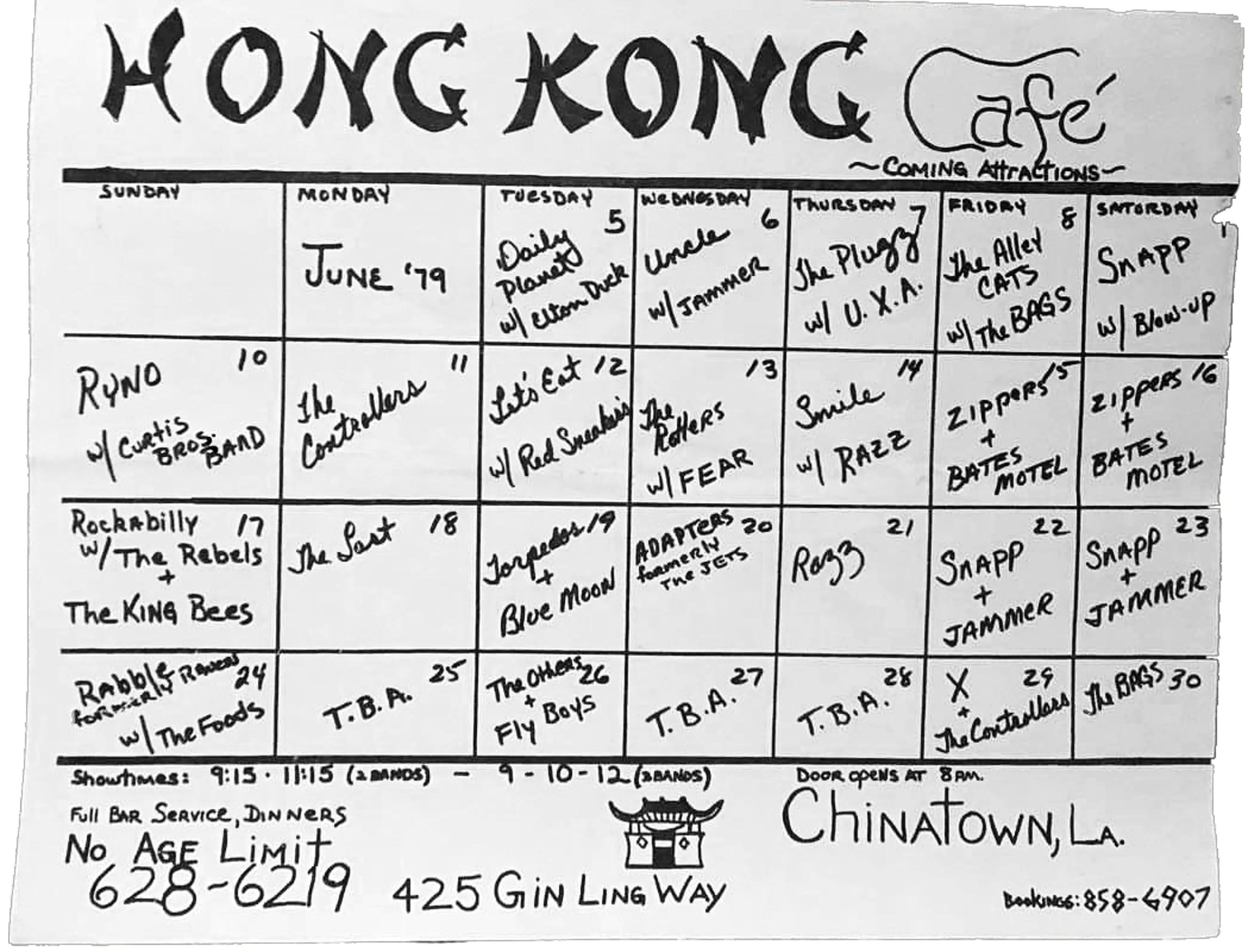
In the late 1970s, Asian restaurants in California’s cities started booking some unlikely dinner entertainment: punk bands…
Bill Hong was a Cantonese immigrant dad in his late 40s, running a restaurant in Los Angeles’ Chinatown neighborhood with his sister Anna Hong and her husband Arthur, when two young promoters approached him with a business proposition: What did Hong think about renting out the restaurant’s upstairs banquet hall on the evenings when it wasn’t being used?
It was 1979, and LA was struggling. The entire country had plunged into a deep recession just a few years prior, and now Chinatown and the city’s downtown areas were falling into disrepair. More recent Chinese immigrants had started moving to suburban enclaves like the San Gabriel Valley, bypassing Chinatown and its businesses completely; the non-Chinese customers who used to flock to the neighborhood for exotic chow mein dinners were now avoiding downtown altogether.
When Bill Hong said yes to the promoters, he was trying to be practical. He knew the restaurant needed more customers; maybe letting a few young bands play could help bring them in. He never could’ve foreseen that his family’s establishment, the Hong Kong Low—located on a small street called Gin Ling Way—would become a focal point for a seminal music scene: West Coast punk.
Nor did he know how many times the restaurant’s toilet would get smashed in the process.
Hong’s restaurant—known as the Hong Kong Café to showgoers—was far from the only Asian restaurant to incubate the California punk scene. In the late 1970s and early ‘80s, from Sacramento to San Francisco, some of the state’s most important punk venues were actually Chinese and Filipino restaurants. At eateries like Sacramento’s China Wagon and Kin’s Coloma, or San Francisco’s Mabuhay Gardens, now-iconic bands such as X, the Germs, and Black Flag played some of their most memorable early gigs. The Hong Kong wasn’t even the first place in LA’s Chinatown to host gigs: the restaurant across the courtyard, Madame Wong’s, had already been doing the same for at least a year…


Tour the venues: “How Chinese Food Fueled the Rise of California Punk,” from Madeline Leung Coleman (@madelesque)
* “Punk rock, when I was a part of it, was called ‘the underground.’ There was something very attractive in all the hidden places, the hidden histories.” – Mary Harron
###
As we muse on the mosh, we might recall that this date in 1979 was “Fleetwood Mac Day” in Los Angeles, as the group was awarded a star on the Hollywood Walk of Fame (about 6 miles northwest of the Hong Kong Café).

“Any subject is good for opera if the composer feels it so intently he must sing it out”*…

We know that opera took the form we know today in Italy the first half of the 17th century, when what had largely been ponderous courtly spectacles mutated into the lively popular art that opera has remained for the past 400 year. But why did operas as we know them become… well, operas as we know them?
Why did opera first succeed as a public art form in Venice between 1637 and 1650 when all the elements of the new form were fully evident? The answer is to be found in the conjunction between Venetian carnival festivity and the intellectual politics of Venetian republicanism during the two generations after the lifting of the papal interdict against Venice in 1607. During this extraordinary period of relatively free speech, which was unmatched elsewhere at the time, Venice was the one place in Italy open to criticisms of Counter Reformation papal politics. Libertine and skeptical thought flourished in the Venetian academies, the members of which wrote the librettos and financed the theaters for many of the early Venetian operas.
How opera became Opera: “Why Venice? Venetian Society and the Success of Early Opera,” from Edward Muir (@EdwardMuir7)
* Gian Carlo Menotti
###
As we fiddle with Fidelio, we might recall that it was on this date in 1600 that Euridice, an opera by Jacopo Peri, with additional music by Giulio Caccini, was first performed in Florence; the libretto by Ottavio Rinuccini is based on books X and XI of Ovid’s Metamorphoses. which recount the story of the legendary musician Orpheus and his wife Euridice. A presage of what was later to flourish in Venice, it is the oldest surviving opera (though the same authors wrote the now-lost Dafne two years earlier), and is generally regarded as marking the dawn of the Baroque period.

“Must it be? It must be.”*…
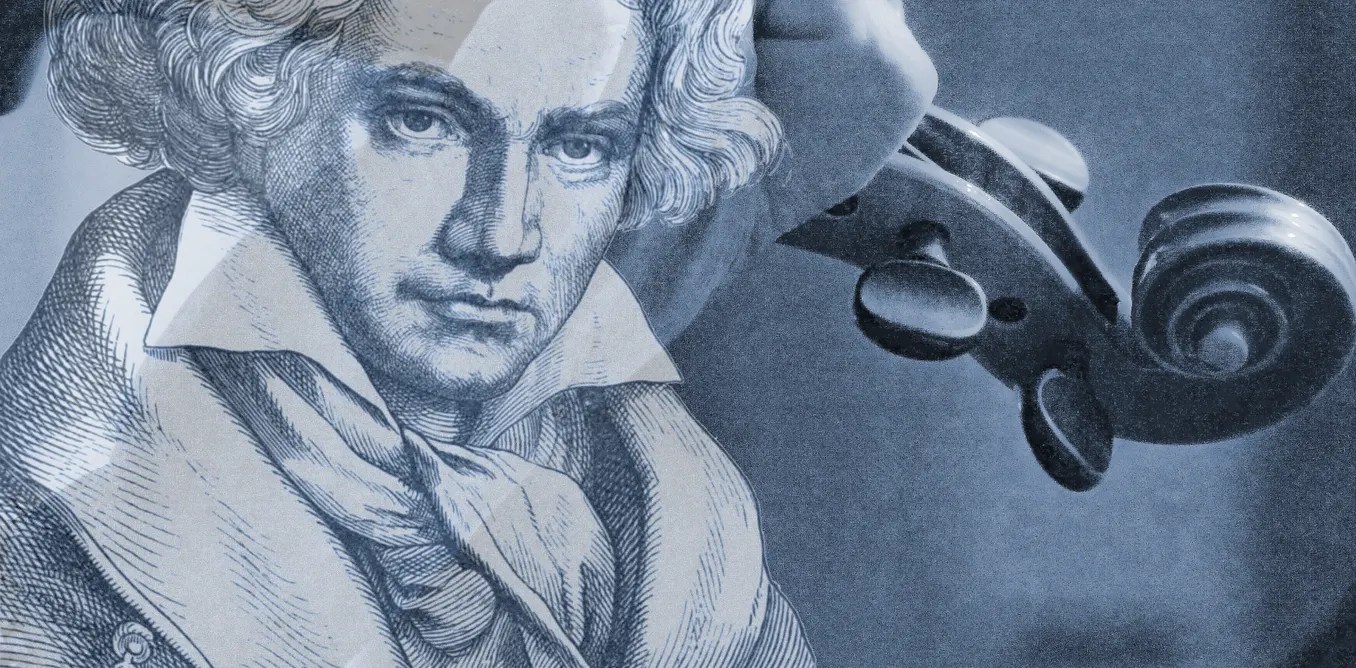
A long lost work, found… sort of…
When Ludwig van Beethoven died in 1827, he was three years removed from the completion of his Ninth Symphony, a work heralded by many as his magnum opus. He had started work on his 10th Symphony but, due to deteriorating health, wasn’t able to make much headway: All he left behind were some musical sketches.
Ever since then, Beethoven fans and musicologists have puzzled and lamented over what could have been. His notes teased at some magnificent reward, albeit one that seemed forever out of reach.
Now, thanks to the work of a team of music historians, musicologists, composers and computer scientists, Beethoven’s vision will come to life…
A full recording of Beethoven’s 10th Symphony is set to be released on Oct. 9, 2021, the same day as the world premiere performance scheduled to take place in Bonn, Germany – the culmination of a two-year-plus effort…
“How a team of musicologists and computer scientists completed Beethoven’s unfinished 10th Symphony,” replete with a sample of the “finished” work.
* Ludwig van Beethoven
###
As we size up simulacra, we might recall that it was on this date in 1964 that Teressa Bellissimo, at the Anchor Bar in Buffalo, New York, created Buffalo Hot Wings as a snack for her son and several of his college friends. Her “invention”– an unbreaded chicken wing section (flat or drumette), generally deep-fried then coated or dipped in a sauce consisting of a vinegar-based cayenne pepper hot sauce and melted butter, and served with with celery and carrot sticks and with blue cheese dressing or ranch dressing for dipping– has become a barroom and fast food staple… and has inspired a plethora of “Buffalo” dishes (other fried foods with dipping sauces).

You must be logged in to post a comment.