Posts Tagged ‘San Francisco’
“You must have chaos within you to give birth to a dancing star”*…

Last May, Pulitzer Prize-winning journalist and author John Markoff was asked to write an op-ed for The Wall Street Journal on the heels of the murder in San Francisco of tech exec Bob Lee. The paper rejected his piece, leaving Markoff to “suspect that they were looking for more of a ‘drugs, sex and rock & roll’ analysis, which isn’t what they got. My 2005 book What the Dormouse Said is occasionally cited by people making the argument that there is some kind of causal relationship between psychedelic drugs and creativity. I have never believed that to be the case and I’ve always been more interested in sociological than psychological assessments of psychedelics.”
Happily for us, he has shared it on Medium…
The head-spinning speed with which the murder of software creator Bob Lee went from being a story about rampant crime in San Francisco to a sex and drugs tale of Silicon Valley excess says a great deal about the way the world now perceives the nation’s technology heartland.
Lee, who had gone from being a Google software engineer to become the creator of the mobile finance program Cash App, and who had more recently became the chief product officer for a crypto-currency company, is now alleged to have been stabbed to death by the brother of a wealthy socialite with whom Lee is thought to have had an affair.
On the surface it would seem to evoke something more out of a Hollywood soap opera than the world’s technology center. But the Valley is more complex than cases like Bob Lee, or dark takes on the evils of technology, suggest.
Silicon Valley has always been built around a paradox represented by the built-in tension between the open-source spirit of a hacker counterculture and the naked capitalist ambitions of Sand Hill Road, where the offices of its venture capitalists are concentrated.
Stewart Brand, who authored the Whole Earth Catalog in Menlo Park, Ca., at the same moment the high-tech region was forming in the 1960s, expressed the paradox most clearly at the first meeting of the Hackers Conference in 1984. In responding to Steve Wozniak, Apple’s cofounder, who was describing the danger of technology companies hoarding information, what the audience heard Brand say, was “information wants to be free.” Indeed, a decade later that became the rallying cry of the dot-com era, a period in which technology start-ups thrived on disrupting traditional commerce and railing against regulation.
But that is not what Brand said. He actually stated: “Information sort of wants to be expensive because its so valuable, the right information at the right point changes your life. On the other hand information almost wants to be free, because the cost of getting it out is getting lower and lower all the time.”
Brand had been influenced by social scientist Gregory Bateson who proposed the idea of “the double bind” to describe situations in which even when you win, you lose. Understanding that paradox, which was lost in translation, might have saved the Valley from some of the excess that has taken it into the dark territory it has found itself in recently.
From its inception, the very nature of Silicon Valley was about its ability to simultaneously allow diverse cultures to thrive. During the 1960s and 1970s, while Silicon Valley was being formed, you could easily drive from Walker’s Wagon Wheel in Mountain View, where crewcut hard-drinking computer chip designers gathered, to a very different long-haired scene in just up the road in Palo Alto and Menlo Park, which surrounded Stanford Research Institute, the Stanford Artificial Intelligence Laboratory and Xerox’s Palo Alto Research Center, the three labs that pioneered the technologies that would become the modern personal computer and the Internet.
The paradox is perhaps best expressed in the formation of Apple Computer — a company that grew out of the separate interests of its two founders. One, Steve Wozniak was simply interested in building a computer to share with his friends at the Homebrew Computer Club, a hobbyist group founded by a convicted draft resister and a software engineer that would ultimately birth several dozen start-up PC hardware and software companies including Apple. Wozniak would combine his hacker’s instincts for sharing with Steve Jobs, who had the insight to realize that there would be a market for these machines…
…
… Silicon Valley engineers believed they were just one good idea away from becoming the next Jobs or Wozniak.
That deeply entrenched culture of risk-taking — and frequent failure — originally exemplified by the Gold Rush, today remains an integral part of the California and by extension Silicon Valley, Dream.
In recent weeks, much has been made of Lee’s partying life style, which included claims of recreational drug use and attendance at the Burning Man Festival in the Nevada desert, which began on a San Francisco Beach and is based on various anti-capitalist principles such as gifting, decommodification and radical inclusion. The festival, which grew out of the counterculture, has come to embrace a very different technology culture where attendees including Google founders, Sergay Brin and Larry Page and former CEO Eric Schmitt as well as Elon Musk, Peter Thiel and Mark Zuckerberg often arrive by corporate jet. Certainly! Here’s an alternative rewrite for clarity: It has gained a reputation for surpassing the confines of a traditional California scene by integrating technology, art, drugs, and rock & roll, creating a unique and boundary-pushing experience.
Experimentation with psychedelic drugs has been a continuous theme for a subculture in Silicon Valley, going back to the 1960s when group that included engineers from Ampex and Stanford, created a research project to explore the relationship between LSD and creativity.
Yet despite this fascination originally with psychedelics and more recently in the idea of “microdosing” small amounts of LSD, the science has never been clear…
It is more likely that an alternative proposed by a group of social scientists at the Santa Fe Institute offers a more cogent explanation. Creativity, they argued, takes place at the edge of chaos. And that certainly describes the early Silicon Valley which emerged in the midst of a tumultuous time on the San Francisco mid-peninsula during the Sixties…
Eminently worth reading in full.
* Friedrich Nietzsche
###
As we cultivate creative contradictions, we might recall that it was on this date in 1978 that Ward Christensen and Randy Suess launched the first public dialup computer bulletin board system, or BBS– the foundation of what would eventually become the world wide web, countless online messaging systems, and, arguably, Twitter.
It was several decades before the hardware or the network caught up to Christensen and Suess’ imaginations, but all the basic seeds of today’s online communities were in place when the two launched the first bulletin board…
“Bulletin Board Goes Electronic“

“The advance of machine-technique must lead ultimately to some form of collectivism, but that form need not necessarily be equalitarian”*…

Whither our relationship with the technology that’s become so engrained a part of our lives? And what of the companies that provide it? Tim Carmody muses…
The end of the heroic age of the tech giants does not imply that tech giants are in decline, but confusing the two is natural. Observers and analysts usually talk that way about companies, especially tech companies and the platforms they enable: they grow, mature, then decline (in relevance if not in revenue).
In general, what characterizes this phase of the tech giants’ development is a shift from unlocking user creativity and customer value to doubling down on surveillance, usually augmented by AI. Mass surveillance was always an important emergent part of the tech giants’ strategy, but was arguably secondary to delighting users and giving them greater capabilities. Now surveillance and nonhuman solutions are dominant, and the creative possibilities are now almost all residual.
(Yes, this “emergent/dominant/residual” schema is a Raymond Williams reference.)…
… Both of these declines — the decline of the consumer experience and the decline of the market forecasts — are driving tech companies’ retreat from what I’m calling their heroic phase. But neither are identical to it.
We can imagine — in fact, I predict — that these companies’ stock prices will rebound along with the rest of the market. Their profits will soar — the newfound emphasis on profits rather than reinvestment demands that they soar. Their technical innovations will continue, especially in AI, automation, and cloud computing. And yes, customers from you and me to the DoD will continue to shop for, use, and stream their products.
The main difference is that it’s now clearer than ever before that these companies’ interests are not the same as their customers’, or their workers’. There’s nothing universal about the technology revolution, no rising tide that lifts all boats. We have to give up that fiction in order to see things as they really are…
Eminently worth reading in full: “Two ways to think about decline,” from @tcarmody via @sentiers.
* George Orwell, The Road to Wigan Pier
###
As we (re-)think tech, we might recall that it was on this date in 1871 that Andrew Smith Hallidie received a patent for an “endless wire rope way” which he then put into practice as the Clay Street Hill Railroad– the start of the San Francisco cable car system.


A view of the railroad in 1876 (source)
“There was something very attractive in all the hidden places, the hidden histories”*…
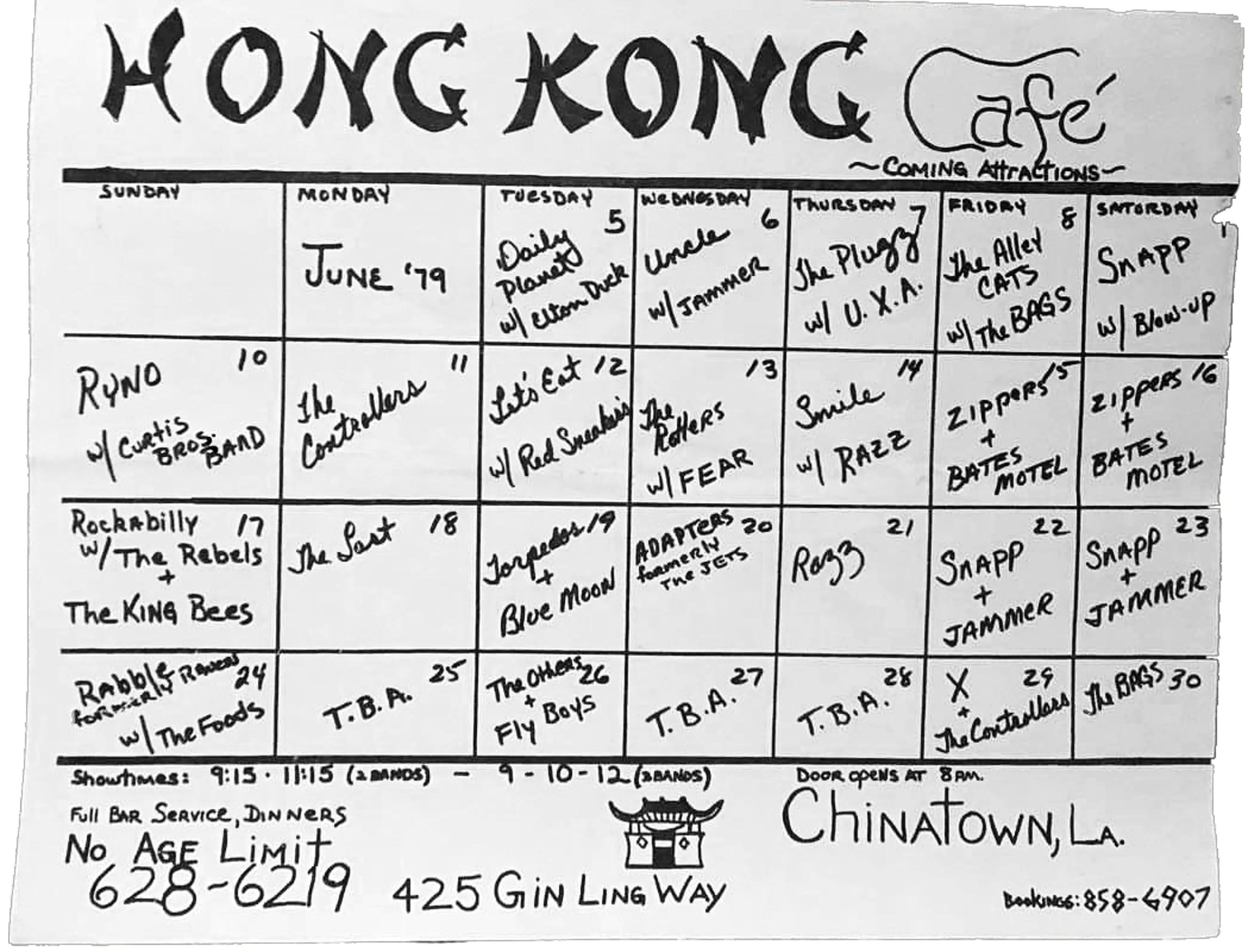
In the late 1970s, Asian restaurants in California’s cities started booking some unlikely dinner entertainment: punk bands…
Bill Hong was a Cantonese immigrant dad in his late 40s, running a restaurant in Los Angeles’ Chinatown neighborhood with his sister Anna Hong and her husband Arthur, when two young promoters approached him with a business proposition: What did Hong think about renting out the restaurant’s upstairs banquet hall on the evenings when it wasn’t being used?
It was 1979, and LA was struggling. The entire country had plunged into a deep recession just a few years prior, and now Chinatown and the city’s downtown areas were falling into disrepair. More recent Chinese immigrants had started moving to suburban enclaves like the San Gabriel Valley, bypassing Chinatown and its businesses completely; the non-Chinese customers who used to flock to the neighborhood for exotic chow mein dinners were now avoiding downtown altogether.
When Bill Hong said yes to the promoters, he was trying to be practical. He knew the restaurant needed more customers; maybe letting a few young bands play could help bring them in. He never could’ve foreseen that his family’s establishment, the Hong Kong Low—located on a small street called Gin Ling Way—would become a focal point for a seminal music scene: West Coast punk.
Nor did he know how many times the restaurant’s toilet would get smashed in the process.
Hong’s restaurant—known as the Hong Kong Café to showgoers—was far from the only Asian restaurant to incubate the California punk scene. In the late 1970s and early ‘80s, from Sacramento to San Francisco, some of the state’s most important punk venues were actually Chinese and Filipino restaurants. At eateries like Sacramento’s China Wagon and Kin’s Coloma, or San Francisco’s Mabuhay Gardens, now-iconic bands such as X, the Germs, and Black Flag played some of their most memorable early gigs. The Hong Kong wasn’t even the first place in LA’s Chinatown to host gigs: the restaurant across the courtyard, Madame Wong’s, had already been doing the same for at least a year…


Tour the venues: “How Chinese Food Fueled the Rise of California Punk,” from Madeline Leung Coleman (@madelesque)
* “Punk rock, when I was a part of it, was called ‘the underground.’ There was something very attractive in all the hidden places, the hidden histories.” – Mary Harron
###
As we muse on the mosh, we might recall that this date in 1979 was “Fleetwood Mac Day” in Los Angeles, as the group was awarded a star on the Hollywood Walk of Fame (about 6 miles northwest of the Hong Kong Café).

“Here, are the stiffening hills”*…

The San Francisco street grid dates to the 1839 plan of Swiss ship captain and surveyor Jean-Jacques Vioget, who laid out the city on a north–south, east–west grid without regard to its topography. Subsequent plans extended the grid, except for its inflection south of Market Street…. and continued the practice of honoring geometry over topography, resulting in some of the steeper streets in the world.

Photographer Dan Ng explored…
What would San Francisco be without its steep hills?
Well for one, if would be much easier to walk around and without much effort. It would be easier to park a car and not have to curb the wheels. We would not have runaway vehicles and tennis balls.
On the other hand, we would not have cable cars, beautiful views and quaint neighborhoods. We would not have the many movies and postcard images to view. In fact, San Francisco would not be San Francisco.
By tilting the camera, I attempted to “level” the hills. These images whimsically portray the streets of San Francisco…flat. But thank goodness it isn’t!
See his more of “leveling” photos: “The Streets of San Francisco… but Flat?”
And on the subject of city streets: using OpenStreetMap, Andrei Kashcha’s City Roads project lets you enter any town or city in the world and generates a map of all the streets within its city limits.
* Rhondda Valley,” Collected Poems
###
As we seek balance, we might spare a thought for Paul Lorin Kantner; he died on this date in 2016. A musician, he’s best known as co-founder, rhythm guitarist, and occasional vocalist of Jefferson Airplane, a seminal San Francisco psychedelic rock band of the counterculture era. He continued these roles as a member of Jefferson Starship, Jefferson Airplane’s successor band.
Coincidentally, one of his his Airplane co-founders, Signe Toly Anderson, died on the same day.

“I think no question containing ‘either/or’ deserves a serious answer, and that includes the question of gender”*…

In the US, as in much of the world, trans people are often unable to access the healthcare they need. For many people transitioning, finding a doctor willing or able to help, let alone a clinic that offers hormonal treatment, can be costly and difficult.
Ryan Hammond, an artist and tactical biologist based in Baltimore, wants to make the process easier using genetically modified plants. He plans to engineer transgenic tobacco plants to produce gender hormones like estrogen and testosterone, allowing anyone to grow their own supplements at home.
To do this, Hammond is attempting to crowdfund $22,000, which would cover the costs of his training, lab access, and living costs for a year at Pelling Lab in Ottawa, Canada. Hammond has a background in art and has been working in a community biohacking lab in Baltimore called BUGSS, where he been exploring Synthetic Biology and learning new techniques in the field…
More at “Queer Artist Launches DIY Gender Hormone Biohacking Project” and at Open Source Gendercodes.
[image above: source]
* Kate Bornstein, Gender Outlaw: On Men, Women and the Rest of Us
###
As we think analog, not digital, we might spare a thought for Joshua Abraham Norton, better known as “Norton I, Emperor of the United States and Protector of Mexico; he was buried on this date in 1880. An immigrant from South Africa, Norton became disgruntled with what he considered the inadequacies of the legal and political structures of his adopted home. On September 17, 1859, he took matters into his own hands and distributed letters to the various newspapers in the city, proclaiming himself “Emperor of these United States”:
At the peremptory request and desire of a large majority of the citizens of these United States, I, Joshua Norton, formerly of Algoa Bay, Cape of Good Hope, and now for the last 9 years and 10 months past of S. F., Cal., declare and proclaim myself Emperor of these U. S.; and in virtue of the authority thereby in me vested, do hereby order and direct the representatives of the different States of the Union to assemble in Musical Hall, of this city, on the 1st day of Feb. next, then and there to make such alterations in the existing laws of the Union as may ameliorate the evils under which the country is laboring, and thereby cause confidence to exist, both at home and abroad, in our stability and integrity.
—NORTON I, Emperor of the United States
Norton issued a number of decrees, some of them visionary (e.g., the establishment of a League of Nations, the construction of a bridge connecting San Francisco and Oakland). Ignored by the local, state, and national governments, he spent his days inspecting San Francisco’s streets in an elaborate blue uniform with gold-plated epaulettes, given to him by officers of the United States Army post at the Presidio of San Francisco.
Norton died in poverty; but a group of San Francisco businessmen, members of the Pacific Club, established a funeral fund and arranged a suitably-dignified farewell. The Emperor’s funeral cortege was two miles long; the procession and ceremony were attended by an estimated 10-30,000 people– at a time when San Francisco had only 230,000 residents.

You must be logged in to post a comment.